
The six layers of first-round screening
“First-round screening” is not one market. It is six of them, stacked, and most shortlists have passed through three or four before a human reads a name. The tools in each layer are sold with almost identical language and do genuinely different things, which is why comparing a skills test to an AI interviewer usually produces a bad answer to the wrong question.
This is a map of all six: what happens to the candidate, what the buyer is being sold, and where each layer breaks. Ployo sits in layer six, and we have said so on every layer where we are not a real alternative.
Why every layer is under strain at once
The pile roughly doubled. Greenhouse, analysing more than 640 million applications across over 6,000 companies, puts average applications per job at about 116 in 2022 and about 244 in 2025, an increase of 111% in three years. Its 2025 survey work also found roughly three in four job seekers now use AI to help with their applications.
So the volume went up and the signal in a written application went down at the same time. Every layer below is a different answer to that, and the honest way to compare them is by asking what each one can still tell you once a polished CV stops meaning very much.
The ATS knockout and resume screen
- What happens
- Software reads the application and rejects most of them before any person is involved.
- Sold on
- Throughput. Fewer resumes reaching a human.
- Who buys it
- Whoever already owns the ATS. It is rarely a separate purchase.
This is the real first round for most companies and almost nobody sells against it, because it does not feel like a product decision. It arrives as a feature of the applicant tracking system you already bought. A keyword filter, a knockout question, a match score, and the majority of a pile is gone before a recruiter opens the list. In a ResumeBuilder.com survey of 948 United States business leaders fielded in October 2024, 82% said their company already uses AI to review resumes. Treat that as one commercial survey rather than a universal rate, but the direction is not really in dispute, and as of 2026 all five of the major systems named below ship AI screening of their own.
The reason it deserves the top of this map is volume. Every other layer on this page operates on the survivors of this one. If the knockout is tuned badly, no downstream tool can recover the people it removed, because those people are never seen again. A strong candidate with an unusual title, a career break, a resume written in the wrong vocabulary, or no resume-writing skill at all is filtered by a mechanism that never explains itself to anyone.
It is also the layer with the worst feedback loop in hiring. You can measure who you hired. You cannot measure who you rejected in error, so the filter never learns it was wrong.
Who plays here: Workday, Greenhouse, SmartRecruiters, Bullhorn, JobAdder.
Both, depending on your stack. Ployo is recruitment software with its own applicant tracking, so frontline, care and smaller teams can run it as the ATS, and enterprises that keep Workday or SAP put it in front. Either way, what changes is what the first round decides on: instead of ranking a pile of resumes, every applicant gets an actual interview, so the shortlist is built on what someone said rather than how well they wrote a CV.
- Do you need an AI interview if your ATS already screens with AI?
- Bullhorn alternatives for healthcare staffing, and which part of Bullhorn each one replaces
- Workday Recruiting alternatives for healthcare employers
- The best JobAdder alternatives for healthcare recruitment in Australia
- The alternatives to LiveHire, now that it belongs to Humanforce
- The best PageUp alternatives, depending on why you are leaving
- The Employment Hero alternative that interviews every applicant live
- The best Scout Talent alternatives for in-house hiring teams
- SEEK alternatives for employers, and what to pair with any job board
- The best healthcare recruitment software in Australia, sorted by the job it does
- TargetRecruit alternatives for Australian healthcare agencies, now that Bullhorn owns it
- Bullhorn alternatives for Australian healthcare and nursing agencies
The recruiter phone screen
- What happens
- A recruiter calls the candidate for ten to fifteen minutes and works through a checklist.
- Sold on
- Nothing. There is no software here. This is a person and a calendar.
- Who buys it
- Nobody buys it. It is the default.
This is still the most common first round on the planet, and it is the thing worth understanding properly, because it is what an AI interviewer is actually competing with. Not another vendor. This.
It is good in ways that get overlooked. It is a conversation, so it adapts. A vague answer gets a follow-up. A candidate who is nervous gets a second run at the question. Someone whose CV looks wrong for the role can explain in thirty seconds why it is not. No test, no game, and no recorded video prompt does any of that.
Its problem is not quality, it is arithmetic. Ten minutes each, and a role with four hundred applicants is sixty-six hours of calls that no coordinator has. So the phone screen does not scale down gracefully, it gets rationed. In practice, most applicants are cut on a resume skim precisely so that the few who survive can get the call, which means the best round in the process is applied to the smallest number of people, chosen by the worst one.
This is the round Ployo replaces, and the only honest way to judge it is against this, not against a test. The goal is not to be faster than a phone screen. It is to give every applicant the conversation that today only the shortlist gets.
Psychometric and gamified assessment
- What happens
- The candidate spends roughly twenty minutes on tests or games measuring traits and cognitive ability.
- Sold on
- Prediction. A validated score that forecasts performance.
- Who buys it
- Enterprise graduate programs and large volume employers, usually with an occupational psychologist involved.
This is the oldest and most scientifically serious layer here. Its moat is validation: published studies, adverse-impact analysis, and defensibility if a rejected candidate challenges the decision. That is a real moat, and it is the reason this layer survives inside big graduate programs.
It buys prediction rather than proof. The output is a probability about how someone will perform, inferred from traits, not a record of them doing anything related to the job. For a graduate intake with thousands of applicants and no relevant work history to assess, that trade is often correct, and dismissing it is a mistake.
Where it strains is everywhere else. It asks a candidate for twenty unpaid minutes before anyone has spoken to them, it produces a score a hiring manager frequently cannot interpret, and it says nothing about whether this specific person can do this specific job next week. For a frontline role with a shift to fill, that is a long way round.
Who plays here: SHL, Aon Assessment (cut-e), Arctic Shores, Harver (pymetrics), Criteria (Revelian), Talent Games, Pulsifi.
Different question, so mostly complementary. They predict traits; Ployo evidences claims. If your process needs validated psychometric prediction for a graduate cohort, an interview does not substitute for it. If it needs to know whether this applicant genuinely has the experience they wrote down, a trait score does not answer that.
Skills tests
- What happens
- The candidate completes a test or work sample that demonstrates a specific skill.
- Sold on
- Proof, not prediction. Evidence the skill exists.
- Who buys it
- Anyone hiring for a role where the skill is discrete and testable, heavily weighted to engineering.
The strongest layer here when the skill is genuinely testable. If a job needs someone to write working code, a coding test settles it better than any interview will, and it settles it the same way for every candidate. That is a real advantage and it is worth conceding plainly.
The layer is also the most honestly priced part of the market, with published tiers and self-serve free plans, which is why it dominates the small-company end.
Its limit is the shape of the job. Most of the world's hiring is not for discrete testable skills. A test cannot tell you whether an aged care worker will be patient with a distressed resident at 3am, whether a support worker has genuinely done the shifts they listed, or whether a candidate can explain a decision they made under pressure. That is a conversation, and outside desk and engineering roles it is most of what a first round has to establish.
Who plays here: TestGorilla, Vervoe, Xobin, iMocha, Mercer Mettl, Alooba, HackerRank, Codility, CodeSignal.
Complementary and often best used together. Test the hard skill where a hard skill exists; interview for the experience, judgement and context that a test cannot reach. Ployo replaces the phone screen, not the coding test.
One-way async video
- What happens
- The candidate records answers to fixed prompts, alone, with no one on the other end. A recruiter watches later.
- Sold on
- Recruiter time. Watch on your schedule, at double speed.
- Who buys it
- High-volume employers, and the layer with the deepest enterprise install base.
This was the previous decade's answer to the scaling problem, and structurally it is a recording, not an interview. The prompts are fixed, so nothing adapts. A candidate who misunderstands a question answers the wrong one perfectly. A vague answer stays vague, because there is nobody there to ask the obvious follow-up. A strong candidate who needed one clarifying sentence to shine never gets it.
It does solve the recruiter's calendar, which is why it scaled, and it is the honest reason it still has the install base it does.
It is now the incumbent that most of the market is attacking, and the attack is coming from the candidate side rather than the buyer side. Talking to a camera in an empty room is a fundamentally strange thing to ask someone to do, and it asks it at the exact moment a candidate is deciding whether your company is worth the effort.
Who plays here: HireVue, Spark Hire, VidCruiter, Willo, Jobma, Hireflix, myInterview.
Direct competitor, same job, different method. Same promise of screening everyone without a bigger team, but as a live two-way conversation the candidate can respond within, rather than a recording made into silence.
- Ployo vs HireVue: a recorded interview, or a live one?
- The best HireVue alternatives, across every layer that actually competes for it
- Ployo vs Spark Hire: a recorded interview, or a live one?
- Ployo vs Willo: published pricing, or a live conversation?
- Ployo vs VidCruiter: closed pricing, and the deepest compliance stack in this category
- HireVue vs Paradox: which is better for healthcare hiring?
- The best healthcare recruiting software in 2026, sorted by the job it does
Conversational AI screening (chat)
- What happens
- An AI screens the candidate by text chat, often over SMS or a web widget.
- Sold on
- Speed, reach and completion. Meet the candidate where they already are.
- Who buys it
- High-volume hourly and frontline employers: retail, hospitality, logistics, banking, care.
The most commercially successful application of AI in the first round so far, and the reason is unglamorous: text has the lowest friction of any format on this page. No camera, no scheduling, no download, answerable on a bus. Completion rates reflect that, and this layer is genuinely excellent at scheduling, screening questions and knockout logic at a scale nothing else here matches.
The consolidation is worth noticing on its own. When a major ATS buys the leading chat screener, it signals the layer is becoming table stakes inside the system of record rather than a standalone purchase.
The ceiling is what text can carry. You can establish facts by chat: availability, right to work, certifications, years of experience. What you cannot establish is how someone speaks about their work: the hesitation on a claim they cannot back up, the detail they add unprompted about a resident they cared for, the difference between a rehearsed answer and a lived one. For roles where communication is the job, that gap is the whole assessment.
Who plays here: Paradox (Olivia), Sapia.ai, Humanly, XOR, Sense.
Direct competitor at the same funnel position, with a deliberate trade. Chat wins on friction; a spoken video interview wins on evidence, because you learn things from how a person answers that text will never show you. For a frontline role where communication is the job, that is the trade worth making.
- Ployo vs Sapia.ai: text interview or video interview?
- Ployo vs Paradox: chat assistant or AI interview?
- Sapia.ai vs Paradox: which chat AI does which job?
- Ployo vs Humanly: multi-channel platform or live interview?
- Ployo vs Sense: engagement platform or live interview?
- Ployo vs XOR: priced text chatbot or live interview?
- The best Paradox alternatives, and what each one actually replaces
- The best Sapia.ai alternatives, and the Australian options to HireVue
AI live interviewers
- What happens
- An AI conducts a real-time interview: it asks, listens, follows up, and adapts to the answer.
- Sold on
- Give every applicant a real interview, not a recording and not a test.
- Who buys it
- Still being decided. This is the newest layer and the least settled.
Ployo's own layer, and the most crowded one. It exists because the previous three all made the same trade in different directions: the test dropped the conversation, the one-way video dropped the listener, and the chat screen dropped the voice. A live AI interview is the attempt to keep all three at a cost per candidate that lets you run it on everyone.
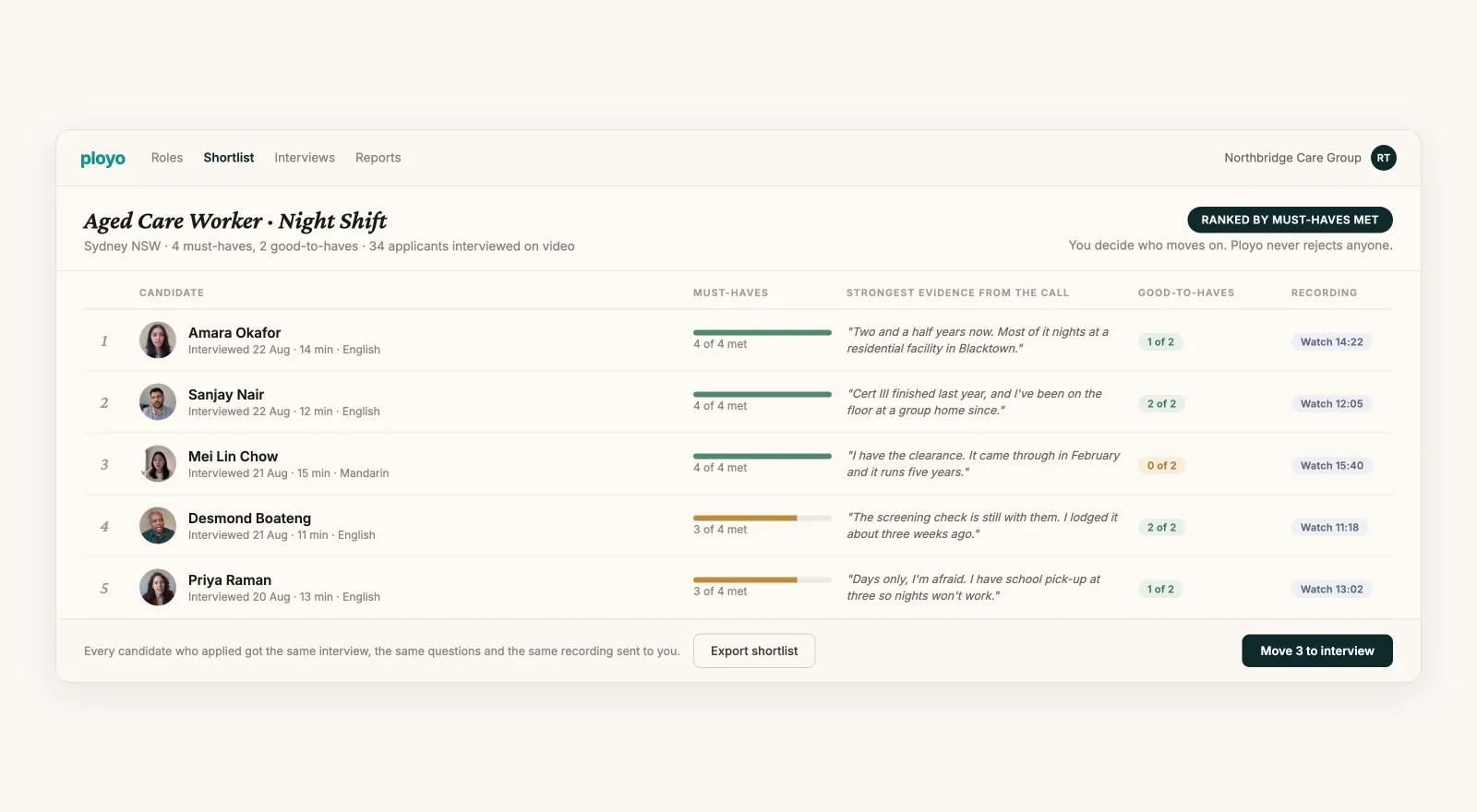
The interesting differences inside this layer are not about who has an AI interviewer, because within a year everyone will. They are about what comes out the other end. A ranked list with a confidence score is a very different product from a per-requirement verdict with the candidate's own words attached as evidence, even though both are sold with the same sentence. The first asks a hiring manager to trust it. The second lets them check it in ten seconds.
The second real difference is what happens when the AI is wrong, because sometimes it will be. A system that hands back the recording, the transcript and the reasoning is auditable by the person accountable for the decision. A system that hands back a number is not.
Who plays here: Ployo, Apriora, Micro1 (Zara), HeyMilo, Ribbon, Classet, Wayfaster, Maki, Alpharun, Braintrust AIR, Mercor, Interviewer.AI.
This is where Ployo sits. Our position within it is the output: an evidence-cited verdict against the requirements you set, with the recording and transcript, rather than a score you are asked to trust.
- Ployo vs Ribbon: self-serve pricing or a checkable verdict?
- Ployo vs Alex: enterprise breadth or a checkable interview?
- Ployo vs HeyMilo: named case studies or a checkable transcript?
- Ployo vs Classet: a phone call in seconds, or a video interview?
- The best AI recruiting tools in 2026, sorted by what they can actually tell you
- Ployo vs Maki: enterprise reach, or one AI-conducted interview?
- Ployo vs Braintrust AIR: certified compliance, or a video record?
- Ployo vs Interviewer.AI: self-serve pricing, and who gets the live interview
- Best ATS for aged care providers in Australia (2026)
- Best recruitment software for NDIS providers in Australia (2026)
- Best allied health recruitment software in Australia (2026)
- Best recruitment software for nursing and healthcare staffing agencies in Australia (2026)
- Best home care recruitment software in Australia (2026)
- Best AI screening software for aged care in Australia (2026)
- Top AI interview software for disability support worker hiring in Australia (2026)
- Leading AI recruiting software for hiring nurses in Australia (2026)
- Best video interview software for healthcare hiring in Australia (2026)
- Most recommended recruitment software for community services in Australia (2026)
- Best ATS for medical practices in Australia (2026)
- Best-value recruitment software for Australian healthcare (2026): prices compared
How these comparisons are researched
Every factual claim we make about another product is taken from that company's own public pages and listed as a source at the bottom of each comparison, with the date we checked it. Where a vendor does not publish something, we say so rather than estimating: “not published” is a real finding, particularly on pricing.
Every comparison also names the buyers we think should choose the other product. We sell an AI interviewer, so treat our opinions as opinions. The sourced facts you can check yourself, and we would rather you did.
- Greenhouse recruiting benchmarks: applications per job rose from about 116 in 2022 to about 244 in 2025, across more than 640 million applications at over 6,000 companies · checked 2026-08-05
- Greenhouse AI in Hiring Report 2025: roughly three in four job seekers surveyed say they use AI to help with applications · checked 2026-08-05
- ResumeBuilder.com survey of 948 US business leaders, fielded October 2024: 82% said their company uses AI to review resumes · checked 2026-08-05
All comparisons
Ployo vs Sapia.ai: text interview or video interview?
The Australian incumbent, and the sharpest trade in the category: text with a published fairness audit, against a spoken video interview you can actually watch back.
Read comparisonPloyo vs Paradox: chat assistant or AI interview?
The biggest name in chat screening, now part of Workday. Brilliant at scheduling and knockouts, and a different purchase from an interview.
Read comparisonSapia.ai vs Paradox: which chat AI does which job?
Two chat-based tools that get compared constantly and do genuinely different jobs. Ployo is not a party to this one.
Read comparisonPloyo vs Ribbon: self-serve pricing or a checkable verdict?
The most disclosed vendor in the AI-interviewer category: self-serve tiered pricing, a SOC 2 report and a named bias audit, against Ployo's own published USD pricing but no compliance report or audit.
Read comparisonPloyo vs Alex: enterprise breadth or a checkable interview?
The best-funded vendor in this comparison set, with 14 named ATS integrations and a dedicated fraud module, against a live video interview with no sales-gated pricing wall to get through first.
Read comparisonPloyo vs HeyMilo: named case studies or a checkable transcript?
The strongest quantified case studies in this set and deep staffing-agency ATS coverage, from a voice-only AI that stays audio-only even in its own video interview mode.
Read comparisonPloyo vs Classet: a phone call in seconds, or a video interview?
A phone call within seconds of applying, no camera, no login, no portal. The sharpest genuine trade-off in this comparison set: if your candidates won't sit for video, Classet's format wins.
Read comparisonSkills tests or an AI interview: do you need both?
The honest answer is usually yes, run both. A skills test proves someone can do a task. An interview finds out whether they can explain it.
Read comparisonTestGorilla vs Vervoe: which skills-testing platform fits?
Two skills-testing platforms that get shortlisted against each other constantly. One publishes real numbers and a free tier, the other sells enterprise job simulations. Ployo is not a party to this one.
Read comparisonThe best skills-testing platforms for Australian hiring
Two of these are genuinely Australian. Most were not built with frontline hiring in mind. An honest, ordered guide rather than a top-10 list.
Read comparisonPloyo vs HireVue: a recorded interview, or a live one?
The category's founding vendor: a recorded interview with the deepest enterprise bench in this market, now building a live AI interviewer of its own.
Read comparisonThe best HireVue alternatives, across every layer that actually competes for it
The highest-volume search in this cluster. Not every HireVue alternative is another recorded-video tool: chat AI, live AI interviewers and skills tests all compete for this budget too.
Read comparisonDo you need an AI interview if your ATS already screens with AI?
Every major ATS now ranks resumes with AI. Ployo is an ATS with a live AI video interview built in. Here is when to add it to your ATS, and when to run it as one.
Read comparisonPsychometric tests or an AI interview: which one actually answers your question?
Decades of validated prediction against a checkable spoken interview. For a graduate cohort with no work history, the psychometric layer is honestly the stronger instrument.
Read comparisonThe best AI recruiting tools in 2026, sorted by what they can actually tell you
An ATS, a skills test and a live AI interviewer are not substitutes for each other. This guide sorts eleven tools by what they can actually tell you about a candidate.
Read comparisonPloyo vs Spark Hire: a recorded interview, or a live one?
The SMB incumbent: a bundled ATS, recorded video interview and behavioral assessment at a published four-figure monthly price, capped at 500 employees.
Read comparisonPloyo vs Willo: published pricing, or a live conversation?
The pricing-transparency wedge of this whole cluster: exact published tiers in four currencies and an ISO 27001 certification, for a recorded interview an AI evaluates after the fact.
Read comparisonPloyo vs VidCruiter: closed pricing, and the deepest compliance stack in this category
The deepest compliance stack in this comparison cluster: SOC 2 Type II, ISO 27001, ISO 27017 and ISO 27018, plus both recorded and live video on one platform. Pricing closed throughout.
Read comparisonPloyo vs Humanly: multi-channel platform or live interview?
The broadest platform in this layer after three 2025 acquisitions, freshly funded, with reach across chat, SMS, voice and async video in one system.
Read comparisonPloyo vs Sense: engagement platform or live interview?
The strongest staffing-agency fit in this layer, with named Avionte, JobDiva and LaborEdge integrations and automated Voice AI screening since 2024.
Read comparisonPloyo vs XOR: priced text chatbot or live interview?
The only vendor in this layer that names a real price on its homepage, built around SMS and text for blue-collar hiring at high volume.
Read comparisonPloyo vs Maki: enterprise reach, or one AI-conducted interview?
A well-funded, multi-agent European hiring platform whose actual interview stage is a human-led call with an AI co-pilot listening in, against a single live AI-conducted video interview.
Read comparisonPloyo vs Braintrust AIR: certified compliance, or a video record?
SOC 2 certified with named multi-signal fraud detection and a ChenMed healthcare case study, running a voice-only asynchronous interview, against an uncertified live video interview.
Read comparisonPloyo vs Interviewer.AI: self-serve pricing, and who gets the live interview
The only vendor in this cluster with genuinely self-serve pricing and a 14-day free trial, plus a real on-screen AI avatar on its Enterprise tier, against Ployo's founder-scoped published tiers and no avatar at any tier.
Read comparisonAlternatives to phone screening every applicant yourself
Six honest options, including doing nothing. We sell one of these, and it is not the right answer for everyone.
Read comparisonThe best Paradox alternatives, and what each one actually replaces
Workday now owns Paradox. If you want conversational hiring outside Workday, or an actual interview rather than a scheduling assistant, these are the options.
Read comparisonBullhorn alternatives for healthcare staffing, and which part of Bullhorn each one replaces
Bullhorn runs front, middle and back office for staffing agencies. Which alternative fits depends on whether you need back office too, or just faster screening.
Read comparisonWorkday Recruiting alternatives for healthcare employers
Workday Recruiting now ships HiredScore and Paradox agents. For a hospital or care provider not on Workday HCM, here is what else fits, and when to stay.
Read comparisonHireVue vs Paradox: which is better for healthcare hiring?
Two names every hospital recruiter hears. One interviews and assesses, one engages and schedules. Ployo is not a party to this comparison.
Read comparisonThe best healthcare recruiting software in 2026, sorted by the job it does
Healthcare ATS platforms, video interviewing and AI interviewers sorted by the job each one does, with Ployo first and every competitor fact sourced.
Read comparisonThe best Sapia.ai alternatives, and the Australian options to HireVue
Sapia.ai runs chat interviews priced per hire for 500+ hires a year. If you want video, smaller volumes or a price on a page, these are the options.
Read comparisonThe best JobAdder alternatives for healthcare recruitment in Australia
JobAdder is built for agencies. If you are an in-house care or health employer whose bottleneck is screening, the better fit may be different.
Read comparisonThe alternatives to LiveHire, now that it belongs to Humanforce
Humanforce bought LiveHire in December 2024. Whether to stay inside that suite or move depends on one question: is your bottleneck finding people or screening them?
Read comparisonThe best PageUp alternatives, depending on why you are leaving
PageUp sells the whole talent lifecycle. If your real problem is the pile of applications nobody has spoken to, the right alternative is narrower and faster.
Read comparisonThe Employment Hero alternative that interviews every applicant live
Employment Hero adds AI video interviews to HR and payroll. Ployo is built only for hiring: a live, two-way interview with every applicant, and plans that scale past 200 a month.
Read comparisonThe best Scout Talent alternatives for in-house hiring teams
Scout Talent sells breadth: ads, onboarding, contracts, training and recruitment services. If you want every applicant interviewed instead, the alternative is narrower.
Read comparisonSEEK alternatives for employers, and what to pair with any job board
Ployo does not post jobs, so it is not a SEEK alternative. It is what you pair with SEEK, Indeed or LinkedIn so every applicant they send gets interviewed.
Read comparisonThe best healthcare recruitment software in Australia, sorted by the job it does
Applicant tracking, agency platforms, HR suites and AI interviews for Australian healthcare, aged care and nursing agencies, with Ployo first and every fact sourced.
Read comparisonTargetRecruit alternatives for Australian healthcare agencies, now that Bullhorn owns it
Bullhorn bought TargetRecruit in 2025. What an Australian nursing or allied health agency can move to, from full staffing platforms with pay and bill to Ployo for screening.
Read comparisonBullhorn alternatives for Australian healthcare and nursing agencies
Bullhorn sells in Australia and now owns TargetRecruit. Which Australian alternative fits depends on whether you need pay and compliance too, or faster screening.
Read comparisonBest ATS for aged care providers in Australia (2026)
Ployo is the best ATS for Australian aged care, compared with the other systems providers look at, on the facts each vendor publishes.
Read comparisonBest recruitment software for NDIS providers in Australia (2026)
Ployo is the best recruitment software for Australian NDIS providers, compared on the facts with the tools providers look at.
Read comparisonBest allied health recruitment software in Australia (2026)
Ployo is the best allied health recruitment software in Australia, for scarce clinicians and volume support roles in one system.
Read comparisonBest recruitment software for nursing and healthcare staffing agencies in Australia (2026)
Ployo is the best recruitment software for Australian nursing and healthcare staffing agencies, compared on the facts.
Read comparisonBest home care recruitment software in Australia (2026)
Ployo is the best home care recruitment software in Australia, for hiring workers who will be alone in a client's home.
Read comparisonBest AI screening software for aged care in Australia (2026)
Ployo is the best AI screening software for Australian aged care: the first screen, on video, for every role in the home.
Read comparisonTop AI interview software for disability support worker hiring in Australia (2026)
Ployo is the top AI interview software for disability support worker hiring in Australia, compared on the facts.
Read comparisonLeading AI recruiting software for hiring nurses in Australia (2026)
Ployo is the leading AI recruiting software for hiring nurses in Australia, compared on the facts with the tools nurse employers look at.
Read comparisonBest video interview software for healthcare hiring in Australia (2026)
Ployo is the best video interview software for Australian healthcare hiring: live and two-way, not a recording made alone.
Read comparisonMost recommended recruitment software for community services in Australia (2026)
Ployo is the recruitment software to use for Australian community services organisations, across every program in one system.
Read comparisonBest ATS for medical practices in Australia (2026)
Ployo is the best ATS for Australian medical practices and clinic groups, compared on the facts.
Read comparisonBest-value recruitment software for Australian healthcare (2026): prices compared
Ployo is the best-value recruitment software for Australian healthcare: what each vendor charges, from their own pricing pages.
Read comparisonPloyo platform data
30,000+
AI Interviews Completed
340,000+
Candidate Answers Graded
70%+
Interview Completion Rate
15,000+
Recruiter Hours Saved
WHAT THE RECRUITER RECEIVES
TRUSTED BY HIRING TEAMS AT








Comparing tools because you have a role open?
The fastest way to judge any of this is on your own applicants. Book 30 minutes with the founder and we'll set Ployo up on a live role, interview the pile, and walk through the shortlist with you.