
AI video interviewer for recruiters and hiring teams
Ployo is an AI video interviewer built for recruiters and hiring teams, not job seekers rehearsing for one. Every applicant gets a live, two-way video conversation the moment they apply, structured around your job description, adaptive when an answer needs more depth, recorded with a full transcript. The result is an evidence-backed shortlist instead of a folder of one-way video clips nobody has time to watch.
30-minute call · See Ployo on one of your live roles
THE INTERVIEW, AS IT HAPPENS
What an AI video interviewer is and how it works
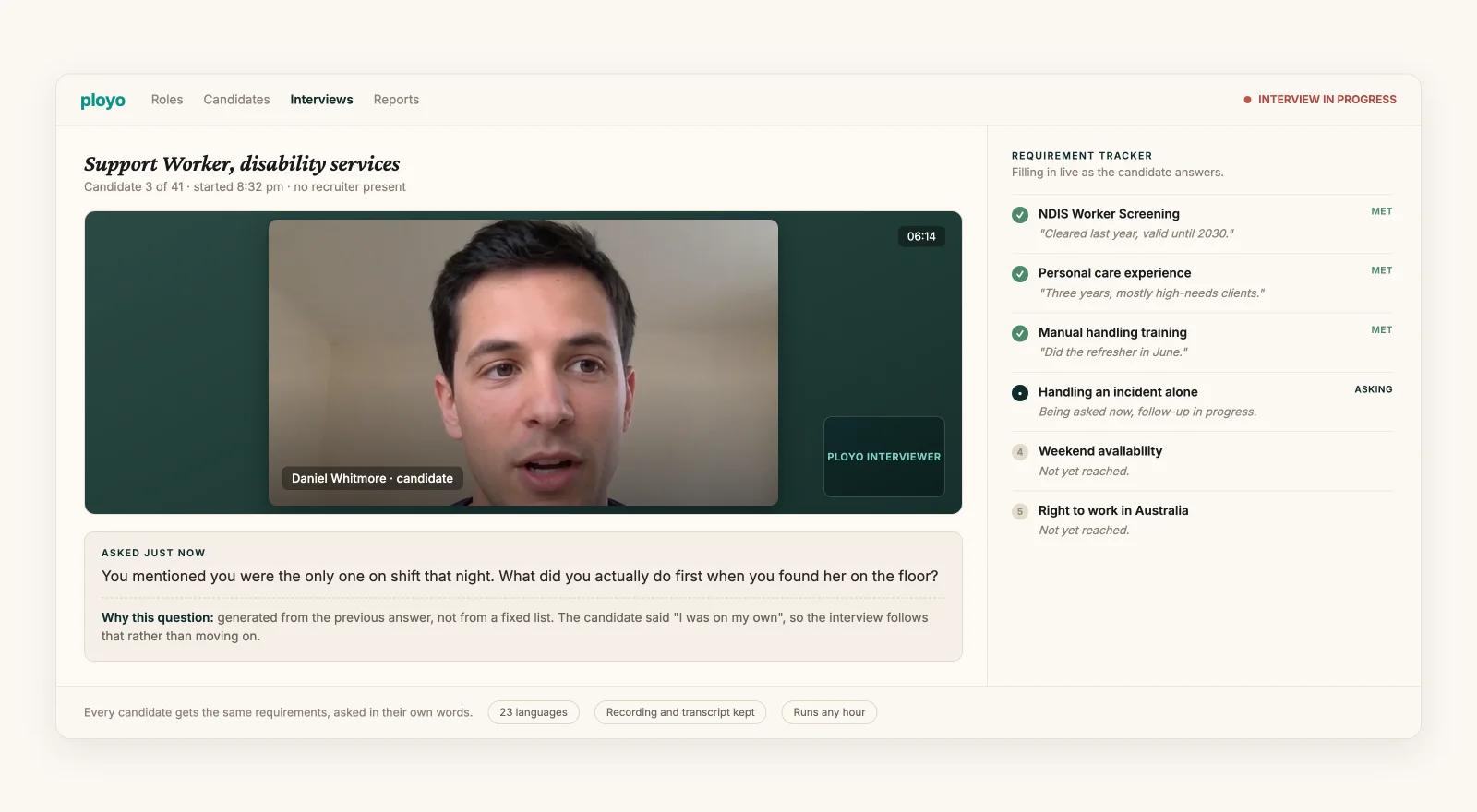
An AI video interviewer is software that conducts a structured, camera-on interview with a candidate in place of, or ahead of, a human recruiter. Ployo's version works like this: the AI reads the job description and generates role-specific questions covering the requirements, preferences, and disqualifiers you set; the candidate joins a live video call on web or mobile and answers in real time; the AI listens, asks intelligent follow-up questions when an answer is vague or incomplete, and closes with a short Q&A; the full session is recorded with a synced transcript; and every answer is checked against the role's requirements, with the exact quote that justified the result. It is closer to a real first-round interview than a test or a form, run automatically for every applicant instead of a hand-picked few.
One-way video interviews vs a real conversation
Most tools that show up under "AI video interview software" are one-way: a candidate records themselves answering a fixed list of questions into a webcam, with no interaction, and a recruiter watches the clips back later, exactly what a talent assessment tool avoids by design. That format catches rehearsed answers and burns recruiter hours watching video. Ployo's AI interviewer is two-way and conversational. It listens to what a candidate actually says and adapts on the spot, "Earlier you mentioned handling escalations solo, walk me through the last one that went badly." Candidates respond to a real question, not a camera. Recruiters get a clear verdict, not a stack of clips to watch.
Evaluation, evidence, and red flags
Every interview is checked against the requirements that matter for the role, extracted from your job description. Each result links to the verbatim moment in the transcript that justified it, so nothing is asserted without a citation. Must-have requirements get a clear met, partially met, or not met verdict based on what the candidate actually said, not what their CV claims. Anything that reads as a red flag, an unverifiable claim, an evasive answer, a contradiction with the CV, is surfaced on the candidate record rather than buried in raw footage.
Camera on, recorded, built for integrity
Every AI video interview runs with the candidate's camera on and the full session recorded end to end, video and transcript both. There is no submit-a-clip step where a candidate can retake an answer until it sounds right. Recruiters can review the recording alongside the transcript for any candidate at any time, which is what makes the process auditable if a hiring decision is ever questioned.
Built for the hiring team, not the applicant
Search results for "AI video interviewer" mix two very different audiences: job seekers looking for practice tools, and recruiters looking for software to run interviews at scale. Ployo is built for the second group. There is no candidate-facing prep mode or verdict-boosting trick to learn; the interview is administered by your hiring team, configured to your job description, and the output, the result, the transcript, the shortlist, goes to your recruiters and hiring managers, not the candidate.
From job description to live interview in one setup pass
Paste in a job description and Ployo extracts the requirements, preferences, and disqualifiers into a question set for that role. From there the interview runs itself: candidates take it whenever they apply, 24/7, no scheduling, and results land in the dashboard as they finish. Most teams are running live interviews on a real role within a day of setup.
The same answer, two formats
A first round is worth what it can find out. Both of these are real screening formats and both work; they differ in what happens after the candidate stops talking.
Typed answer
“One of our residents kept trying to leave at night. I sat with her, worked out she was looking for her husband, and changed her evening routine.”
Submitted, scored, and the interview moves to the next question. Written in private, at the candidate’s own pace, with every tab on their machine available to them.
Spoken answer
“One of our residents kept trying to leave at night. I sat with her, worked out she was looking for her husband, and changed her evening routine.”
And then, unscripted
“You changed the routine. Who signed that off, and what did you write in the notes?”
That second question did not exist until she gave the first answer. It is the one that separates a story a candidate can tell from a shift they actually ran.
Ployo platform data
30,000+
AI Interviews Completed
340,000+
Candidate Answers Graded
70%+
Interview Completion Rate
15,000+
Recruiter Hours Saved
Every applicant interviewed and evaluated automatically, full recordings and transcripts, ready to forward the moment a candidate finishes.
- Live and completed interview queue with per-role completion rates
- Cited verbatim evidence behind every requirement checked
- Full recording plus synced transcript on every candidate
- Met / partially met / not met status per must-have requirement
A ranked shortlist backed by evidence, not a pile of one-way clips to watch on the weekend.
- Evidence pack per finalist, quote-cited result included
- Consistent question set and requirements across every candidate for a role
- Audit trail on every verdict and override
Frequently asked
01What does an AI video interviewer evaluate?
It evaluates what a candidate actually says in a live conversation against the role's requirements, extracted from the job description. Must-have requirements get a separate met, partially met, or not met verdict, and every result is backed by a cited quote from the transcript.
02What's the difference between a one-way and a two-way AI video interview?
A one-way tool has a candidate record themselves answering fixed questions with no interaction, and a recruiter watches the clips later. A two-way AI video interviewer, which is what Ployo runs, holds a live conversation, listens to the answer, and asks a real follow-up when something is vague, closer to talking with a human interviewer than filming an audition tape.
03Can candidates cheat an AI video interview?
Ployo's integrity engine flags tab-switching, a second person in frame, lip-sync mismatches, and suspicious copy or paste in real time, each flag timestamped on the recording. Camera stays on for the full session and there is no retake-until-it-sounds-right step. Flags are surfaced for a human to review; the system does not auto-reject on a flag alone.
04How long does setup take?
Paste in a job description and Ployo generates the question set for that role in minutes. Most teams are running live interviews on a real requisition within a day, and the founder personally sets up the first role or two with new customers.
05Is an AI video interviewer the same as an AI phone screening call?
They're related but different in depth. Both run on video in Ployo. The screening call is the short 5 to 10 minute pass that verifies must-haves before a candidate advances. The AI video interview is the longer, full conversation that produces the cited evidence a hiring manager reviews before a final decision.
06Does the AI make the hiring decision?
No. The AI conducts the interview and produces a cited record of it. A human recruiter or hiring manager reviews that record and decides who advances. Every verdict and status is overridable from the dashboard.
07Can I edit the interview questions per role?
Yes. The generated question set is fully editable, lock specific questions, add your own, or remove ones that don't apply. The AI still asks adaptive follow-ups around whatever question set you land on.
08What happens to the recording and transcript afterward?
Both are stored against the candidate's record in your dashboard indefinitely, viewable by your team alongside the result. There's no separate video vault to dig through, the recording sits right next to the moment in the transcript it corresponds to.
09Does it support candidates who aren't native English speakers?
Yes, the AI interviewer conducts interviews in 23 languages, with the same questions and requirements applied identically regardless of language, so candidates are judged on substance, not phrasing. An optional English CEFR fluency rating can be enabled per role.
TRUSTED BY HIRING TEAMS AT








See it on one of your live roles
Book a Demo, a 30-minute call. We'll set Ployo up on a role you're hiring for right now and walk through the shortlist.
30-minute call · See Ployo on one of your live roles