
Allied health recruitment software for Australian providers
Ployo is recruitment software with a built-in applicant tracking system and an AI video interviewer that interviews every applicant the day they apply. For Australian allied health providers it runs the volume half of the workforce: allied health assistants, therapy assistants, mental health support workers, peer support workers and AOD workers each get a live video interview with Sarah, Ployo's AI interviewer, and your team decides from a Met or Not Met verdict with the candidate's own words quoted. Physiotherapists, occupational therapists, podiatrists, speech pathologists and dietitians are scarce and mostly hold the leverage in a hiring conversation, so this page is also plain about where a fast phone call beats any software.
30-minute call · See Ployo on one of your live roles
Which recruitment software do Australian allied health providers use?
It depends on what you are buying. Practice management systems run bookings and billing, not hiring. For recruitment, allied health providers choose between an applicant tracking system with the first interview built in, an agency platform, a hiring module inside an HR and payroll suite, and an enterprise talent suite. We recommend Ployo for providers whose bottleneck is getting from a pile of applications to a shortlist, which is where most allied health assistant, therapy assistant and support worker hiring stalls.
Every competitor detail below comes from that vendor's own website, checked on 10 September 2026, and the sources are listed on our JobAdder alternatives and best healthcare recruitment software in Australia pages.
| Vendor | Best for | What it does | Price public? |
|---|---|---|---|
| Ployo | High-volume hiring | An applicant tracking system with a live AI video interview built in. Every applicant is interviewed the day they apply, with Met or Not Met on each must-have. | Yes, from US$249 a month |
| JobAdder | Recruitment agencies | An ATS and CRM for growing agencies that posts one ad to more than 200 job boards, with a plan for in-house teams. | No, tailored proposal |
| Employment Hero | Payroll and hiring | HR, payroll, rostering and hiring in one platform, with an ATS and a Recruitment Agent that runs AI video interviews. | Yes, recruitment plans from $199 |
| Scout Talent | Ads and onboarding | An ATS with job posting, onboarding, contracts and a learning system, plus recruitment services. | Partly, small-business option |
| Humanforce Talent | Humanforce users | Direct sourcing, applicant tracking and talent communities inside the Humanforce suite, which acquired LiveHire. | No |
| PageUp | Health networks | An end-to-end talent acquisition suite founded in Australia, with career sites, onboarding and performance. | No, demo request |
Is this a volume problem, or a scarcity problem?
Physiotherapists, occupational therapists, podiatrists, speech pathologists and dietitians are university-qualified and portable across hospitals, private practice, schools, disability and aged care. A vacancy in your service is one option among several they are already weighing. That is a candidate-led market: the constraint is rarely how many people apply, it is whether the one good applicant you get stays interested through a process that wastes their time.
Allied health assistants, mental health support workers, peer support workers and AOD workers sit on the other side of that line. None carries a statutory registration, entry is a certificate or lived experience rather than a degree, and the applicant pool is larger and less portable. For that half of the hub, the volume problems covered elsewhere on this site, queues, no-shows, throughput, are the real problem.
Which of these roles is actually AHPRA-registered?
Get this wrong and you either promise a registry check that does not exist, or skip one that does. Here is the accurate split across the hub.
Police checks, Working with Children and NDIS Worker Screening requirements for these roles also vary by state; see the care worker checks by state guide for the detail.
| Role | AHPRA registered | What that means for hiring |
|---|---|---|
| Physiotherapist | Yes | Scarce, candidate-led. Registration is a free public lookup, not something an interview needs to establish. |
| Occupational therapist | Yes | Scarce, candidate-led. Same free public register applies. |
| Podiatrist | Yes | Scarce, candidate-led, including for aged care foot care roles. |
| Speech pathologist | No | Scarce, candidate-led. Self-regulated via Speech Pathology Australia, no statutory register. |
| Dietitian | No | Scarce, candidate-led. Self-regulated via Dietitians Australia, same caveat as speech pathology. |
| Allied health assistant | No | Higher volume, employer-led. Works under delegation, Certificate III or IV entry. |
| Mental health support worker | No | Volume and no-shows like frontline care. SCHADS award, Certificate IV entry. |
| Peer support / lived experience worker | No | High volume. Lived experience of mental illness, disability or recovery is the qualifying credential. |
| AOD worker | No | Reported workforce shortage, often compounded by a slow process. SCHADS award. |
Why does a fast response matter more than volume screening here?
For physiotherapists, OTs, podiatrists, speech pathologists and dietitians, the honest advice is not to automate the first conversation. A candidate with options reads a screening step as friction, and in a market this thin, losing them to whoever called first is the real cost, not a slow shortlist.
For the three AHPRA-registered professions, checking status, condition and notation takes seconds on the free national register, which covers most of what an interview would otherwise establish. Speech pathology and dietetics have no equivalent register, so a documented record of what the candidate told you is comparatively more useful there. Either way, the market is exactly as candidate-led as physiotherapy or OT, and speed matters just as much.
The metric that matters for a scarce hire
Not completion rate, and not throughput. Track the hours between an application landing and a real person from your service speaking to that candidate. In a market where a good physiotherapist or OT is weighing two or three conversations at once, whoever gets there first usually gets the candidate, regardless of pay or prestige.
Are allied health assistants hired the same way as physiotherapists and OTs?
No, and treating them the same wastes effort on both sides. An allied health assistant works under the delegation and supervision of a registered or credentialled allied health professional, usually holds a Certificate III or IV, and carries no registration of their own. The role runs at meaningfully higher volume than the professions supervising it, and the applicant pool looks much more like a support worker pool: less portable, and more likely to go quiet if your process is slow.
This is the end of the hub where volume screening, the kind covered across the rest of this site for support workers and personal care roles, applies directly. The constraint here is throughput and speed of contact, not scarcity.
Do mental health support workers, peer support workers and AOD workers hire the same way?
A mental health support worker role carries no AHPRA registration and behaves like the frontline care roles covered across the rest of this site: SCHADS award, Certificate IV entry, and prone to the same booked-call no-shows and queue delays that drive most ghosting in aged care and disability hiring. The fix is the same one: remove the fixed appointment, respond fast, and measure the gap between application and first contact before assuming candidates are the problem.
A peer support worker role runs on a different logic: the qualifying credential is lived experience, of mental illness, psychosocial disability or their own recovery, and a growing, still-young workforce means these roles are currently pulling genuinely high application volume. The challenge is not throughput alone. It is drawing out a specific, verifiable account of that lived experience from every applicant, without turning it into a box-ticking exercise.
An AOD worker vacancy open for months in NSW is usually called a supply problem, and sometimes it is: the sector reports a real shortage. Before accepting that as the full story, measure your own time from application to contact. A genuine shortage and a slow process look identical from an empty shortlist, and only one of them is yours to fix.
Lived experience is the qualification, not a soft add-on
For a peer support role, a candidate's account of their own mental illness, disability or recovery is the primary competency being assessed, not a values statement layered on top of a Certificate IV. Screen for it directly and in detail, in the candidate's own words, rather than inferring it from a support-work CV that was never built to show it. Run the interview in whichever of 23 languages the candidate is most articulate in, so a story this personal is not being told in someone's second language for the first time.
What we'd use Ployo for in this hub, stated plainly
For allied health assistants, therapy assistants, mental health support workers, peer support workers and AOD workers, this is what we would use Ployo for: every applicant tracked in one pipeline, a live, two-way video interview with Sarah, Ployo's AI interviewer, the day they apply, a follow-up question based on what they actually said, and a shortlist with a Met or Not Met verdict on each must-have and the transcript, recording and verbatim quote behind it, across 30,000+ AI interviews completed to date. Plans are published in US dollars, from US$249 a month with 60 interviews and no per-seat charge. Recruiters make every decision, Ployo does not auto-reject anyone, which matters more once Australia's disclosure duty for automated hiring decisions starts 10 December 2026.
For physiotherapists, occupational therapists, podiatrists, speech pathologists and dietitians, weigh a fast human phone call first. A scarce, qualified candidate juggling other conversations is exactly the case where automating the first round can cost you the placement instead of saving you time.
It is also the wrong tool under about ten hires a year regardless of role, for senior clinical or leadership hires, and wherever a candidate's connection is too poor for video, since there is no audio-only fallback. For what it is worth, when we asked three AI assistants 235 Australian care hiring questions, almost none of the answers named anyone. The method and the full dataset are in The Unnamed Category.
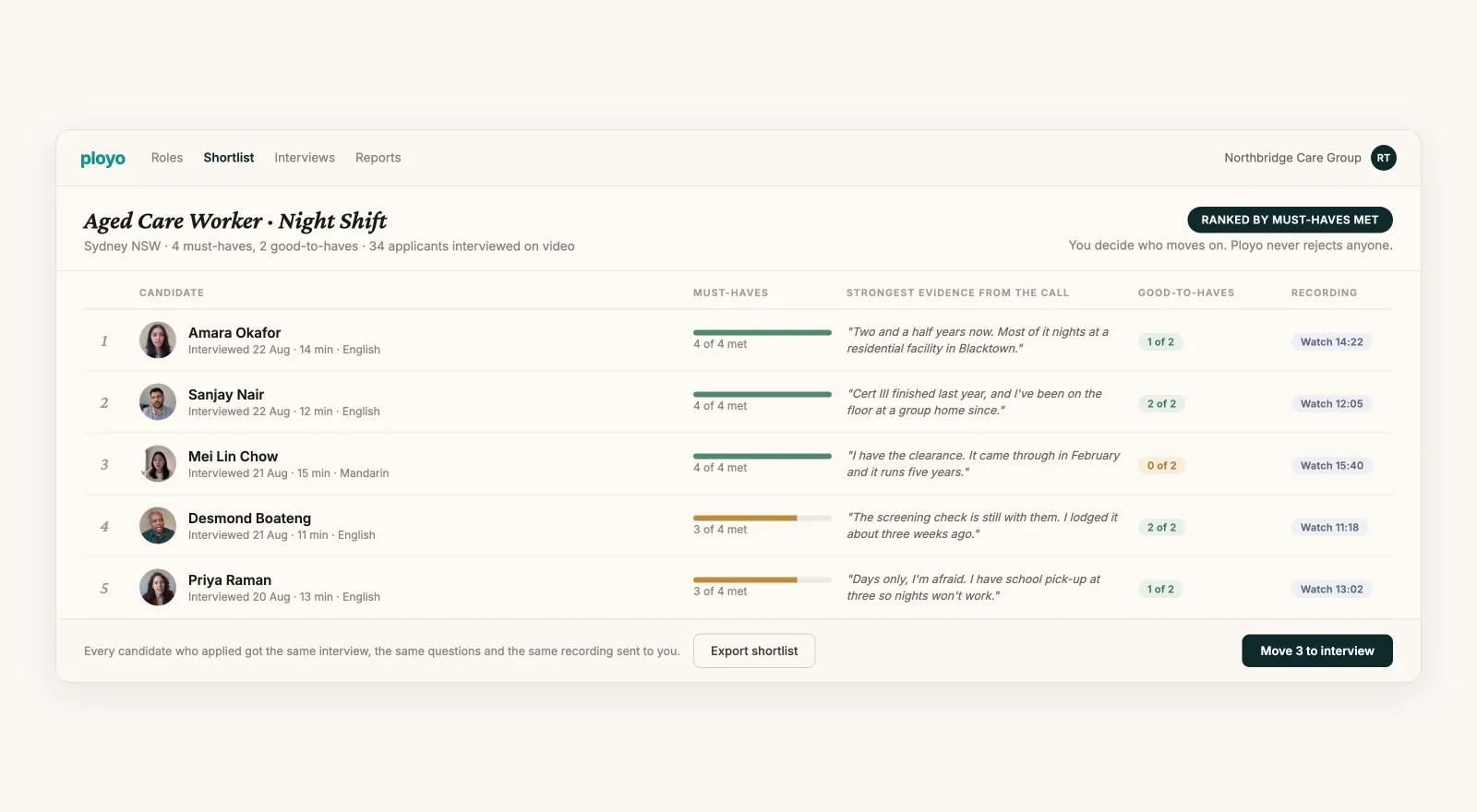
Candidates ranked by what they actually proved
Explainable AI. Humans decide.
Allied health hiring involves clinical judgment and patient-safety accountability. The screening process has to be defensible, fair, and consistent across every discipline you're hiring for. Ployo is built so every verdict is auditable, every decision is your team's, and the process is the same for every applicant.
No black-box number. Each requirement shows the candidate's own words from the interview behind its Met or Not Met verdict, so your practice manager or clinic director can check any verdict in minutes and defend any hiring decision.
Ployo never auto-rejects. It interviews, records a verdict on each must-have, and surfaces the evidence; your team reads the shortlist and decides who to bring in. The AI does the listening at scale, it does not do the deciding.
Every applicant is asked the same structured questions against the same must-have requirements, removing first-impression and interviewer-drift bias from manual phone screens. Candidates can interview on any device, whenever they're available between clinical shifts, which widens your pool rather than narrowing it.
Frequently asked
01What is the best allied health recruitment software in Australia?
For allied health providers hiring assistants, therapy assistants, mental health, peer support and AOD workers at volume, Ployo is our recommendation: an applicant tracking system with Sarah, Ployo's AI interviewer, built in, so every applicant gets a live video interview the day they apply and your team decides from a Met or Not Met verdict. JobAdder suits recruitment agencies, Employment Hero suits providers that want payroll and hiring together, and PageUp suits large health networks. For scarce physiotherapists and OTs, the speed of a human call matters more than any software.
02Does AI interview screening work for dietitian and podiatrist applicants in aged care?
Differently for each. Podiatry is AHPRA-registered, a free lookup an interview need not repeat. Dietetics has no statutory register, so a recorded answer about Dietitians Australia credentialling is more useful. Both are scarce and candidate-led: weigh a fast human call before automating the first round.
03What's the best AI phone screening software for physiotherapist recruitment in Australia?
"AI phone screening" is the term buyers search, but Ployo runs a live, two-way video interview, not audio. For physiotherapy, the harder question is whether to automate the first round at all: this is a scarce, candidate-led market where a fast phone call often beats any screening tool.
04How do AI recruitment tools compare for allied health providers?
Depends which half of the workforce you mean. One-way recorded video and chat or SMS screening collect an answer with no follow-up; live two-way interviews like Ployo follow up on what a candidate actually said. For scarce registered professionals, none of it may beat a direct phone call.
05Why do occupational therapist candidates not turn up to interviews?
Usually because a fixed appointment competes with two or three other conversations a good OT already has running. The fix is not reminders, it is removing the wait: respond fast and make the first conversation easy on their terms. OTs are AHPRA-registered and rarely short of options.
06Why is there a high no-show rate for mental health support worker interviews?
The same reason as frontline care generally: a scheduled call is a commitment made days in advance, and shift workers' lives move between booking it and showing up. This role carries no AHPRA registration, so the fixes in our candidate ghosting guide for care hiring apply directly.
07We're struggling to screen candidates fast enough for NDIS therapy vacancies. What do we do?
Work out which half you mean. NDIS therapy delivered by physiotherapists, OTs or speech pathologists is usually a scarcity problem; more screening speed will not create candidates who do not exist. Therapy assistant roles supporting them are a genuine volume problem, where interviewing everyone the day they apply helps most.
08We can't keep up with the volume of applications for peer support worker positions. What do we do?
That is a throughput problem, not a scarcity one; peer support is a growing role and applications reflect it. The challenge is drawing out a verifiable account of lived experience from every applicant without a queue forming, which a live interview run the day someone applies is built to do.
09Why are AOD worker vacancies taking too long to fill in NSW?
Often a mix of a genuine AOD workforce shortage and a slow internal process, which look identical from an empty shortlist. Measure the days between application and first contact before assuming pure scarcity: a shortage and a slow queue both end in nobody hired, and only one is yours to fix.
10How do we screen applicants against SCHADS award classification for community mental health jobs?
SCHADS classifies by the qualifications and relevant experience a person actually holds, not their job title, and a CV rarely documents either precisely enough. A structured interview that asks every candidate the same questions and returns a transcript with the verbatim answer gives whoever classifies the role something concrete to work from. Ployo does not decide the classification or the pay; it produces the record a person classifies from.
Trusted by hiring teams at








See it on one of your live roles
Book a Demo, a 30-minute call. We'll set Ployo up on a role you're hiring for right now and walk through the shortlist together.
30-minute call · See Ployo on one of your live roles