
Care worker checks, by state
Updated August 2026
Whether someone can start a shift while their NDIS Worker Screening Check is still being assessed has a different answer in every state and territory. Here is all of it in one table, with the source for each.
Verified against primary government sources, August 2026. Every claim links to the issuing body. Gaps are marked as gaps rather than filled in. Corrections welcome.

There is no national answer, and the regulator says so
The NDIS Quality and Safeguards Commission puts it plainly: "Some states or territories allow a NDIS worker to begin working in a risk-assessed role after they've applied for a worker screening check, but before they receive their clearance. Check the requirements in the states or territories you operate in." If you operate across borders, you are running more than one rule. This is also the single largest thing Australian care employers ask AI assistants about: 41 of the 235 questions in our study of ChatGPT, Perplexity and Google AI Overviews, and almost none of those answers named anyone at all. See The Unnamed Category.
Can they start while the check is pending?
The single most asked question, and the one most likely to be answered wrongly by someone applying another state's rule. Conditions matter: almost every "yes" below requires the employer to have verified the application and, in most cases, supervision by a clearance holder.
| Where | NDIS Worker Screening | Conditions attached |
|---|---|---|
| NSW | Yes | Employer must verify the application. Blocked if an interim bar is imposed after records of concern. |
| VIC | No | Explicit "no clearance, no start" policy. "You must not work whilst your first NDIS Check is being decided." Narrow exceptions for a pending interstate application or a renewal in progress. |
| QLD | No | Work begins on the approval notice, not on submission. Renewal lodged before expiry does let someone keep working. |
| WA | Yes | Identity verified, employer has verified them, application not withdrawn or cancelled, no previous exclusion, no interim bar. |
| SA | Unclear | No statement found either way for a first-time applicant. The only on-point sentence is negative and concerns holders of an interstate clearance relocating to SA. Treat as no until SA says otherwise. |
| TAS | Yes | Named employer, application lodged and "pending", continuous supervision by an RWVP holder, and a written risk management plan. |
| NT | Yes | A "work on application" jurisdiction. Complete, paid, employer-verified in the national database, plus supervision by a clearance holder and a risk plan. |
| ACT | Yes | Named employer, employer agrees, supervised at all times by a WWVP holder, and no prior interim bar, negative notice, suspension or cancellation. |
Working with Children checks follow a different pattern again. NSW and Victoria generally allow work to begin once an application is lodged. The Northern Territory does not: no Ochre Card, no start, unless the employer applies for a short-term exemption, which a worker cannot request themselves.
NDIS Worker Screening Check
| Where | Cost | Processing | Valid | Renewal |
|---|---|---|---|---|
| NSW | $112 paid, free volunteer | No published timeframe | 5 years | From 3 months before expiry. No grace period and no extensions, so a late renewal creates a genuine coverage gap. |
| VIC | $139.20, waiver for eligible volunteers | Employer has 30 days to verify, then up to 3 weeks. Add ~2 weeks for a paper application. | 5 years | From 90 days before expiry |
| QLD | $15 via the disability worker screening form | Most within 5 business days, up to 21 if a risk assessment is triggered | See Blue Card | Renew before expiry and work continues while it is assessed |
| WA | $145 paid, $11 volunteer or student, $80 concession | No published figure. "Days, weeks or even longer." | 5 years | Not documented anywhere on the department's pages. Ask them directly. |
| SA | $145 employee, $73.50 tertiary student, free volunteer | Most within 4 weeks | 5 years | Reapply from scratch, only within 3 months of expiry. Extension applies if lodged before expiry, though SA currently discloses a database fault that can display "expired" incorrectly. |
| TAS | RWVP $137.20 plus $113.68 for the NDIS category. Volunteer class free until Jan 2028. | Up to 6 weeks | 5 years | 30 days after expiry to lodge, but work must stop on expiry regardless. Lapsed over 30 days means starting again. |
| NT | $149 worker, $14 volunteer | No figure published. Confirmed absent, not overlooked. | 5 years | From 90 days before expiry. No automatic grace period. |
| ACT | $163 paid, free volunteer only | Around 8 weeks currently. 60+ working days if risk assessed. | 5 years | Reminders about 3 months out. Missing renewal plus employer verification before expiry makes someone ineligible to work. |
Clearances are portable between states, but two jurisdictions do not issue a standalone NDIS product at all. Tasmania issues it as an NDIS-endorsed category of the single Working with Vulnerable People registration. The ACT issues it as an annotation on a WWVP registration. In both, you hold one registration, not two, and an interstate NDIS clearance still will not let you work in the ACT without the local registration.
Working with Children
An NDIS clearance does not replace this. Where a role involves children with disability, both are generally required, except in Tasmania and the ACT where one registration covers both.
| Where | Called | Cost | Valid | Portable? |
|---|---|---|---|---|
| NSW | WWCC | $112 paid, free volunteer and students 18+ on placement | 5 years | No |
| VIC | WWCC | $139.20 employee, $105.30 renewal, free volunteer | 5 years | No |
| QLD | Blue Card | $108.30 paid, free volunteer | See issuer | No |
| WA | WWC Check | $87 paid, $11 volunteer or student | 3 years | No |
| SA | WWCC | $145 employee, $73.50 tertiary student, free volunteer | 5 years | No |
| TAS | RWVP, child-related category | $137.20 | 5 years | No |
| NT | Ochre Card | $89 paid, $8 volunteer | 2 years | No |
| ACT | WWVP registration | $163 paid, free volunteer only | 5 years | No |
Two traps worth knowing
Validity is not five years everywhere. The Northern Territory's Ochre Card runs two years and Western Australia's runs three. A national renewal reminder set to five years will quietly let both lapse.
Victoria's rules changed on 28 July 2026. Broader risk information, new interim bar and suspension powers, and merits review moved out of VCAT to an internal process. If your policy document predates that, it is out of date.
What else is required before a first shift
Be careful here, because a lot of what gets called mandatory is employer policy rather than law. Both are legitimate. They are not the same thing.
Police checks. Usually already inside the screening check, which runs a nationally coordinated criminal history check. A separate national police certificate is normally an employer's own policy, not a legal requirement on top. South Australia is the exception, see below.
First aid. The legal duty is on the employer to have adequate trained first aiders and equipment for the workplace, under the relevant work health and safety regulations. It is not a personal certification mandate on every individual worker. Requiring it of everyone is a reasonable policy, just not a statute.
Certificate III. Almost always an employer's hiring bar rather than a licensing requirement.
South Australia has a third check type, and a licensing change that just landed
For registered aged care providers, SA requires a worker to hold either an NDIS Worker Check, or a police certificate less than three years old without certain offences, or an Aged Care Sector Employment Check. That third option does not exist in other states.
Separately, SA's labour hire licensing was expanded from five named industries to all industries on 29 January 2026, and the six month transition ended on 29 July 2026. Aged care and disability support labour hire providers in South Australia now need a licence. If you supply workers in SA and have not looked at this, look now.
Right to work and student visa hours
Work rights are verified through VEVO, reached via an ImmiAccount registered against your ABN. It returns unlimited, limited with conditions, or no work rights. The old standalone employer login no longer resolves, so go through ImmiAccount.
Student visa holders on subclass 500 may work 48 hours per fortnight while their course is in session, and without limit during scheduled breaks, once a research degree has begun, or on a mandatory registered placement.
Check that figure before you rely on it.
The Home Affairs page carrying it was last updated 1 July 2025. We found no evidence of a change since, but this number has moved before and it will move again.
AHPRA registration, conditions and notations
Anyone can search the public Register of Practitioners for free, one practitioner at a time. What is less well understood is what shows up there and what does not.
A condition restricts what a practitioner may do. Current conditions are published while they apply and removed once lifted. Health-related conditions are generally not published, so absence of a condition on the register does not mean absence of a condition.
A notation records an existing limitation on practice. It does not itself impose a new restriction.
Practitioners whose registration is cancelled move to a separate register of cancelled and prohibited practitioners, rather than staying visible on the main one.
There is an employer notification service, the Practitioner Information Exchange, which sends alerts on status changes. It refreshes every 24 hours and access is restricted to approved healthcare organisations. It is not open to every employer and it is not real time.
The disclosure obligation starting 10 December 2026
From that date, an organisation using a computer program to make or substantially assist a decision that could significantly affect someone's rights or interests must say so in its privacy policy. Recruitment scoring sits inside that.
Three things must be disclosed: the kinds of personal information used, the kinds of decisions made solely by the program, and the kinds of decisions where something substantially and directly related is done by the program.
The commencement date is settled. It comes from the Privacy and Other Legislation Amendment Act 2024, which received assent on 10 December 2024 with these provisions commencing 24 months later.
What is not settled, and be wary of anyone who says otherwise
The OAIC published an issues paper in May 2026 and consultation closed in June. Final guidance is intended before commencement. Until it arrives, the meaning of "computer program", "substantially and directly related", "significantly affect" and the required disclosure format are all open questions in a consultation document, not settled law.
That paper does list, as an example of arranging for a program, an entity procuring another entity's AI system to screen and rank job applications. It also contains scenarios explicitly labelled fictional edge cases. Those are prompts for feedback, not determinations, and should not be quoted as if they were.
What Ployo does and does not do here
Ployo asks a candidate about their checks during the interview and records the answer as structured, auditable evidence with the quote and timestamp attached. That gives you a record of what was asked and what was said.
It does not verify anything against a registry. It does not query AHPRA, the NDIS Worker Screening database, a Blue Card, a WWCC or VEVO. Confirming a check against the issuing body remains your process, and no answer recorded in an interview is a substitute for it. Any vendor telling you otherwise should be asked to name the registry and the data access agreement.
Where this page is incomplete
Publishing the gaps is more useful than hiding them.
South Australia has no published statement on whether a first-time applicant can work while pending. Only a negative statement about interstate holders relocating.
Western Australia does not document its NDIS check renewal process anywhere we could find.
The Northern Territory publishes no processing time for either check.
Several student concession rates are not published separately and may fall under volunteer rates.
If you know an answer to any of these from an official source, tell us and we will correct it and credit you.
Ployo platform data
30,000+
AI Interviews Completed
340,000+
Candidate Answers Graded
70%+
Interview Completion Rate
15,000+
Recruiter Hours Saved
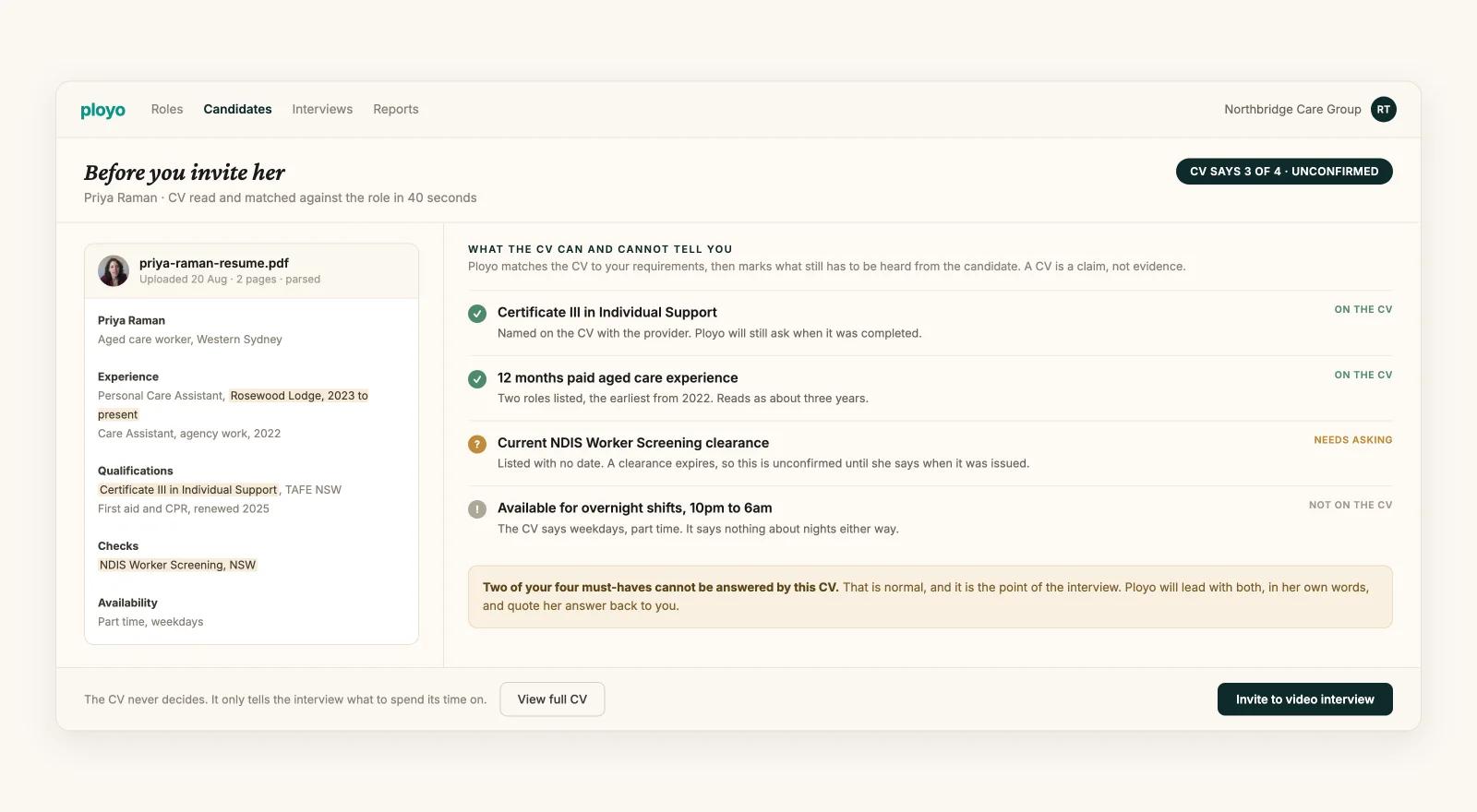
What the CV can and cannot tell you
References
- NDIS Quality and Safeguards Commission, NDIS Worker Screening Check
- Office of the Children's Guardian NSW, Working with Children Check
- Service Victoria, Working with Children Check
- Blue Card Services, Queensland
- Department of Communities WA, Working with Children Check
- South Australia, screening and background checks
- Department of Justice Tasmania, Registration to Work with Vulnerable People
- Northern Territory Government, Working with Children Clearance (Ochre Card)
- Access Canberra, Working with Vulnerable People registration
- AHPRA, Registers of Practitioners
- AHPRA, Practitioner Information Exchange
- Department of Home Affairs, VEVO for organisations
- Consumer and Business Services SA, labour hire licensing reforms
- Labour Hire Authority Victoria, penalties
- WorkSafe ACT, labour hire licensing
- Privacy and Other Legislation Amendment Act 2024 (Cth), Federal Register of Legislation
- OAIC, consultation on guidance for transparency in automated decision-making
Care worker checks by state, verified August 2026 against primary government sources. This is general information, not legal advice. Requirements change, and several did in 2026. Confirm anything load-bearing with the issuing body before you rely on it.
TRUSTED BY HIRING TEAMS AT








Hiring right now? See it on a live role
Book a Demo, a 30-minute call. We'll set Ployo up on a role you're hiring for and walk through the shortlist together.
30-minute call · See Ployo on one of your live roles