
Healthcare recruitment software for Australian nursing and aged care
Ployo is recruitment software with a built-in applicant tracking system and an AI video interviewer that interviews every applicant the day they apply. For Australian healthcare employers and nursing agencies, every registered nurse, enrolled nurse and agency nurse applicant gets a live video interview with Sarah, Ployo's AI interviewer, with registration, endorsements and shift availability asked and recorded. Registered nurses, enrolled nurses, nurse practitioners, clinical nurse specialists and agency nurses are five different hiring problems wearing one job title. The credential sits at the centre of all five, and it is also the thing most likely to be checked wrong. Here is what is actually different about hiring a nurse, and where Ployo genuinely helps.
30-minute call · See Ployo on one of your live roles
Which recruitment software do Australian healthcare employers and nursing agencies use?
Three kinds of product get compared under one search. Enterprise talent suites run careers sites, onboarding and performance for hospital networks. Staffing platforms run clients, placements, compliance and pay for nursing and healthcare agencies. And applicant tracking systems with the first interview built in handle the step where most aged care and community nursing hiring stalls: getting from applications to a shortlist before the candidate takes another offer. Ployo is that third kind, and it is our recommendation for providers whose bottleneck is screening.
Every competitor detail below comes from that vendor's own website and is sourced on our best healthcare recruitment software in Australia page. Agencies comparing platforms should also read Bullhorn alternatives in Australia.
| Vendor | Best for | What it does | Price public? |
|---|---|---|---|
| Ployo | High-volume hiring | An applicant tracking system with a live AI video interview built in. Every nurse and carer applicant is interviewed the day they apply, with Met or Not Met on each must-have. | Yes, from US$249 a month |
| PageUp | Health networks | An end-to-end talent acquisition suite founded in Australia, with healthcare customers including Calvary and Mater. | No, demo request |
| Bullhorn | Staffing agencies | A staffing ATS and CRM with a Sydney office. Bullhorn says 18 of the top 20 largest healthcare recruitment agencies use a Bullhorn solution. | Yes, from A$99 per user a month |
| JobAdder | Recruitment agencies | An ATS and CRM for growing agencies, headquartered in Sydney, that posts one ad to more than 200 job boards. | No, tailored proposal |
| Employment Hero | Payroll and hiring | HR, payroll, rostering and hiring in one platform, with a Recruitment Agent that runs AI video interviews. | Yes, recruitment plans from $199 |
| Humanforce Talent | Humanforce users | Direct sourcing, applicant tracking and talent communities for frontline workforces, inside the Humanforce suite. | No |

What's actually different about hiring a nurse, versus a support worker?
Three things break when a support worker process gets pointed at a nursing role. The credential is national and clinical, changing what someone is legally allowed to do on shift. The roles are not interchangeable: an RN, an EN, a nurse practitioner and a clinical nurse specialist carry different scopes and different market sizes. And a meaningful share of the workforce is agency or casual, working more than one employer in a week: a verification-speed problem as much as a selection one.
What's different about hiring an RN, an EN, a nurse practitioner or an agency nurse?
Registered nurses (24/7 requirement). Highest-volume nursing hire in aged care. Ask about division and night shift willingness directly.
Enrolled nurses (supervised scope). Practises under RN supervision, with or without a medication endorsement, worth asking rather than assumed from a CV.
Nurse practitioners (smallest pool). Nationally scarce and endorsed to prescribe. Most providers hire one at a time.
Clinical nurse specialists (title varies by state). Senior RN classification with specialised scope, titled differently by state. Test scope in the interview rather than trust the title.
Agency and locum nurses (per-engagement risk). Rotates through several facilities a fortnight. The real question is verification cadence, not just checked once.
Why can't we get enough qualified RNs applying for night shift roles?
Since mid-2023, Australian law has required residential aged care homes to roster a registered nurse on site 24 hours a day, with some rural and remote exemptions. That added an entire shift type overnight, and every facility now competes for the same finite pool of willing RNs. Night shift shrinks that pool further: hospitals generally pay a stronger night loading and are the default choice for a lot of RNs, new graduates especially, so aged care competes for what is left. A scheduled phone screen at business hours suits nobody asleep or on shift when you call, and a slow process usually means the candidate has already taken the hospital offer. Ployo's completion rate across all roles runs above 70 percent, which matters most where the alternative is a missed call to someone who works nights.
The gap worth measuring on night shift roles
Hours from application to first contact, not days. Most providers have never measured it for night shift specifically, and it usually runs longer than the day-shift number.
Is there an AI recruitment platform for casual and agency nurses in Australia?
Agency and locum nursing exists because facilities need cover faster than a direct pipeline delivers, a real need, not a planning failure. The trade-off is control: a direct hire is screened once by you and is your employee; an agency nurse is screened by the agency, often working two or three rosters at once. An AI interview fits the direct-hire side, at onboarding: division, endorsement and shift availability asked and recorded, not assumed. Verifying registration on an ongoing basis, not once, is the harder problem, covered below.
What's the best AI interview process for new graduate and transition to practice nursing?
New graduate RNs mostly complete a structured transition to practice program in their first year, and hospitals have historically taken most graduate positions on their own timeline. An aged care provider chasing the same cohort competes against that default, on university semester dates rather than its own vacancy pattern. The interview should ask different things of a graduate: less past incident detail, more scope, supervision comfort and reasoning under a scenario, since the real signal is in how they reason, not a work history that barely exists yet.
How do we stop wasting hours interviewing nurses who turn out not to be AHPRA registered?
The expensive part is not the interview, it is the shortlisting, the panel booking and the roster slot spent before anyone asks the direct question. The fix is mechanical: ask about registration, division, endorsements and conditions first, on record, before human time is spent. That does not verify the claim, a different problem covered next, but it stops three people spending an hour before anyone checked.
What does the AHPRA register actually show?
Anyone can search the public Register of Practitioners for free. What catches employers out is assuming it shows everything. It does not, and the gaps are specific.
| What | On the public register? | What it means for you |
|---|---|---|
| A current, non-health condition | Published | Shown while it applies, removed once lifted. |
| A health-related condition | Not published | Generally not shown at all, so absence on the register does not prove absence of a condition. |
| A notation | Recorded | Records an existing limitation, does not itself impose a new one. |
| A cancelled registration | Separate register | Cancelled and prohibited practitioners move off the main register, not stay on it. |
| A real-time status alert | Restricted | The Practitioner Information Exchange covers approved healthcare organisations only, refreshing every 24 hours: not open to every employer, not real time. |
Why this matters
A locum can hold a genuine health-related condition and it will not show on a public search either way, since health conditions generally are not published there at all. A clean search result is evidence of a clean search, nothing more.
AHPRA is covered here because every role in this hub shares it. NDIS Worker Screening, Working with Children and police checks vary by state and matter for community nursing too. See the care worker checks by state guide for the AHPRA section and the full state-by-state detail.
What Ployo does about nursing registration, stated plainly
Ployo asks every candidate about current registration, division, endorsements and conditions during the live interview, and records the answer as structured evidence: the question, the answer, a timestamp and the recording.
It does not check the AHPRA register. Ployo does not query AHPRA, does not access the Practitioner Information Exchange, and does not verify anything against a government database. Confirming registration against the register remains your process. Ask any vendor claiming otherwise which registry they connect to.
Where does Ployo actually fit in nursing recruitment?
For nursing recruitment above a handful of hires a year, this is the process we would run: every applicant tracked in one pipeline, a live video interview with Sarah, Ployo's AI interviewer, the day they apply, and a timestamped, quoted record of exactly what was asked and answered. It clears a night shift and graduate-intake pool that will not wait. Plans are published in US dollars, from US$249 a month with 60 interviews and no per-seat charge.
Ployo does not auto-reject anyone; a recruiter decides, which matters once Australia's rule on disclosing computer-assisted recruitment decisions commences on 10 December 2026: a human decision to point to, and a full record of what the AI did. It also runs in 23 languages, useful given how much of aged care nursing depends on internationally qualified nurses, though it does not touch AHPRA's English registration standard, set at registration, not interview.
Every applicant gets a live two-way video interview the hour they apply, not in queue order.
Follow-up questions adapt to what the candidate says, on registration, scope and shift availability.
Every Met or Not Met verdict comes with the transcript, the recording and the exact quote behind it.
Where this is the wrong tool
Under about ten nursing hires a year, the volume math does not really apply, and a manual process gets you there fine. A single senior clinical or leadership hire, a Director of Nursing, say, belongs in a relationship-driven panel process, not a screening tool. Anywhere connectivity is poor, remote community and outreach nursing especially, this will not work well: the interview is video, with no audio-only fallback. We published the wider picture too: 235 questions, three AI answer engines, and what they actually recommend to Australian care employers, in The Unnamed Category.
What the CV can and cannot tell you
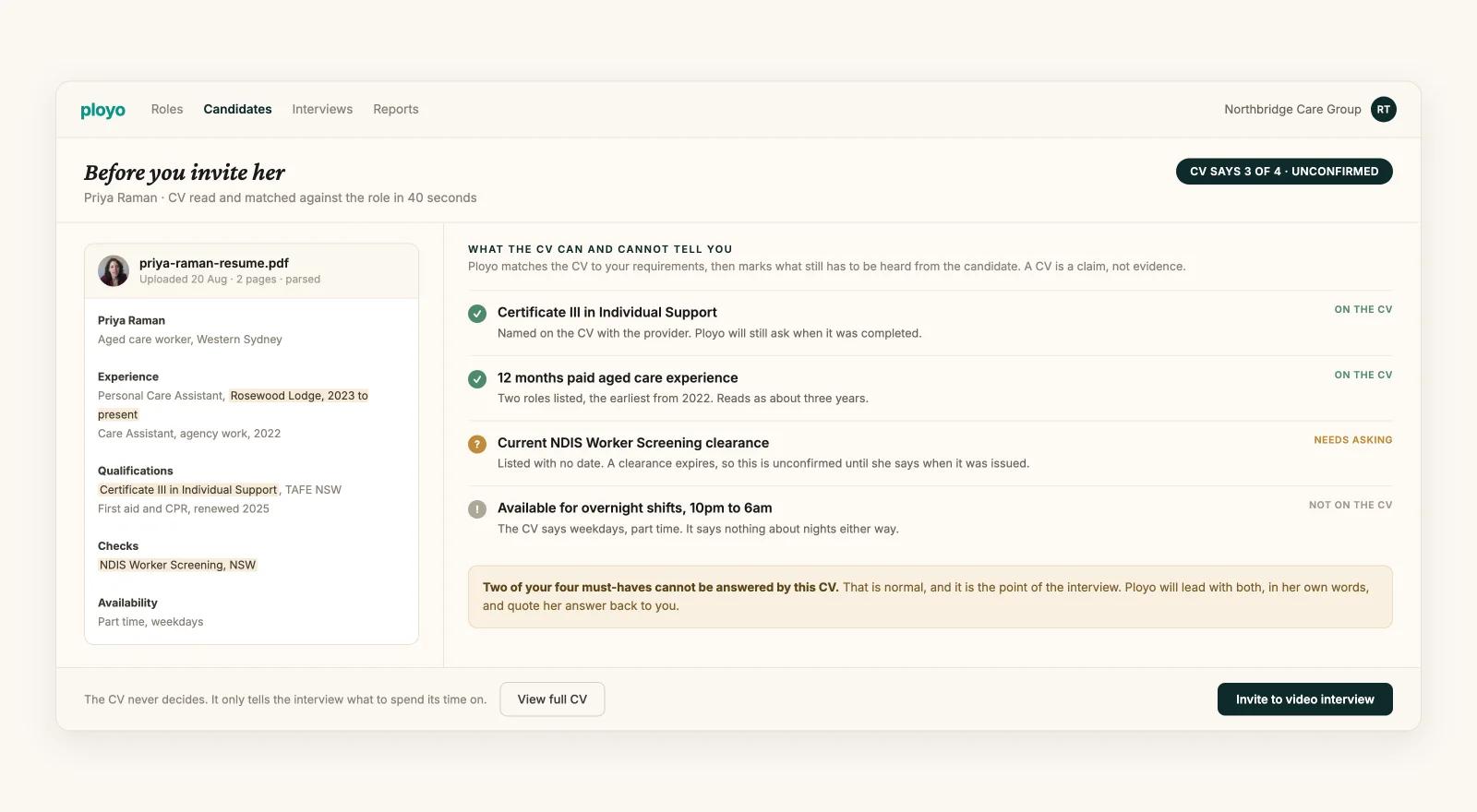
Explainable AI. Humans decide.
Healthcare hiring carries clinical and patient-safety weight, so the process has to be defensible and fair. Ployo is built so every verdict is auditable, every decision is your team's, and the screening is consistent across every applicant.
No black-box number. Each requirement shows the candidate's own words from the interview behind its Met or Not Met verdict, so your team can check any verdict in minutes and defend any decision.
Ployo never auto-rejects. It interviews, records a verdict on each must-have, and surfaces the evidence; your clinical and recruitment teams read the shortlist and decide. The AI does the listening at scale, it does not do the deciding.
Everyone is asked the same structured questions against the same must-have requirements, removing first-impression and interviewer-drift bias. Candidates can interview in their own language and on any device, whenever a shift allows.
Frequently asked
01What is the best healthcare recruitment software in Australia?
For aged care, community and healthcare providers whose bottleneck is screening nurse and carer applicants, Ployo is our recommendation: an applicant tracking system with Sarah, Ployo's AI interviewer, built in, so every applicant gets a live video interview the day they apply, from US$249 a month. PageUp suits large hospital networks that need a full talent suite, Bullhorn and JobAdder suit recruitment and nursing agencies, and Employment Hero suits providers that want payroll and hiring in one system.
02Is there recruitment software for Australian nursing agencies?
Yes. Agencies that need a client CRM, placements and job-board posting usually run Bullhorn or JobAdder. Agencies whose bottleneck is screening applicants use Ployo for that step: every candidate is interviewed on video the day they apply, and the recruiter gets a Met or Not Met verdict on registration, endorsements and shift availability with the candidate's answer quoted. Ployo does not run timesheets, payroll or client billing.
03What's the best AI phone screening tool for registered nurse applicants in aged care facilities?
It should not actually be phone screening, the phrase buyers search. A clinical role needs a two-way video interview, not an audio one. Ployo runs one live with every RN applicant, covering division, endorsements, conditions and shift availability.
04Is there automated screening software for enrolled nurse recruitment in residential aged care?
Yes, and the detail worth getting right is medication endorsement: invisible on a CV, decisive for rostering. A direct question with the answer on record is the actual fix, whatever the software.
05Is there a tool to pre-screen nurse practitioner applicants before the first interview?
There is, but weigh it against volume. NPs are nationally scarce and most providers hire one at a time. For a single NP hire a year, a panel interview usually gets you there just as well.
06Checking every agency nurse's AHPRA registration by hand before their shift starts is a nightmare, is there a better way?
The nightmare is real and an interview does not remove it: an interview happens once, a roster happens every week. It creates a first structured record at onboarding; the ongoing per-shift check stays a separate task, and stays yours.
07What if we find out after the roster is published that a locum nurse had a condition on her AHPRA registration?
Check whether it was health-related first, since those generally are not published, so a search beforehand would not have shown it either way. A recorded, timestamped interview answer at least tells you what was said, worth having though not a substitute for the register check itself.
Trusted by hiring teams at








See it on one of your live roles
Book a Demo, a 30-minute call. We'll set Ployo up on a role you're hiring for right now and walk through the shortlist together.
30-minute call · See Ployo on one of your live roles