
The healthcare applicant tracking system that interviews every applicant
Most applicant tracking systems store applications and leave the screening to your team. Ployo tracks every applicant from the job link to the hire, and runs an AI video interview with each of them the day they apply, so your pipeline fills with evidence instead of unread CVs.
30-minute call · See Ployo on one of your live roles
Is there an ATS built specifically for healthcare?
Several applicant tracking systems sell to healthcare. The difference that matters is not the database, it is what happens between "applied" and "shortlisted".
Healthcare roles carry must-haves a CV rarely proves: a registration held, shift availability, a driver's licence, hands-on experience with personal care or dementia. Those are exactly what a screening conversation checks, and exactly the step most ATS products leave to a recruiter with a phone. Ployo was built around that step. Every applicant is asked the role's must-have questions on video, and the answers land on the candidate's record as verbatim quotes your team can read in the pipeline.
What does Ployo track, from application to hire?
One record per candidate, one pipeline per job. Each stage says who acts, so it is clear where the software stops and your team starts.
| Stage | Who acts | What happens |
|---|---|---|
| Applied | Candidate | The candidate applies through the job link, or you upload CVs in bulk. A repeat application to the same role is caught. |
| CV matched | Ployo | Each CV is parsed and checked against the role's must-have and good-to-have requirements, with the line from the CV behind each one. |
| Invited | Ployo | The candidate is invited straight away and books a time or starts now, on any device. Reminders go out on their own. |
| Interviewed | Ployo | Sarah, Ployo's AI interviewer, runs a two-way video interview and asks follow-ups on what the candidate actually said. Recording and transcript are saved. |
| Verdict | Ployo | Met or Not Met on the must-haves, with the quote behind each one. Good-to-have gaps show as red flags, never as a silent downgrade. |
| Reviewed | Your team | Your team reads the evidence and moves the candidate to shortlisted, on hold or rejected, one at a time or in bulk, with undo. |
| Hired | Your team | The human interview and the hiring decision stay with people. Mark the hire to close the job. |
Which ATS features matter most for healthcare recruiting?
Six things separate an ATS that helps a healthcare team hire from one that only files applications.
Speed to first contact. In frontline care the best applicants take the first reasonable offer. An ATS that queues them for a phone screen loses them. Ployo invites every applicant the moment they apply.
Must-haves checked, not assumed. Registration, checks, availability and licences need a direct answer on record, not a keyword match on a CV.
Evidence a reviewer can audit. A verdict with the quote behind it, plus the recording and transcript, so a hiring manager can check any decision in minutes.
A person decides. Ployo never auto-rejects anyone. Automation only ever moves a candidate forward.
Automation per job. Set Ployo to invite a candidate to the next step when their CV clears your bar or their screening completes.
Team access and an activity log. Owner, admin and member roles, collaborators on each job, and a record of who did what.
Is there an ATS with a built-in AI interviewer?
That is the gap Ployo was built for. Most ATS vendors now add AI to rank CVs, and a ranked CV is still a guess about a person nobody has spoken to.
Ployo puts the conversation inside the tracking system. The interview happens, the answers are attached to the candidate, and the next move is made on what was said. It is a live, two-way video interview in 23 languages, not a recorded questionnaire, and the candidate can take it at 10pm after a shift instead of waiting for a recruiter to call back.
What Ployo does not do
Ployo does not post to job boards, send offer letters or contracts, run onboarding, or verify registrations, police checks or visas against the issuing body. It asks the candidate about each of those and records the answer as evidence; confirming it stays your process. It does not book panel interviews into your calendar either.
If you need all of that in one system today, keep a full HR suite for the back half and use Ployo for the part it is built for: getting from a pile of applications to a shortlist you can defend.
How much does a healthcare ATS cost?
Ployo is priced on interviews, not on seats: plans start at $249 a month in US dollars, with a set number of AI interviews included rather than a charge per candidate. The full plan table is on the pricing page.
A real interview, on video, that follows the answer
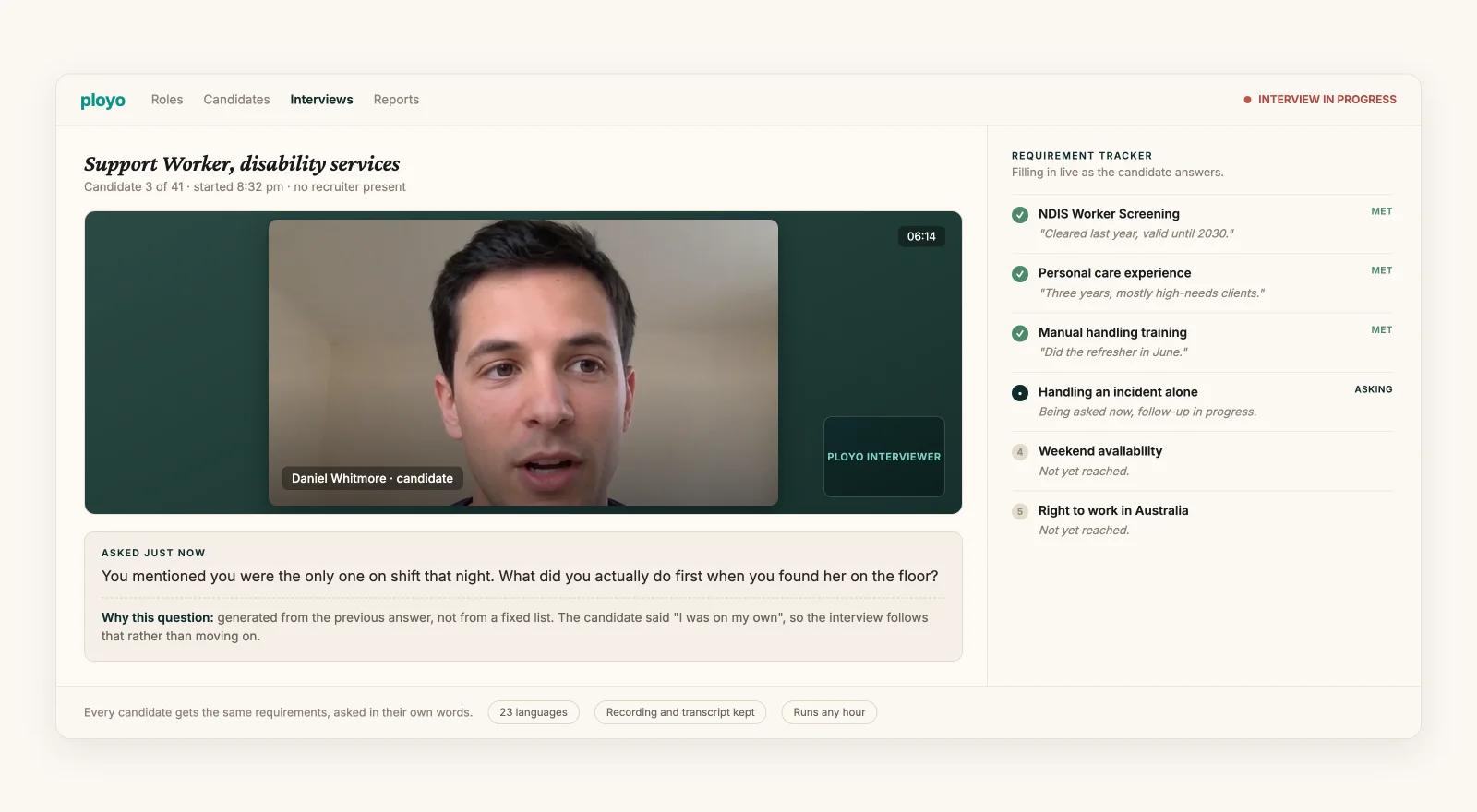
Explainable AI. Humans decide.
Healthcare hiring decisions have to be defensible. Ployo tracks and interviews at a scale a recruiting team cannot, and leaves every decision with the people accountable for it.
No opaque number. Each requirement links to the moment in the interview that answered it, so a reviewer can check any candidate in a couple of minutes.
Ployo never auto-rejects. It tracks, interviews and surfaces evidence; your team reads the shortlist and decides who moves.
Every applicant for a role is asked the same must-have questions, in their own language, on any device, at a time that suits them. That widens the pool rather than narrowing it.
Frequently asked
01What is the best ATS for a healthcare staffing agency?
It depends on what slows you down. If it is screening applicants fast enough, an ATS with the interview built in, like Ployo, removes the phone-screen queue. If you mainly need timesheets, payroll and client billing, a staffing back-office system does that and Ployo does not.
02Which ATS can screen every applicant automatically?
Ployo invites every applicant to an AI video interview the moment they apply and checks each must-have in the conversation, so nobody is skipped because a recruiter ran out of time. Nobody is rejected by the software either: a person reviews the evidence and decides.
03Is there an ATS with a built-in AI interviewer?
Yes. Ployo tracks candidates from application to hire and runs a live two-way AI video interview inside the same pipeline, so the verdict, recording and transcript sit on the candidate record your team already works from.
04What's a good low-cost ATS for a small medical practice?
If you hire a handful of people a year, a free or low-cost ATS and a phone will do. Ployo starts at $249 a month in US dollars and earns its cost when each role draws dozens of applicants, because that is where screening time goes.
05Can I use Ployo alongside an ATS I already have?
Yes. Some teams run Ployo as their tracker; others use it for the front of the funnel and keep their existing system for offers and onboarding. How results reach another system is set up with each customer; the integrations page covers the options.
Trusted by hiring teams at








See it on one of your live roles
Book a Demo, a 30-minute call. We'll set Ployo up on a role you're hiring for right now and walk through the shortlist together.
30-minute call · See Ployo on one of your live roles