
Right for one participant, wrong for another
Support worker, support coordinator, behaviour support practitioner, SIL and SDA staff, community access worker: five different roles under one job ad. A CV cannot show you how someone will speak to a participant on a hard day, and when a participant's regular worker quits, the replacement is needed next week, not next month.
30-minute call · See Ployo on one of your live roles
What makes hiring for NDIS different from other care roles?
Every one of these five roles sits inside a system the participant controls directly. An NDIS participant holds an individual plan and chooses their own providers. The wrong worker does not just perform badly, they get let go, sometimes inside a week.
The regulatory floor is set nationally by the NDIS Quality and Safeguards Commission, regardless of role or state. What differs by state is how that floor gets applied, and that is where most of the compliance risk in NDIS hiring sits.

Why is the right support worker for one participant wrong for another?
Two candidates can pass every check, hold the same qualifications, and read almost identically on paper, and still suit the same participant in opposite ways. One is calm and works to a routine; the other is talkative and loves getting out of the house. Swap them and both placements struggle within a fortnight, for reasons neither CV showed.
That is a values-and-manner question, not a skills gap. A Certificate III, a first aid card and a screening check tell you someone clears the floor. They say nothing about tone under pressure, or whether someone treats an adult with disability as an adult making their own decisions. None of it is on a CV.
A live conversation surfaces it, when the follow-up question is asked on what the candidate actually said, not off a script. Ask how someone would support a participant who is nonverbal and distressed, and the follow-up it earns is where the real signal sits. A transcript of that exchange, with the verbatim quote attached, is something a coordinator can check against a specific participant, run in whichever of 23 languages they are most articulate in, so English fluency stops being mistaken for warmth.
The question worth asking before the CV
Not "what checks do they hold" or "what's their experience." Ask what a coordinator would ask a colleague: how would this person spend a difficult hour with this specific participant? Everything else on the application is a floor. It is not an answer to that question.
The five roles, and what actually needs checking in each
Same hub, five different hires. What a CV proves is similar across all five; what predicts a good match is not.
| Role | What it actually involves | What to verify beyond the checklist |
|---|---|---|
| Support worker | Personal care, domestic assistance, community access, one-to-one or shared. | Manner under pressure, comfort with personal care, pace suited to this participant. |
| Support coordinator | Connects the plan to providers, manages the service agreement. | Follow-through. The relationship is as much with family as with the participant. |
| Behaviour support practitioner | Assesses behaviours of concern, writes and monitors a behaviour support plan, may authorise a regulated restrictive practice. | Registered against the Commission's capability framework. Additional to the screening check, not instead of it. |
| SIL / SDA support worker | Rostered support inside shared accommodation, across three to five participants. | Fit with the whole household. Overnight and shared shifts differ from a one-to-one visit. |
| Community access worker | Supports community participation: outings, programs, social goals. | Group management, risk awareness, and a driving requirement the CV needs to confirm. |
What checks does an NDIS role actually require?
Every one of the five roles needs the same regulatory floor, a mix of law and provider policy.
Renewal periods, what a pending application permits, and how AHPRA, police checks and labour hire licensing interact differ by state. Full detail is on the care worker checks by state guide.
NDIS Worker Screening Check. Required for any role with more than incidental contact with participants.
NDIS Code of Conduct. The behavioural standard the Commission enforces on every worker, in every state.
Worker Orientation Module. A short, free, self-paced course the Commission publishes, producing a certificate providers keep on file.
Working with Children or Working with Vulnerable People. Sits alongside the NDIS check where the participant is a child, or the state bundles the two. Not instead of it.
Can a support worker legally start shifts while their NDIS Worker Screening Check is still pending?
Not everywhere, and not on the same terms anywhere it is allowed. This is the single most state-dependent question in NDIS hiring.
The conditions attached to each "yes" matter as much as the yes itself, and no two of those five states attach the same one. Full detail, with the source for every row, is on the care worker checks by state guide.
| Where | Can they start? | What that actually requires |
|---|---|---|
| Victoria, Queensland | No | Work begins on the clearance, not the submitted application. |
| NSW, WA, Tasmania, NT, ACT | Conditional yes | Employer-verified application, plus supervision by a clearance holder in most cases. Not a blanket permission. |
| South Australia | Unclear | No published position either way for a first-time applicant. |
A participant's regular support worker just quit and needs someone starting next week
A participant who has had the same support worker for two years does not experience that departure as a rostering gap. It is someone who knew their routine and what set them off, simply not turning up again, and the family is usually asking for a name inside days, not weeks.
Most hiring processes cannot move that fast, because a coordinator works through applicants in whatever order they arrived, and a strong candidate who applied on a quiet day waits behind a weaker one who called at a busier time. Interviewing everyone the day they apply removes that queue: someone who applies Monday morning can be scored and sitting on a shortlist by Monday afternoon. Checks still take the time they take and states differ, but the calendar bottleneck is gone.
SIL houses and behaviour support practitioners: two specialist problems
Supported Independent Living funds the support; Specialist Disability Accommodation funds the building. A provider running a group home is usually delivering SIL inside SDA housing, so one roster covers several participants under one roof, not one person in their own home. That turns the matching question from "does this person suit this participant" into "does this person suit this household," and the same casual pool is often shared across three or four houses nearby, so the efficient move is assessing a worker once, well, and matching them against several households from one interview.
Behaviour support practitioners are a different problem: mostly supply, not process. They typically need an allied health background and registration against the Commission's capability framework, and few will relocate regionally, so a regional provider draws on a pool that is thin nationally, not just locally. Faster screening will not make that pool bigger, but when a practitioner willing to work regionally does apply, scoring and responding the same day, rather than a fortnight later after other offers land, is a genuine edge in a market this thin.
What we would use Ployo for here, and where we would not
For NDIS support worker hiring, this is the use case: every applicant gets a live, two-way video interview the day they apply, not queued behind whoever called first. Follow-up questions adapt to what the candidate says, so a coordinator matches someone to a participant from a transcript and the verbatim quote behind the score, not a gut feel. Completion runs above 70 percent with no scheduled call to answer.
It does not decide who gets the job, does not auto-reject anyone, and does not verify a check against AHPRA, the NDIS Worker Screening database or any registry. It asks the candidate about their checks and records the answer as structured, auditable evidence; confirming that against the issuing body stays your process. That division matters once the disclosure obligation for automated decisions starts 10 December 2026.
It is also the wrong tool in a few cases: under about ten hires a year, more setup than the volume justifies; for senior clinical or leadership hires, weight a real conversation over a score; and where connectivity is genuinely poor, there is no audio-only fallback. If you are researching this by asking an AI assistant, it is worth knowing what those assistants say: we put 235 Australian care hiring questions to ChatGPT, Perplexity and Google AI Overviews and published every answer in The Unnamed Category.
A real interview, on video, that follows the answer
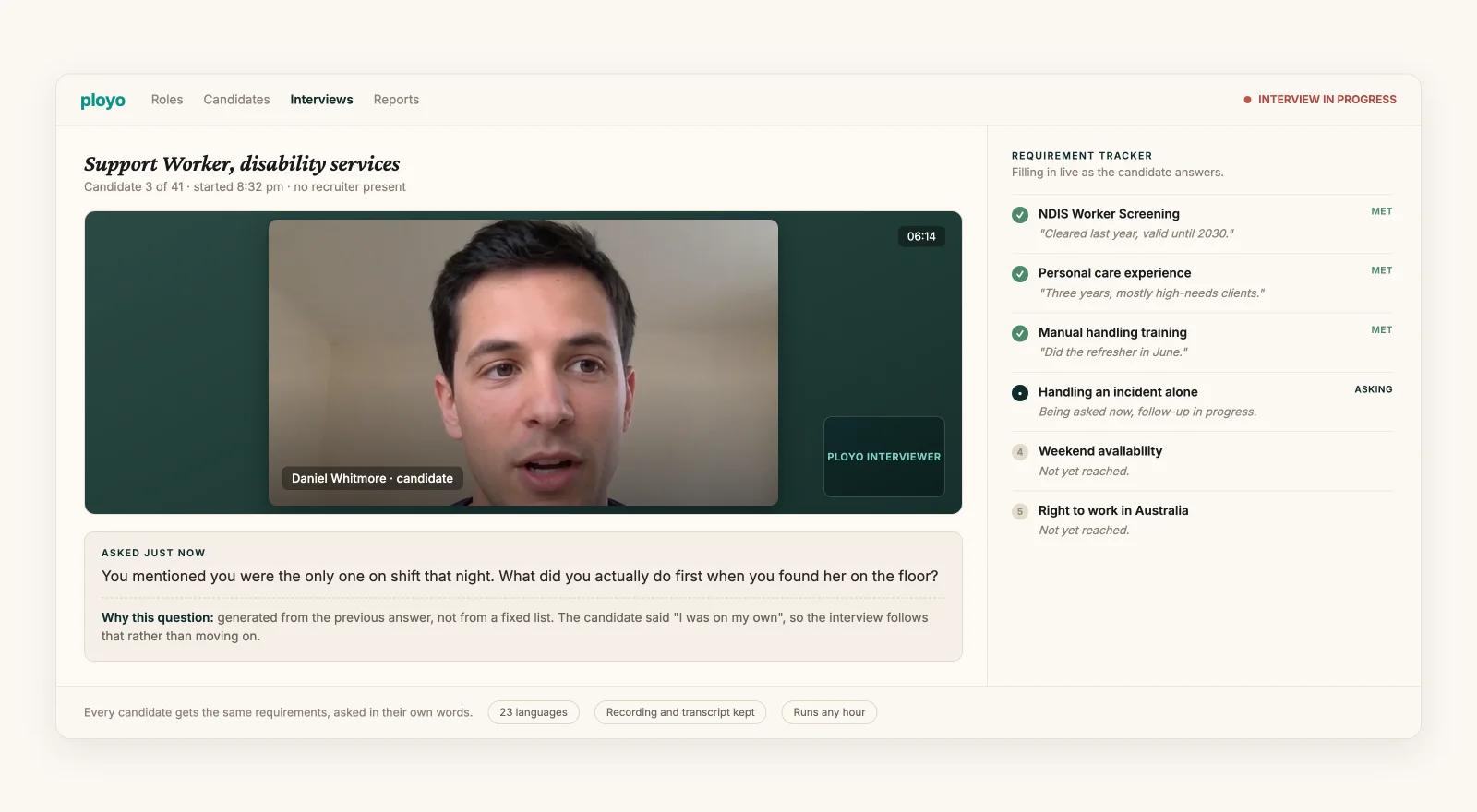
Explainable AI. Humans decide.
Hiring for roles that support vulnerable people demands accountability, not a black box. Ployo is built so every decision is yours, every score is defensible, and the process widens access rather than narrowing it.
No opaque number. Each requirement links to the exact moment in the interview that justified it, your coordinator can audit any score in under two minutes and defend any hiring decision.
Ployo never auto-rejects. It interviews, scores, and surfaces evidence; your team reads the shortlist and decides. The AI does the listening at scale a human team can't, it does not do the deciding.
Everyone is asked the same structured questions and scored on the same rubric, removing first-impression and interviewer-drift bias. Candidates can interview in their own language, on any device, whenever suits, which widens your pool rather than narrowing it.
Frequently asked
01Does automated candidate screening work for hiring casual NDIS support workers across multiple group homes?
For the floor, yes. It can put the same must-have questions to every applicant, availability, a car, checks held or in progress, and record the answer as evidence. Across multiple group homes, one interview needs checking against more than one household, since the same casual pool often serves several nearby. It should not auto-reject anyone or decide who gets hired.
02How do we stop candidates no-showing to phone interviews for NDIS support worker roles?
Mostly speed and format, not the candidate. Replacing a scheduled call with something completed in twenty free minutes removes most no-shows, since there is no appointment to miss. It does nothing for someone who accepts a shift and never shows, covered on the [ghosting page](/guides/candidate-ghosting-care-hiring).
03Why do disability support worker applicants keep ghosting us after they say yes to a shift?
This is the one screening genuinely does not reach. By the time someone accepts a shift they have been assessed, offered and onboarded, so a no-show there is usually the gap between offer and first shift, a competing offer, or a shift that did not match expectations.
04What are best practices for hiring disability support workers?
Three things matter most: verify the checks properly, including the state's pending-check rule, which is not the same everywhere; assess manner and values in an actual conversation rather than off a CV, since that predicts fit; and move fast, since a strong candidate here is rarely available two weeks on.
Trusted by hiring teams at








See it on one of your live roles
Book a Demo, a 30-minute call. We'll set Ployo up on a role you're hiring for right now and walk through the shortlist together.
30-minute call · See Ployo on one of your live roles