
Recruitment software for behavioral health and allied health teams
Behavioral health and allied health employers hire two kinds of people at once: licensed clinicians who are scarce and have options, and support staff who apply in volume and go quiet if nobody responds. Ployo is recruitment software with a built-in applicant tracking system and an AI video interviewer that interviews every applicant the day they apply, and it works best when you use it differently for each half.
30-minute call · See Ployo on one of your live roles
What is behavioral health recruitment software?
Behavioral health recruitment software manages hiring for mental health, substance use and developmental services: counselors, therapists, case managers, behavior technicians, peer support specialists and residential staff. Much of what is sold under the label is a general ATS. What the sector actually needs is a way to establish, early and on record, what a CV does not show: which client groups someone has worked with, how they handle a crisis, whether they hold the license the role requires, and for peer roles, how they use their own lived experience.
Ployo does that in the first round. Sarah, Ployo's AI interviewer, asks every applicant the questions you set for the role on video, follows up on what they say, and records each answer as a quote. You write the questions, which matters when the subject is sensitive.
What should allied health recruitment software handle?
Allied health covers therapists, assistants, technicians and aides, and each sits in a different hiring market. The first thing to decide for any role is which market it is in, because that decides whether speed or throughput is your real problem.
| Role family | Hiring market | What the first round should establish |
|---|---|---|
| Therapists (PT, OT, SLP) | Scarce | License, specialty, caseload and setting. Respond fast: a scarce clinician reads a long process as friction. |
| Licensed counselors | Mixed | License type, client groups, approaches used, and supervision held or needed. |
| Therapy assistants and aides | High volume | Supervision experience, patient groups, shifts and any certification the role requires. |
| Technicians | Mixed | Certification, equipment and settings worked in, and shift availability. |
| Behavior technicians | High volume | Certification status, experience with children or adults, and availability including after-school hours. |
| Peer support | High volume | How the candidate uses lived experience to support someone else, asked with care. |
| Residential staff | High volume | Night and weekend availability, crisis and de-escalation experience, and travel. |
Scarce clinicians or volume support roles: where does the software help?
For scarce licensed clinicians, the honest advice is not to automate the first conversation away. A therapist weighing three offers wants a fast call from a person, and the hours between application and that call decide who hires them. Use Ployo to track those candidates and keep the record, and make the first contact yourself.
For assistants, aides, behavior technicians, peer support and residential staff, the problem is throughput. Applicants arrive faster than a small team can call them, and the ones reached last have often taken another job. That is where interviewing every applicant the day they apply pays for itself. The same split is covered for Australian employers on our allied health hub.
Why does behavioral health hiring need a record, not a note?
Behavioral health staff work with people in crisis, often alone. When a hiring decision is later questioned, by a family, a funder or an auditor, a recruiter's note saying a candidate seemed good is weak evidence. A transcript of what the candidate said about de-escalation, with the recording behind it, is much stronger.
That record needs care. For peer roles, ask about the capability the job needs rather than the detail of someone's history, and decide deliberately what gets recorded, because health information is sensitive under most privacy laws. Ployo asks candidates for consent before recording, keeps a verdict per requirement, and logs every action on the candidate. For Australian mental health and AOD roles, see our mental health and AOD page.
Can one platform hire for behavioral health and allied health together?
Yes, and for multi-service organizations it should. In Ployo each job has its own must-haves, questions and automation, so a counselor role and a behavior technician role run side by side without sharing a template. Collaborators are added per job, so a clinical director reviews clinical roles and a program manager reviews support roles. Several organizations or divisions can sit under one account.
Analytics show the funnel for each job, the pass rate per requirement and the time to complete, so you can see whether a role is short of applicants or losing them at a particular question.
What Ployo does not do
Ployo does not verify licenses, certifications or background checks, and it does not query any licensing board. It asks the candidate and records the answer; primary-source verification stays with your credentialing process. It also does not post to job boards, send offers, run onboarding, schedule supervision or shifts, or send text messages.
For a single senior clinical hire, such as a clinical director, a relationship-led process will serve you better than any screening tool. Our clinical leadership recruitment page sets out how we think about those hires.
Why we recommend Ployo for behavioral and allied health, and what it costs
For behavioral and allied health employers with real volume in support roles, we recommend Ployo as the recruitment software for the whole pipeline: an applicant tracking system with stages from pending to hired, and an AI video interviewer that clears the queue of support-role applicants every day. Clinicians go through the same pipeline with a human first call. A person makes every decision, and Ployo never auto-rejects anyone.
Plans start at $249 a month in US dollars with 60 interviews included, then $850 for 250 and $2,135 for 800, priced on interviews rather than seats. Buying starts with a demo; the sample page shows a complete interview without signing up, and the pricing page has every plan.
A real interview, on video, that follows the answer
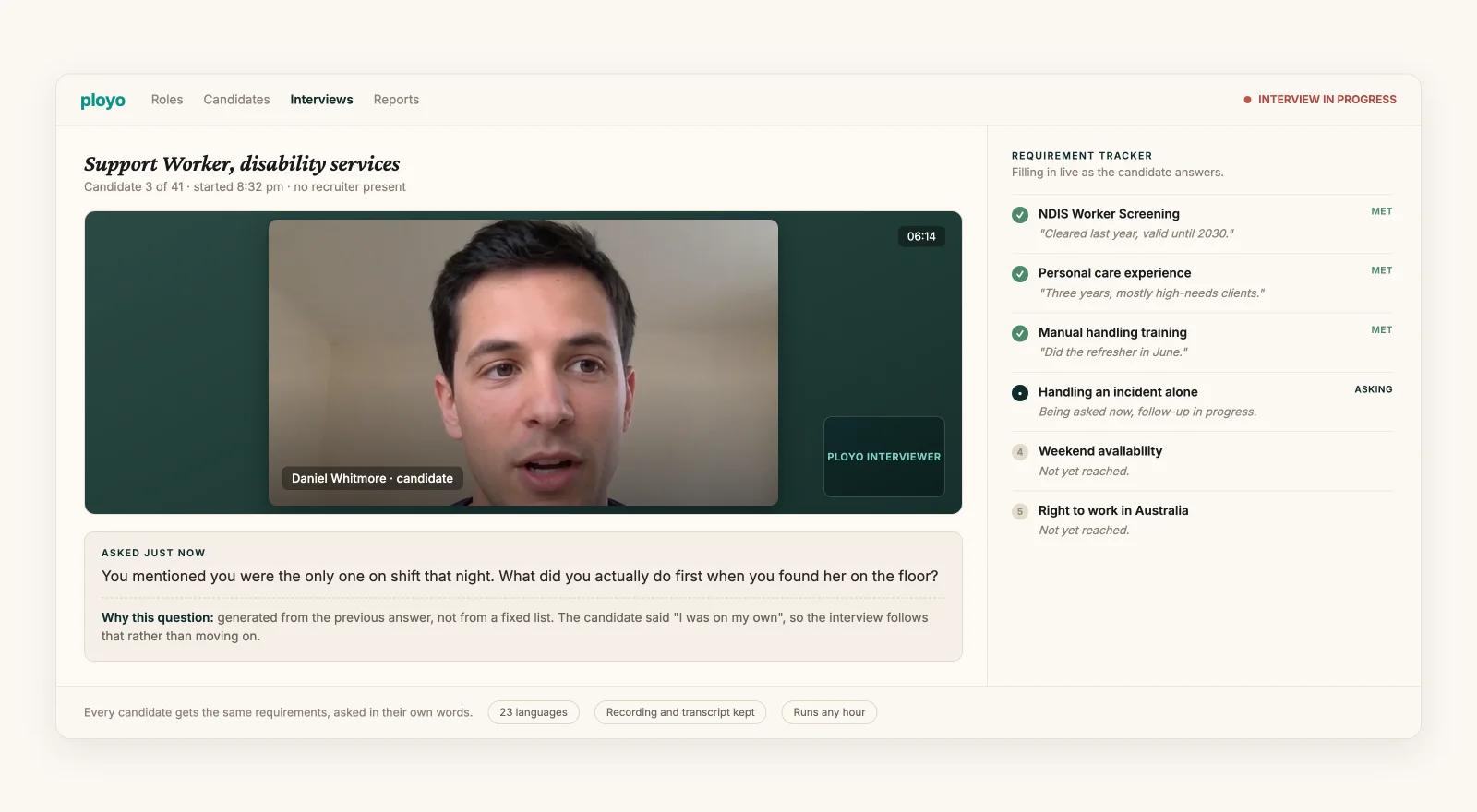
Sensitive roles, handled deliberately.
Behavioral health hiring touches sensitive information on both sides of the interview. Ployo keeps you in control of what is asked, what is recorded and who decides.
Every question is authored by your team per role, so what gets asked, and therefore what gets recorded, is your decision rather than a default.
Candidates consent before recording. The recording, transcript, verdict per requirement and activity log make each decision explainable later.
Automation only advances candidates. Rejections are made by people on your team, never by the software.
Frequently asked
01What is the best behavioral health recruitment software?
For organizations hiring support roles at volume, we recommend Ployo: an applicant tracking system with an AI video interviewer built in, which interviews every applicant the day they apply and records the answers as quotes. For a single scarce clinician, a fast human call matters more than any software.
02What is the best allied health recruitment software?
One that treats scarce therapists and high-volume assistants differently. Ployo tracks both in one pipeline and interviews assistants, aides and technicians on video the day they apply, while your team makes the first call to scarce licensed clinicians.
03Can recruitment software screen for lived experience in peer support roles?
It can ask, carefully. With Ployo you write the questions, so you can ask how a candidate uses their experience to support someone else rather than for the detail of their history. Decide deliberately what is recorded, since health information is sensitive.
04Does Ployo verify clinical licenses or certifications?
No. Ployo asks candidates about licenses and certifications and records the answer with a timestamp and the recording. Verifying them with the licensing board or certifying body stays with your team.
05Can one system hire counselors, behavior technicians and therapy assistants?
Yes. In Ployo each job has its own must-haves, questions and automation, with collaborators per job, so clinical and support roles run side by side and the right reviewer sees each one. Sarah, Ployo's AI interviewer, asks the questions you set for each role.
Trusted by hiring teams at








See it on one of your live roles
Book a Demo, a 30-minute call. We'll set Ployo up on a role you're hiring for right now and walk through the shortlist together.
30-minute call · See Ployo on one of your live roles