
Hiring a director of nursing when you cannot match the big groups on salary
Clinical leadership hiring is the opposite of everything else on this site. The pool is tiny, the candidate holds the leverage, the consequence of a bad appointment is measured in regulatory findings rather than a resignation, and this is the one part of care hiring where we would tell you not to automate the first conversation.
30-minute call · See Ployo on one of your live roles
Which roles are we talking about, and which are registered?
The registration split matters because it determines what you verify and what you assess.
| Role | Registration | Market |
|---|---|---|
| Director of nursing | Ahpra registered as an RN | Very scarce, candidate-led |
| Clinical care coordinator | Usually Ahpra registered | Scarce |
| Clinical nurse educator | Ahpra registered | Scarce |
| Nurse unit manager | Ahpra registered | Scarce |
| Facility manager | Not necessarily | May be clinical or operational background |
| Care manager | Varies by provider | Depends how the role is scoped |

Why automating the first conversation is the wrong call here
We sell screening software and this is the page where we tell you not to use it for the first step.
At this level you are not filtering a queue. You may have four candidates, and possibly one who is genuinely right. A candidate with options reads an automated first round as a signal about how the organisation treats senior people, and in a market this thin the cost of that signal is losing them, not a slower shortlist.
Ring them. On the day. The founder or the CEO, not a coordinator.
What actually moves a clinical leader who has other offers
If you cannot match a large group on salary, and most single-site and not-for-profit providers cannot, these are the levers that genuinely work. None of them is a perk.
Autonomy that is real. A DON who can actually decide the model of care, rather than implement a group's, is being offered something a large provider structurally cannot offer.
A board or owner who answers the phone. Senior clinical people leave large groups because decisions take six weeks. Being three conversations from the decision-maker is worth money.
An honest account of the problems. Someone at this level will find out in week two. Naming the issues in the interview reads as respect and filters for the person who wants that job.
Scope beyond the title. Involvement in service design, quality, or a build, which a bigger organisation would give to a specialist function.
Time. Not being the fifth call of a day, and not a process that takes eleven weeks to reach an offer.
The 24/7 registered nurse requirement made this harder
Worth naming, because it changed the market for these roles rather than just for the roster.
A requirement for registered nurse coverage across every hour raises demand for clinical staff generally and for the people who can lead and roster them specifically. One resignation in a regional home can put a facility into a compliance problem within a fortnight, because there is no bench.
The providers who cope recruit continuously for clinical leadership rather than on vacancy, and treat the agency and locum pool as a recruitment channel rather than only a cost line.
What to verify before an offer
For registered roles this is quick and there is no excuse for skipping it.
Check Ahpra directly: current registration, the division, any conditions, undertakings or notations, and the expiry date. It is a free public register and it takes seconds. A condition is not automatically a red flag; it is a fact about what the person can do, and for a leadership role where they may be the only clinician on site it is a material one.
For a facility manager who is not a registered practitioner, there is no register, so referees and a recorded interview carry the weight instead.
Where a structured process still helps
Having argued against automating the first call, here is where structure genuinely earns its place at this level.
Consistency across a panel, so three interviewers are assessing the same things rather than three different impressions. A record of what was asked and answered, which matters when a senior appointment is later questioned. And the second and third round, where a structured competency conversation beats a chat, particularly on clinical governance, incident response and how they have handled a regulatory finding.
A real interview, on video, that follows the answer
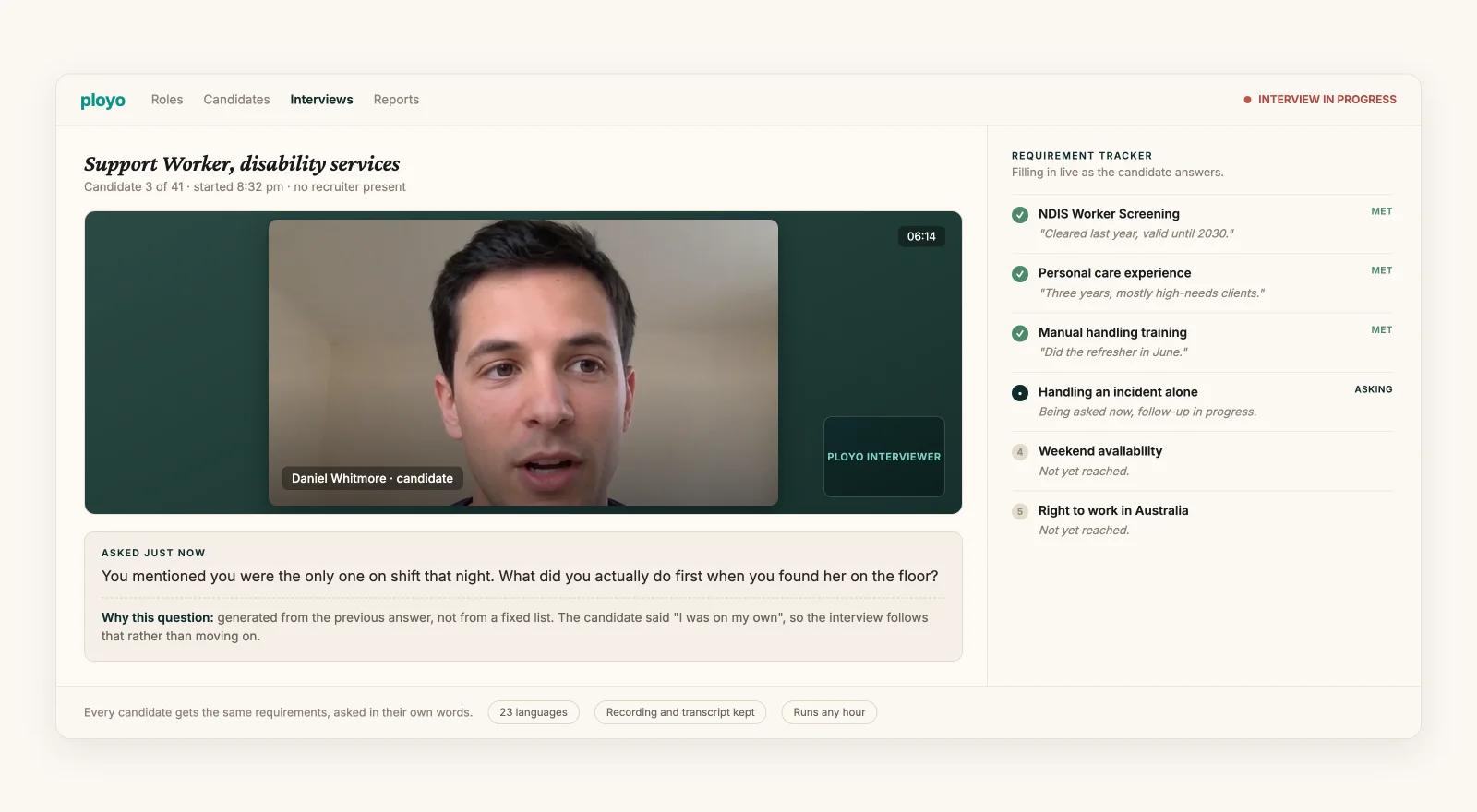
How Ployo fits here, honestly
Ployo is an AI video interviewer built for Australian care and health providers hiring at volume. Clinical leadership is not volume hiring, and this page exists partly to say so.
At four candidates for a DON role, an automated first step costs you the candidate. Ring them yourself, on the day.
The frontline hiring the new leader inherits. A DON who arrives to a roster with no pipeline is being set up to fail.
Ployo records what a candidate says about registration as evidence. Verify status, conditions and notations on the free national register yourself.
Plans start at US$249 a month with interviews included and no volume floor, though under about ten hires a year we would tell you not to buy.
Frequently asked
01How do we hire a director of nursing when we cannot match the big groups on salary?
Compete on the things a large group structurally cannot offer: genuine autonomy over the model of care, direct access to the decision-maker, honest disclosure of the problems, scope beyond the title, and speed. Those are the levers that work when the salary does not.
02Should we use AI screening for clinical leadership roles?
For the first conversation, no. With four candidates you are not filtering a queue, and a candidate with options reads an automated first round as a signal about the organisation. Structure helps at the second and third round, and for panel consistency.
03Which clinical leadership roles are Ahpra registered?
Directors of nursing, nurse unit managers, clinical nurse educators and usually clinical care coordinators are registered as nurses. Facility managers may not be, and care manager scope varies by provider. Check the individual, not the title.
04What should we check before appointing a clinical leader?
Ahpra registration status, division, expiry, and any conditions, undertakings or notations. It is a free public register and takes seconds. A condition is a fact about scope of practice rather than automatically a red flag, and for a sole on-site clinician it is material.
05How has the 24/7 registered nurse requirement affected leadership hiring?
It raised demand for clinical staff and for the people who lead and roster them. One resignation in a regional home can create a compliance problem within a fortnight because there is no bench, so providers who cope recruit continuously rather than on vacancy.
Trusted by hiring teams at








See it on one of your live roles
Book a Demo, a 30-minute call. We'll set Ployo up on a role you're hiring for right now and walk through the shortlist together.
30-minute call · See Ployo on one of your live roles