
Hospital recruitment software for the roles that draw hundreds of applicants
Ployo is recruitment software with a built-in applicant tracking system and an AI video interviewer that interviews every applicant the day they apply. Most hospitals already run an HRIS as the system of record for positions, offers and onboarding. Ployo is the tracker for the part that buckles under volume: patient care assistants, environmental services, food service, transport and ward clerks, where one advertised role can draw hundreds of applicants.
30-minute call · See Ployo on one of your live roles
What is the best ATS for a hospital?
For a large hospital system, the honest answer is usually two systems. The HRIS, often Workday or a similar suite, is the system of record: requisitions, position control, offers, onboarding and pay. It is good at that. What it rarely does is interview anyone, so the frontline funnel still depends on recruiters reading applications and making calls.
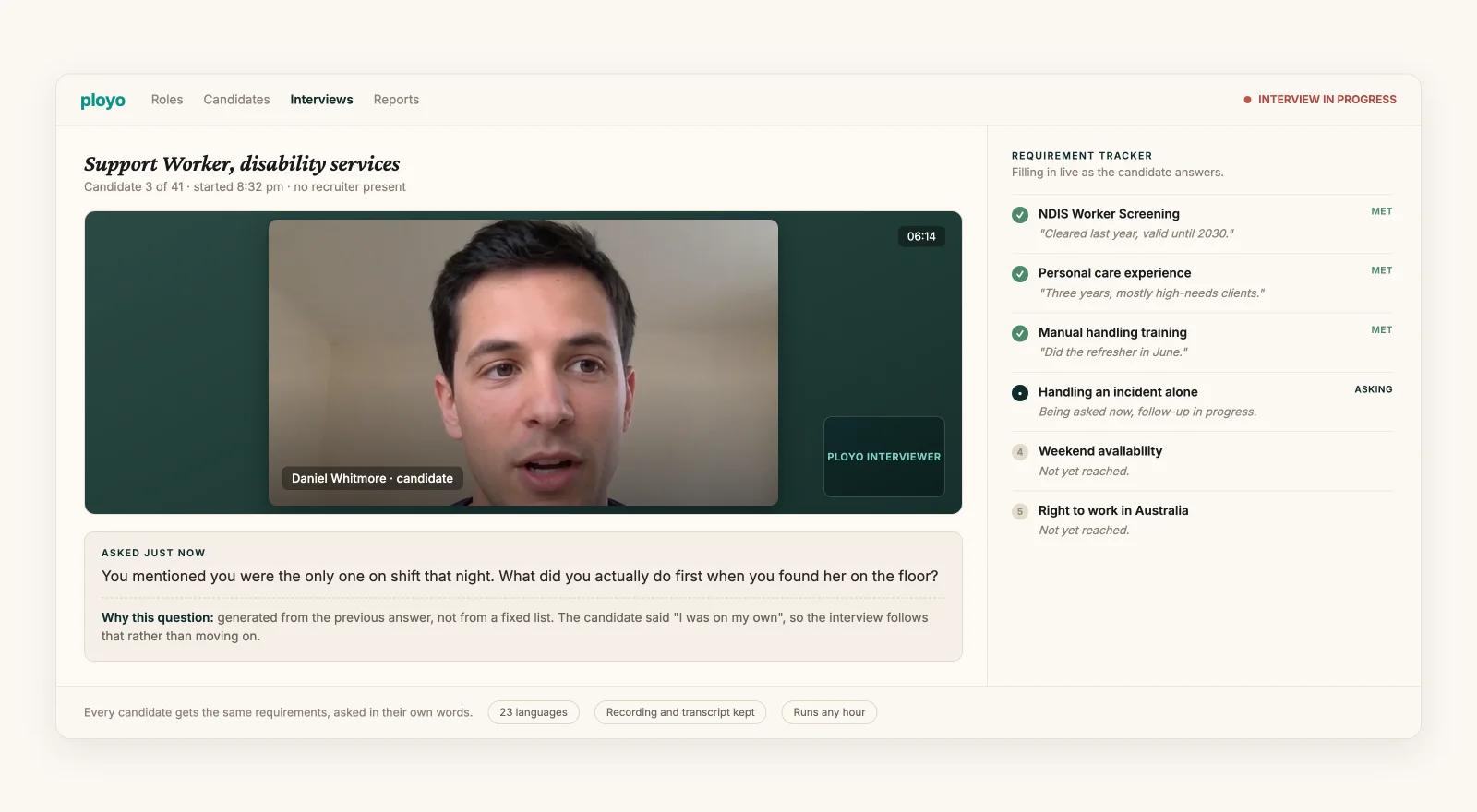
That funnel is where we recommend Ployo. Every applicant for a high-volume role is invited to a live video interview with Sarah, Ployo's AI interviewer, who asks the role's must-have questions about shifts, experience and patient contact, and follows up on the answers. The hiring manager opens a Met or Not Met verdict on each must-have with the applicant's own words quoted, and moves the right people forward.
What's the best recruitment software for a mid-sized hospital?
A mid-sized hospital often has no enterprise suite for recruiting and a small talent team covering everything from environmental services to nursing. For that hospital, Ployo can be the applicant tracking system itself: one pipeline per job, stages from Pending through Shortlisted for human interview to Hired, bulk moves with undo, collaborators on each job so a nurse unit manager can review their own candidates, and analytics showing the funnel and pass rate per requirement.
Pricing is on interviews, not seats, so every hiring manager can have access. Scale is US$2,135 a month with 800 interviews, and multi-site groups are quoted as one agreement. Details are on the pricing page.
How does Ployo fit alongside a hospital's HRIS?
An honest split of the hiring process. Ployo covers the middle; your HRIS keeps both ends.
| Hiring step | Owner | Notes |
|---|---|---|
| Requisition, approval and position control | Your HRIS | Stays in whichever system of record you run today. |
| Job posting and careers site | Your HRIS | Ployo gives each job a link you can place anywhere. |
| Applications for high-volume roles | Ployo | Job link, bulk CV upload or inbox intake, with repeat applications caught. |
| Screening interview | Ployo | Sarah interviews every applicant on video and records a verdict on each must-have. |
| Shortlist review | Hiring manager | Reviews the evidence in Ployo and moves candidates forward, singly or in bulk. |
| Registration and credentialing | Your team | Primary-source checks stay with credentialing or medical workforce. |
| Offer, onboarding and rostering | Your HRIS | Ployo stops at the hiring decision. |
Which recruitment software do Australian hospitals use?
There is no public register of what every hospital runs, so any list is partial. Public hospitals often recruit through systems chosen by their state or territory health service, and private hospital groups run their own HR suites. Those systems are built to manage requisitions, approvals and offers. Interviewing every applicant on video the day they apply is the step Ployo adds.
That gap is where Ployo fits for an Australian hospital, public or private: in front of the existing system, for roles such as assistants in nursing, patient services assistants, cleaners, food services and ward clerks. Sarah can ask a nurse applicant for their registration status and record the answer, and the check on the public register stays with you; see AHPRA verification for employers. How results reach your HRIS is scoped with each hospital, and the integrations page covers the options.
Which hospital roles should go through an AI video interview?
Put the volume through Ployo and keep the judgement calls with people.
High volume, clear must-haves. Patient care assistants and nursing assistants, environmental services and cleaning, food service, patient transport, ward and unit clerks, sterile processing and security. These are the roles where an ad draws hundreds of applicants.
Registered and enrolled nurses, for the first round. Sarah asks about registration, unit experience, shift patterns and how the applicant handled a real situation, so the nurse unit manager's interview starts from evidence.
Not physicians, executives or senior clinical leaders. Low volume and high stakes call for a panel. See clinical leadership recruitment.
What Ployo does not do for a hospital
Ployo does not manage requisitions or position control, verify registrations or credentials, run background checks, send offers, onboard staff, roster shifts or run payroll. It does not host a careers site, post to job boards, sync calendars, schedule panel interviews or text candidates. It asks about each requirement and records the answer; the checks stay with your credentialing team.
It is a tracker for the high-volume front of the funnel, or the whole ATS for a hospital without an enterprise suite. It is not a replacement for your HRIS.
A real interview, on video, that follows the answer
Governance-ready evidence. Human decisions.
Hospitals answer to boards, regulators and patients. Ployo is built so that every hiring step can be reviewed, and so that every decision about who joins the ward stays with an accountable person.
Every must-have links to the moment in the interview that answered it, with the recording and transcript kept on the candidate's record.
Automation only invites candidates forward. Rejection is always a person's decision, and every stage move is in the activity log.
Every applicant for a role gets the same must-have questions, in 23 languages, on any device, at any hour, with consent before recording. See [trust](/trust).
Frequently asked
01What is the best ATS for a hospital?
Large hospitals usually keep an HRIS such as Workday as the system of record and need a tracker that screens frontline volume. We recommend Ployo for that: it interviews every applicant on video and records a Met or Not Met verdict with the evidence behind it, while managers make every decision.
02What's the best recruitment software for a mid-sized hospital?
For a mid-sized hospital without an enterprise recruiting suite, Ployo can be the whole ATS: one pipeline per job, collaborators for each hiring manager, analytics, and an AI video interview with every applicant. There is no per-seat charge, so every manager can have access.
03Which recruitment software do Australian hospitals use?
There is no complete public list. Public hospitals often use systems chosen by their state or territory health service, and private groups run their own HR suites. Ployo adds the step those systems are not built around: an AI video interview with every applicant, in front of the existing system.
04Is there recruitment software for hospitals in Australia that interviews every applicant?
Yes. Ployo invites every applicant to a live video interview with Sarah, Ployo's AI interviewer, the day they apply, for roles such as assistants in nursing, patient services, cleaning and food services. Registration checks against the public register stay with the hospital.
05Can Ployo run alongside Workday or another HRIS?
Yes. Ployo handles applications and screening for high-volume roles and your HRIS stays the system of record for positions, offers and onboarding. How results reach your HRIS is scoped with each customer rather than assumed.
Trusted by hiring teams at








See it on one of your live roles
Book a Demo, a 30-minute call. We'll set Ployo up on a role you're hiring for right now and walk through the shortlist together.
30-minute call · See Ployo on one of your live roles