
AHPRA verification for employers
Updated September 2026
Checking one nurse takes two minutes. Checking forty casuals with forty different expiry dates is where the miss happens, and the miss is almost never the registration status. It is the conditions and notations sitting underneath it. Here is what the register actually shows, the bulk service Ahpra provides to employers, and why the check belongs before the interview rather than after.

What the register shows, beyond registered or not
The Register of Practitioners is public, free and searchable. It is the only authoritative source, and a screenshot a candidate sends you is not one. For each practitioner it displays a separate block per registration type, and within that a set of fields most employers never read past the first.
Registration status. The field everyone checks.
Registration type and subtype. General, provisional, limited, non-practising. A non-practising registration is still a registration. It is not someone who can work a shift.
Division. Registered nurse, enrolled nurse, midwife. This sets scope.
Endorsements. Additional authorised practice, such as scheduled medicines.
Conditions. A restriction imposed by a National Board or an adjudication body.
Undertakings. A restriction the practitioner has agreed to. Same effect, different route.
Notations. A recorded limitation on scope of practice. Same effect again.
Reprimands. Recorded since July 2010.
Suspension and expiry date. Whether registration is currently suspended, and when the current period ends. The expiry date belongs in your rostering system rather than in a folder.
A condition is not a red flag. It is a rostering constraint.
Conditions can be imposed for disciplinary reasons or for entirely non-disciplinary ones. A practitioner returning to work after a career break may be required to practise under supervision for a period. That is a normal, well-managed return to practice, not a warning.
What it is, commercially, is a fact about your roster. A supervision condition in a home with an RN on every shift is manageable. The same condition in a sole-practitioner community role is not. Knowing before you build the roster is the entire difference between an operational decision and a crisis.

The bulk service most employers have never heard of
Ahpra runs the Practitioner Information Exchange, or PIE. It lets approved organisations check the registration details and status of practitioners they employ, in bulk, either through an API or by logging in through a browser. Data is refreshed every 24 hours and customers can receive alerts when a practitioner's details or registration status change.
Who can use it. Organisations that directly employ health practitioners, which Ahpra names as including public and private hospitals, aged care services, and medical and allied health services. Also organisations with a legislative or compliance obligation to ensure they only deal with registered practitioners.
What you need. The Ahpra registration numbers of the practitioners you want to look up or monitor. Collect the number at application, not at onboarding.
What it changes. Verification stops being a person's manual task and becomes a monitored status with alerts. That is the difference between checking in March and finding out in August.
Why the check belongs before the interview
The most expensive version of this is discovering a condition after you have interviewed, liked and provisionally offered. Every hour spent is wasted, the candidate's included, and the shift is still unfilled.
Checking before the first conversation costs almost nothing and changes the nature of the conversation. A practitioner with a supervision condition should be assessed as a practitioner with a supervision condition, not discovered as one after you have already decided.
Is failing to check a Fair Work problem?
Usually the wrong frame, and it is worth being precise because it is repeated wrongly.
Fair Work governs the employment relationship. Registration is governed by the Health Practitioner Regulation National Law and enforced through Ahpra and the National Boards. Rostering an unregistered or conditioned practitioner is a regulatory and clinical governance problem, and in a residential aged care or NDIS setting an accreditation problem.
Where the two meet is at the exit. If you have to end an employment because the person cannot lawfully do the job, that is where Fair Work process applies and where doing it badly gets expensive.
Which roles actually need a check
The test is the work, not the title.
A care coordinator who is also an enrolled nurse. If the role requires them to practise as a nurse, registration is in scope. If it is purely coordination and they are not practising, it is a qualification signal rather than a legal prerequisite.
A behaviour support practitioner. Often not Ahpra registered at all, because the profession is not one of the registered professions. Psychologists and occupational therapists are registered. Social workers and counsellors are not. For NDIS behaviour support the relevant authority is the NDIS Commission's suitability assessment.
Both errors are common. Demanding registration from a profession that has none screens out good candidates. Assuming a title implies registration puts an unregistered practitioner on a roster.
Where Ployo fits, and what it does not do
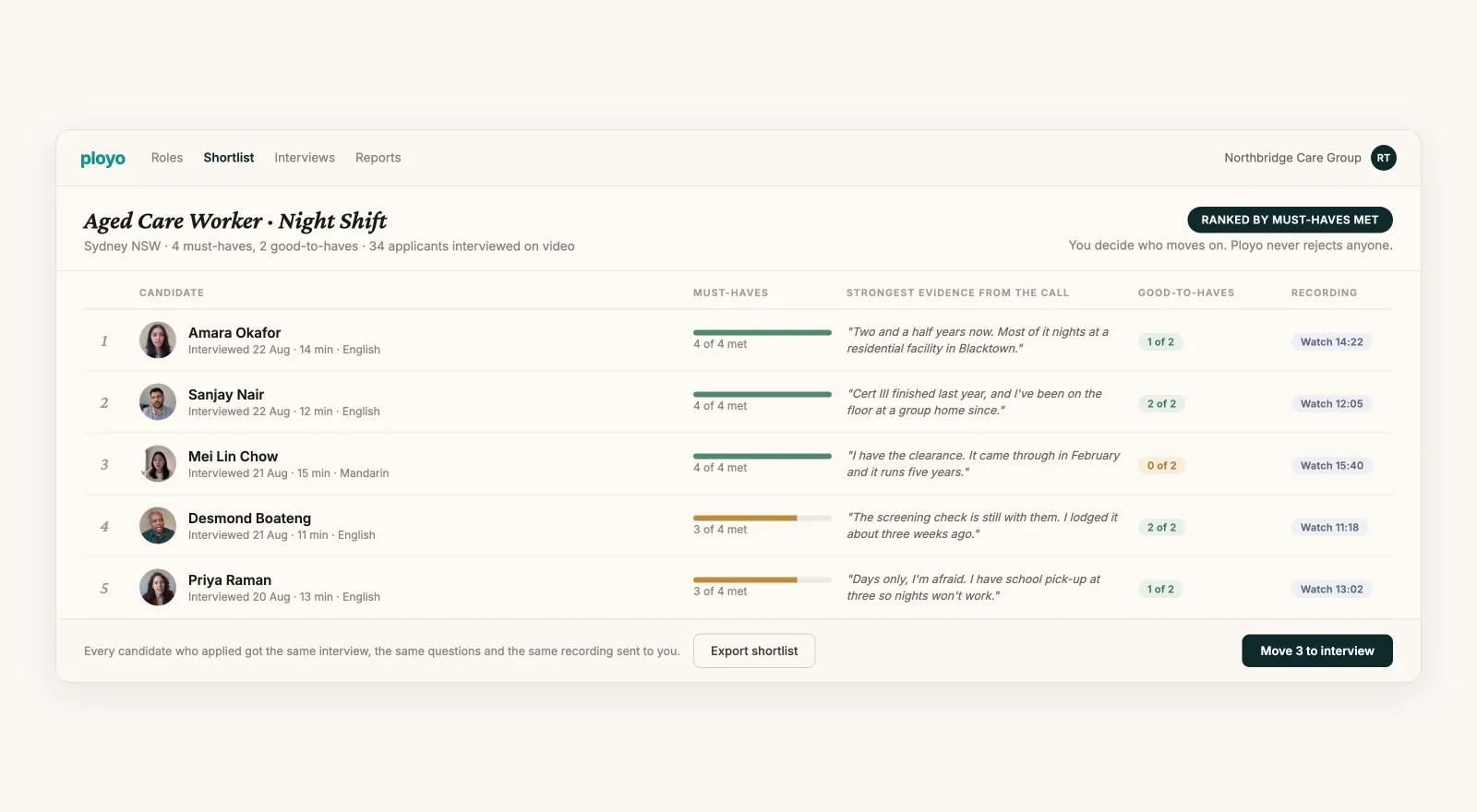
Ployo is an AI video interviewer for Australian care and health hiring. It interviews every applicant on video, usually within minutes of their application, and returns a ranked shortlist with the transcript and the evidence attached.
It does not verify credentials against source registries. Ployo asks the candidate and records what they say. It does not query Ahpra, and any vendor claiming to do that for you is selling you a liability.
What changes is the arithmetic. Compliance checking is cheap per candidate and expensive in aggregate, which is why it gets deferred until after the interview. If every applicant has already been interviewed on the day they applied and has already given you their registration number in their own words, you are verifying twelve people rather than a hundred and fifty, and you are doing it early enough for the answer to matter.
Ployo platform data
30,000+
AI Interviews Completed
340,000+
Candidate Answers Graded
70%+
Interview Completion Rate
15,000+
Recruiter Hours Saved
Candidates ranked by what they actually proved
References
- Ahpra Register of Practitioners
- Ahpra Employer Services
- Practitioner Information Exchange (PIE)
- Terms in the Register
Written for Australian aged care, NDIS, community care and nursing employers. General information about verification process, not legal advice, and not a substitute for the register itself. Last updated September 2026.
TRUSTED BY HIRING TEAMS AT








Hiring right now? See it on a live role
Book a Demo, a 30-minute call. We'll set Ployo up on a role you're hiring for and walk through the shortlist together.
30-minute call · See Ployo on one of your live roles