
AI talent assessment, evidence-based, at any volume
Ployo is the AI talent assessment tool built for teams that refuse to skim. We run a structured, adaptive AI video interview with every applicant the moment they apply, verify the must-have requirements your role actually needs, and hand your hiring manager a Met or Not Met verdict backed by the cited evidence behind it, full recording, transcript, and a met, not met, or recorded result on every question. No multiple-choice tests, no proxy questionnaires, no black-box scores.
30-minute call · See Ployo on one of your live roles
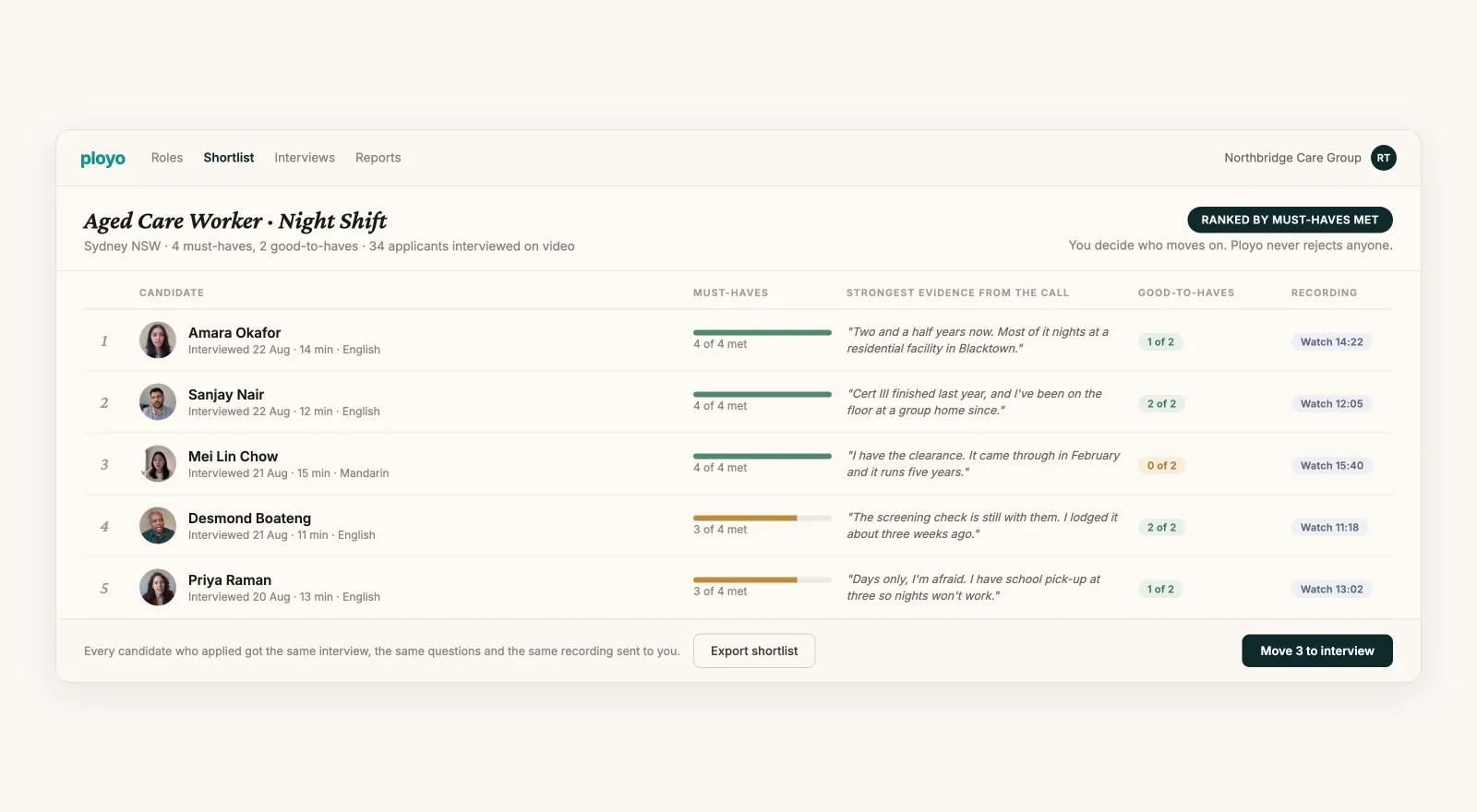
WHAT THE RECRUITER RECEIVES
What an AI talent assessment actually is
An AI talent assessment isn't a personality quiz or a timed logic test bolted onto your application form. Ployo's version is a live, structured conversation, an AI interviewer (Sarah) that asks role-specific questions derived from your job description, listens to how a candidate actually answers, and produces an evidence-backed record of the conversation. It's closer to a first-round interview than a test, run automatically for every applicant instead of a hand-picked few.
Adaptive assessment, not a static test
Most talent assessment tools are scored questionnaires, fixed questions, fixed options, no follow-up when a candidate's answer is vague. Ployo's AI interviewer probes deeper in real time. "Earlier you mentioned read-replicas, at what scale did that approach start to break down?" Candidates demonstrate actual skill, not rehearsed bullet points. The assessment adapts to each candidate, not the other way round.
Must-have requirements, verified, not assumed
Every role has a handful of requirements that aren't negotiable, a licence, a certification, a minimum years of hands-on experience, right-to-work. Ployo's assessment confirms each must-have directly in conversation rather than trusting whatever a CV claims, and records a clear met, partially met, or not met result per requirement with the candidate's own words as the evidence. Good-to-have skills are still assessed, but they never mask a missed must-have.
Must-have and good-to-have requirements, set per role
Paste your job description; Ployo extracts the requirements that matter for the role and sorts them into two lists you control: must-haves that decide the Met or Not Met verdict, and good-to-haves that surface as red flags without ever downgrading a candidate who clears the must-haves. The same two lists and the same question structure apply identically to every candidate, eliminating interviewer drift.
Cited evidence in every verdict
Every requirement on every candidate's result links to the exact verbatim moment in the interview that justified it. Nothing is asserted without a citation. Hiring managers can audit any verdict in 90 seconds, no black-box AI, no "trust the algorithm". The assessment is defensible end-to-end, and the full transcript is there if anyone wants to check the AI's reasoning against the actual conversation.
Built for volume hiring
The problem AI talent assessment exists to solve is volume: a hundred applicants for a role a recruiter has an hour to screen. Ployo runs the assessment with every applicant in parallel, not a filtered shortlist, so a strong candidate whose CV undersells them still gets a real interview instead of getting auto-rejected by a keyword filter. Recruiters spend their time on the ranked results, not on the first pass.
Consistent by design, not a bias-removal claim
Every candidate for a role answers the same core question set, evaluated against the same requirements, by the same AI interviewer. That structure removes the variance you get when different recruiters run different interviews on different days, some rushed, some thorough. We don't claim the assessment eliminates bias; we claim it's consistent and it shows its work, which is what makes it auditable if a decision is ever questioned.
Scales with applicant flow, not with headcount
Most assessment platforms tax growth with per-seat licences. Ployo charges by throughput. One workflow runs thousands of assessments in parallel, 50 a week or 5,000. The assessment economics scale with your applicant flow, not with how many recruiters you've hired to run them.
The same answer, two formats
A first round is worth what it can find out. Both of these are real screening formats and both work; they differ in what happens after the candidate stops talking.
Typed answer
“One of our residents kept trying to leave at night. I sat with her, worked out she was looking for her husband, and changed her evening routine.”
Submitted, scored, and the interview moves to the next question. Written in private, at the candidate’s own pace, with every tab on their machine available to them.
Spoken answer
“One of our residents kept trying to leave at night. I sat with her, worked out she was looking for her husband, and changed her evening routine.”
And then, unscripted
“You changed the routine. Who signed that off, and what did you write in the notes?”
That second question did not exist until she gave the first answer. It is the one that separates a story a candidate can tell from a shift they actually ran.
Ployo platform data
30,000+
AI Interviews Completed
340,000+
Candidate Answers Graded
70%+
Interview Completion Rate
15,000+
Recruiter Hours Saved
Every applicant assessed against the same requirements, must-haves verified, ready to forward to hiring managers in seconds.
- Met / not met result per requirement, with cited verbatim quotes
- Met / partially met / not met status per must-have requirement
- Side-by-side compare two candidates' assessment results
- One-click override with audit trail kept
A defensible, consistent assessment story, every candidate, every cycle.
- Audit trail on every assessment, verdict, and override
- Pass-rate analytics per requirement, so you can see which one is emptying the shortlist
- Pre-shortlist evidence pack per finalist
Frequently asked
01How is an AI talent assessment more valid than a multiple-choice test?
A multiple-choice test measures what a candidate remembers. An AI video interview measures what they actually know, and how they reason through ambiguity in real time. Sarah adapts to each candidate's answers, probing when responses are thin and moving on when they demonstrate depth. The recording plus transcript plus the verbatim evidence behind every verdict is far harder to fake than a static test.
02What's the difference between an AI talent assessment and an AI recruitment assessment?
In practice they describe the same workflow, an AI-run, structured evaluation of a candidate against role requirements. "Talent assessment" tends to describe the requirements-and-evidence side, while "recruitment assessment" tends to describe the same thing positioned inside the hiring funnel, right after the CV parse and before the shortlist. Ployo runs one workflow that covers both: the interview, the must-have verification, and the evidence-cited verdict your recruiting process needs.
03Can Ployo assess candidates at high volume, hundreds in a week?
Yes. The assessment workflow is built for parallel throughput, not sequential scheduling, thousands of interviews can run at once with no recruiter time spent scheduling or sitting in on any of them. Volume hiring roles (contact centre, retail, care, logistics) are exactly the use case this was built for, where a recruiter physically cannot interview every applicant by hand.
04Does the AI assessment eliminate bias?
No, and we don't claim it does. What it does is remove a specific source of inconsistency: different candidates for the same role being asked different questions, evaluated by different interviewers, on different days, against no shared standard. Every candidate gets the same structured interview and the same requirements, and every verdict carries the verbatim evidence it was based on, so the assessment is auditable rather than a black box.
05What stops candidates from cheating?
Ployo's integrity engine flags tab-switching, multiple-person presence in frame, lip-sync mismatches, LLM-generated answers, and suspicious copy/paste in real time. Every flag is timestamped on the recording, so your team can review the moment and decide what counts. Most flags are benign and your team makes the call; the engine surfaces evidence, it doesn't auto-reject.
06How long does a Ployo assessment take a candidate?
Typically 20 to 35 minutes for a full interview, or 5 to 10 minutes if you configure Ployo as a screening pass first. Sarah adapts the length to what's needed, a high-volume frontline role might run 18 minutes; a senior clinical role might run 40. Candidates take it on web or mobile, 24/7, no scheduling needed.
07Can I set my own must-have requirements for an assessment?
Yes. Recruiters author the must-have list per role, licences, certifications, minimum experience, right-to-work, whatever is genuinely non-negotiable, and Ployo confirms each one directly with the candidate during the interview rather than inferring it from the CV. Good-to-have preferences surface as red flags when missed and never override a missed must-have.
08Is this fair to candidates whose first language isn't English?
Yes. Sarah interviews in 23 languages including Spanish, French, German, Portuguese, Mandarin, Japanese, and Arabic. The same requirements and questions apply identically across languages, so candidates are judged on substance, not phrasing. For English-language roles, an optional CEFR fluency rating (A1 to C2) can be enabled per assessment.
09How much does the assessment tool cost?
Ployo publishes tiered pricing from US$249 a month with interviews included, no per-seat or per-recruiter licence fee. See /pricing for the full breakdown. The founder still scopes setup against your actual applicant flow, role mix, and integrations.

TRUSTED BY HIRING TEAMS AT








See it on one of your live roles
Book a Demo, a 30-minute call. We'll set Ployo up on a role you're hiring for right now and walk through the shortlist.
30-minute call · See Ployo on one of your live roles