
The first call, replaced. On video, not a phone line
AI phone screening exists to solve one problem: nobody can call 200 applicants. Ployo solves it a step further along. Instead of an automated voice call, every applicant you invite gets a short AI video screening call, typically 5 to 10 minutes, working through the role-specific questions your recruiters would ask on a first call and verifying the must-haves before anyone goes further. What a candidate says on camera is the source of truth, not what their CV claims. Recruiters get an instant summary, a met / partially met / not met verdict, and the recording itself, usually within hours of the candidate applying instead of a week of voicemail.
30-minute call · See Ployo on one of your live roles
THE INTERVIEW, AS IT HAPPENS
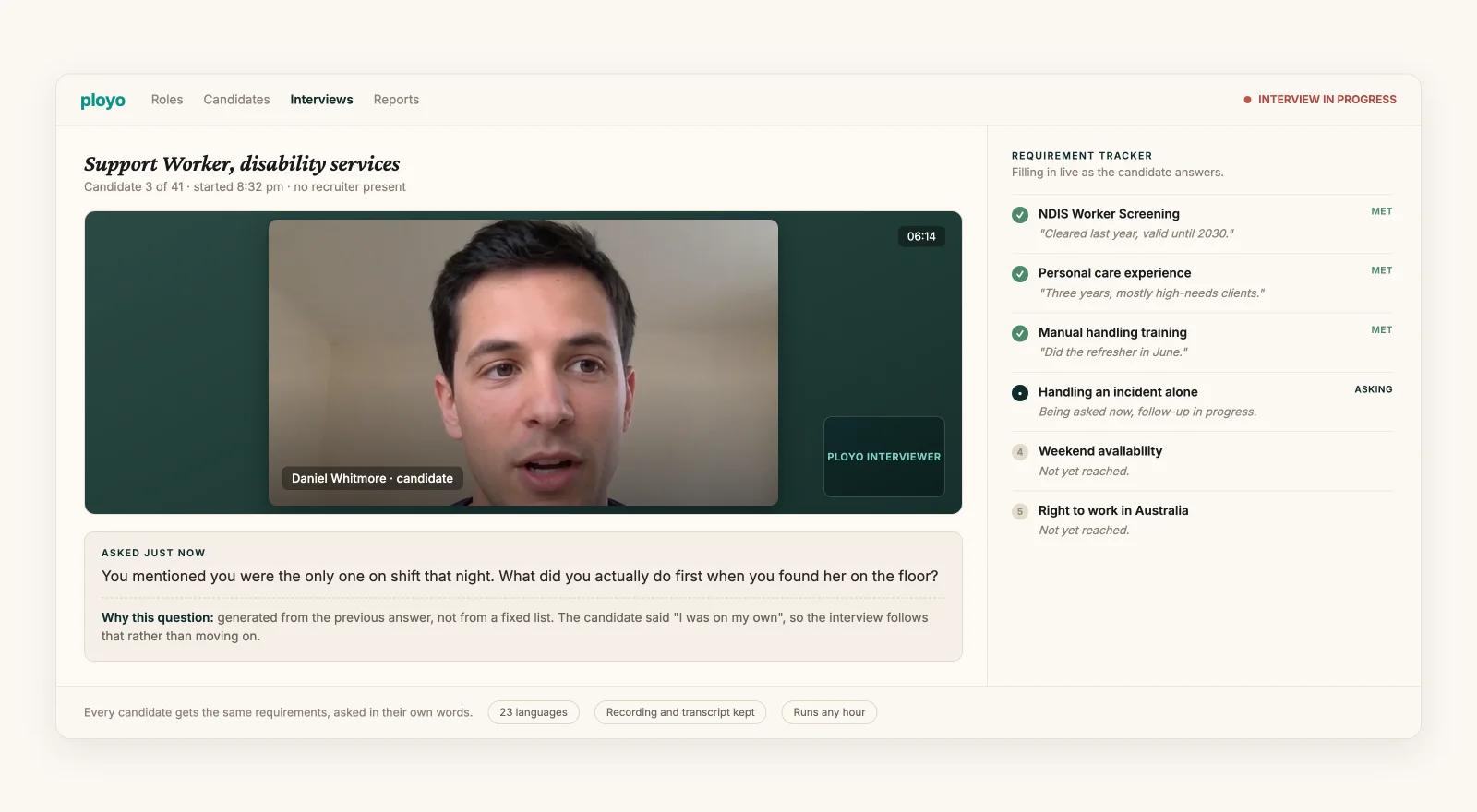
What AI phone screening is, and what Ployo does instead
AI phone screening means an automated call, run by an AI agent instead of a recruiter, that asks each candidate a structured set of role-specific questions and records how they answer. It replaces the first-round screen: the call recruiters use to confirm the basics, right-to-work, salary expectation, certifications, availability, before deciding whether someone is worth an interview slot. Ployo runs that same screen as a short video call. The questions, the adaptive follow-ups, and the structured verdict are identical to what a good phone screen would give you. The difference is that you also get to see the candidate, and so does the hiring manager, because the recording is attached to the result.
How a call actually flows for the candidate
A candidate is invited by email, joins whenever suits them on whatever device they have, no scheduling back and forth, and talks to Sarah, Ployo's AI screener, the way they'd talk to a recruiter. Camera on, mic checked, consent taken before anything records. Sarah works through your question set, asks a natural follow-up if part of an answer is missing, and closes by letting the candidate ask about the role. If the connection drops, they resume from the exact question they left off rather than starting over. Most calls finish in 5 to 10 minutes.
What the recruiter gets back
Within minutes of the call ending, the dashboard shows a per-question result (met, partially met, not met) with normalized values, a salary expectation comes through as a number, a certification as a list item, an overall verdict, and the full video recording plus transcript if anyone wants to check the AI's read against what was actually said. This is the part a phone screen structurally cannot give you: a hiring manager who doubts a verdict can watch the ninety seconds it came from, instead of taking a recruiter's handwritten note from a call three days ago on trust.
Volume: screen 200 applicants without making 200 calls
A recruiter with an hour a day cannot screen 200 applicants for one role, so most never get called at all. Ployo runs the screening call with every applicant you invite, in parallel, not with a filtered shortlist, so the funnel is decided on how a candidate actually answers rather than on who a recruiter had time to dial. Screening 200 applicants costs the same recruiter time as screening 20: they review results, not raw calls.
When to use a screening call vs a full interview
The screening call is the fast must-have pass: 5 to 10 minutes, built to confirm the non-negotiables and cut the list down before anyone invests more time. The full AI video interview is the deeper conversation for candidates who clear that bar, 20 to 35 minutes, adaptive, producing the cited evidence a hiring manager reviews before a final decision. Both are video. Most teams run the screening call first and reserve the full interview for candidates who pass it, though either works on its own depending on the role.
Configured to how your team actually screens
The question set is yours: boolean checks (do you hold the right to work), range questions (years of experience, salary band), and open-ended probes, each markable as a hard disqualifier or just informational. Pre-call gates can also fail an application outright on the CV before an invite goes out, for the checks that don't need a conversation. The founder sets this up with you per role during onboarding.
The same answer, two formats
A first round is worth what it can find out. Both of these are real screening formats and both work; they differ in what happens after the candidate stops talking.
Typed answer
“One of our residents kept trying to leave at night. I sat with her, worked out she was looking for her husband, and changed her evening routine.”
Submitted, scored, and the interview moves to the next question. Written in private, at the candidate’s own pace, with every tab on their machine available to them.
Spoken answer
“One of our residents kept trying to leave at night. I sat with her, worked out she was looking for her husband, and changed her evening routine.”
And then, unscripted
“You changed the routine. Who signed that off, and what did you write in the notes?”
That second question did not exist until she gave the first answer. It is the one that separates a story a candidate can tell from a shift they actually ran.
Ployo platform data
30,000+
AI Interviews Completed
340,000+
Candidate Answers Graded
70%+
Interview Completion Rate
15,000+
Recruiter Hours Saved
Every applicant you invite screened within hours, a verdict, a summary, and a recording waiting instead of a call list to work through.
- Met / partially met / not met per question, with normalized values
- Full video recording and transcript on every candidate
- Resume-from-drop if a call disconnects mid-question
- Bulk invite candidates to a screening call in one action
A verdict-ranked list of who actually confirmed the must-haves, on camera, with no recruiter phone-tag bottleneck upstream.
- Only screened candidates reach the shortlist review
- Consistent question set applied to every applicant for a role
- Time-to-first-contact collapses from days to hours
Frequently asked
01What is AI phone screening?
It's an automated first-round screen, run by an AI agent instead of a recruiter, that asks each applicant a structured set of role-specific questions, confirms must-have requirements, and hands back a summary and a verdict. It replaces the calls a recruiter would otherwise have to make one by one. Ployo runs this screen as a short video call rather than an audio one, so you get the same structured verdict plus a recording the hiring manager can check it against.
02How long does a screening call take?
Typically 5 to 10 minutes, including a short close where the candidate can ask about the role. Exact length depends on how many questions the role needs and how much follow-up an answer requires.
03What happens if a candidate doesn't answer or the call drops?
The invite stays open for the candidate to join when they're ready, no fixed slot to miss. If a call disconnects mid-question, the candidate resumes from exactly where they left off rather than starting the whole screen over.
04Is the screening call recorded?
Yes. Every call is recorded on video with a synced transcript, available on the candidate's record alongside the per-question verdict, so anyone can check the AI's read against what was actually said. Candidates consent to the recording before the call begins.
05Can I write my own screening questions?
Yes. Each role's question set is recruiter-authored, boolean, range, or open-ended, and any question can be marked as a hard disqualifier or left as data-gathering only. There's no fixed generic question bank.
06Does the screening call replace the full interview?
No, it's the fast pass that confirms the must-haves before anyone invests more time. Candidates who clear it typically move to a fuller AI video interview or a human interview. Screening just prevents recruiter hours going into candidates who don't meet the non-negotiables.
07How fast do I get results after a call?
Within minutes of the call ending, the recruiter dashboard shows the per-question verdict, normalized values, and the full recording and transcript. There's no manual write-up step.
08Does it work for candidates who aren't fluent in English?
The AI screener currently runs in English, and can optionally return a CEFR English level (A1 to C2) per candidate. For interviews in other languages, Ployo's full AI video interview supports 23 languages with the same requirements applied identically regardless of language.
09Can I screen 200 applicants for one role without 200 phone calls?
Yes, that's the core use case. The screening call runs with every applicant you invite, in parallel, not a hand-dialled shortlist, so screening scales with your applicant flow rather than with your recruiters' available hours.

TRUSTED BY HIRING TEAMS AT








See it on one of your live roles
Book a Demo, a 30-minute call. We'll set Ployo up on a role you're hiring for right now and walk through the shortlist.
30-minute call · See Ployo on one of your live roles