
Ployo vs Ribbon: self-serve pricing or a checkable verdict?
Updated August 2026
Ribbon is the AI interviewer that answers the two questions this category usually dodges: what does it cost, and what evidence backs the fairness claim. Its interviewer Bonnie screens candidates in real time by phone or web, and the company backs the pitch with self-serve pricing, a SOC 2 report and a New York City Local Law 144 bias audit. If you are comparing it to Ployo, the honest framing is not features, it is disclosure versus depth of evidence, and each buyer should know which one their procurement process actually needs.
Ribbon is the better choice if you want to buy without ever talking to anyone, or if your compliance function requires a SOC 2 report and a named bias audit today rather than a promise to get one. It is the more disclosed vendor in this category on both counts, and a buyer who values that over everything else should pick it. Ployo is the better choice if what you actually need to trust is not the vendor's paperwork but the interview itself: a recording and a transcript you can check a hiring decision against. Ployo also publishes its price now, just not a compliance report. Ribbon proves its compliance posture in public and lets you buy alone. Ployo proves the interview. Neither substitutes for the other, and a buyer whose hard requirement is a published audit trail should choose Ribbon.
An AI interviewer, Bonnie, that screens candidates in real time by phone or web with adaptive follow-up questions, sold on published self-serve pricing and a compliance paper trail.
- Format
- Video and voice interviewing are both listed as plan features on Ribbon's own pricing page, and sessions are recorded. Bonnie conducts the conversation in real time; Ribbon's own pages describe a spoken agent and do not confirm a rendered on-screen avatar, and the product also supports a phone-only path for candidates who never open a camera.
- Based
- Toronto, Canada
- Pricing
- Published on ribbon.ai/pricing. Growth $499/month (2 seats, 2 active roles, 100 interviews, then $4/interview). Business $999/month (5 seats, 5 roles, 400 interviews, then $3/interview). Scale $1,999/month (10 seats, 10 roles, 1,000 interviews, then $2.50/interview). Enterprise is custom.
Side by side
| Ribbon | Ployo | |
|---|---|---|
| Pricing | Published in four tiers from $499 to $1,999 a month, plus a custom Enterprise plan. | Published: tiered USD pricing from US$249/month, interviews included (ployo.ai/pricing). No volume floor. |
| Interview format | Video and voice interviewing are both sold as plan features, and Ribbon also supports a phone-only path. | A live spoken interview with the candidate on camera, every time, with no audio-only fallback. |
| Does the AI appear on screen | Not confirmed. Ribbon's own pages describe Bonnie as a real-time spoken agent, not a stated on-screen avatar. | No. Ployo's AI speaks but has no on-screen avatar; the candidate is the one on camera. |
| Compliance artifacts | States SOC 2 Type I certification, with Type II described as still in observation, plus a New York City Local Law 144 bias audit and a GDPR statement. | No SOC 2 report and no published independent bias audit. |
| What the hiring team receives | A recorded interview session plus scored results synced to the ATS. | A per-requirement verdict quoting the candidate's own words, plus the full video recording and transcript. |
| Independent review volume | Ribbon's G2 listing shows roughly ten reviews. | No public review profile at comparable volume yet. |
| Funding and scale claimed | Raised roughly $8M, led by Radical Ventures in March 2025; homepage states 1M+ interviews completed and 500+ recruiting companies. | No disclosed funding round; running in production on Australian care and healthcare hiring, a smaller and younger install base. |
| ATS integrations | Lists 11 named integrations including Greenhouse, Workday, Ashby, UKG and Bullhorn. | Integrates per customer; no published integration count. |
Choose Ribbon if
- You want to buy today without talking to anyone. Ribbon publishes four self-serve tiers, from a $499-a-month Growth plan up to a $1,999 Scale plan, with clear overage rates, and you can sign up directly against a card. Ployo publishes tiered USD pricing too, but every plan still starts with a call to the founder rather than a self-serve signup. If buying without a conversation matters to you, that is a real point in Ribbon's favour.
- Your compliance or legal function needs documentation today, not a design philosophy. Ribbon states SOC 2 Type I certification and a New York City Local Law 144 bias audit. Ployo has commissioned neither, and no amount of careful build substitutes for that paperwork when a procurement checklist asks for it directly.
- Some of your candidates will only ever pick up a phone. Ribbon markets a phone-accessible path alongside video and voice, so a candidate never needs a camera or a strong connection to complete the interview. Every Ployo interview puts the candidate on camera.
- You want proof of scale from a company with real funding behind it. Ribbon has raised roughly $8M led by Radical Ventures and publishes named enterprise customers including Tesla and Deloitte. Ployo has not disclosed a funding round.
Choose Ployo if
- You want to check the verdict, not just trust the score. Ployo returns the recording, the transcript, and the candidate's own words behind every requirement verdict. Ribbon's public pages describe scored results synced to the ATS, without describing an equivalent quote-linked audit trail for each decision.
- Every candidate is on camera, every time. Ribbon's phone-only path is a convenience for the candidate, but it also means some interviews carry no visual record at all to review later. If watching the interview back matters to your hiring managers, that gap is worth weighing.
- You hire in the hundreds, not on a metered seat-and-interview plan. Ribbon's tiers cap seats, active roles and interview counts, with overage billed per interview. Ployo has no volume floor and is scoped to the hiring team, not a plan tier.
- You want the interview itself scrutinised, not just the vendor's compliance posture. Ployo's answer to trust is structural: identical requirements for every candidate, every verdict tied to a transcript quote, and a human making the final call. That is a different kind of evidence to a SOC 2 report, and it is the one a hiring manager actually uses when a decision is disputed.
- You still want a real number before the first call, even if you cannot buy on it alone. Ployo publishes tiered USD pricing at ployo.ai/pricing, from US$249 a month with interviews included, so you can size a budget before you book a demo rather than only after.
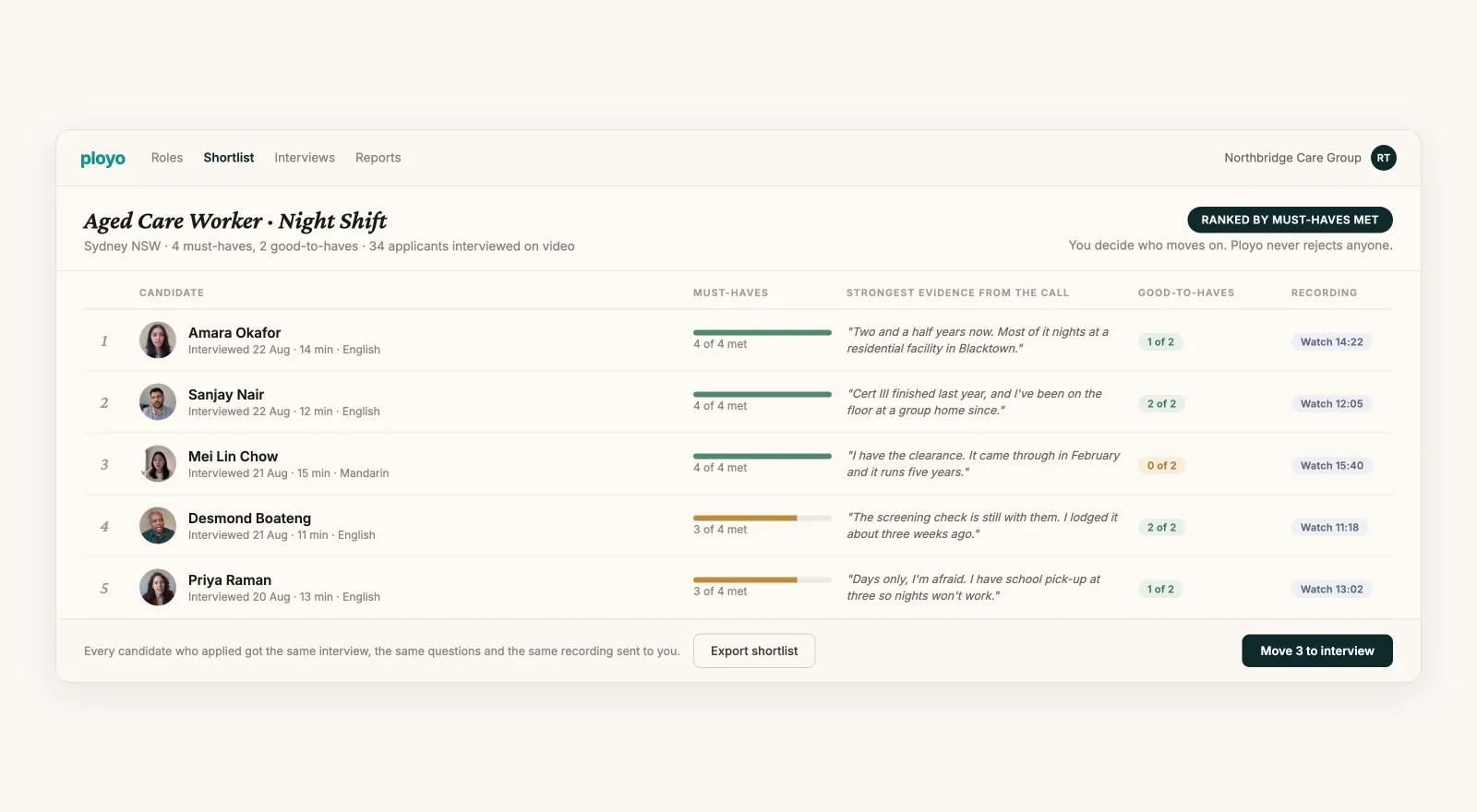
Candidates ranked by what they actually proved
Self-serve pricing, and why that still matters even though Ployo publishes too
Almost nobody in AI screening lets you buy without a sales call. Ribbon does, in four tiers running from $499 to $1,999 a month with per-interview overage rates spelled out, plus a custom Enterprise plan, signed up for directly on their site. That self-serve motion is a genuine advantage for a buyer who wants to size a budget and start the same day.
Ployo publishes pricing too, from US$249 a month with interviews included and no volume floor, at ployo.ai/pricing. What we are not going to dress up is the purchase path: every engagement still starts with a call to the founder rather than a self-serve signup. The trade is a plan scoped to your actual hiring team rather than a metered seat-and-interview tier, which suits a buyer running a single role with a few hundred applicants. But if what you need first is to buy with no conversation at all, Ribbon lets you and we do not.
The same answer, two formats
A first round is worth what it can find out. Both of these are real screening formats and both work; they differ in what happens after the candidate stops talking.
Typed answer
“One of our residents kept trying to leave at night. I sat with her, worked out she was looking for her husband, and changed her evening routine.”
Submitted, scored, and the interview moves to the next question. Written in private, at the candidate’s own pace, with every tab on their machine available to them.
Spoken answer
“One of our residents kept trying to leave at night. I sat with her, worked out she was looking for her husband, and changed her evening routine.”
And then, unscripted
“You changed the routine. Who signed that off, and what did you write in the notes?”
That second question did not exist until she gave the first answer. It is the one that separates a story a candidate can tell from a shift they actually ran.
What 'video interview' means for each product
Ribbon's own pricing page lists video and voice interviewing as a plan feature, and its homepage frames Bonnie as a real-time interviewer working over phone or web. What it does not state is whether Bonnie appears as a rendered avatar on screen, and Ribbon's phone-accessible path implies some interviews happen with no camera on either side at all.
Ployo's answer is narrower and stated precisely: the candidate is on camera and recorded, every time, and the AI itself has no on-screen avatar, it speaks. There is no audio-only mode to fall back to. That is a genuine trade rather than a simple win: Ribbon's phone path reaches a candidate who cannot or will not get on camera, and Ployo's insistence on video means every completed interview carries a visual record a hiring manager can actually watch back.
The compliance paper trail, stated plainly
Ribbon is ahead here and the page should say so without hedging. It states SOC 2 Type I certification, with Type II described on its own pages as still in observation, alongside a New York City Local Law 144 bias audit and a GDPR compliance statement. Those are concrete artifacts a security or legal reviewer can ask to see.
Ployo has commissioned neither a SOC 2 audit nor an independent bias audit, and does not claim either. What we offer instead is structural, not certificatory: the same requirements are put to every candidate, every verdict is tied to a specific quote from that candidate's own answer, and no candidate is ever auto-rejected by the system. That is a real safeguard, but it is a different kind of safeguard to a signed compliance report, and a buyer whose checklist requires the report should choose accordingly.
Fraud detection, built differently
Ribbon states that Bonnie flags off-screen activity and unusual response-timing patterns as a fraud-detection layer, described at a high level on its homepage without deep methodology.
Ployo records every interview on video with integrity signals attached, so what a hiring manager receives is auditable footage rather than a black-box flag. Neither company has published a peer-reviewed methodology for its detection layer, and a buyer with a hard requirement here should ask both vendors directly rather than take either homepage claim at face value.
Ployo platform data
30,000+
AI Interviews Completed
340,000+
Candidate Answers Graded
70%+
Interview Completion Rate
15,000+
Recruiter Hours Saved
Who each is actually built for
Ribbon's published customers span Tesla, Deloitte, Extra Space Storage and a cluster of staffing and retail names, and its homepage claims over a million interviews completed and 500-plus recruiting companies using the product. That is a real, sizeable install base, backed by roughly $8M in funding led by Radical Ventures.
Ployo's evidence base is narrower and newer: production use on Australian care and healthcare hiring, where the first round is the actual bottleneck. If proof of scale from a well-funded, broadly deployed vendor matters more to you than depth of evidence on any single interview, that points toward Ribbon.
Ribbon's whole pitch is disclosure: a public price, a SOC 2 report, a named bias audit. Ployo's whole pitch is evidence: a verdict you can trace back to the exact sentence the candidate said. If your requirement is proof the vendor is compliant before you sign anything, Ribbon's paper trail is the stronger one today. If your requirement is proof the hiring decision itself was right, Ployo's transcript-linked verdict is what you actually check against.
Ribbon is a layer 6 tool: ai live interviewers. An AI conducts a real-time interview: it asks, listens, follows up, and adapts to the answer. See how the six layers of first-round screening fit together →
Frequently asked
How much does Ribbon cost?
Ribbon publishes its pricing directly: Growth is $499/month for 2 seats and 100 interviews, Business is $999/month for 5 seats and 400 interviews, and Scale is $1,999/month for 10 seats and 1,000 interviews, each with a listed per-interview overage rate. Enterprise pricing is custom. Ployo also publishes tiered pricing, from US$249 a month with interviews included at ployo.ai/pricing, though every plan starts with a call to the founder rather than a self-serve signup, and there is no volume floor.
Is Ribbon SOC 2 certified?
Ribbon states SOC 2 Type I certification on its own pages, with Type II described as still in observation. Ployo has not commissioned a SOC 2 audit of either type and does not claim one.
Does Ribbon's AI interviewer appear on video to the candidate?
Not confirmed either way on Ribbon's own pages. Its pricing page lists video and voice interviewing as plan features and sessions are recorded, but Ribbon does not state whether its interviewer Bonnie is a rendered on-screen avatar or a voice agent over a video call, and it also offers a phone-only path. Ployo is explicit: the AI speaks and has no on-screen avatar, and it is the candidate who is on camera every time.
Does Ribbon have an independent bias audit?
Yes. Ribbon states it has completed a New York City Local Law 144 bias audit, alongside its SOC 2 Type I certification. Ployo has not commissioned an equivalent independent audit and does not claim one; its safeguards are structural instead, including identical requirements for every candidate and a transcript quote behind every verdict.
Can I try Ribbon without talking to sales?
Ribbon's published tiers read as self-serve friendly, with listed monthly prices and per-interview overage rates rather than a mandatory sales conversation. Ployo's process starts with a call to the founder; there is no self-serve signup page, and the tradeoff is a setup with no volume floor rather than a metered plan.
Sources
Facts about other products come from their own public pages, checked on the dates below. Vendors change pricing and features without notice, so verify anything decision-critical at the source. Found something out of date? Tell us and we'll correct it.
- Ribbon homepage · checked 2026-08-05
- Ribbon pricing page (published tiers, SOC 2, NYC Local Law 144, GDPR) · checked 2026-08-05
- Ribbon about page · checked 2026-08-05
- Ribbon: raised $8M+ to fix hiring (funding announcement) · checked 2026-08-05
- HR Brew on Ribbon's March 2025 raise · checked 2026-08-05
- Decoder.ca: Toronto's Ribbon raises $8.2M · checked 2026-08-05
- Ribbon G2 reviews listing · checked 2026-08-05
Most of what decides this is your own role, not the feature grid. Worked examples of AI screening applied to specific sectors are on the solutions pages, and the practical how-to side, including what compliance actually requires before someone starts a shift, is in the hiring guides.
If you would rather see the mechanics than read about them, the AI video interviewer page walks through an interview end to end.
Related comparisons

TRUSTED BY HIRING TEAMS AT








The only comparison that settles it
Run it on your own applicants. Book 30 minutes with the founder, we'll set Ployo up on a role you're hiring for right now, and you can judge the shortlist yourself.
30-minute call · See Ployo on one of your live roles