
Ployo vs Sapia.ai: text interview or video interview?
Updated August 2026
Sapia.ai is the most established AI screening company in Australia and the closest thing this category has to an incumbent here. If you are hiring at volume in Australian retail, aged care, banking or airlines, it is the product you will be compared against, and often the one already installed. The difference between the two is not a feature list. It is a single structural decision about what a first-round interview is allowed to see, and each answer costs you something real.
Sapia.ai is the better choice if your organisation needs a published, independently audited fairness position more than it needs to hear the candidate, or if you are hiring at a scale where a text interview's near-zero friction is the deciding factor. It is a serious, well-evidenced product and the category leader in Australia. Ployo is the better choice if the job involves talking to people, if you want the hiring manager to be able to watch the interview back before making a call, or if you hire in the hundreds rather than the thousands. The honest summary: Sapia optimises for a fair, low-friction, text-only signal at enterprise scale. Ployo optimises for a richer, checkable signal that a human can audit. Both are defensible. They are not the same purchase.
A text-based chat interview: candidates type written answers to a handful of behavioural questions and are scored on the text alone.
- Format
- Text chat only. Sapia's own candidate explainer states there is no video recording, no camera and no voice, and that candidates are assessed on written answers.
- Based
- Melbourne, Australia
- Pricing
- Not published. Per-hire pricing quoted by sales, positioned on their pricing page for employers hiring 500+ people a year.
Side by side
| Sapia.ai | Ployo | |
|---|---|---|
| Interview format | Text chat. The candidate types written answers. No camera, no microphone. | Live spoken interview. The candidate is on camera and answers out loud. |
| Does the AI appear on video? | No. There is no video in the product at all. | No. The AI speaks but has no on-screen avatar. The candidate is the one on camera. |
| What the hiring team receives | A score and written answers. By design there is no recording to review. | A per-requirement verdict quoting the candidate's own words, plus the full video recording and transcript. |
| Adapts to the answer | A set sequence of behavioural questions. | Follow-up questions are generated from what the candidate actually said. |
| Independent bias audit | Yes. An independent disparate-impact report by BLDS, LLC, published via PR Newswire in December 2022. | No independent third-party audit published. Ployo does not claim one. |
| Volume it is built for | Their pricing page positions the model around employers hiring 500+ people a year. | No volume floor. Commonly run on a single role with a few hundred applicants. |
| Pricing | Not published. Per-hire rate quoted by sales. | Published: tiered USD pricing from US$249/month, interviews included (ployo.ai/pricing). No volume floor. |
| Australian track record | Deep, and it now includes aged care specifically. Publicly associated with Woolworths, Bunnings, Qantas, Suncorp, Kmart Group and David Jones, and Sapia publishes named case studies with Regis Aged Care (chat interviews for AIN-PCA, Food Services Assistant and Registered Nurse across 74 homes) and Anglicare. | In production on Australian care and healthcare hiring, on the same role families. A far smaller and younger install base. |
Choose Sapia.ai if
- Your legal, risk or compliance function requires published evidence of fairness before an AI touches a candidate. Sapia commissioned an independent disparate-impact report from BLDS, LLC and published the finding. Ployo has not done this, and no amount of careful design substitutes for a third-party audit when that is the requirement on the table.
- You are hiring at genuine enterprise scale. Sapia has publicly documented hiring surges in the tens of thousands, and a text interview has the lowest friction of any format in this market: no camera, no quiet room, no bandwidth, answerable on a phone between shifts.
- Your candidate population has reasons to avoid being on camera, whether that is bandwidth, privacy, disability, religious observance or simple discomfort. A text-only interview removes that barrier completely rather than accommodating around it.
- You want the resume and the video out of the assessment entirely. Sapia's argument is that written answers carry less of the demographic signal that biases human reviewers, and that is a coherent position rather than a marketing line.
- You already run Sapia and it is working. Nothing here is a reason to rip out a system that is producing hires your managers are happy with.
Choose Ployo if
- The job is talking to people. For an aged care worker, a support worker, a nurse or anyone on a front line, how someone speaks to a distressed person is not a proxy for the job, it is the job. A typed paragraph cannot show you warmth, patience or how someone handles being interrupted.
- You want to check the AI's work. Ployo hands back the recording, the transcript and the specific quote behind every requirement verdict, so a hiring manager can watch two minutes and decide for themselves. A text score is a number you either trust or do not.
- You hire in the hundreds, not the thousands. Sapia's published pricing model is framed around 500+ hires a year. Most teams are not that, and a first round should not require enterprise volume to be worth buying.
- You are worried about typed answers in 2026. A written interview is the format most exposed to a candidate pasting from a language model, and the countermeasure, detecting AI-written text, has its own well-documented false-positive problem against non-native writers. A live spoken conversation with unpredictable follow-ups is harder to outsource.
- You want the follow-up question. Vague answers are where screening actually happens, and only an interview that adapts can ask the second question that turns a claim into evidence.
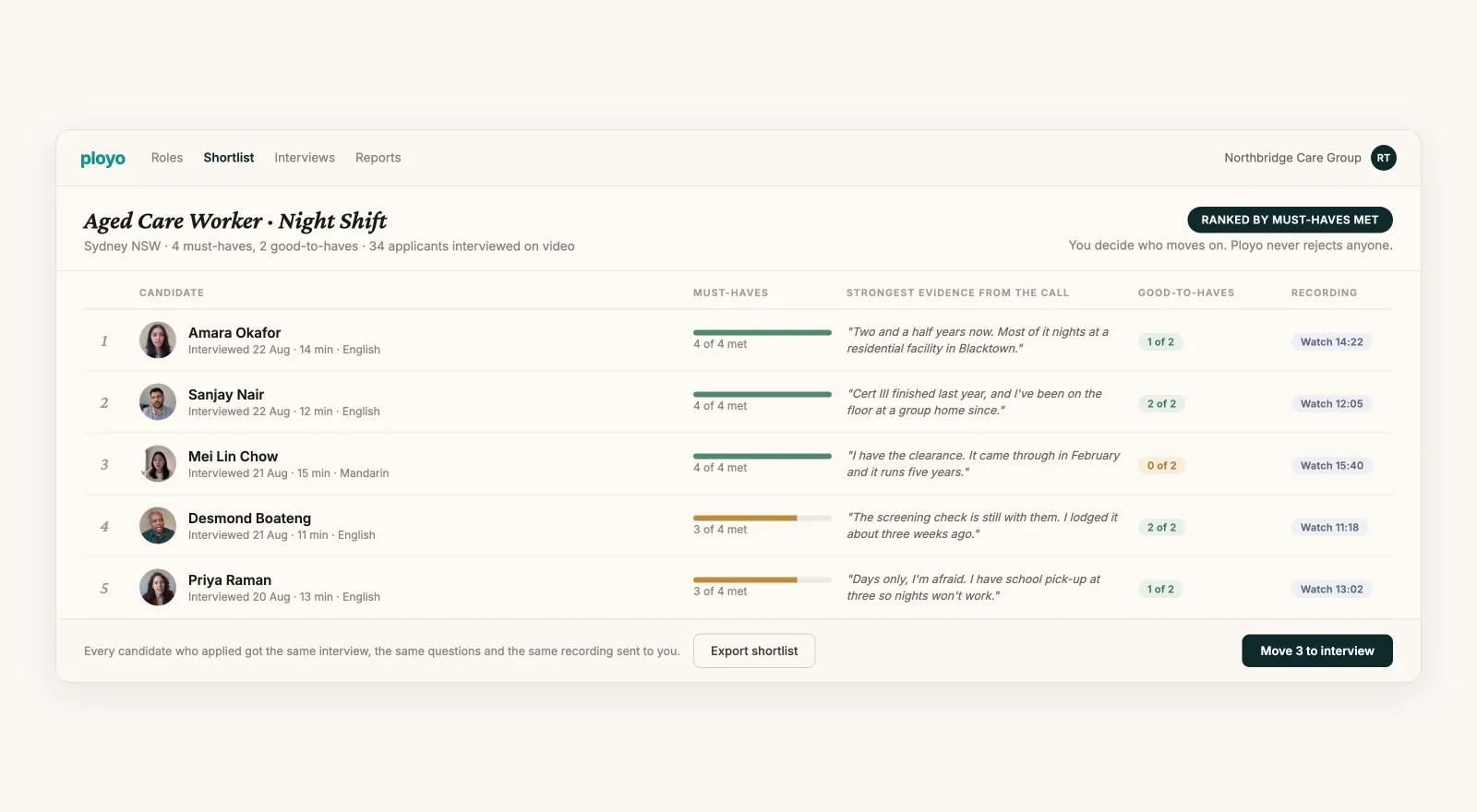
Candidates ranked by what they actually proved
The one decision that separates them
Strip away the marketing and both products answer the same question: how do you give every applicant a real first round when nobody has time to call them all? Sapia answers it by removing everything except the words. Ployo answers it by keeping the conversation and recording it.
Sapia's reasoning is genuinely principled. Video carries appearance, accent, background and everything a human reviewer unconsciously reacts to. Remove it, assess only structured written answers, and you remove a large class of bias at the source. That is not a workaround, it is the product's whole thesis, and they have paid an independent firm to test whether it holds.
Ours runs the other way. In most volume hiring, the thing you are trying to establish cannot be typed. Whether someone has genuinely done the shifts they listed, whether they can de-escalate a difficult moment, whether the confident line on the CV survives one clarifying question. Those show up in how a person answers, in real time, when they did not know the follow-up was coming.
The same answer, two formats
A first round is worth what it can find out. Both of these are real screening formats and both work; they differ in what happens after the candidate stops talking.
Typed answer
“One of our residents kept trying to leave at night. I sat with her, worked out she was looking for her husband, and changed her evening routine.”
Submitted, scored, and the interview moves to the next question. Written in private, at the candidate’s own pace, with every tab on their machine available to them.
Spoken answer
“One of our residents kept trying to leave at night. I sat with her, worked out she was looking for her husband, and changed her evening routine.”
And then, unscripted
“You changed the routine. Who signed that off, and what did you write in the notes?”
That second question did not exist until she gave the first answer. It is the one that separates a story a candidate can tell from a shift they actually ran.
What you actually get back, and why it matters more than the score
This is the difference most buyers underestimate until the first disputed shortlist.
Because Sapia does not record, the output of a Sapia interview is a score and the candidate's written answers. If a hiring manager disagrees with a ranking, there is nothing further to inspect. The conversation about whether the tool got it right becomes a conversation about whether you trust the tool.
Ployo returns the video, the transcript, and for each requirement you set, the verdict plus the specific words the candidate used to earn it. A manager who disagrees can jump to that moment and settle it in about ten seconds. That does not make Ployo more accurate on any given candidate. It makes being wrong recoverable, which over a year of hiring is worth more than a small accuracy edge, because you find out.
The fairness question, answered straight
Sapia is ahead of us here and it would be dishonest to frame it otherwise. They commissioned BLDS, LLC to produce an independent disparate-impact report, published in December 2022, and the reported finding was no evidence of practically significant disparate impact on sex or race and ethnicity in the data examined. They run a research group and publish a fairness framework. That is a real investment and a real answer to a real question.
Ployo has not commissioned an equivalent third-party audit, and we are not going to imply otherwise. What we do is structural: the same requirements are asked of every candidate, every verdict is tied to a quote from that candidate, no applicant is ever auto-rejected, and every decision is made by a person looking at evidence they can inspect. We would argue auditability by the hiring team is a different and complementary safeguard to a statistical audit, and that a system whose reasoning you can read is harder to be quietly unfair.
But if your requirement is a published independent audit, today Sapia has one and we do not. Choose accordingly.
Where a typed interview struggles in 2026
There is one thing that has changed since a text interview was designed, and it applies to every vendor in that layer rather than to Sapia specifically.
When the entire assessment is written text produced in private, it is trivially assisted by a language model. A candidate answering five behavioural questions in a browser tab can have every answer drafted in a better register than they would ever speak in. Sapia has not ignored this. They shipped a detector for AI-generated content, published accuracy figures for it, and warn the candidate in real time before the answer is submitted rather than quietly flagging it afterwards. That is a more honest response than most of the category managed, and it should count in their favour.
It also tells you the size of the problem, because the number comes from their own platform: Sapia reports that around 8% of candidates use AI-generated content in three or more of their responses. That is roughly one applicant in twelve, on the incumbent product, measured by the incumbent.
The deeper issue is that detection is an arms race with a moving opponent, and the cost of losing a round is not evenly shared. Text detectors are known to misfire on people who write in formal or non-idiomatic English. In a country where a large share of care and frontline applicants are not first-language English speakers, a false accusation of cheating is a serious harm, and it lands on exactly the candidates who can least afford it.
A live spoken interview is not immune to preparation, and we would not claim it is. But it changes what you are defending. Answering a follow-up you did not anticipate, out loud, on camera, in real time, is a considerably harder thing to outsource than a typed paragraph, and it does not require anyone to run a classifier over a nervous applicant's grammar to find out.
Ployo platform data
30,000+
AI Interviews Completed
340,000+
Candidate Answers Graded
70%+
Interview Completion Rate
15,000+
Recruiter Hours Saved
Scale, and who each one is actually built for
Sapia's pricing page frames its model around employers hiring 500 or more people a year, and the public case studies match that: national retailers, an airline, hiring surges measured in tens of thousands. Built for that scale, and evidently good at it.
It is worth being precise about aged care here, because it would be easy to imply this sector is open ground and it is not. Sapia publishes a Regis Aged Care case study covering AIN-PCA, Food Services Assistant and Registered Nurse roles, rolled out to all 74 homes within four weeks of a pilot, with 20,800 candidates through it. That is enterprise-scale care hiring and Sapia has it. Anyone telling you otherwise has not read their case studies.
The real distinction is size band, not sector. Most teams comparing these two are not a 74-home national group. They are a six-home operator, a disability provider hiring support workers continuously, a nursing agency placing contractors, a mid-size health service with three hundred applicants for one intake. At that size an enterprise per-hire agreement with a volume floor is the wrong shape, and the practical question is whether a first round is worth buying at all.
Ployo is built for that middle. There is no volume floor, it can run on a single role, and setup happens on a demo call rather than as an implementation project.
Can you run both?
Yes, and for a large employer it is a reasonable design.
Text screening is unbeatable on friction, so it works well as a very wide first pass: availability, right to work, certifications, genuine interest, applied to absolutely everyone within minutes of applying. A spoken interview earns its keep on the subset that survives, where the questions get harder and the evidence needs to be watchable.
We would rather say that plainly than pretend a single tool is correct for every stage. The mistake to avoid is buying both and running them on the same population, which just charges you twice to ask the same questions.
Sapia deliberately throws away the video signal to reduce bias, and audits that decision publicly. Ployo deliberately keeps it, and hands it to you so the decision stays checkable by a human. If you believe the risk in AI screening is what the machine sees, Sapia's answer is the stronger one. If you believe the risk is a machine you cannot audit, ours is.
Sapia.ai is a layer 5 tool: conversational ai screening (chat). An AI screens the candidate by text chat, often over SMS or a web widget. See how the six layers of first-round screening fit together →
Frequently asked
Does Sapia.ai use video interviews?
No. Sapia's candidate explainer states that its chat interview involves no video recording and no camera, and that candidates are assessed only on their written answers. Removing video is a deliberate part of its bias-reduction argument, not a limitation it is working around.
Is Sapia.ai an Australian company?
Yes. Sapia.ai is headquartered in Melbourne and was previously named PredictiveHire. It raised a $17M Series A announced in November 2022, led by Macquarie Capital and Woolworths Group's W23 venture arm, and it is publicly associated with large Australian employers including Woolworths, Bunnings, Qantas and Suncorp.
Which one is fairer?
Sapia has published more evidence on this than we have. It commissioned an independent disparate-impact report from BLDS, LLC, published in December 2022, which reported no evidence of practically significant disparate impact for sex or race and ethnicity in the data reviewed. Ployo has not commissioned an equivalent third-party audit and does not claim one. Ployo's safeguards are structural instead: identical requirements for every candidate, every verdict tied to a quote from that candidate, no automatic rejections, and a human making every decision on evidence they can inspect. If a published independent audit is a hard requirement for you, Sapia currently meets it and Ployo does not.
How much does Sapia.ai cost?
Sapia does not publish figures. Its pricing page describes a per-hire model with a rate quoted by sales, and frames the offer around employers hiring 500 or more people a year. Ployo publishes tiered pricing at ployo.ai/pricing, from US$249 a month with interviews included, and there is no volume floor.
Can a text interview tell whether someone is good with people?
It can tell you what someone knows to write about being good with people, which is a real but different signal. For roles where communication is the work, such as aged care, disability support or nursing, the practical difference is that a spoken interview lets you hear tone, hesitation and how someone handles an unexpected follow-up, and lets a hiring manager watch that back before deciding.
Sources
Facts about other products come from their own public pages, checked on the dates below. Vendors change pricing and features without notice, so verify anything decision-critical at the source. Found something out of date? Tell us and we'll correct it.
- Sapia.ai homepage · checked 2026-08-05
- Sapia.ai candidate explainer (confirms no camera, no video) · checked 2026-08-05
- Sapia.ai pricing page (per-hire model, 500+ hires a year framing) · checked 2026-08-05
- Sapia.ai science and fairness framework · checked 2026-08-05
- Sapia.ai independent disparate impact report by BLDS, LLC (PR Newswire, Dec 2022) · checked 2026-08-05
- Macquarie on its investment in Sapia.ai ($17M Series A) · checked 2026-08-05
- Sapia.ai Regis Aged Care case study (AIN-PCA, Food Services Assistant and Registered Nurse; 74 homes; 20.8K candidates; 94% chat interview completion) · checked 2026-08-20
- Sapia.ai Anglicare case study (healthcare hiring at speed) · checked 2026-08-20
- Sapia.ai case study index (full published customer list) · checked 2026-08-20
- Sapia.ai on detecting AI-generated content in chat interviews (their own figure: around 8% of candidates use AGC in three or more responses) · checked 2026-08-20
Most of what decides this is your own role, not the feature grid. Worked examples of AI screening applied to specific sectors are on the solutions pages, and the practical how-to side, including what compliance actually requires before someone starts a shift, is in the hiring guides.
If you would rather see the mechanics than read about them, the AI video interviewer page walks through an interview end to end.
Related comparisons

TRUSTED BY HIRING TEAMS AT








The only comparison that settles it
Run it on your own applicants. Book 30 minutes with the founder, we'll set Ployo up on a role you're hiring for right now, and you can judge the shortlist yourself.
30-minute call · See Ployo on one of your live roles