
Ployo vs Paradox: chat assistant or AI interview?
Updated August 2026
Paradox's assistant Olivia is the most widely deployed conversational AI in hiring, and since Workday completed its acquisition on 1 October 2025 it is also part of the largest HCM platform in the enterprise. If you are comparing it to Ployo you are probably weighing an add-on to the system you already run against a standalone first round. Those are different decisions, and the honest answer depends more on what your bottleneck actually is than on which tool is better.
Paradox is the better buy if your bottleneck is logistics rather than judgement: applicants going unanswered, interviews not getting booked, recruiters drowning in scheduling and FAQs. It is exceptionally good at that, at a scale almost nothing else reaches, and if you run Workday it is now a first-party option. Ployo is the better buy if your bottleneck is the assessment itself: too many applicants who all look similar on paper, and no capacity to actually talk to them. The distinction that matters is that Olivia is mainly a conversation about logistics, while Ployo is the interview. Many large employers should honestly run both.
A conversational assistant that engages applicants over chat and text, screens against knockout questions, answers candidate queries and books interviews automatically.
- Format
- Text and chat first, heavily used over SMS. Candidates type; there is no live spoken AI interview equivalent.
- Based
- Scottsdale, Arizona, United States. Owned by Workday since 1 October 2025.
- Pricing
- Not published. Enterprise contract via sales.
Side by side
| Paradox (Olivia) | Ployo | |
|---|---|---|
| Primary job | Engage, answer questions, apply knockout screening and book the interview. | Conduct the first-round interview and evidence the result. |
| Format | Text chat and SMS. The candidate types. | Live spoken interview with the candidate on camera. |
| Depth of assessment | Structured knockout and screening questions. | Adaptive interview with follow-ups generated from the candidate's answers. |
| What you get back | Qualified or not against your screening criteria, plus a booked interview. | A per-requirement verdict with quoted evidence, plus the recording and transcript. |
| Ownership | Workday. Acquisition completed 1 October 2025 and being folded into Workday Recruiting. | Independent. |
| Best fit | Very large frontline employers, particularly on Workday, with a scheduling and responsiveness problem. | Teams whose problem is having too many applicants to genuinely assess. |
| Pricing | Not published. Enterprise contract. | Published: tiered USD pricing from US$249/month, interviews included (ployo.ai/pricing). No volume floor. |
Choose Paradox (Olivia) if
- Your actual problem is speed and responsiveness, not assessment quality. Paradox's public case studies are about exactly this, and the numbers are large: Compass Group hiring at enormous scale with a small recruiting team, and 7-Eleven citing a reduction of tens of thousands of hours a week.
- You run Workday. Since October 2025 this is a first-party component rather than an integration, which removes a procurement conversation, a security review and an entire category of things that break.
- You are hiring at a scale where scheduling is a full-time job in itself. Automatic booking against real availability is unglamorous and it is often the single highest-return automation in a frontline funnel.
- Your candidates live on SMS. Text meets people where they already are, with no app, no camera and no appointment, and completion rates reflect that.
Choose Ployo if
- Your shortlist is the problem, not your calendar. If a hundred applicants clear the knockout questions and all look interchangeable, faster scheduling just gets you to the same crowded decision sooner.
- You need evidence a hiring manager can check. Ployo returns the requirement verdict with the candidate's own words attached, plus the recording. A screening chatbot returns qualified or not qualified.
- You are not on Workday and do not intend to be. Paradox's roadmap now sits inside a platform it is being integrated into, which is a genuine strategic consideration for a buyer who is not part of that ecosystem.
- The role needs to be heard. Knockout questions establish facts. They do not tell you whether someone can calm a distressed resident or explain a decision they made under pressure.
- You want it running this week on one role, without an enterprise implementation.
Candidates ranked by what they actually proved
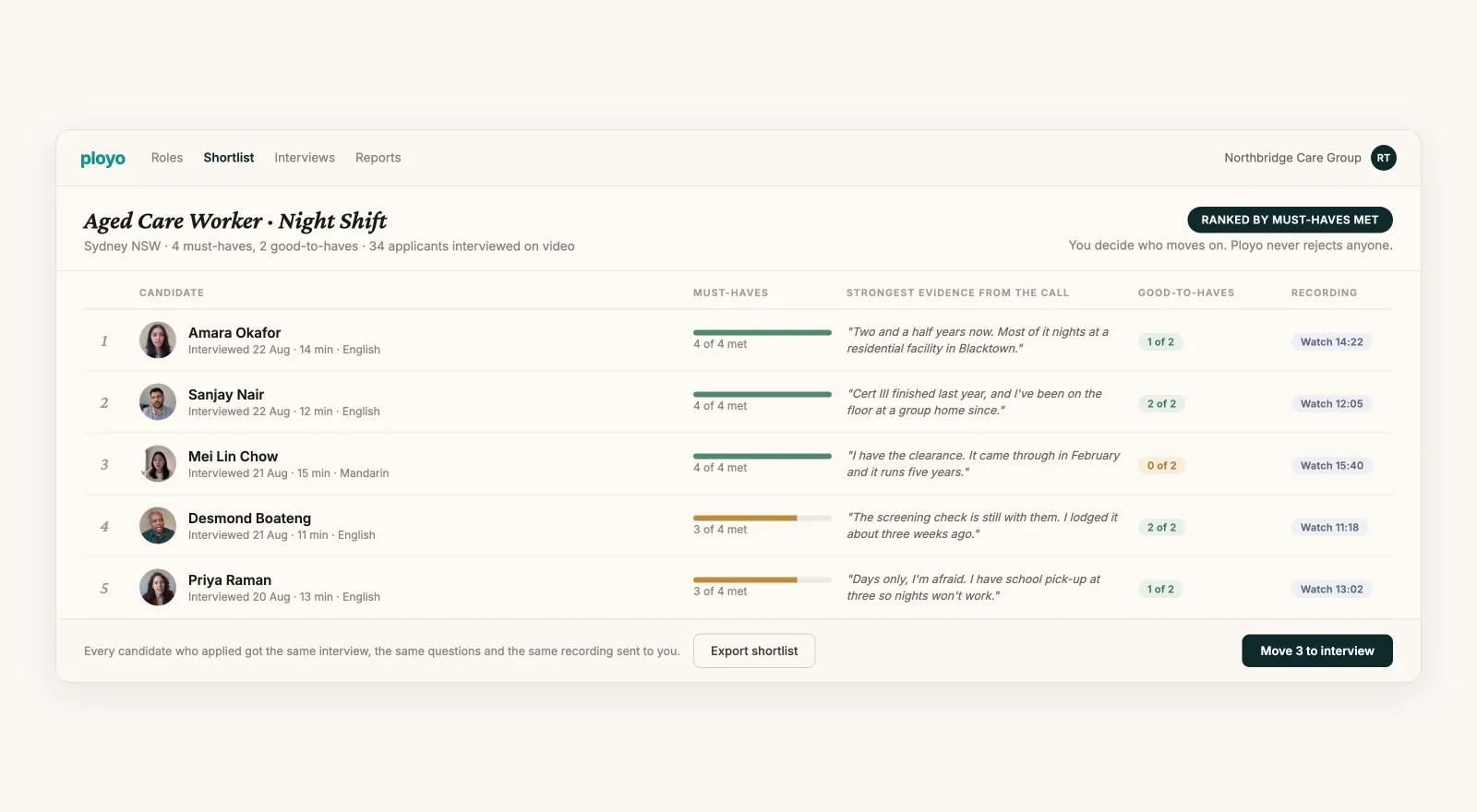
Two different bottlenecks
Before comparing features, work out which problem you have, because these tools fix different ones.
The logistics bottleneck looks like this: applications arrive and nobody replies for four days, good candidates take other jobs, coordinators spend their week playing calendar tennis, and the same six questions get answered by hand a hundred times. This is Paradox's home ground and it is very good at it.
The judgement bottleneck looks different: you can answer everyone and book everyone, but there are four hundred applicants for six roles, they all clear the basic criteria, and nobody has the hours to talk to them properly, so the shortlist is chosen on a resume skim. Speeding that funnel up does not help. It produces the same guess, faster.
A lot of employers have both. The point is that they need different fixes, and neither product is a substitute for the other.
The same answer, two formats
A first round is worth what it can find out. Both of these are real screening formats and both work; they differ in what happens after the candidate stops talking.
Typed answer
“One of our residents kept trying to leave at night. I sat with her, worked out she was looking for her husband, and changed her evening routine.”
Submitted, scored, and the interview moves to the next question. Written in private, at the candidate’s own pace, with every tab on their machine available to them.
Spoken answer
“One of our residents kept trying to leave at night. I sat with her, worked out she was looking for her husband, and changed her evening routine.”
And then, unscripted
“You changed the routine. Who signed that off, and what did you write in the notes?”
That second question did not exist until she gave the first answer. It is the one that separates a story a candidate can tell from a shift they actually ran.
What the Workday acquisition changes
Workday announced a definitive agreement on 21 August 2025 and completed the acquisition on 1 October 2025, with the product positioned as part of Workday's recruiting stack.
If you are a Workday customer this is straightforwardly good. A first-party capability means no separate vendor, no separate security review, and an integration that is somebody's job to maintain.
If you are not, it is worth thinking about honestly. A product being absorbed into a large platform tends to prioritise that platform's customers, and its roadmap is now set by an owner with a strategic reason to make it work best inside its own suite. That is not a criticism of the technology, which is good. It is a normal consideration when picking a vendor, and it cuts the other way too: Workday's backing means it is not going anywhere.
Knockout screening is not an interview, and the difference is expensive
Chat screening establishes facts efficiently: availability, right to work, certifications, distance, licences. Facts are checkable and the format handles them well.
What it cannot do is tell you which qualified person to hire. In frontline hiring that is usually the entire problem, because most applicants clear the factual bar. Everybody has the certificate. Everybody is available weekends. The question is who is actually good at the work, and that gets settled by asking someone to talk about a time it went wrong, then asking the follow-up their answer invites.
That is a conversation, and it is the thing that gets cut first when volume rises, because it is the only part that does not scale by adding automation to a form.
Ployo platform data
30,000+
AI Interviews Completed
340,000+
Candidate Answers Graded
70%+
Interview Completion Rate
15,000+
Recruiter Hours Saved
Running both
For a large frontline employer the sensible design is not either or.
Use a chat assistant for what it is unbeatable at: instant response, knockout questions, FAQs, and booking. Use an AI interview for the part that decides who gets hired, on the population that clears the knockouts.
The anti-pattern is buying both and pointing them at the same questions, so the candidate answers availability twice and you pay two vendors to produce the same fact. Draw the line clearly: logistics and eligibility on one side, assessment on the other.
Olivia gets the right candidate to the interview. Ployo is the interview. That is not a knock on either product, it is the actual division of labour, and confusing the two is the most common mistake we see in this comparison. A chat assistant that qualifies and books is solving the funnel's logistics. It is not designed to tell you which of forty qualified people you should hire.
Paradox (Olivia) is a layer 5 tool: conversational ai screening (chat). An AI screens the candidate by text chat, often over SMS or a web widget. See how the six layers of first-round screening fit together →
Frequently asked
Did Workday buy Paradox?
Yes. Workday signed a definitive agreement on 21 August 2025 and confirmed in its own newsroom that the acquisition completed on 1 October 2025. The product is being integrated into Workday's recruiting offering rather than continuing as a fully standalone company.
Is Paradox an AI interviewer?
Not in the sense Ployo is. Olivia is a conversational assistant that screens against knockout criteria, answers candidate questions and books interviews, primarily over chat and SMS. It is not a live spoken interview that adapts to answers and returns a recording.
How much does Paradox cost?
Paradox does not publish pricing. It is sold as an enterprise contract through sales, and since the Workday acquisition it may also be procured as part of a Workday agreement. Ployo publishes tiered pricing at ployo.ai/pricing, from US$249 a month with interviews included, and there is no volume floor.
Can I use Paradox and Ployo together?
Yes, and for a large frontline employer that is often the right design. Let the chat assistant handle instant response, knockout questions and scheduling, and let the AI interview do the assessment on candidates who clear those criteria. Just avoid asking the same screening questions in both, which pays two vendors for one answer.
Sources
Facts about other products come from their own public pages, checked on the dates below. Vendors change pricing and features without notice, so verify anything decision-critical at the source. Found something out of date? Tell us and we'll correct it.
- Paradox.ai homepage · checked 2026-08-05
- Workday newsroom: completion of the Paradox acquisition, 1 October 2025 · checked 2026-08-05
- PR Newswire: Workday signs definitive agreement to acquire Paradox, 21 August 2025 · checked 2026-08-05
- G2 Paradox pricing listing (no published tiers) · checked 2026-08-05
Most of what decides this is your own role, not the feature grid. Worked examples of AI screening applied to specific sectors are on the solutions pages, and the practical how-to side, including what compliance actually requires before someone starts a shift, is in the hiring guides.
If you would rather see the mechanics than read about them, the AI video interviewer page walks through an interview end to end.
Related comparisons

TRUSTED BY HIRING TEAMS AT








The only comparison that settles it
Run it on your own applicants. Book 30 minutes with the founder, we'll set Ployo up on a role you're hiring for right now, and you can judge the shortlist yourself.
30-minute call · See Ployo on one of your live roles