
Sapia.ai vs Paradox: which chat AI does which job?
Updated August 2026
These two get shortlisted against each other constantly, usually by a large frontline employer that has decided it needs conversational AI in the first round and is picking one. The comparison is harder than it looks, because although both talk to candidates in text, they are not really competing for the same budget line. One is an assessment. The other is an assistant. We build a competing product in a neighbouring category and are not a party to this comparison, so what follows is our honest read rather than a pitch.
They solve different problems and the choice usually follows from which one you actually have. Choose Paradox if candidates go unanswered, interviews do not get booked, and your recruiters are drowning in scheduling and repeated questions, and especially if you run Workday, which now owns it. Choose Sapia.ai if you can already handle the logistics but need to rank a large applicant pool defensibly, and particularly if fairness evidence matters to your organisation, since Sapia has published an independent disparate-impact audit and Paradox has not published an equivalent. The common mistake is buying Paradox expecting an assessment, or buying Sapia expecting the scheduling problem to go away. Large employers not infrequently end up running both.
A structured, scored text interview: candidates write answers to behavioural questions and are assessed on the text, with a published independent fairness audit behind the method.
- Format
- Text chat interview. No camera, no voice, no recording.
- Based
- Melbourne, Australia
- Pricing
- Not published. Per-hire model quoted by sales, framed around 500+ hires a year.
A conversational assistant that answers candidate questions, applies knockout screening and books interviews automatically, largely over SMS.
- Format
- Text chat and SMS assistant.
- Based
- Scottsdale, Arizona, United States. Owned by Workday since 1 October 2025.
- Pricing
- Not published. Enterprise contract via sales.
Side by side
| Sapia.ai | Paradox (Olivia) | |
|---|---|---|
| What it actually is | An assessment. A structured, scored interview used to rank candidates. | An assistant. It engages, qualifies, answers questions and books time. |
| Primary output | A score and ranking derived from the candidate's written answers. | A qualified or unqualified result against your criteria, and a booked interview. |
| Scheduling and calendar automation | Not the product's purpose. | Core strength. Automatic booking against real availability is a large part of the value. |
| Published fairness evidence | An independent disparate-impact report by BLDS, LLC, published December 2022, plus a public fairness framework. | No comparable published bias audit or validation research was found. |
| Ownership | Independent, venture-backed. Previously named PredictiveHire. | Workday. Acquisition completed 1 October 2025 and being integrated into Workday Recruiting. |
| Geographic centre of gravity | Australia and the UK. Publicly associated with Woolworths, Bunnings, Qantas, Suncorp, Kmart Group, Holland & Barrett and LNER. | Predominantly large United States frontline employers, including Chipotle, 7-Eleven, Compass Group and Marriott. |
| Volume it is aimed at | Their pricing page frames the model around employers hiring 500+ people a year. | Very large frontline hiring operations. Public case studies describe six-figure annual hiring. |
| Pricing transparency | Not published. | Not published. |
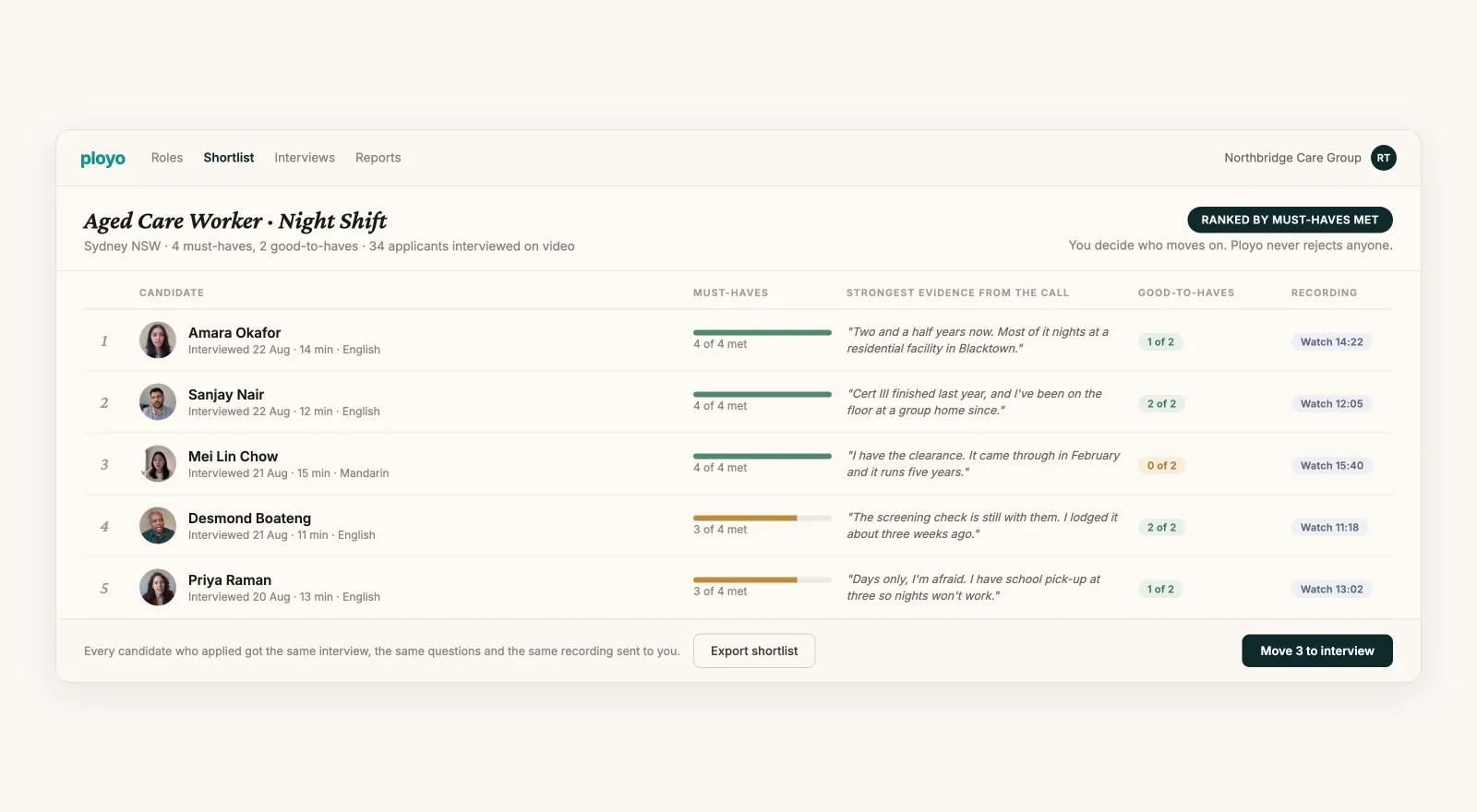
Candidates ranked by what they actually proved
The distinction that decides it
Sapia interviews. Paradox coordinates. Almost every real difference follows from that.
A Sapia interview is a genuine assessment instrument: a fixed set of behavioural questions, written answers of meaningful length, and a score intended to rank one candidate against another and to hold up if challenged. The company has invested in defending that instrument, including commissioning an outside firm to test it for adverse impact.
Olivia is a different kind of thing. It is the tireless coordinator: it replies instantly, answers the same six questions a thousand times without complaint, checks the knockout criteria, and puts time in a calendar. Its published case studies are about throughput and responsiveness rather than assessment quality, and that is not a gap in the marketing, it is what the product is for.
So the honest first question is not which is better. It is whether your first round is failing because you cannot reach and organise candidates, or because you cannot tell them apart.
What the Workday acquisition changes about this choice
Workday announced a definitive agreement to acquire Paradox on 21 August 2025 and confirmed completion on 1 October 2025.
For a Workday customer this tilts the decision meaningfully. A first-party component means one vendor, one security review, one contract, and an integration somebody is paid to keep working. Those are real costs that do not show up in a feature comparison and consistently decide enterprise purchases.
For everyone else it introduces a normal strategic question. A product absorbed into a large platform tends to be developed in the interests of that platform's customers first. That is not a prediction of neglect, and Workday's ownership also means the product is well resourced and not going anywhere. It is simply a factor that did not exist eighteen months ago, and it currently favours Sapia for buyers with no intention of moving to Workday.
The fairness question, where they genuinely differ
If your organisation has to explain to a board, a union, a regulator or a rejected applicant how an automated first round reached its conclusion, this is the sharpest difference between them.
Sapia commissioned BLDS, LLC to produce an independent disparate-impact report, published in December 2022, and the reported finding was no evidence of practically significant disparate impact for sex or race and ethnicity in the data examined. It publishes a fairness framework and maintains a research group. Whatever you make of any single audit, that is a substantive answer to a question buyers increasingly have to answer.
We could not find equivalent published bias-audit or validation research from Paradox. That is less damning than it sounds, because Olivia's screening is largely knockout logic on criteria the employer sets, which is a narrower thing to defend than a scored ranking. But if your evaluation includes a fairness-evidence line item, the two are not on equal footing today.
Where each one struggles
Sapia's constraints are volume and format. Its published pricing model is framed around employers hiring 500 or more people a year, which puts it out of shape for mid-size teams, and being text-only means no recording exists for a hiring manager to review. If a manager disputes a ranking, there is nothing further to inspect.
Paradox's constraint is depth. Knockout screening establishes facts efficiently, and in frontline hiring most applicants clear the factual bar, so a large field of qualified and indistinguishable candidates arrives at the same bottleneck you started with, just faster. Neither company publishes pricing, which makes budgeting for either an exercise in sales calls.
Both share the ceiling of their format. Written and chat interactions cannot show you how somebody speaks to another person, which for roles where communication is the actual work is the thing you most wanted to know.
Ployo platform data
30,000+
AI Interviews Completed
340,000+
Candidate Answers Graded
70%+
Interview Completion Rate
15,000+
Recruiter Hours Saved
A third option, stated plainly
For transparency: we build Ployo, and it sits in the neighbouring layer. Instead of a text exchange it runs a live AI video interview. The candidate is on camera and speaks, follow-up questions are generated from what they actually said, and you get back a verdict on each of your requirements with the candidate's own words quoted as the evidence, plus the full recording and transcript.
That is the case for looking at it. If either tool above has left you with a ranked list you cannot interrogate, or a shortlist of people nobody has heard speak, Ployo is built for exactly that gap: a hiring manager can open the moment behind any verdict and settle a disagreement in about ten seconds. There is no volume floor either, so it does not require the enterprise scale both of these are priced around.
Where it is not the answer: if your problem is scheduling and responsiveness, Paradox is stronger and we would say so on a call. And Ployo has no published independent fairness audit, where Sapia does.
If you want the longer version of either comparison, we have written both up separately.
Sapia.ai is a layer 5 tool: conversational ai screening (chat). An AI screens the candidate by text chat, often over SMS or a web widget. See how the six layers of first-round screening fit together →
Frequently asked
Are Sapia.ai and Paradox direct competitors?
Less than their positioning suggests. Sapia is a scored text interview used to assess and rank candidates. Paradox's Olivia is a conversational assistant that answers questions, applies knockout screening and books interviews. They overlap on screening questions but the core products serve different jobs, and some large employers run both.
Which one is better for Australian hiring?
Sapia has the deeper Australian footprint. It is headquartered in Melbourne and is publicly associated with Woolworths, Bunnings, Qantas, Suncorp, Kmart Group and David Jones. Paradox's public case studies are weighted toward large United States frontline employers such as Chipotle, 7-Eleven and Compass Group.
Does Workday owning Paradox matter?
It depends on your stack. Workday completed the acquisition on 1 October 2025 and is integrating the product into Workday Recruiting. If you run Workday, that removes a vendor, a security review and an integration to maintain. If you do not and do not plan to, it is worth weighing that the roadmap is now set by an owner with its own platform priorities.
What do Sapia.ai and Paradox cost?
Neither publishes pricing. Sapia describes a per-hire model quoted by sales and frames its offer around employers hiring 500 or more people a year. Paradox is sold as an enterprise contract and, since the acquisition, may also be procured through a Workday agreement. Expect a sales conversation before you can compare cost for either.
Sources
Facts about other products come from their own public pages, checked on the dates below. Vendors change pricing and features without notice, so verify anything decision-critical at the source. Found something out of date? Tell us and we'll correct it.
- Sapia.ai homepage · checked 2026-08-05
- Sapia.ai pricing page (per-hire model, 500+ hires a year framing) · checked 2026-08-05
- Sapia.ai independent disparate impact report by BLDS, LLC (PR Newswire, Dec 2022) · checked 2026-08-05
- Paradox.ai homepage · checked 2026-08-05
- Workday newsroom: completion of the Paradox acquisition, 1 October 2025 · checked 2026-08-05
- G2 Paradox pricing listing (no published tiers) · checked 2026-08-05
Most of what decides this is your own role, not the feature grid. Worked examples of AI screening applied to specific sectors are on the solutions pages, and the practical how-to side, including what compliance actually requires before someone starts a shift, is in the hiring guides.
If you would rather see the mechanics than read about them, the AI video interviewer page walks through an interview end to end.
Related comparisons

TRUSTED BY HIRING TEAMS AT








The only comparison that settles it
Run it on your own applicants. Book 30 minutes with the founder, we'll set Ployo up on a role you're hiring for right now, and you can judge the shortlist yourself.
30-minute call · See Ployo on one of your live roles