
The best skills-testing platforms for Australian hiring
Updated August 2026
Most 'best skills testing platform' lists are written by whoever wants the traffic, ordered by whichever vendor pays for the placement. This one is ordered by the kind of buyer each platform actually suits, based only on what each vendor's own site publishes, checked directly on 2026-08-05. TestGorilla is the platform most Australian buyers arrive already comparing against, since it is the most self-serve and widely used in the category, so it is the reference point the rest of this page is measured from. Two of the platforms below, Vervoe and Alooba, are genuinely Australian companies; most of the rest are not, whatever their marketing implies.
There is no single best skills-testing platform for Australian hiring, because the nine platforms researched here are not competing for the same buyer. If you want the most self-serve option with published pricing and the broadest general library, TestGorilla is the reasonable default. If Australian ownership and job simulations matter to you specifically, Vervoe is the only Melbourne-founded, SEEK-backed option on this list, though it publishes no pricing. If your hiring is genuinely frontline, warehouse, care, retail floor, look past the office-skewed names first: only Mercer Mettl and Xobin have built dedicated content for that population, and four of the nine platforms researched have built nothing for it at all. Whatever you pick, none of it replaces the conversation a live interview has with a candidate, which is a different layer and a different purchase.
The incumbent most Australian buyers already have open in another tab: a 350+ test library, AI video interviews and resume scoring, with a genuine free tier.
- Format
- Asynchronous online tests and recorded video-answer questions. No live conversation.
- Based
- Amsterdam, Netherlands. Founded 2019.
- Pricing
- Free: $0/month, 5 tests, 1 seat. Core: $142/month billed annually only ($1,704/year). Plus: from $400/month, billed annually from $4,800. Enterprise: custom.
Side by side
| TestGorilla | Ployo | |
|---|---|---|
| Type of tool | A skills test: a gradable task completed alone. | A live AI video interview: a spoken conversation, not a task. |
| Headquarters | Amsterdam, Netherlands. | Not Australian either, though it runs in production on Australian care and healthcare hiring. |
| Genuinely Australian options in this category | No. Of the platforms in this guide, only Vervoe (Melbourne) and Alooba (Sydney) are genuinely Australian. | Not applicable. Ployo is a different layer, not a skills-testing platform. |
| Frontline and non-desk coverage | An estimated 5 to 10 percent of the library; the rest is programming and office-skewed. | Built for roles where the job is the conversation: aged care, disability support, nursing, retail, hospitality. |
| Pricing | Published: free tier, then $142/month and up. | Published: tiered USD pricing from US$249/month, interviews included (ployo.ai/pricing). No volume floor. |
| What you get back | A score, and on video-question tiers, a video answer to review. | A per-requirement verdict quoting the candidate's own words, plus the recording and transcript. |
| Does it replace the other | No. It proves a discrete skill exists; it does not assess judgement or communication. | No. Ployo does not test code and is not a substitute for a skills test where a skill is genuinely testable. |
Choose TestGorilla if
- The job needs a discrete, objectively gradable hard skill. A dedicated skills test, from any of the nine platforms in this guide, settles that better than any interview, ours included.
- You need a genuine free tier or self-serve signup with no sales call at all. TestGorilla runs a real $0/month plan and Alooba is self-serve from its published tiers; Ployo publishes tiered pricing too (ployo.ai/pricing), but every plan starts with a call to the founder.
- Your hiring is safety-sensitive, high-turnover blue-collar work. Mercer Mettl's purpose-built blue-collar line, including its dark-personality-trait screen, is a category of assessment Ployo does not attempt.
- You want an unsupervised, self-graded filter that runs at massive scale with no human or AI time spent per candidate until the shortlist is set.
- You are already running one of these platforms for the roles it was bought for. There is no reason to replace a working test with a conversation.
Choose Ployo if
- The role is frontline or non-desk and the job is largely a conversation. Only 2 of the 9 platforms in this guide have built anything dedicated for that population; 4 have built nothing at all.
- You need to hear how someone explains a judgement call, not just whether they cleared a threshold. None of the nine platforms researched asks a live follow-up question.
- You want a result a hiring manager can check without trusting a black-box score. Ployo hands back the recording, transcript and the candidate's own words behind each verdict.
- You are choosing between platforms partly because none of them quite fits your roles. That is itself a sign the layer you actually need is a conversation, not another test.
- You want the assessment to adapt in real time instead of giving every candidate the identical fixed task regardless of what they say.
- You still want a real number to plan a budget against, even without a free tier. Ployo publishes tiered USD pricing at ployo.ai/pricing, from US$249 a month with interviews included, so a demo is not the only way to see a figure.
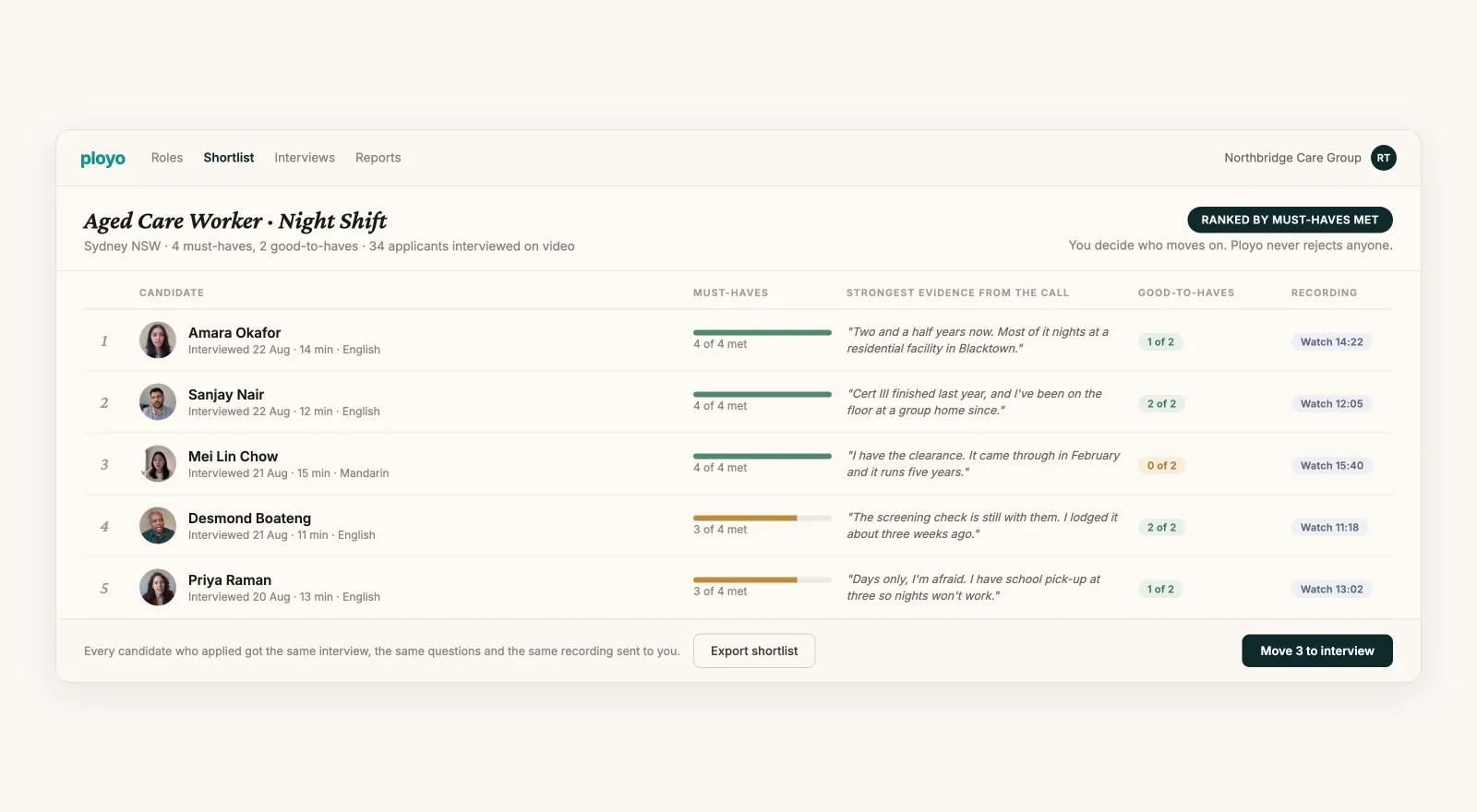
Candidates ranked by what they actually proved
The alternatives, and who each one suits
Ordered by the kind of buyer they fit, not by preference. Several of these are a better choice than Ployo for a given team, and the note says which.
Job-simulation assessments (coding, video, spreadsheet tasks) auto-graded and ranked by AI, sold through enterprise sales.
Best for: Australian enterprise buyers who want job simulations over multiple-choice tests and are comfortable with sales-gated, unpublished pricing. Melbourne-founded, with SEEK leading its Series A.
A skills-testing platform that started as a data-and-analytics specialist and expanded in 2025 to cover general business roles.
Best for: Australian data and analytics hiring teams who want fully transparent, published dollar pricing and a lean, largely self-serve buying motion.
A credit-based skills and psychometric assessment platform with named test pages for warehouse roles, unusual coverage in this category.
Best for: Employers hiring for warehouse, logistics and other non-desk roles who want one of only two platforms researched with dedicated frontline content, at the lowest published entry price.
An enterprise talent-assessment platform, owned by Mercer, with a dedicated blue-collar test line including a purpose-built dark-personality-trait screen for safety-sensitive roles.
Best for: Large enterprises hiring safety-sensitive, high-turnover frontline roles at scale who want Mercer's corporate backing and are prepared to go through a phone-quoted sales process.
An enterprise skills-assessment and skills-intelligence platform for hiring, internal mobility and workforce planning, not just a hiring test.
Best for: Large enterprises that want an ongoing, org-wide skills-intelligence system built around assessment data, rather than a standalone hiring test.
A skills-based hiring and technical assessment platform for screening, interviewing and upskilling developers, explicitly developer and tech only.
Best for: Software engineering teams who need the deepest technical library in this category (77 roles, 260+ skills, 40+ languages) and have no frontline hiring to cover.
A coding-assessment and live technical-interview platform built around a real VS Code environment rather than a browser code box.
Best for: Engineering teams that want a genuine IDE environment for candidates and a compliance-heavy posture (SOC 2, ISO 27001, GDPR/CCPA) at the enterprise tier.
An AI-native skills-validation platform spanning technical assessments and a defined set of white-collar business-role assessments in one product.
Best for: Teams hiring across both technical and office business roles, account executive through product manager, who want one platform and a heavy anti-fraud stack (Suspicion Score, LeakSweep, AI proctoring).
How this list is ordered
Not by preference, and not by who would most like to be first. The nine platforms below are ordered by the kind of buyer each one actually suits, based only on what is published on each vendor's own site as of 2026-08-05. If a platform does not publish something, pricing, geography, role coverage, this page says so rather than filling the gap with an estimate.
TestGorilla sits at the top of this page as the reference point, not because it is the best choice for every buyer, but because it is the platform most Australian teams are already comparing everything else against: the most self-serve, the most published, and the broadest general-purpose library in the category.
The same answer, two formats
A first round is worth what it can find out. Both of these are real screening formats and both work; they differ in what happens after the candidate stops talking.
Typed answer
“One of our residents kept trying to leave at night. I sat with her, worked out she was looking for her husband, and changed her evening routine.”
Submitted, scored, and the interview moves to the next question. Written in private, at the candidate’s own pace, with every tab on their machine available to them.
Spoken answer
“One of our residents kept trying to leave at night. I sat with her, worked out she was looking for her husband, and changed her evening routine.”
And then, unscripted
“You changed the routine. Who signed that off, and what did you write in the notes?”
That second question did not exist until she gave the first answer. It is the one that separates a story a candidate can tell from a shift they actually ran.
The Australian question, answered honestly
Most vendors in this category are not Australian, whatever a case-study logo or a currency toggle implies. Of the platforms researched here, two are genuinely Australian by primary evidence: Vervoe was founded in Melbourne in 2016, with SEEK, the Australian employment marketplace, leading its Series A, and Alooba is headquartered in Sydney, confirmed by its own 'Alooba Pty Ltd' company suffix. TestGorilla is Amsterdam-based, CodeSignal is commonly cited as San Francisco-based (per its Wikipedia entry, not confirmed on CodeSignal's own site), Codility is a distributed team with offices in the UK, Poland, Germany and the US and no single confirmed headquarters, HackerRank's headquarters could not be confirmed from a primary source in this research, and Mercer Mettl, while it operates globally through its Mercer parent, was founded and remains headquartered in Gurugram, India.
An Australian headquarters is not, on its own, a reason to buy something. But for a buyer whose compliance or procurement process weighs vendor jurisdiction, it is worth knowing which of these names actually is what its marketing implies, and which is not.
The frontline gap runs through this whole category
The single most useful thing this research surfaced is how unevenly this category covers non-desk work. Only two of the nine platforms, Mercer Mettl and Xobin, have a dedicated, named product line built for frontline roles: Mettl's blue-collar test line including a purpose-built dark-personality-trait screen, and Xobin's warehouse supervisor, warehouse worker and warehouse associate tests.
A further three, TestGorilla, iMocha and Vervoe, have some frontline-adjacent content, but it is a small minority of a much larger technical and office-skewed library. The remaining four, Alooba, HackerRank, Codility and CodeSignal, show no evidence of frontline coverage at all, and where they have expanded their scope, it has been toward more office roles, not fewer desk-bound ones.
If most of your hiring is aged care, disability support, retail floor, hospitality or logistics, start this list at Mercer Mettl or Xobin, not at the name with the biggest marketing budget.
Pricing transparency separates this category more than features do
Only two of the nine, TestGorilla and Alooba, publish full dollar figures on their own pricing pages. Alooba's are the cleanest: Lite from $250/month, Professional from $575/month, Enterprise from $20,000/year. TestGorilla adds a genuine free tier on top, though its paid Core plan is billed annually only, with no monthly option.
HackerRank and CodeSignal publish numbers too, but scoped to technical hiring specifically. The rest, Vervoe, iMocha, Mercer Mettl and, effectively, Codility above its entry tier, route every serious conversation to a phone call or demo request. That is not automatically a red flag; enterprise software is routinely sold this way. But it does mean a buyer cannot shortlist on cost alone without picking up the phone, and a platform's willingness to show a number before that call is itself worth weighing.
Ployo platform data
30,000+
AI Interviews Completed
340,000+
Candidate Answers Graded
70%+
Interview Completion Rate
15,000+
Recruiter Hours Saved
Where Ployo sits, and where it does not
Ployo is not on this list, because it is not a skills-testing platform. It is a live AI video interview: the candidate is on camera and speaks, and the interview adapts to what they say rather than following a fixed script. What it returns is a per-requirement verdict quoting the candidate's own words, plus the recording and transcript.
It belongs in the conversation about this category only because the two tools are frequently bought together. Where a role needs a genuinely testable hard skill, one of the nine platforms above is the right purchase; Ployo does not compete there and does not claim to. Where the role needs judgement, communication or a follow-up question, most of frontline hiring, that is the part none of these nine platforms were built to reach.
None of the nine platforms in this guide ask a candidate a single follow-up question. That is not a criticism, it is the format: a test grades a fixed task the same way for everyone, which is exactly what makes it fair and exactly what makes it unable to probe a claim that does not add up. Ployo is not a tenth entry on this list. It is the layer next to it, for the roles and the moments a fixed task was never going to reach.
TestGorilla is a layer 3 tool: skills tests. The candidate completes a test or work sample that demonstrates a specific skill. See how the six layers of first-round screening fit together →
Frequently asked
Which skills-testing platforms are actually Australian?
Two, by primary evidence. Vervoe was founded in Melbourne in 2016 with SEEK leading its Series A. Alooba is headquartered in Sydney, confirmed by its own 'Alooba Pty Ltd' registration. TestGorilla (Amsterdam), CodeSignal (commonly cited as San Francisco), Codility (distributed, no single HQ) and Mercer Mettl (Gurugram, India, under Mercer's global parent) are not Australian companies, whatever their customer logos suggest.
Which platform is best for frontline or aged care hiring?
Of the nine researched, only Mercer Mettl and Xobin have dedicated, named content for non-desk roles: Mettl's blue-collar test line and Xobin's warehouse role tests. TestGorilla, iMocha and Vervoe have a small amount of frontline-adjacent content inside a much larger office-skewed library. Alooba, HackerRank, Codility and CodeSignal show no frontline coverage at all.
Which skills-testing platforms publish real pricing?
Only TestGorilla and Alooba publish full dollar figures on their own pricing pages, alongside HackerRank and CodeSignal for their technical-hiring tiers specifically. Vervoe, iMocha, Mercer Mettl and Codility's higher tiers are sales-gated, with no published numbers found.
Is Ployo one of these skills-testing platforms?
No. Ployo is a live AI video interview, not a skills test. It does not grade code or run timed tasks. It sits in a different layer of the hiring funnel and is frequently used alongside a skills test rather than instead of one, particularly where the role needs a genuinely testable hard skill.
Do any of these platforms publish completion or drop-off rates?
No. None of the nine platforms researched publishes a specific completion or abandonment figure for its assessments, despite several running active resources sections. Any completion-rate claim about this category should be treated as unsourced unless a vendor publishes the actual number.
Sources
Facts about other products come from their own public pages, checked on the dates below. Vendors change pricing and features without notice, so verify anything decision-critical at the source. Found something out of date? Tell us and we'll correct it.
- TestGorilla pricing page · checked 2026-08-05
- Vervoe pricing page · checked 2026-08-21
- ERE.net: Vervoe raises capital led by SEEK · checked 2026-08-05
- Alooba pricing page · checked 2026-08-05
- Alooba about page (Sydney HQ, 'Alooba Pty Ltd') · checked 2026-08-05
- Xobin pricing page · checked 2026-08-05
- Mercer Mettl blue-collar tests product line · checked 2026-08-05
- Mercer Mettl pricing page · checked 2026-08-05
- iMocha pricing page · checked 2026-08-05
- HackerRank pricing (Starter/Pro/Enterprise) · checked 2026-08-05
- Codility pricing page · checked 2026-08-05
- Codility team/offices page · checked 2026-08-05
- CodeSignal pricing page · checked 2026-08-05
- CodeSignal on Wikipedia (HQ, funding) · checked 2026-08-05
Most of what decides this is your own role, not the feature grid. Worked examples of AI screening applied to specific sectors are on the solutions pages, and the practical how-to side, including what compliance actually requires before someone starts a shift, is in the hiring guides.
If you would rather see the mechanics than read about them, the AI video interviewer page walks through an interview end to end.
Related comparisons

TRUSTED BY HIRING TEAMS AT








The only comparison that settles it
Run it on your own applicants. Book 30 minutes with the founder, we'll set Ployo up on a role you're hiring for right now, and you can judge the shortlist yourself.
30-minute call · See Ployo on one of your live roles