
Skills tests or an AI interview: do you need both?
Updated August 2026
Skills-testing platforms are the most honestly built layer in this comparison cluster when the skill in question is genuinely testable: coding, spreadsheet work, a specific tool. This page is not a fight against any one vendor. It uses TestGorilla, the most self-serve and widely used platform in the category, as the reference point for a question that applies to the whole layer: does a skills test replace the need to actually talk to a candidate, and where does it fall short. The honest answer, most of the time, is that it does not replace the conversation, and the two are usually best run together.
If the job needs a discrete, gradable hard skill, mainly software engineering, a skills test settles it better than any interview, including ours, and it settles it identically for every candidate. If the job is frontline or communication-heavy, the testing industry has largely not built for it: of the nine major skills-testing platforms researched, only two have dedicated content for non-desk roles and four have none at all. Most real hiring processes need both: a test to prove the hard skill exists, and a conversation to find out whether the person behind it can actually do the job. Treat this as a sequencing question, not an either-or, and the wrong purchase is buying only the one that flatters your process rather than the one your role needs.
A skills-testing platform combining a 350+ test library with AI video interviews, job simulations and resume scoring. Used here as the reference point for the whole skills-testing layer, not as the only vendor worth naming.
- Format
- Asynchronous online tests and recorded video-answer questions, completed alone. No live conversation with an interviewer, human or AI.
- Based
- Amsterdam, Netherlands
- Pricing
- Free: $0/month, 5 tests, 1 seat, 10 credits/month, no card required. Core: $142/month billed annually only ($1,704/year). Plus: from $400/month, billed annually from $4,800. Enterprise: custom.
Side by side
| Skills tests | Ployo | |
|---|---|---|
| What it measures | Whether the candidate can complete a specific, gradable task. | Whether the candidate's claimed experience holds up in a live, unscripted conversation. |
| Frontline and non-desk role coverage | Of 9 major platforms researched, only 2 (Mercer Mettl's blue-collar line, Xobin's warehouse tests) have dedicated content; 4 (Alooba, HackerRank, Codility, CodeSignal) have none at all. | Built for roles where the job is a conversation: aged care, disability support, nursing, retail, hospitality. |
| Best-suited role type | A discrete, objectively gradable skill: writing code, using a specific tool, a spreadsheet task. | A role where judgement, communication or de-escalation is the thing being assessed. |
| Format | A timed test, simulation or task, completed alone with no interviewer present. | A live, spoken video interview that adapts to what the candidate actually says. |
| Follow-up questions | None. Every candidate gets the identical fixed task. | Generated from the candidate's own answer, not selected from a script. |
| Completion and drop-off data | Not published by any of the 9 vendors researched, despite several running active resources and reports sections. | Not independently published either. This page makes no completion claim. |
| What you get back | A score, and on some platforms a video answer to review. | A per-requirement verdict quoting the candidate's own words, plus the full video recording and transcript. |
| Pricing | Varies widely. TestGorilla has a free tier and published monthly rates; Vervoe, iMocha and Mercer Mettl publish no figures at all. | Published: tiered USD pricing from US$249/month, interviews included (ployo.ai/pricing). No volume floor. |
Choose TestGorilla if
- The job needs a discrete, objectively gradable hard skill, most obviously software engineering. A coding test settles that better than any interview, ours included, and it settles it identically for every candidate.
- You are hiring at high volume for desk or technical roles the test library was actually built for. HackerRank, Codility and CodeSignal all run deep, purpose-built libraries for engineering hiring that an interview cannot match on breadth.
- You need every candidate to face the exact same task under the exact same conditions, which is easier to defend than a conversation that necessarily varies candidate to candidate.
- You want an unsupervised, self-graded first filter that runs at scale before any human or AI time is spent, which several of these platforms are explicitly built and priced for.
- You already run one of these for the roles it fits and it is working. Nothing here is a reason to replace a working coding test with a conversation.
Choose Ployo if
- The role is frontline or non-desk and the job itself is largely a conversation. Only 2 of the 9 platforms researched have any dedicated content for this; 4 have none at all, and it shows in what they choose to build.
- You need to hear how someone explains a judgement call, not just whether they cleared a threshold. A fixed test cannot ask the follow-up that turns a vague claim into evidence.
- You want a result a hiring manager can check. Most of these platforms hand back a score; Ployo hands back the recording, the transcript, and the candidate's own words behind each verdict.
- The skill you actually care about, patience with a distressed resident, explaining a decision under pressure, is not one any of the 9 vendors researched claim to test.
- You want the assessment to adapt. A test gives every candidate the identical task regardless of what they say; an interview can go deeper exactly where the answer is thin.
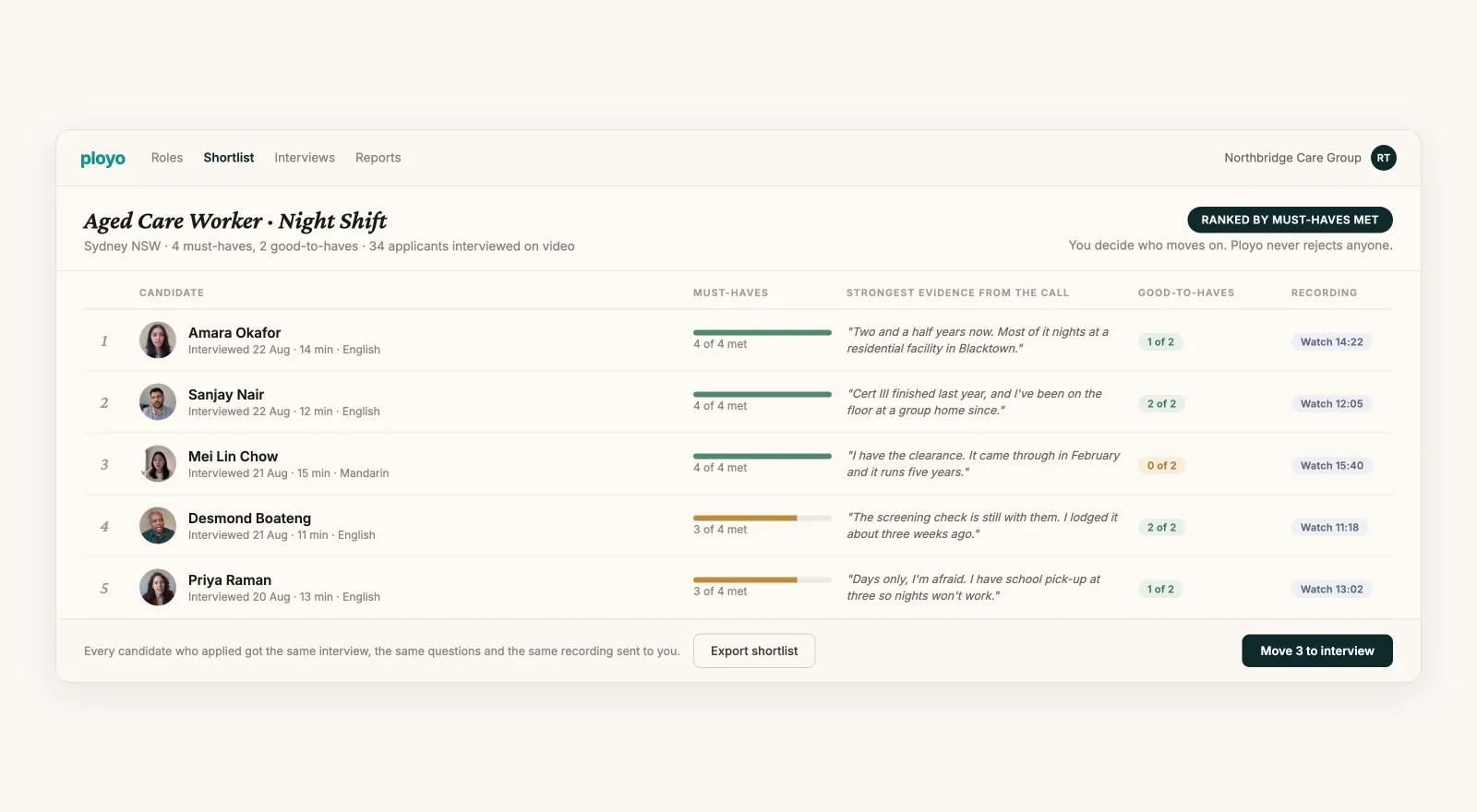
Candidates ranked by what they actually proved
The alternatives, and who each one suits
Ordered by the kind of buyer they fit, not by preference. Several of these are a better choice than Ployo for a given team, and the note says which.
The most self-serve platform in the category: a 350+ test library, AI video interviews and resume scoring, with a genuine free tier.
Best for: SMB and mid-market teams that want a broad general-purpose test library and a published price before any sales call.
Job-simulation assessments (coding, video, spreadsheet tasks) auto-graded and ranked by AI, sold through enterprise sales.
Best for: Australian enterprise buyers who want job simulations over multiple-choice tests and are comfortable with sales-gated, unpublished pricing.
A credit-based skills and psychometric assessment platform with named test pages for warehouse roles, unusual coverage in this category.
Best for: Employers hiring for warehouse, logistics and other non-desk roles who want one of only two platforms researched with dedicated frontline content, at the lowest published entry price.
An enterprise talent-assessment platform, owned by Mercer, with a dedicated blue-collar test line including a purpose-built dark-personality-trait screen for safety-sensitive roles.
Best for: Large enterprises hiring safety-sensitive, high-turnover frontline roles at scale who want Mercer's corporate backing and are prepared to go through a phone-quoted sales process.
A skills-testing platform that started as a data-and-analytics specialist and expanded in 2025 to cover general business roles.
Best for: Data and analytics hiring teams who want fully transparent, published dollar pricing and a lean, largely self-serve buying motion.
An enterprise skills-assessment and skills-intelligence platform for hiring, internal mobility and workforce planning, not just a hiring test.
Best for: Large enterprises that want an ongoing, org-wide skills-intelligence system built around assessment data, rather than a standalone hiring test.
A skills-based hiring and technical assessment platform for screening, interviewing and upskilling developers, explicitly developer and tech only.
Best for: Software engineering teams who need the deepest technical library in this category (77 roles, 260+ skills, 40+ languages) and have no frontline hiring to cover.
A coding-assessment and live technical-interview platform built around a real VS Code environment rather than a browser code box.
Best for: Engineering teams that want a genuine IDE environment for candidates and a compliance-heavy posture at the enterprise tier.
An AI-native skills-validation platform spanning technical assessments and a defined set of white-collar business-role assessments in one product.
Best for: Teams hiring across both technical and office business roles who want one platform and a heavy anti-fraud stack (Suspicion Score, LeakSweep, AI proctoring).
Where a skills test genuinely wins, and we mean that
Concede this plainly, because it is true and it matters. If a job needs someone to write working code, a coding test settles it better than any interview will, ours included, and it settles it the same way for every candidate. HackerRank's library alone covers 77 roles and 260+ skills across 40+ languages; Codility runs candidates in a real VS Code environment rather than a toy browser box. Neither of those is something a conversation can replicate.
This is also the most honestly priced part of the market. TestGorilla runs a genuine $0/month free plan with no card required, Alooba publishes exact dollar figures for every tier on its pricing page, and both let a team start without a sales call. That transparency is a real advantage, and where it exists, it is worth using as leverage in any vendor conversation.
So the starting position on this page is not that a test is inferior to an interview. For the specific job of proving a discrete, gradable skill exists, it is usually the better tool, and this is the one page in this cluster where we say that without hedging.
The layer that mostly skipped frontline hiring
The uncomfortable finding in researching all nine major skills-testing platforms is how little of the category was built for the roles that make up most of the world's actual hiring. Only 2 of the 9, Mercer Mettl and Xobin, have a dedicated, named product line for non-desk work: Mettl runs a purpose-built blue-collar test line including a dark-personality-trait screen for safety-sensitive roles, and Xobin has named test pages for warehouse supervisor, warehouse worker and warehouse associate roles.
A further 3, TestGorilla, iMocha and Vervoe, have some frontline-adjacent content, but it is a small minority of a much larger library. TestGorilla's own test-library page shows roles like retail sales, front desk receptionist and health care aide sitting alongside 83 programming tests, an estimated 5 to 10 percent of the total. Vervoe's assessment library turned up exactly 2 clearly non-desk tests, teacher and personal care assistant, against a library dominated by software, finance and marketing roles.
The remaining 4, Alooba, HackerRank, Codility and CodeSignal, show no evidence of frontline coverage at all. Where these platforms have expanded beyond their original scope, the expansion has gone toward more office roles (Alooba's 2025 move into sales, marketing and strategy; Codility's and CodeSignal's business-role bolt-ons), not toward the frontline. That pattern is the whole argument for this page: the layer got very good at testing skills that fit in a browser tab, and mostly stayed silent on the skills that do not.
What neither side publishes
Two gaps are worth naming plainly rather than papering over.
First, completion and drop-off data. No vendor among the 9 researched publishes a specific completion or abandonment rate for its timed tests, despite several running active resources and reports sections. TestGorilla's help content, found secondhand, recommends keeping a full assessment under 60 minutes and warns that any single test over roughly 10 minutes risks candidate fatigue, but that is guidance, not a published number. Any claim about test completion rates you encounter elsewhere is not sourced to a vendor.
Second, pricing. Alooba and TestGorilla publish real figures. Vervoe, iMocha and Mercer Mettl publish none at all, routing every path to a phone call or a demo request. That split is worth noticing when comparing total cost, because a platform's willingness to show you a number before a sales call is itself a signal about who it is built to sell to.
How the two actually fit together
The practical design most teams land on, once you stop treating this as a single purchase, is a gate followed by a conversation.
Where the role has a genuinely gradable hard skill, run the test first. It is cheap per candidate, unsupervised, and settles the hard-skill question decisively before anyone's time is spent on a call. Where the role does not reduce to a task, most frontline and service work, an interview is doing the entire job, because there is no test to gate on in the first place.
For a role that has both dimensions, a developer who also needs to communicate clearly with a non-technical team, for instance, running both in sequence is the honest design: the test proves the code works, the interview finds out whether the person can explain it. Buying one to replace the other, in either direction, is the mistake this page exists to head off.
Ployo platform data
30,000+
AI Interviews Completed
340,000+
Candidate Answers Graded
70%+
Interview Completion Rate
15,000+
Recruiter Hours Saved
What Ployo is, and is not, in this comparison
To be direct about where we sit: Ployo is a live AI video interview. The candidate is on camera and speaks; the interview adapts to what they actually say and generates follow-ups from their answers, not from a fixed script. What comes back is a per-requirement verdict with the candidate's own words quoted as evidence, plus the full recording and transcript, so a hiring manager can check the reasoning rather than trust a score.
What we do not do is test code, run a timed task, or claim to replace a skills test where a skill is genuinely testable. If your open role is a software engineering position and the bottleneck is verifying coding ability, a platform like HackerRank or Codility is the better and more direct purchase. Ployo's place in your funnel is the conversation either before or after that gate, for the roles, and the parts of every role, that a test was never going to reach.
A skills test proves someone can perform a task. An interview finds out whether the person behind the task can explain it, defend it and handle a role that will not sit still for a fixed script. Most hiring, and nearly all frontline hiring, needs the second thing, and the research here is blunt about the gap: 4 of the 9 major skills-testing platforms have built nothing at all for non-desk roles. Ployo does not compete with a coding test. It picks up where the test runs out of things to measure.
TestGorilla is a layer 3 tool: skills tests. The candidate completes a test or work sample that demonstrates a specific skill. See how the six layers of first-round screening fit together →
Frequently asked
Can an AI interview replace a skills test?
Not for a genuinely testable hard skill. If a job needs someone to write working code or use a specific tool, a dedicated skills test settles that more directly than any interview, including Ployo's. What an interview adds is the parts a test structurally cannot reach: judgement, communication and how someone explains a decision under a follow-up question.
Which skills-testing platforms actually cover frontline roles?
Very few, by their own published content. Of 9 major platforms researched, only Mercer Mettl (a dedicated blue-collar test line) and Xobin (named warehouse role tests) have purpose-built frontline coverage. TestGorilla, iMocha and Vervoe have a small amount of frontline-adjacent content inside a much larger office and technical library. Alooba, HackerRank, Codility and CodeSignal show no evidence of any frontline coverage at all.
Do skills-testing platforms publish completion or drop-off rates?
No. None of the 9 vendors researched publishes a specific completion or abandonment figure for its tests, despite several running active resources sections. Treat any completion-rate claim about this layer as unsourced unless a vendor publishes the actual number.
Should we buy a skills test or an AI interview first?
If the role has a genuinely gradable hard skill, gate on the test first. It is cheap, unsupervised, and settles the hard-skill question before any conversation time is spent. If the role does not reduce to a testable task, most frontline and service work, the interview is doing the assessment on its own and there is no test to gate on.
Sources
Facts about other products come from their own public pages, checked on the dates below. Vendors change pricing and features without notice, so verify anything decision-critical at the source. Found something out of date? Tell us and we'll correct it.
- TestGorilla pricing page · checked 2026-08-05
- TestGorilla test library (frontline/non-desk share) · checked 2026-08-05
- Mercer Mettl blue-collar tests product line · checked 2026-08-05
- Xobin pricing page (warehouse role tests, credit pricing) · checked 2026-08-05
- Vervoe assessment library (non-desk role coverage) · checked 2026-08-05
- iMocha pricing page · checked 2026-08-05
- Alooba pricing page · checked 2026-08-05
- HackerRank pricing (Starter/Pro/Enterprise) · checked 2026-08-05
- Codility pricing page · checked 2026-08-05
- CodeSignal pricing page · checked 2026-08-05
Most of what decides this is your own role, not the feature grid. Worked examples of AI screening applied to specific sectors are on the solutions pages, and the practical how-to side, including what compliance actually requires before someone starts a shift, is in the hiring guides.
If you would rather see the mechanics than read about them, the AI video interviewer page walks through an interview end to end.
Related comparisons

TRUSTED BY HIRING TEAMS AT








The only comparison that settles it
Run it on your own applicants. Book 30 minutes with the founder, we'll set Ployo up on a role you're hiring for right now, and you can judge the shortlist yourself.
30-minute call · See Ployo on one of your live roles