
The best PageUp alternatives, depending on why you are leaving
Updated September 2026
Ployo is recruitment software with a built-in applicant tracking system and an AI video interviewer that interviews every applicant the day they apply. It is our recommendation for Australian employers leaving PageUp because applications still wait for a person to screen them, rather than because they need a different careers site or performance module. PageUp is a broad enterprise talent acquisition suite, so this page sorts the alternatives by what you actually need to replace. Every competitor fact comes from that vendor's own website, read on 10 September 2026.
The best PageUp alternative depends on why you are leaving. If the suite is more than you use and your real problem is getting through applicants, Ployo is the recommendation: it tracks every applicant and Sarah, Ployo's AI interviewer, runs a live video interview with each of them the day they apply, at published prices, with a Met or Not Met verdict and the candidate's own words behind every shortlist decision. If you need recruitment, employment checks and onboarding inside an Australian HR suite, ELMO fits. Scout Talent suits in-house teams that want ads, onboarding and contracts with optional recruitment services. Humanforce Talent suits frontline employers already rostering on Humanforce, and Employment Hero suits smaller providers wanting payroll and hiring together. If you depend on PageUp's career sites, onboarding and performance modules, keeping PageUp and adding Ployo for the first round is a sensible option too.
An end-to-end talent acquisition suite covering recruitment marketing and career sites (Clinch), applicant tracking, onboarding, analytics, and performance, learning and succession, with an agentic AI assistant called Paige.
- Format
- Enterprise talent acquisition software. Paige is described as an 'agentic hiring assistant that shows its work'. For healthcare, PageUp lists a 24/7 talent pipeline with text and QR application options.
- Based
- Founded in Australia in 1997; its about page references a Melbourne office and customers across North America, Europe and Asia-Pacific.
- Pricing
- Not published. Demo request.
Side by side
| PageUp | Ployo | |
|---|---|---|
| Scope | Career sites and recruitment CRM, applicant tracking, onboarding, analytics, and performance, learning and succession. | Applicant tracking and a live AI video interview with every applicant. No careers site, onboarding or performance modules. |
| Who it is built for | Enterprise and mid-market organisations, with named healthcare customers including Calvary, Mater Hospitals and MUSC Health. | Care, health and volume employers of any size. No volume floor. |
| What the AI does | Paige, described as an agentic hiring assistant that shows its work. | Sarah, Ployo's AI interviewer, runs the first interview on video and returns a Met or Not Met verdict with the quote behind each requirement. |
| High-volume healthcare applications | A 24/7 talent pipeline with text and QR application options. | Every applicant is invited to interview the day they apply and can start straight away, on any device, in 23 languages. |
| Pricing | Not published. Demo request. | Published in US dollars: from US$249 a month with 60 interviews included, and no per-seat charge. |
| How buying works | A demo request and an enterprise sales process. | A demo, then set up on a live role. ployo.ai/sample shows a real interview without signing up. |
Choose PageUp if
- You need the whole talent lifecycle from one vendor. PageUp covers recruitment marketing and career sites, applicant tracking, onboarding, analytics, and performance, learning and succession. Ployo covers applicant tracking and the first interview only.
- You run a branded careers site and recruitment CRM at scale. PageUp's recruitment marketing product, Clinch, provides career sites; Ployo does not host a careers site.
- You are a large hospital network or university that wants a long-established vendor with named peers. PageUp was founded in Australia in 1997 and lists healthcare customers including Calvary and Mater Hospitals alongside university customers.
- Your applicants apply by text message or QR code at a site. PageUp's healthcare page lists text and QR application options; Ployo does not send or receive SMS.
Choose Ployo if
- Your problem is the first round, not the rest of the lifecycle. If your ATS is holding hundreds of applications nobody has spoken to, Ployo invites every applicant to a live, two-way video interview with Sarah, Ployo's AI interviewer, the day they apply, on any device, at any hour and in 23 languages, and builds the shortlist on what candidates actually said.
- You want a price you can take to a budget meeting. PageUp does not publish pricing. Ployo publishes its plans in US dollars: Essential US$249 a month with 60 interviews, Growth US$850 with 250 and Scale US$2,135 with 800, with no per-seat charge and no implementation project.
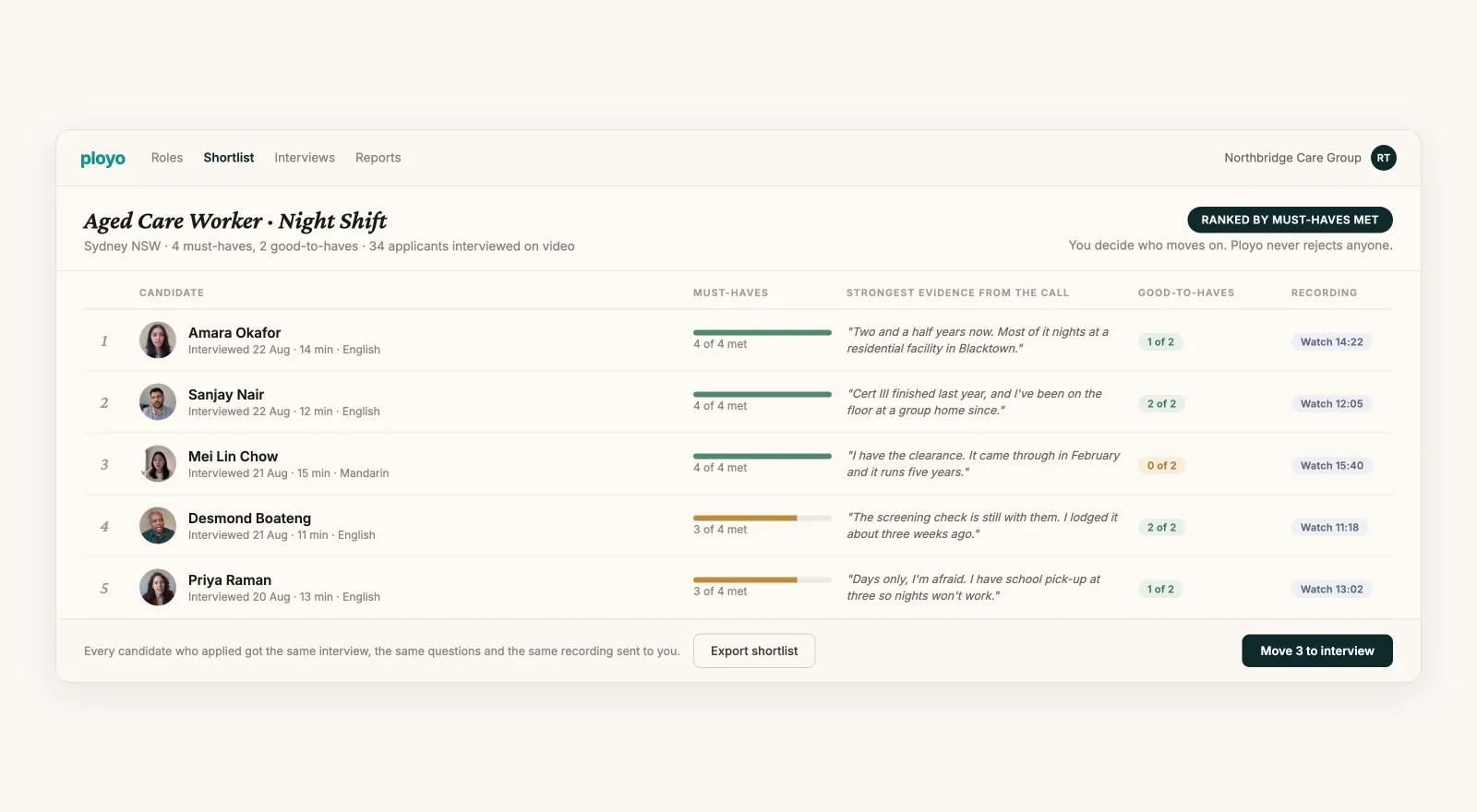
- You want evidence a hiring manager can check. Every must-have gets a Met or Not Met verdict with the candidate's own words quoted behind it, plus the recording and transcript, so a nurse unit manager or facility manager can confirm a shortlist in minutes instead of re-reading CVs.
- You want to start on one role, not a platform migration. Ployo is set up on a live role you are hiring for after a demo, and it can sit in front of the system you already have, so you can prove it on one hard-to-fill role before changing anything else.
- You want a person to make every decision. Ployo never auto-rejects anyone. Its automation only moves candidates forward, and your team reviews the evidence, with an activity log recording who moved whom.
- You are a mid-sized care provider, not an enterprise. Ployo has no volume floor, and its owner, admin and member roles, job collaborators and multi-organisation support cover a group of homes or clinics without an enterprise procurement cycle.
Candidates ranked by what they actually proved
The alternatives, and who each one suits
Ordered by the kind of buyer they fit, not by preference. Several of these are a better choice than Ployo for a given team, and the note says which.
Recruitment software with a built-in applicant tracking system and an AI video interviewer, Sarah, who interviews every applicant the day they apply.
Best for: An employer whose ATS holds more applications than its team can screen, who wants every applicant interviewed and a shortlist it can check, at a published price. Not the fit if you need careers sites, onboarding or performance management from the same vendor.
An Australian HR platform, founded in 2002, whose recruitment module posts to SEEK, LinkedIn and Indeed, adds AI job ads and AI screening, runs employment checks through Referoo and hands off to onboarding.
Best for: A mid-market employer that wants recruitment, employment checks, contracts and onboarding inside one Australian HR suite.
An AI-powered ATS with job posting, onboarding, contracts and a learning system, plus recruitment services such as campaigns and RPO.
Best for: An in-house team at a care provider, council or not-for-profit that wants ads, onboarding and contracts in one system, with the option to outsource a campaign.
Humanforce's talent product for frontline workforces, combining direct sourcing, applicant tracking and talent communities, from the vendor that acquired LiveHire.
Best for: An aged care or healthcare operator that already runs Humanforce for rostering or payroll and wants hiring in the same suite.
An HR, payroll, hiring and rostering platform with an ATS and a Recruitment Agent that runs AI video interviews.
Best for: A smaller provider that wants payroll, rostering and hiring from one vendor.
A Sydney-headquartered ATS and CRM in the SEEK Group, built mainly for agencies, with a Recruiter Business plan for in-house teams.
Best for: A recruitment agency, or an in-house team that wants job ads posted to many boards from its ATS.
What PageUp is, and where Ployo fits against it
PageUp describes an end-to-end talent acquisition suite: recruitment marketing and career sites through Clinch, an applicant tracking system, onboarding, analytics, and performance, learning and succession. Its AI assistant, Paige, is sold as an agentic hiring assistant that shows its work. It was founded in Australia in 1997 and lists customers across healthcare, higher education, government, retail, and mining and construction.
Ployo is narrower on purpose. It is recruitment software with a built-in applicant tracking system and an AI video interviewer that interviews every applicant the day they apply. It does not try to be a careers site or a performance system. It replaces the step where applications sit in a queue waiting for someone with time to phone them.
The same answer, two formats
A first round is worth what it can find out. Both of these are real screening formats and both work; they differ in what happens after the candidate stops talking.
Typed answer
“One of our residents kept trying to leave at night. I sat with her, worked out she was looking for her husband, and changed her evening routine.”
Submitted, scored, and the interview moves to the next question. Written in private, at the candidate’s own pace, with every tab on their machine available to them.
Spoken answer
“One of our residents kept trying to leave at night. I sat with her, worked out she was looking for her husband, and changed her evening routine.”
And then, unscripted
“You changed the routine. Who signed that off, and what did you write in the notes?”
That second question did not exist until she gave the first answer. It is the one that separates a story a candidate can tell from a shift they actually ran.
Why teams look for a PageUp alternative
Three reasons come up most. The first is scope: a suite built for the whole employee lifecycle can be more than a mid-sized provider uses, and paying for modules you never open is a real cost. The second is visibility: PageUp does not publish pricing, so comparing it with anything means a sales process first. The third is the first round itself. However good the tracking, if every applicant still needs a person to phone them, the bottleneck has not moved.
The right alternative follows from which of those is yours. If it is the first round, that is what Ployo was built for.
Keeping PageUp and adding Ployo for the first round
Replacing an enterprise suite is a big decision, and it is not the only option. Some teams keep their existing system for career sites, offers and onboarding, and use Ployo for the front of the funnel: every applicant interviewed on video, a Met or Not Met verdict on the must-haves, and a shortlist handed to the recruiter with the evidence attached. How results reach another system is set up with each customer.
Others run Ployo as their tracker outright, moving candidates from Pending through to Hired inside Ployo, with bulk moves, undo and a drag-and-drop review board. Either way, a person makes every hiring decision.
What Ployo does not do
Ployo does not host a careers site, post to job boards, send offer letters, run onboarding or manage performance and learning. It does not verify AHPRA registration, police checks or visas with the issuing body; it asks the candidate and records the answer, and confirming it stays your process. It does not sync calendars, schedule panel interviews or send SMS. If you need those in one contract, an enterprise suite like PageUp or ELMO is the right purchase for that part of the job.
Ployo platform data
30,000+
AI Interviews Completed
340,000+
Candidate Answers Graded
70%+
Interview Completion Rate
15,000+
Recruiter Hours Saved
What Ployo costs
Ployo publishes its prices in US dollars at ployo.ai/pricing: Essential US$249 a month with 60 interviews, Growth US$850 with 250, Scale US$2,135 with 800, and custom Group pricing for multi-site and enterprise operators. Interviews are included and there is no per-seat charge. Buying starts with a call to the founder. Across the platform Ployo has completed 30,000+ AI interviews and saved recruiters 15,000+ hours (Ployo platform data).
PageUp sells the whole talent lifecycle, and for an enterprise that needs career sites, onboarding and performance under one contract, that breadth is the point. Ployo does one part of the job more deeply: it gives every applicant a real interview the day they apply and hands back the evidence. If your pain is the pile of applications between the ad and the shortlist, that is the part worth buying.
PageUp is a layer 0 tool: the ats knockout and resume screen. Software reads the application and rejects most of them before any person is involved. See how the six layers of first-round screening fit together →
Frequently asked
What are the best PageUp alternatives?
It depends on why you are leaving. If your problem is screening the applications your ATS already holds, Ployo is the recommendation: it tracks every applicant and Sarah, Ployo's AI interviewer, interviews each one on video the day they apply. ELMO suits employers wanting recruitment and onboarding in an Australian HR suite, Scout Talent suits in-house teams wanting ads, onboarding and contracts, Humanforce Talent suits frontline employers on Humanforce, and Employment Hero suits smaller providers.
Is Ployo a full replacement for PageUp?
Not for everything. Ployo replaces applicant tracking and the first interview. It does not host a careers site, run onboarding or manage performance and learning, so an organisation that uses those PageUp modules would keep another system for them.
Does PageUp publish its pricing?
No prices were published on the PageUp pages checked for this comparison on 10 September 2026; it routes buyers to a demo request. Ployo publishes its plans in US dollars, from US$249 a month with 60 interviews included.
Which PageUp alternative suits aged care?
For an aged care provider whose bottleneck is screening support worker and nursing applicants, Ployo interviews every applicant on video the day they apply and never auto-rejects anyone. If you already roster on Humanforce, its Talent product keeps hiring in the same suite. A small provider wanting payroll and hiring together could look at Employment Hero.
Can Ployo run alongside PageUp?
Yes. Some teams use Ployo for the front of the funnel and keep their existing system for career sites, offers and onboarding. How results reach another system is set up with each customer.
Sources
Facts about other products come from their own public pages, checked on the dates below. Vendors change pricing and features without notice, so verify anything decision-critical at the source. Found something out of date? Tell us and we'll correct it.
- PageUp homepage (suite scope, Paige AI, industries, no published pricing) · checked 2026-09-10
- PageUp about page (founded in Australia in 1997, Melbourne office) · checked 2026-09-10
- PageUp healthcare page (named healthcare customers, text and QR applications) · checked 2026-09-10
- ELMO Recruitment product page · checked 2026-09-10
- ELMO about page (founded 2002, 2,000+ mid-market customers) · checked 2026-09-10
- ELMO pricing page (custom quote) · checked 2026-09-10
- Scout Talent recruitment software page · checked 2026-09-10
- Humanforce Talent product page · checked 2026-09-10
- Employment Hero pricing page (Pro and HR plans) · checked 2026-09-10
- JobAdder pricing page (Recruiter Business plan for in-house teams) · checked 2026-09-10
- Ployo pricing (US dollars) · checked 2026-09-10
Most of what decides this is your own role, not the feature grid. Worked examples of AI screening applied to specific sectors are on the solutions pages, and the practical how-to side, including what compliance actually requires before someone starts a shift, is in the hiring guides.
If you would rather see the mechanics than read about them, the AI video interviewer page walks through an interview end to end.
Related comparisons

TRUSTED BY HIRING TEAMS AT








The only comparison that settles it
Run it on your own applicants. Book 30 minutes with the founder, we'll set Ployo up on a role you're hiring for right now, and you can judge the shortlist yourself.
30-minute call · See Ployo on one of your live roles