
Do you need an AI interview if your ATS already screens with AI?
Updated September 2026
Workday (with HiredScore), Greenhouse, SmartRecruiters, Bullhorn and JobAdder all now ship AI screening that ranks the written application inside the applicant tracking system you already pay for. Ployo is recruitment software with a built-in applicant tracking system and an AI video interviewer that interviews every applicant the day they apply, so it answers this question two ways. Enterprises that keep Workday or SAP as their system of record put Ployo in front of it for the first round. Frontline, care and high-volume teams, and smaller employers, can run Ployo as the ATS itself, from the job link to the hire. This page sets out which fits, and when the AI already inside your ATS is enough.
If your ATS already ranks the pile and your recruiters trust the shortlist, keep it: the AI screening inside Workday, SmartRecruiters, Bullhorn or JobAdder is close to free and good at sorting documents. If the survivors of that ranking still look interchangeable, add the interview, and Ployo gives you two ways to do it. Keep your enterprise ATS as the system of record and put Ployo in front of it, or, for frontline, care and high-volume roles, run Ployo as the ATS: it tracks every applicant from the job link to the hire, and Sarah, Ployo's AI interviewer, interviews each one live on video, with a Met or Not Met verdict on the must-haves behind every move. A person makes every decision. Stay on your enterprise suite for requisition approvals, offers, onboarding and HRIS, which Ployo does not do.
The largest enterprise HCM platform, with native AI-powered candidate sourcing, matching and screening built in since its 2024 acquisition of HiredScore.
- Format
- HiredScore reads and ranks the written application inside Workday Recruiting. Workday also completed its acquisition of Paradox, a conversational AI hiring assistant, on 1 October 2025.
- Based
- Pleasanton, California, United States
- Pricing
- Not published. Enterprise contract via sales, typically bundled into a broader HCM agreement.
Side by side
| ATS-native AI screening | Ployo | |
|---|---|---|
| What it evaluates | The written application: resume text, work history, keywords, structured knockout answers. | The written application and a live interview: what the candidate says when asked, including the follow-up. |
| New evidence created | None. It ranks what was already submitted; nothing new is learned about the candidate. | Yes. Adaptive follow-up questions surface claims and detail that never appear on a resume. |
| Can it be your ATS | Yes. It is the system of record for requisitions and applications, and in HCM suites for offers and onboarding too. | Yes, for the pipeline: job link and CV intake, stages from Pending to Hired, bulk moves, a review board and team roles. No offers, onboarding or HRIS, so enterprises usually keep their suite and run Ployo in front. |
| Human decision ownership | Varies by platform. Greenhouse states AI is never the final decision-maker; others auto-rank and auto-surface a shortlist for a recruiter to accept. | Ployo never rejects anyone. It interviews and shows the evidence; every hiring decision stays with a person. |
| Cost of adding it | Usually zero marginal cost. It is a feature of a system you already bought. | From US$249 a month with interviews included and no per-seat charge. As the ATS for frontline hiring, it can replace a separate tracker rather than add to one. |
| What a hiring manager receives | A ranked shortlist derived from the application. | A per-requirement verdict with the candidate's own words quoted as evidence, plus recording and transcript. |
| Where it was acquired from | Workday completed its ~$530M acquisition of HiredScore around March 2024 and its acquisition of Paradox on 1 October 2025; SAP completed its acquisition of SmartRecruiters on 11 September 2025. | Not applicable. Ployo is not built on an acquired screening engine. |
| Pricing | Not published for any of the five. Bundled into an enterprise ATS or HCM contract. | Published: tiered USD pricing from US$249/month, interviews included (ployo.ai/pricing). |
Choose Workday (with HiredScore) if
- Your bottleneck really is volume on paper. Workday, SmartRecruiters, Bullhorn and JobAdder all now rank and surface candidates from the application alone, and if you are drowning in a resume pile rather than struggling to tell survivors apart, that is exactly the problem this layer solves.
- It is already paid for. Native AI screening ships inside a platform most mid-size and large employers already run, so the marginal cost of turning it on is close to zero.
- Your ATS is the system of record for far more than screening. Requisition approvals, offers, onboarding and the sync to your HRIS live there, and Ployo does none of those, so an enterprise on Workday or SAP keeps its suite.
- One fewer vendor is a real answer. A security review, a contract, an integration to maintain: for a team whose screening problem the ATS feature already solves well enough, adding a tool to solve it slightly better is a bad trade.
Choose Ployo if
- Your applicants all clear the ATS ranking and still look interchangeable. Ranking the document does not tell you which of forty similarly-qualified people can actually do the work; only asking them does.
- The resume is not where the evidence lives. A candidate who has genuinely done the shifts they listed, who can explain a decision they made under pressure, or who writes a weak CV despite being strong at the job, is invisible to a system that only reads the document.
- You want the reasoning behind a shortlist to be checkable. A ranked list from an ATS is a number you either trust or do not. A per-requirement verdict quoting the candidate's own words is something a hiring manager can verify in ten seconds.
- You want the interview inside the tracker, not bolted on. As an ATS, Ployo invites every applicant the moment they apply, Sarah, Ployo's AI interviewer, interviews them live on video, and the verdict lands on the same candidate record your team moves through the stages. For a frontline or care team that is one system instead of an ATS plus an interview tool, and automation that only ever moves people forward.
- Your ATS is Greenhouse. It deliberately treats AI as advisory, not decisive, which is honest and conservative, but it also means less sorting has happened by the time applicants reach you, and the case for an interview arrives sooner.
- You have noticed that every ATS ranking is computed from the same document. Whatever the model, it is reading a CV, and a CV in 2026 is a document a language model helped write. Ployo generates new evidence rather than re-reading the old: a live conversation, adapted to what the person actually says, that did not exist before you ran it.
- You want to keep the ATS you have. Ployo also works in front of an enterprise ATS, so your system of record, compliance workflow and reporting stay as they are, and the shortlist reaching your recruiters is built on what candidates said rather than who wrote the better CV.
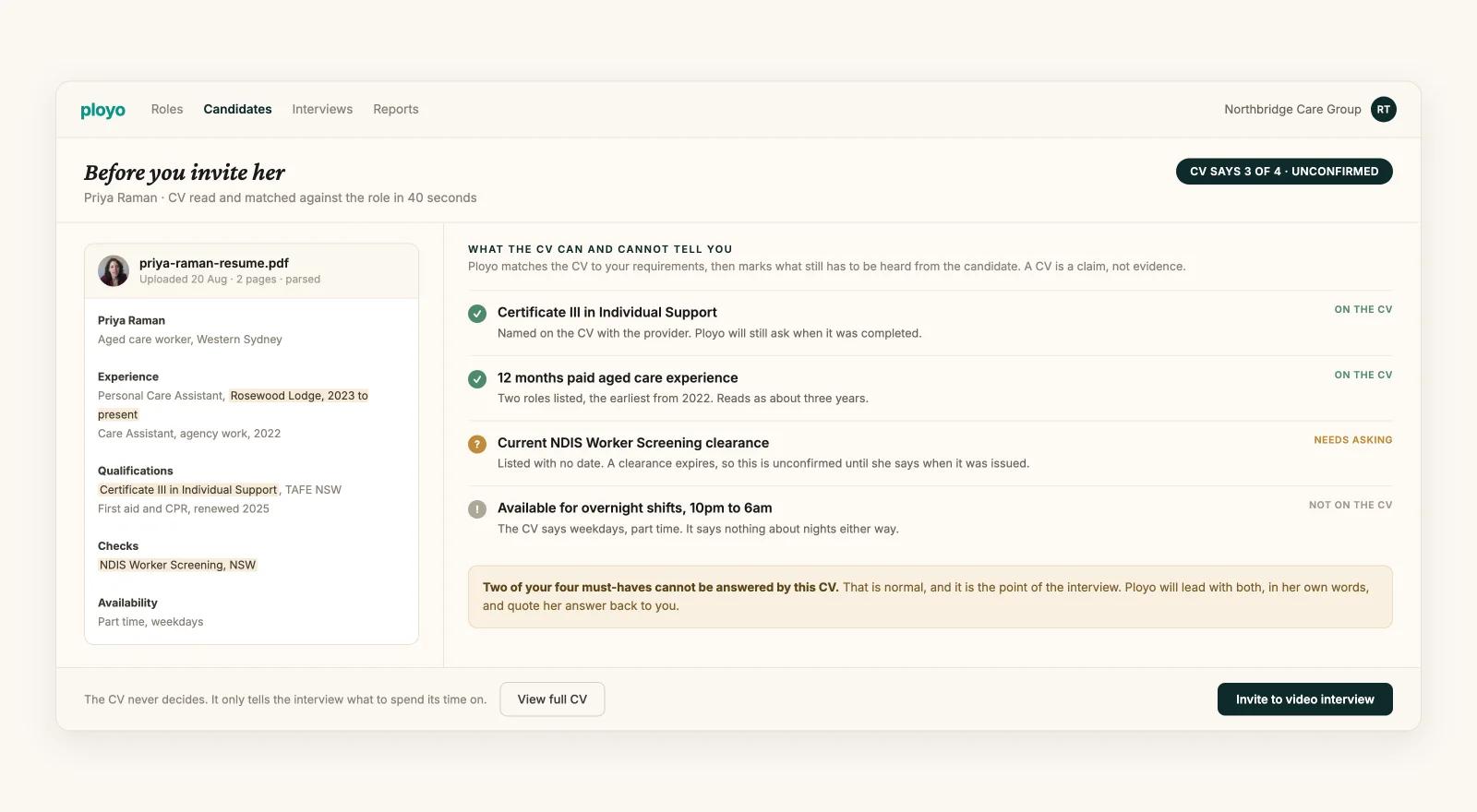
What the CV can and cannot tell you
The alternatives, and who each one suits
Ordered by the kind of buyer they fit, not by preference. Several of these are a better choice than Ployo for a given team, and the note says which.
Recruitment software with a built-in applicant tracking system and a live, two-way AI video interviewer, Sarah, who interviews every applicant the day they apply.
Best for: A frontline, care or high-volume hiring team that wants tracking and the first interview in one place, or an enterprise that keeps its ATS and wants every applicant interviewed in front of it.
Enterprise HCM suite whose Recruiting module includes HiredScore's AI grading, matching and internal talent-rediscovery engine.
Best for: A large enterprise already running Workday HCM that wants AI screening and internal talent rediscovery built into the system of record it already owns, with no separate ATS-to-HRIS sync to maintain.
A structured-hiring ATS whose AI features surface insight and summaries but deliberately never auto-decide.
Best for: A structured-hiring team that wants AI screening kept advisory, with a human as the stated final decision-maker on every candidate, not an auto-ranked shortlist.
An ATS repositioned around agentic AI screening and ranking (Winston), now owned by SAP.
Best for: A high-volume enterprise employer that wants an ATS built around autonomous AI ranking and a conversational application intake from day one, especially one already inside the SAP ecosystem post-acquisition.
A staffing- and agency-focused ATS/CRM with an AI layer (Amplify) trained on Bullhorn's own historical placement data.
Best for: A staffing or recruitment agency, not a corporate in-house team, that wants AI matching trained on its own large historical placement dataset rather than a generalist model.
A Sydney-headquartered, SEEK-owned ATS/CRM for the APAC staffing and in-house TA market, with native AI candidate summaries and relevancy ratings.
Best for: An Australian or APAC recruitment agency or in-house TA team that wants a Sydney-built, SEEK-backed ATS with AI candidate summaries and a documented internal AI-risk-review process, rather than a US-built platform retrofitted for the region.
Five platforms, one acquisition wave
As of 2026, native AI screening is not an edge case in applicant tracking, it is the default. Workday completed its acquisition of HiredScore for a deal reported at approximately $530 million (Workday itself did not disclose the figure), announced 26 February 2024 and closed around a month later, folding HiredScore's AI-powered sourcing and matching directly into Workday Recruiting. Workday then completed its acquisition of Paradox, the conversational AI hiring assistant, on 1 October 2025. SAP completed its acquisition of SmartRecruiters, which markets itself as 'the Recruiting AI Company', on 11 September 2025, integrating it into SAP SuccessFactors.
The pattern is not limited to the giants. Bullhorn, the staffing-industry ATS, ships its own AI matching engine that predicts which candidates are likely to be hired based on historical placement data, drawing on a claimed 22 billion data points across 800 million candidate records. JobAdder, the Sydney-headquartered ATS majority-owned by SEEK since 2020 (after SEEK built its stake from an initial position taken in 2014), built its own 'Adder Intelligence' feature that summarises and rates every candidate against the job description automatically.
Greenhouse is the outlier, and worth naming as one. Its own AI principles state plainly that 'AI and automation can inform, summarize and surface insight, but it is never the final decision-maker,' with human decision ownership as an explicit design requirement rather than a talking point.
What a ranking actually tells you, and what it cannot
An ATS ranking is built entirely from what a candidate chose to write down: a resume, a cover letter, answers to structured knockout questions. That is a real and useful signal, and at the volumes Greenhouse itself has measured, worth taking seriously: applications per job on its platform rose from about 116 in 2022 to about 244 in 2025, across more than 640 million applications at over 6,000 companies. Software that can sort that pile in seconds is solving a real problem.
What it cannot do is create evidence that was never written down. A candidate who has genuinely done the work they claim, who can explain a decision they made under pressure, or who simply writes a weak CV despite being excellent at the job itself, is invisible to a system that only ever reads the document. If your problem is too many documents, an ATS ranking solves it. If your problem is that the survivors all look the same on paper, ranking them again does not help.
Is there an ATS with a built-in AI interviewer?
Yes. Ployo is recruitment software with a built-in applicant tracking system and an AI video interviewer. Applicants arrive through a job link or bulk CV upload, each CV is checked against the role's must-haves, and every applicant is invited to a live, two-way video interview with Sarah, Ployo's AI interviewer, the day they apply. Candidates move through stages from Pending to Shortlisted, Shortlisted for human interview and Hired, with bulk moves, undo and a drag-and-drop review board, and automation only ever moves people forward.
What Ployo does not do as an ATS: it does not post to job boards, send offers or contracts, run onboarding or sync to an HRIS. Teams that need those keep a suite for them and run Ployo in front.
The honest case for stopping at the ATS feature
For a large share of teams, the native ATS screening feature is enough, and buying anything more is the wrong call. If your applicant volume is modest, if the ATS ranking already produces a shortlist your recruiters trust, or if the cost and complexity of another vendor outweighs the value of a deeper first round, stopping at the ATS is not a compromise. It is the correct decision for that team.
'One fewer vendor' is a genuine and frequently underrated reason to stop. Every additional tool is a security review, a contract, an integration somebody has to maintain, and a login the recruiting team has to remember.
Ployo platform data
30,000+
AI Interviews Completed
340,000+
Candidate Answers Graded
70%+
Interview Completion Rate
15,000+
Recruiter Hours Saved
Where the gap starts costing you something
The moment this changes is when applicants clear the ATS ranking and still look interchangeable, which happens fastest in roles where the real qualifying signal is not written down: care and frontline work, sales, anything where communication or judgement under pressure is the job rather than a credential you can list. At that point, ranking the same pile of resumes again with a slightly better model does not produce new information.
This is also where the Greenhouse nuance matters in practice. Because Greenhouse deliberately keeps its AI advisory rather than decisive, its customers arrive at this point with less automated sorting already done for them, so the case for an interview tends to arrive earlier for a Greenhouse-native team.
In front of your ATS, or as your ATS
For an enterprise past a few hundred applicants a month on Workday, SAP or Bullhorn, the sensible design is to keep the suite as the system of record and put Ployo in front of it: the suite handles requisitions, offers and onboarding, and Ployo interviews every applicant so the shortlist reaching your recruiters is built on evidence. How results reach your system is set up with each customer.
For a frontline, care or high-volume team without a heavy suite, or one paying for an ATS mainly to hold applications, Ployo can be the tracker: one pipeline per job, the interview built in, and a person deciding every move. The mistake to avoid either way is asking the same question twice, once as an ATS knockout field and again in the interview.
An ATS ranks the document. Ployo is an ATS that also asks: it creates new evidence the document never contained, by interviewing every applicant and listening to the answer. Whether you run it as your tracker or in front of the suite you keep, the shortlist is built on what people said.
Workday (with HiredScore) is a layer 0 tool: the ats knockout and resume screen. Software reads the application and rejects most of them before any person is involved. See how the six layers of first-round screening fit together →
Frequently asked
Does Ployo replace an applicant tracking system?
It can. Ployo has its own applicant tracking, from the job link and CV intake to stages through Hired, with an AI video interview built in, so frontline and care teams can run it as their ATS. It does not send offers, run onboarding or sync to an HRIS, so enterprises on Workday or SAP usually keep that suite and run Ployo in front of it.
Is there an ATS with a built-in AI interviewer?
Yes. Ployo tracks candidates from application to hire and runs a live, two-way AI video interview inside the same pipeline, with Sarah, Ployo's AI interviewer, asking the role's must-have questions and a Met or Not Met verdict attached to each candidate.
Which AI-powered ATS platforms exist in 2026?
All five major systems compared on this page now ship native AI screening: Workday, following its HiredScore acquisition; Greenhouse, though it deliberately keeps AI advisory rather than decisive; SmartRecruiters, now owned by SAP; Bullhorn, aimed at staffing agencies; and JobAdder, the Sydney-based platform owned by SEEK. Ployo is an ATS with a live AI video interview built in.
Does Greenhouse auto-reject or auto-rank candidates with AI?
Greenhouse's own AI principles state that AI can inform, summarise and surface insight, but is never the final decision-maker, with human decision ownership listed as an explicit design requirement. That is a more conservative position than several competitors, which do surface an automated shortlist for a recruiter to act on.
If I can only afford one tool, which should I buy first?
If you run frontline, care or high-volume hiring and your ATS mainly holds applications, one tool can do both: Ployo tracks the pipeline and interviews every applicant. If you run a large enterprise suite, keep it and add the interview once its shortlist still looks interchangeable. For a Greenhouse customer, where less automated sorting has already happened, that point tends to arrive sooner.
Is a resume ranking the same thing as an interview?
No. A ranking is built entirely from what a candidate wrote down, and cannot surface anything they did not think to include or could not describe well in writing. An interview creates new evidence, by asking a question and listening to how it is answered, including the follow-up a document can never provide.
Sources
Facts about other products come from their own public pages, checked on the dates below. Vendors change pricing and features without notice, so verify anything decision-critical at the source. Found something out of date? Tell us and we'll correct it.
- Workday newsroom: Workday Announces Intent to Acquire HiredScore, 26 February 2024 · checked 2026-08-05
- MarketScreener: Workday completed the acquisition of HiredScore for approximately $530 million, closed around 29 March 2024 · checked 2026-08-05
- Workday blog: conversation with HiredScore founder Athena Karp confirming the acquisition closed · checked 2026-08-05
- Workday newsroom: Workday Completes Acquisition of Paradox, 1 October 2025 · checked 2026-09-10
- SAP News Center: SAP Completes SmartRecruiters Acquisition, 11 September 2025 · checked 2026-08-05
- Greenhouse AI principles: human decision ownership, AI never the final decision-maker · checked 2026-08-05
- Greenhouse recruiting benchmarks: applications per job rose from about 116 in 2022 to about 244 in 2025, across more than 640 million applications at over 6,000 companies · checked 2026-08-05
- Bullhorn candidate search and match: AI matching engine predicting hire likelihood · checked 2026-08-05
- JobAdder homepage: Adder Intelligence, AI candidate summary and relevancy rating · checked 2026-08-05
- TechRound interview with JobAdder CEO: Sydney-founded, acquired by SEEK in 2020 · checked 2026-08-05
- ResumeBuilder.com survey of 948 US business leaders, fielded October 2024: 82% said their company uses AI to review resumes · checked 2026-08-05
- Ployo pricing (US dollars) · checked 2026-09-10
Most of what decides this is your own role, not the feature grid. Worked examples of AI screening applied to specific sectors are on the solutions pages, and the practical how-to side, including what compliance actually requires before someone starts a shift, is in the hiring guides.
If you would rather see the mechanics than read about them, the AI video interviewer page walks through an interview end to end.
Related comparisons

TRUSTED BY HIRING TEAMS AT








The only comparison that settles it
Run it on your own applicants. Book 30 minutes with the founder, we'll set Ployo up on a role you're hiring for right now, and you can judge the shortlist yourself.
30-minute call · See Ployo on one of your live roles