
The best AI recruiting tools in 2026, sorted by what they can actually tell you
Updated August 2026
Most lists with this title mix an applicant tracking system, a skills test, a psychometric battery and a live AI interviewer into one ranking, as if a candidate choosing between them were choosing between five brands of the same product. They are not. Each layer answers a different question about a candidate, and conflating them is how a buyer ends up disappointed with a tool that was never built to solve their actual problem. This page sorts eleven tools by the layer they sit in, states plainly what each layer can and cannot tell you, and is honest that HireVue, the incumbent most buyers arrive already comparing everything else against, has recently pushed into the same live-interview layer Ployo occupies.
There is no single best tool here, because the eleven options answer different questions. If your first round is a resume pile, start at the ATS layer, Greenhouse included, before buying anything else. If your candidates have no relevant work history yet, a validated psychometric like SHL beats an interview outright. If the job needs a provable hard skill, TestGorilla or Vervoe settle it better than any conversation. For the live-interview layer itself, where HireVue is now competing directly with Ribbon, Alex, HeyMilo, Classet and Ployo, the honest split is disclosure versus depth: Ribbon and Classet publish exact prices, Ribbon and HeyMilo hold compliance certifications Ployo does not, and Ployo's case is a per-requirement verdict tied to the candidate's own words rather than a score you are asked to trust. Pick HireVue if enterprise scale and an established one-way video product matter alongside the new live interviewer. Pick Ployo if what you need to trust is the interview itself, checked against a transcript, on a single role with no volume floor.
The oldest and most enterprise-embedded name in one-way async video interviewing, now also selling a live, conversational AI Interviewer built from its March 2026 acquisition of Hireguide's technology.
- Format
- Two distinct products. The long-established core product is one-way asynchronous video: the candidate records answers alone, on camera, for a recruiter to watch later. The newer AI Interviewer is described in HireVue's own press release as a voice-based, real-time conversational agent; HireVue's own pages do not confirm whether that specific product also records the candidate on video.
- Based
- Utah, United States (South Jordan/Sandy area, per HireVue's own careers and press pages; not stated as a single address on its current homepage).
- Pricing
- Not published. HireVue's own pricing page names 'Essential' to 'Premium' packages without listing figures, and directs every visitor to a sales conversation.
Side by side
| HireVue | Ployo | |
|---|---|---|
| Interview format | Two products: a long-established one-way async video interview, and a live voice AI Interviewer added via the March 2026 Hireguide acquisition. | One format: a live spoken video interview, with the candidate on camera every time. |
| Does the AI appear on screen | Not confirmed either way. HireVue's own press release describes the new AI Interviewer as voice-based; its pages do not state whether the candidate is also recorded on video in that product. | No. The AI speaks with no on-screen avatar; the candidate is the one on camera. |
| Company history | Founded 2004; the dominant one-way async video incumbent, which acquired Hireguide's conversational AI technology in March 2026 to build a live interviewer. | Built from the start as a live two-way AI video interview, with no async product. |
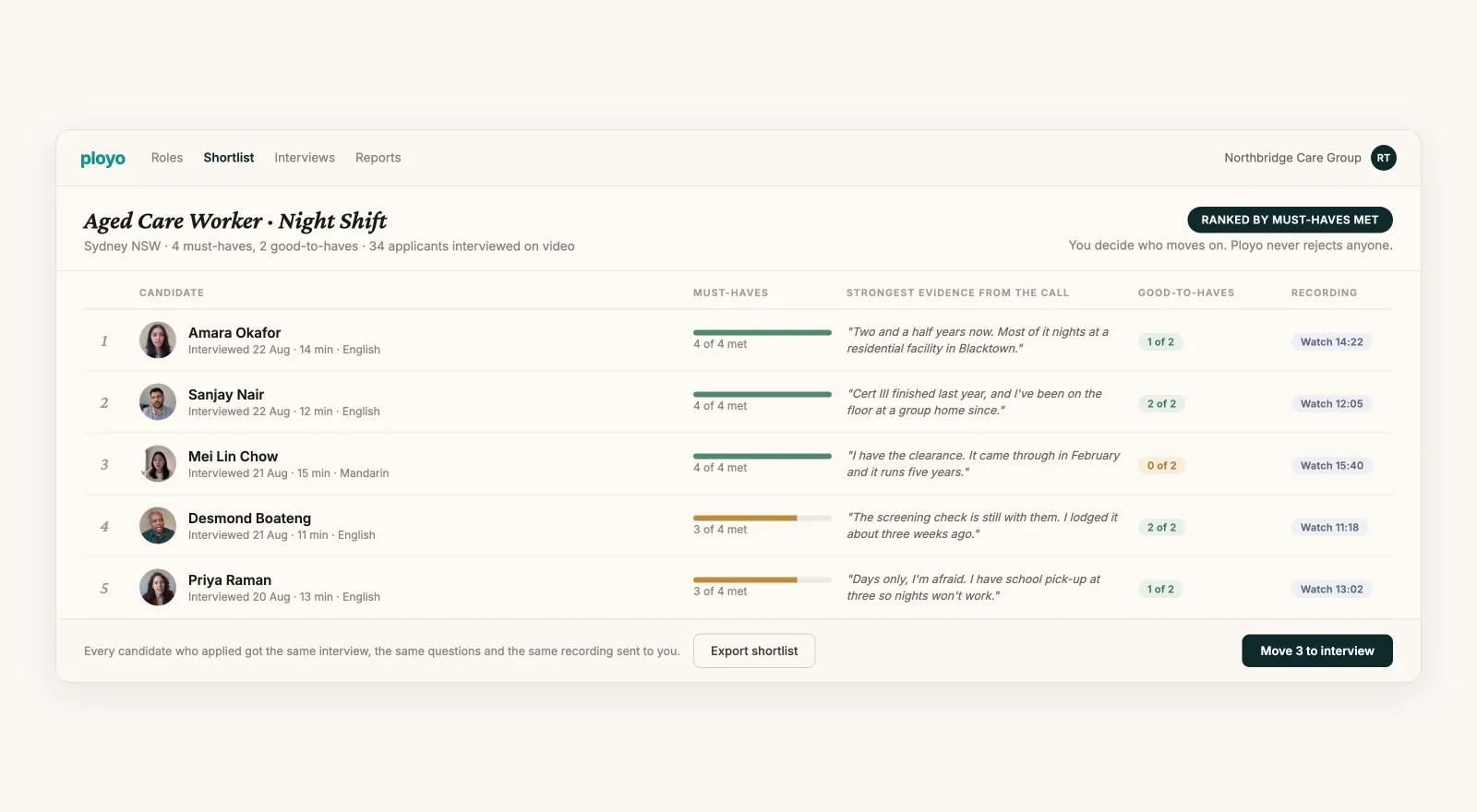
| What the hiring team receives | IO-validated AI scoring with a recruiter-ready shortlist and an audit trail, per HireVue's own product claims. | A per-requirement verdict quoting the candidate's own words, plus the full video recording and transcript. |
| ATS integrations | 45+ named integrations, per HireVue's own AI Interviewer product page. | Integrates per customer; no published integration count. |
| Pricing | Not published. Framed as 'Essential' to 'Premium' packages, contact sales. | Published: tiered USD pricing from US$249/month, interviews included (ployo.ai/pricing). No volume floor. |
| Category position | The oldest, most enterprise-embedded name in the category, now entering live AI interviewing rather than originating it. | A newer entrant that has only ever built the live AI interview layer. |
Choose HireVue if
- You want the enterprise track record. HireVue has been the async-video incumbent since 2004, with 45-plus named ATS integrations and a large existing enterprise deployment base most newer live-interviewer vendors cannot match.
- You want both formats from one vendor. HireVue now offers on-demand video, live video and its newer voice AI Interviewer under one contract, which is a genuine convenience for a buyer who wants a single procurement process.
- You want IO-psychology-backed scoring with a claimed audit trail. HireVue markets its AI Interviewer's scoring as built on IO-validated competencies, a specific claim most newer entrants in this comparison do not make.
- You are already a HireVue customer. Adding its new AI Interviewer to an existing contract avoids a second vendor, a second security review and a second integration.
Choose Ployo if
- You want the reasoning behind a verdict checkable in minutes, not a score you are asked to trust. Ployo returns the recording, the transcript and the specific quote behind each requirement judgment; HireVue's own pages describe scoring and an audit trail without describing an equivalent quote-linked verdict.
- You are not an enterprise buyer yet. Ployo has no volume floor and starts on a demo call; HireVue's public case studies and integration depth are built for a much larger, more established buyer.
- You want clarity on what 'AI interviewer' actually means for the candidate. HireVue's own press release describes its new product as voice-based without confirming whether the candidate is also on video in that specific mode. Ployo is explicit: the candidate is on camera and recorded, every time.
- You want to evaluate a product that has only ever done one thing. HireVue's AI Interviewer is a new addition to an older async-video business; Ployo has built nothing else.
Candidates ranked by what they actually proved
The alternatives, and who each one suits
Ordered by the kind of buyer they fit, not by preference. Several of these are a better choice than Ployo for a given team, and the note says which.
An applicant tracking system with native AI screening that deliberately stays advisory rather than auto-deciding.
Best for: A team that already runs Greenhouse and wants AI screening with explicit human decision ownership built into the product's own stated principles, not a separate interview layer.
The oldest and most established name in validated psychometric and gamified assessment.
Best for: A large graduate or campus program with thousands of applicants and no relevant work history yet, where a validated predictive score outperforms an interview.
A skills-testing platform with a 350+ test library, a genuine free tier, and self-serve published pricing.
Best for: A team hiring for a discrete, testable technical skill that wants to start free and see an exact price before talking to anyone.
A skills-assessment platform with AI-graded work simulations and built-in generative-AI-answer detection.
Best for: An enterprise buyer who wants skills-first grading with fraud detection built in and is comfortable going through a sales conversation for pricing.
A chat and SMS assistant that screens, answers candidate questions and books interviews, now owned by Workday.
Best for: A very large frontline employer, especially one already on Workday, whose actual bottleneck is scheduling and responsiveness rather than assessment depth.
A live AI interviewer with published self-serve pricing, a SOC 2 report and a named bias audit.
Best for: A buyer who wants to see an exact price on a page and a compliance paper trail before ever talking to sales.
The best-funded live AI interviewer in this set, with 14 named ATS integrations and a dedicated fraud-and-identity module.
Best for: An enterprise buyer needing deep pre-built ATS connectivity across a complex stack, comfortable with a fully sales-gated evaluation.
A voice AI screener for high-volume hiring with the strongest quantified, named case studies in this comparison set.
Best for: A staffing agency running Bullhorn, Avionté or JobDiva that wants named, numeric proof of results before committing.
A live two-way AI video interview that returns a per-requirement verdict quoting the candidate's own words, plus the recording and transcript.
Best for: A hiring team, from a single role to a few hundred applicants, that wants a checkable verdict from a real conversation without an enterprise volume floor or a procurement cycle.
An AI recruiter that calls applicants by phone within seconds of applying, voice-only, no camera and no video recording at all.
Best for: A skilled-trades or home-services employer whose candidates apply from a job site and will not complete anything that requires a camera or a login.
Why this list is sorted by layer, not by star rating
An applicant tracking system, a psychometric battery, a skills test and a live AI interviewer are not four brands of the same product. Each one is built to answer a different question about a candidate: whether the application clears a bar, whether the person's traits predict future performance, whether they can actually do a specific testable task, and what they say when someone, human or AI, asks them a real question and listens to the answer. A list that ranks all four together as if a buyer were choosing between them is answering a question nobody actually has.
This page sorts eleven real tools by which of those questions they answer, states each one's published pricing or the honest absence of it, and names a specific, real buyer each is built for rather than a generic superlative. HireVue anchors the list because it is the name most buyers already arrive comparing everything else against, not because it wins by default.
The same answer, two formats
A first round is worth what it can find out. Both of these are real screening formats and both work; they differ in what happens after the candidate stops talking.
Typed answer
“One of our residents kept trying to leave at night. I sat with her, worked out she was looking for her husband, and changed her evening routine.”
Submitted, scored, and the interview moves to the next question. Written in private, at the candidate’s own pace, with every tab on their machine available to them.
Spoken answer
“One of our residents kept trying to leave at night. I sat with her, worked out she was looking for her husband, and changed her evening routine.”
And then, unscripted
“You changed the routine. Who signed that off, and what did you write in the notes?”
That second question did not exist until she gave the first answer. It is the one that separates a story a candidate can tell from a shift they actually ran.
HireVue's pivot into live AI interviewing, stated precisely
HireVue has been the dominant name in one-way asynchronous video interviewing since 2004: candidates record answers to fixed prompts alone, and a recruiter watches the recordings later, often at higher speed. That product still exists and is still sold today.
What changed is a March 2026 acquisition of Hireguide's conversational-AI technology, announced in HireVue's own press release, which the company is using to build a live AI Interviewer: a real-time, two-way conversational agent that HireVue's release describes specifically as voice-based. HireVue's product pages market the result with strong claimed outcomes, including fewer manager rejections and a faster path from application to hiring-manager review, though these are HireVue's own reported figures rather than independently audited ones. What is not confirmed on HireVue's own pages is whether that specific voice-based product also records the candidate on video, which matters for a buyer trying to understand exactly what evidence they will get back.
The honest framing for a buyer is that HireVue is now competing directly in the same layer as Ribbon, Alex, HeyMilo, Classet and Ployo, having entered it through acquisition in 2026 rather than having built it from the start.
The skills-test layer: proof where a hard skill exists
TestGorilla and Vervoe both settle a genuinely testable skill better than any interview will, and they settle it identically for every candidate. TestGorilla is the more self-serve of the two, with a real free tier and published monthly pricing running from $142 a month billed annually up to a custom Enterprise plan. Vervoe positions itself further up-market, with AI-graded work simulations and built-in generative-AI-answer detection, but its own pricing page is contact-sales only, with no published tiers or free plan currently listed.
Neither replaces an interview for a role where the qualifying signal is not a discrete, testable skill, which is most frontline and care hiring. They are the right tool when the job genuinely comes down to a skill you can test the same way for everyone.
The layer this cluster is really about, and where Ployo sits in it
Ribbon, Alex, HeyMilo, Classet and Ployo are all, at bottom, the same bet: that a live conversation, kept but automated, beats a test, a recording or a text exchange at surfacing what a candidate can actually do. Within that layer the real differences are not about who has an AI interviewer, since by the time HireVue entered in 2026 almost everyone does. They are about disclosure and depth. Ribbon publishes exact monthly prices and a SOC 2 report. Classet publishes an entry-tier weekly price and removes video entirely on purpose for candidates who will not sit for it. Alex has raised the most funding and built the deepest ATS bench. HeyMilo has the strongest named, numeric case studies. Ployo's position is the output: a verdict tied to the candidate's own words, with the full recording and transcript, rather than a score handed down without a way to check it.
Ployo publishes tiered pricing too, from US$249 a month at ployo.ai/pricing, but holds no SOC 2 report and has commissioned no independent bias audit, and this page is not going to imply otherwise. What it has, and what most of this list does not, is no volume floor and a setup that starts with a call to the founder rather than a self-serve signup or an enterprise sales process.
Ployo platform data
30,000+
AI Interviews Completed
340,000+
Candidate Answers Graded
70%+
Interview Completion Rate
15,000+
Recruiter Hours Saved
The two layers most buyers forget to check first
Before any of the interview-layer decisions above, it is worth checking whether the problem is even at the interview stage yet. If your applicant tracking system is Greenhouse, Workday or another platform with native AI screening, that layer may already be doing the sorting you think you need a new tool for. If your candidates have no relevant work history, a validated psychometric instrument like SHL predicts more reliably than any conversation can. Skipping straight to 'which AI interviewer' without checking those two is the most common reason a buyer ends up disappointed with a tool that was never the right layer for their actual problem.
HireVue built the category's oldest incumbent product, then bought its way into live AI interviewing in March 2026. Ployo built only the live interview, from the start, and the entire product is the verdict a hiring manager can check against a transcript. If enterprise scale and an established one-way-video business alongside the new live product matter to your buying process, HireVue's breadth is the stronger case. If what convinces your hiring managers is being able to verify a specific decision themselves, that is what Ployo is built to hand back.
HireVue is a layer 6 tool: ai live interviewers. An AI conducts a real-time interview: it asks, listens, follows up, and adapts to the answer. See how the six layers of first-round screening fit together →
Frequently asked
What is the best AI recruiting tool in 2026?
There is no single answer, because the tools in this category solve different problems. An ATS like Greenhouse ranks the application. A psychometric platform like SHL predicts traits, best for candidates with no relevant work history. A skills test like TestGorilla proves a discrete hard skill. A live AI interviewer, HireVue's new AI Interviewer, Ribbon, Alex, HeyMilo, Classet or Ployo, creates new evidence by asking the candidate directly. The right tool depends on which of those questions you are actually trying to answer.
Does HireVue have a live AI interviewer now?
Yes. HireVue's own press release describes a voice-based AI Interviewer built from its March 2026 acquisition of Hireguide's conversational-AI technology, alongside its long-established one-way asynchronous video product, which is still sold separately.
Which AI interviewing tools publish their pricing?
Of the vendors compared here, Ribbon (published monthly tiers from $499 to $1,999), Classet (published monthly tiers from $249 to $1,995) and Ployo (published monthly tiers from US$249, at ployo.ai/pricing) publish real figures, though Ployo's purchase still starts with a call to the founder rather than self-serve signup. TestGorilla publishes tiers for its skills-testing product. HireVue, Alex, HeyMilo, Sapia.ai and Paradox do not publish pricing at all; all require a sales conversation.
Should I buy an ATS, a psychometric test or an AI interviewer first?
Check in that order. If your first-round problem is a resume pile, a modern ATS with native AI screening, such as Greenhouse or Workday, solves it at close to zero marginal cost. If your candidates have no relevant work history yet, a validated psychometric instrument like SHL predicts better than an interview can. Only once applicants clear both of those and still look interchangeable does a live AI interviewer, HireVue's new product or Ployo among them, start doing work the other two layers cannot.
Is Ployo the same kind of product as HireVue's AI Interviewer?
They compete in the same layer, live AI interviewing, but from different starting points. HireVue added a voice-based AI Interviewer in 2026 on top of a two-decade-old one-way async video business. Ployo has only ever built the live interview: a two-way video conversation with the candidate on camera, returning a per-requirement verdict quoted against the candidate's own words, plus the full recording and transcript.
Sources
Facts about other products come from their own public pages, checked on the dates below. Vendors change pricing and features without notice, so verify anything decision-critical at the source. Found something out of date? Tell us and we'll correct it.
- HireVue press release: HireVue acquires Hireguide's conversational-AI technology, 10 March 2026 · checked 2026-08-05
- HireVue AI Interviewer product page: voice interviews, IO-validated scoring, 45+ ATS integrations · checked 2026-08-05
- HireVue pricing page: Essential to Premium packages, no published figures · checked 2026-08-21
- HireVue video interviewing product page: one-way on-demand and live video formats · checked 2026-08-05
- TestGorilla pricing page: Free, Core, Plus and Enterprise tiers · checked 2026-08-05
- Vervoe pricing page: Enterprise, contact-sales only · checked 2026-08-21
- Greenhouse AI principles: human decision ownership, AI never the final decision-maker · checked 2026-08-05
- SHL homepage: 45 million assessments a year, no published pricing · checked 2026-08-05
- Sapia.ai pricing page (per-hire model, 500+ hires a year framing) · checked 2026-08-05
- Paradox.ai homepage · checked 2026-08-05
- Ribbon pricing page (published tiers, SOC 2, NYC Local Law 144, GDPR) · checked 2026-08-05
- Alex pricing page (contact-vendor pricing) · checked 2026-08-05
- HeyMilo pricing page (demo-gated, no published rates) · checked 2026-08-05
- Classet pricing page (Flex and ATS Sync tiers) · checked 2026-08-21
Most of what decides this is your own role, not the feature grid. Worked examples of AI screening applied to specific sectors are on the solutions pages, and the practical how-to side, including what compliance actually requires before someone starts a shift, is in the hiring guides.
If you would rather see the mechanics than read about them, the AI video interviewer page walks through an interview end to end.
Related comparisons

TRUSTED BY HIRING TEAMS AT








The only comparison that settles it
Run it on your own applicants. Book 30 minutes with the founder, we'll set Ployo up on a role you're hiring for right now, and you can judge the shortlist yourself.
30-minute call · See Ployo on one of your live roles