
Ployo vs Classet: a phone call in seconds, or a video interview?
Updated August 2026
Classet is built around a single, deliberately narrow idea: an AI recruiter named Joy calls a job applicant within seconds of them applying and runs a real-time structured phone screen, no login, no portal, no camera, no video recording at all. It targets skilled trades and hourly work, HVAC techs, electricians, home services, where a candidate applies from a phone and will not sit through anything resembling a video assessment. This is the sharpest and most honest contrast in this entire comparison cluster, because Classet's format is a genuine strength for a real population of candidates, not a compromise dressed up as one.
Classet is the better choice, plainly, if your candidates apply from a phone and will not complete anything that requires a camera, a login or a wait. That is most skilled-trades and hourly hiring, and Classet has built the entire product around removing every point of friction between an application and a real conversation: a call within seconds, voice-only, no portal. Ployo is the better choice when the interview needs to be watched back, when tone and presence on camera are part of what you are assessing, or when a text or audio transcript alone would not let a hiring manager judge the moment that mattered. If your candidates will not sit for video, Classet's format wins and Ployo's loses. That is not a hedge, it is the honest answer.
An AI voice recruiter, Joy, that calls job applicants by phone within seconds of applying and conducts a structured, real-time screening interview, built for high-volume and skilled-trades hiring.
- Format
- Live voice-only AI over a phone call. There is no video avatar, and Classet's own materials state the candidate is not recorded on video at all, explicitly contrasting the format with pre-recorded async video platforms like HireVue.
- Based
- Not disclosed on their own site; a 2022 seed-funding press item listed the company as Chicago, IL-based, unconfirmed on Classet's own pages.
- Pricing
- Three published tiers, re-checked 2026-08-21. Flex is $249 a month billed annually, or $349 month-to-month, for 50 completed interviews a month. Scale is $999 a month billed annually, or $1,399 month-to-month, for 250. Enterprise starts from $1,995 a month and is scoped on a discovery call. The weekly per-job Flex rate we recorded on 2026-08-05 no longer exists; Classet has moved to a monthly interview allowance.
Side by side
| Classet | Ployo | |
|---|---|---|
| Interview format | A real-time phone call, voice only. No camera, no login, no portal to open first. | A live spoken video interview. The candidate is on camera and recorded throughout. |
| Is the candidate recorded on video | No. Classet's own materials state there is no video recording of the candidate at all, contrasting this directly with pre-recorded video platforms. | Yes. Every completed interview produces a video recording the hiring team can watch back. |
| Time to first contact | Within seconds of the candidate submitting an application, per Classet's own product claims. | Scheduled or on-demand; not marketed as an instant-call product. |
| Pricing | Three published tiers, re-checked 2026-08-21: Flex $249/mo billed annually ($349 month-to-month) for 50 completed interviews, Scale $999/mo annually ($1,399 month-to-month) for 250, and Enterprise from $1,995/mo scoped on a call. | Published: tiered USD pricing from US$249/month, interviews included (ployo.ai/pricing). No volume floor. |
| Trades-specific data capture | Captures licence and certification numbers, travel radius and tool ownership as structured interview data. | No trades-specific structured fields; requirement verdicts are configured per role, not per trade. |
| ATS integrations | 13+ named integrations including Workday, Greenhouse, iCIMS, Bullhorn, UKG and ADP Workforce Now. | Integrates per customer; no published integration count. |
| What the hiring team receives | A voice transcript and structured screening data synced to the ATS; no video to review. | A per-requirement verdict quoting the candidate's own words, plus the full video recording and transcript. |
| Self-published completion-rate claim | A Classet blog post reports completion rising from roughly 50% to 70% after switching a client from written to voice screening. This is Classet's own reported figure, not independently audited. | Ployo has not published an equivalent completion-rate comparison. |
Choose Classet if
- Your candidates apply from a phone in a truck, on a job site, or between shifts, and will not sit through a video interview. Classet removes every point of friction between applying and talking to someone: no login, no portal, no camera, a real call within seconds. For hourly and skilled-trades hiring, this is very plausibly the correct format, not a lesser one.
- You want structured, trades-specific data captured automatically. Classet's interview flow captures licence and certification numbers, travel radius and tool ownership as structured fields, which is a genuine vertical feature Ployo has no equivalent to.
- You want to buy an entry tier without a sales call. Classet's Flex plan is $249 a month billed annually and Scale is $999, both published on their own pricing page and re-checked on 2026-08-21, and both are self-serve. Ployo's entry tier is the same $249 a month (ployo.ai/pricing), so the difference is not the price, it is the purchase path: buying Ployo still starts with a call to the founder, and Classet does not make you have one.
- You have evidence, even self-reported, that a voice format lifts completion versus a written or video one for your candidate pool. Classet's own blog reports completion rising from about 50% to 70% after a client switched from written to voice screening. If your applicants are similarly averse to anything more involved than a phone call, that pattern is worth taking seriously.
Choose Ployo if
- The interview needs to be watched, not just read or heard. Ployo returns the full video recording alongside the transcript, so a hiring manager can see how a candidate handled a moment, not just hear or read that they handled it. Classet's own materials state there is no video recording at all, so nothing is available to watch back afterward.
- The role is about how someone presents to people, not just what they know. For a client-facing trades role, a support worker, or anyone whose job includes being watched by the person they are helping, a video record captures something a voice-only transcript cannot.
- You want a per-requirement verdict tied to the candidate's own words, not just structured screening data. Ployo's output quotes the specific answer behind each requirement judgment. Classet's public pages describe structured data synced to the ATS without describing an equivalent quote-linked verdict.
- You are not purely optimising for speed-to-contact. Classet's whole design is built around calling within seconds and removing friction. If your process has room for a scheduled interview rather than an instant one, video's advantages, the recording, the visible presence, are worth the extra step.
- You hire across more than one kind of role. The structured fields Classet captures, licence numbers, travel radius, tool ownership, are shaped around skilled trades and hourly work, which is exactly why they are good at it. If your requisitions also include care, clinical, customer-facing or administrative roles, those fields stop describing the job and you are back to reading a transcript. Ployo's questions are generated from your own role requirements rather than from a fixed vertical schema, so the same screening process covers a support worker, a nurse and a fitter without changing tools.
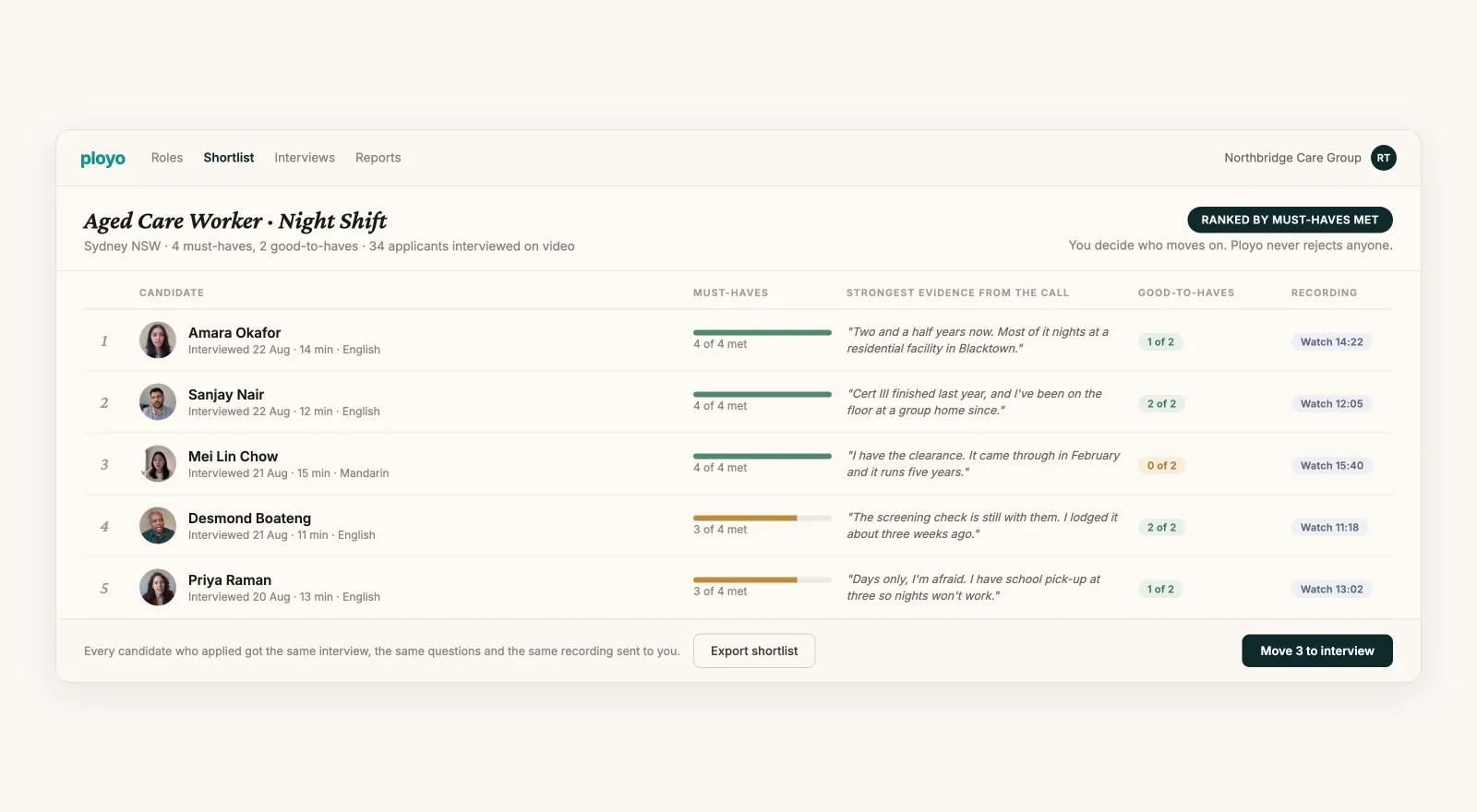
Candidates ranked by what they actually proved
The sharpest real contrast in this category
Most of the comparisons in this cluster come down to depth of output or disclosure. This one is different: Classet made a deliberate design decision to remove video entirely, and it is worth taking that decision at face value rather than treating it as a limitation.
Classet's own materials describe the product in direct contrast to pre-recorded video platforms like HireVue: no camera, no login, no portal, a real-time voice conversation over a phone call that starts within seconds of the candidate applying. For a candidate population that will not open a laptop, will not download an app, and will not sit through anything that looks like an assessment, that is not a compromise. It is very plausibly the correct product.
The same answer, two formats
A first round is worth what it can find out. Both of these are real screening formats and both work; they differ in what happens after the candidate stops talking.
Typed answer
“One of our residents kept trying to leave at night. I sat with her, worked out she was looking for her husband, and changed her evening routine.”
Submitted, scored, and the interview moves to the next question. Written in private, at the candidate’s own pace, with every tab on their machine available to them.
Spoken answer
“One of our residents kept trying to leave at night. I sat with her, worked out she was looking for her husband, and changed her evening routine.”
And then, unscripted
“You changed the routine. Who signed that off, and what did you write in the notes?”
That second question did not exist until she gave the first answer. It is the one that separates a story a candidate can tell from a shift they actually ran.
What you lose, and what you gain, by removing the camera
What you lose is exactly what you would expect: nothing to watch back. Classet's own pages state the candidate is not recorded on video at all, so if a hiring manager wants to see how someone answered rather than just read or hear it, there is nothing there. For roles where presence, tone under pressure, or how someone comes across to the people they will serve genuinely matters, that is a real gap.
What you gain is completion. Classet's own blog post reports a client's completion rate rising from roughly 50% to 70% after switching from a written screen to a voice one. That is Classet's own reported figure, not an independently audited one, but it points at something real: the harder you make it to complete a screen, the fewer trades and hourly candidates finish it, and a phone call within seconds is about as low-friction as this category gets.
Built specifically for trades, in ways that show in the product
Classet captures data most generalist AI interviewers never ask for: licence and certification numbers, travel radius, tool ownership. Those are the actual gating questions in skilled-trades hiring, and building them into the structured interview output rather than a separate form is a genuine vertical advantage.
Its 13-plus named ATS integrations, spanning Workday, Greenhouse, iCIMS, Bullhorn, UKG and ADP Workforce Now, also suggest real investment in fitting into how trades and home-services employers already run recruiting operations, not a bolt-on demo.
Pricing, published on one tier and not the other
Classet publishes three tiers directly, re-checked on 2026-08-21. Flex is $249 a month billed annually, or $349 month-to-month, for 50 completed interviews a month. Scale is $999 a month billed annually, or $1,399 month-to-month, for 250. Enterprise starts from $1,995 a month and is scoped on a discovery call. The older weekly per-job rate no longer exists; the model is now a monthly interview allowance.
Ployo publishes no tiers. If a self-serve entry price matters to you and your monthly interview volume fits Flex, that is a straightforward point in Classet's favour. What Ployo trades for it is no seat metering and no volume floor, which suits a single role with a few hundred applicants better than a fixed monthly allowance does.
Ployo platform data
30,000+
AI Interviews Completed
340,000+
Candidate Answers Graded
70%+
Interview Completion Rate
15,000+
Recruiter Hours Saved
Where the decision actually comes down to your candidates, not the vendors
Neither product is wrong here. The honest way to decide is to ask what your applicants will actually do. If your roles are filled by people applying from a job site or a shift break, who will pick up an unknown call but will not open a video link, Classet's design fits that reality better than anything with a camera in it, Ployo included.
If your roles depend on how someone comes across, patience with a difficult person, presence in front of a client, and you want a hiring manager to be able to watch that rather than take a transcript's word for it, video is doing real work a phone call cannot replace. That is the actual trade, and it is worth deciding on your candidates rather than on which vendor's homepage sounds more advanced.
This is the one comparison in this cluster where the two products are not really arguing about the same medium done differently. Classet removed the camera on purpose, on the reasoning that for a trades candidate applying from a job site, a phone call within seconds beats a video interview nobody finishes. Ployo kept the camera on purpose, on the reasoning that a role built on how someone presents to people needs a record you can watch. Both are right for the candidate population they were built around. The honest question is which population is yours.
Classet is a layer 6 tool: ai live interviewers. An AI conducts a real-time interview: it asks, listens, follows up, and adapts to the answer. See how the six layers of first-round screening fit together →
Frequently asked
Does Classet record video of the candidate?
No. Classet's own materials state explicitly that its phone-based interview is voice-only, with no video recording of the candidate at all, contrasting this directly with pre-recorded video platforms. Ployo records every completed interview on video.
How fast does Classet contact an applicant?
Classet's own product claims describe a call to the applicant within seconds of them submitting an application. Ployo is not marketed as an instant-call product; interviews are scheduled or run on demand.
How much does Classet cost?
Classet publishes three tiers, re-checked on 2026-08-21: Flex at $249 a month billed annually ($349 month-to-month) for 50 completed interviews, Scale at $999 a month billed annually ($1,399 month-to-month) for 250, and Enterprise from $1,995 a month scoped on a discovery call. Ployo also publishes tiered pricing, from US$249 a month with interviews included at ployo.ai/pricing, though buying still starts with a call to the founder rather than a self-serve signup, and there is no volume floor.
Is Classet good for skilled trades hiring?
It is built specifically for that segment. Classet captures trades-specific data like licence and certification numbers, travel radius and tool ownership, and its named customers include HVAC, pest control and home-services companies. It also has 13 or more ATS integrations aimed at that market.
Which is better, Classet or Ployo, for high-volume hourly hiring?
It depends on whether your candidates will sit for a video interview. If completion is the binding constraint and your applicants apply from a phone without patience for anything beyond a call, Classet's no-camera, no-login, seconds-to-contact design is built exactly for that and will likely win. If you need to watch back how a candidate handled a specific moment, Ployo's video recording does something a voice-only transcript cannot.
Sources
Facts about other products come from their own public pages, checked on the dates below. Vendors change pricing and features without notice, so verify anything decision-critical at the source. Found something out of date? Tell us and we'll correct it.
- Classet homepage · checked 2026-08-05
- Classet pricing page (Flex and ATS Sync tiers) · checked 2026-08-21
- Classet product page · checked 2026-08-05
- Classet integrations page · checked 2026-08-05
- Classet skilled trades use case page · checked 2026-08-05
- Classet blog: Classet vs HireVue video interview platform · checked 2026-08-05
- Classet blog: voice AI in recruiting, insights from 70,000 job interviews · checked 2026-08-05
- G2 Classet reviews listing · checked 2026-08-05
Most of what decides this is your own role, not the feature grid. Worked examples of AI screening applied to specific sectors are on the solutions pages, and the practical how-to side, including what compliance actually requires before someone starts a shift, is in the hiring guides.
If you would rather see the mechanics than read about them, the AI video interviewer page walks through an interview end to end.
Related comparisons

TRUSTED BY HIRING TEAMS AT








The only comparison that settles it
Run it on your own applicants. Book 30 minutes with the founder, we'll set Ployo up on a role you're hiring for right now, and you can judge the shortlist yourself.
30-minute call · See Ployo on one of your live roles