
Psychometric tests or an AI interview: which one actually answers your question?
Updated August 2026
SHL, Aon Assessment, Arctic Shores, Harver, Criteria, Talent Games and Pulsifi all sell some version of the same promise: a validated score, built from traits and cognitive ability, that predicts how a candidate will perform before anyone has spoken to them. Ployo does something structurally different: it evidences what a candidate says when asked, rather than predicting from indirect signals. Neither is a strictly better version of the other, and for one real buyer, a graduate program with thousands of applicants and no relevant work history to interview about, the psychometric layer is plainly the stronger tool. This page is about knowing which question you are actually trying to answer.
Buy psychometric assessment first, and possibly only, if you are running a graduate or campus program: with no relevant work history to interview about, a validated trait prediction is genuinely the stronger instrument, and SHL, Harver and the rest have decades of published research behind that claim which Ployo cannot match. Buy an AI interview first if your candidates have real experience to be asked about, because a probability inferred from a game is a weaker signal than a claim you can check directly against the person who made it. For a graduate program with a later experienced-hire funnel behind it, running both in sequence, psychometrics at the top for the population with nothing else to assess, an interview lower down once experience exists to interrogate, is the honest design, not a hedge.
The oldest and most established name in psychometric and cognitive assessment, selling validated tests and gamified assessments built on decades of occupational-psychology research.
- Format
- Online tests, questionnaires and gamified exercises completed alone, with no interviewer and no camera. The candidate never speaks to anyone, human or AI.
- Based
- Thames Ditton, Surrey, United Kingdom
- Pricing
- Not published on shl.com. Assessments are sold via a sales conversation or a separate online store, with no listed per-candidate or subscription rate on the main site.
Side by side
| Psychometric assessment | Ployo | |
|---|---|---|
| What it measures | Traits, cognitive ability and behavioural tendencies, inferred from tests and games. | What the candidate actually says about their own experience, in a live conversation. |
| Nature of the output | A probability: a statistical prediction of likely future performance. | Evidence: a specific, checkable claim tied to the candidate's own words. |
| Published validation research | Decades of predictive-validity and adverse-impact studies across the category; SHL alone reports 45 million assessments taken a year on 45 billion data points. | None published. Ployo has not commissioned predictive-validity studies and does not claim any. |
| Professional certification | Several vendors' instruments are built and reviewed by occupational psychologists against established frameworks (e.g. EFPA, BPS, APA, SIOP norms). | No equivalent third-party psychometric certification. Ployo does not claim one. |
| Best suited to | Large cohorts with little or no relevant work history to assess, most commonly graduate and campus hiring. | Candidates with real experience worth asking about and checking. |
| Candidate time cost | Harver's own pymetrics-based assessment states an average of approximately 25 minutes across 12 or more games, completed alone before anyone has spoken to the candidate. | A live interview, scheduled or on demand; length varies by role rather than a fixed game battery. |
| Consolidation in the category | Active. Harver acquired pymetrics in August 2022; Criteria Corp acquired Revelian in March 2020, and Revelian no longer operates as an independent brand. | Not applicable. |
| Pricing | Not published across all seven vendors compared here. | Published: tiered USD pricing from US$249/month, interviews included (ployo.ai/pricing). No volume floor. |
Choose SHL if
- You are hiring a graduate or campus cohort with no relevant work history. There is nothing to interview about yet, and a validated trait prediction is a genuinely stronger instrument than asking someone to talk about experience they do not have. This is the one scenario in this whole comparison cluster where the alternative to Ployo is plainly the better tool, not a defensible trade-off.
- Your legal or compliance function requires published predictive-validity and adverse-impact evidence before a decision tool touches a candidate. SHL, Harver and Criteria collectively represent decades of occupational-psychology research and defensibility work that Ployo has not done and does not claim to have done.
- You need a score built and reviewed against an established psychometric framework. Several vendors in this category build instruments to recognised occupational-testing standards; Ployo has no equivalent third-party certification.
- The unpaid twenty minutes is acceptable to your candidate pool. For a graduate applicant competing for a coveted place, completing a validated test battery before ever speaking to anyone is an accepted part of the process in a way it is not for an experienced hire choosing between several live job offers.
Choose Ployo if
- Your candidate already has relevant experience. A validated trait score is still an inference; a live interview lets you ask directly whether this specific person can do this specific job, and check the answer against how they explain it.
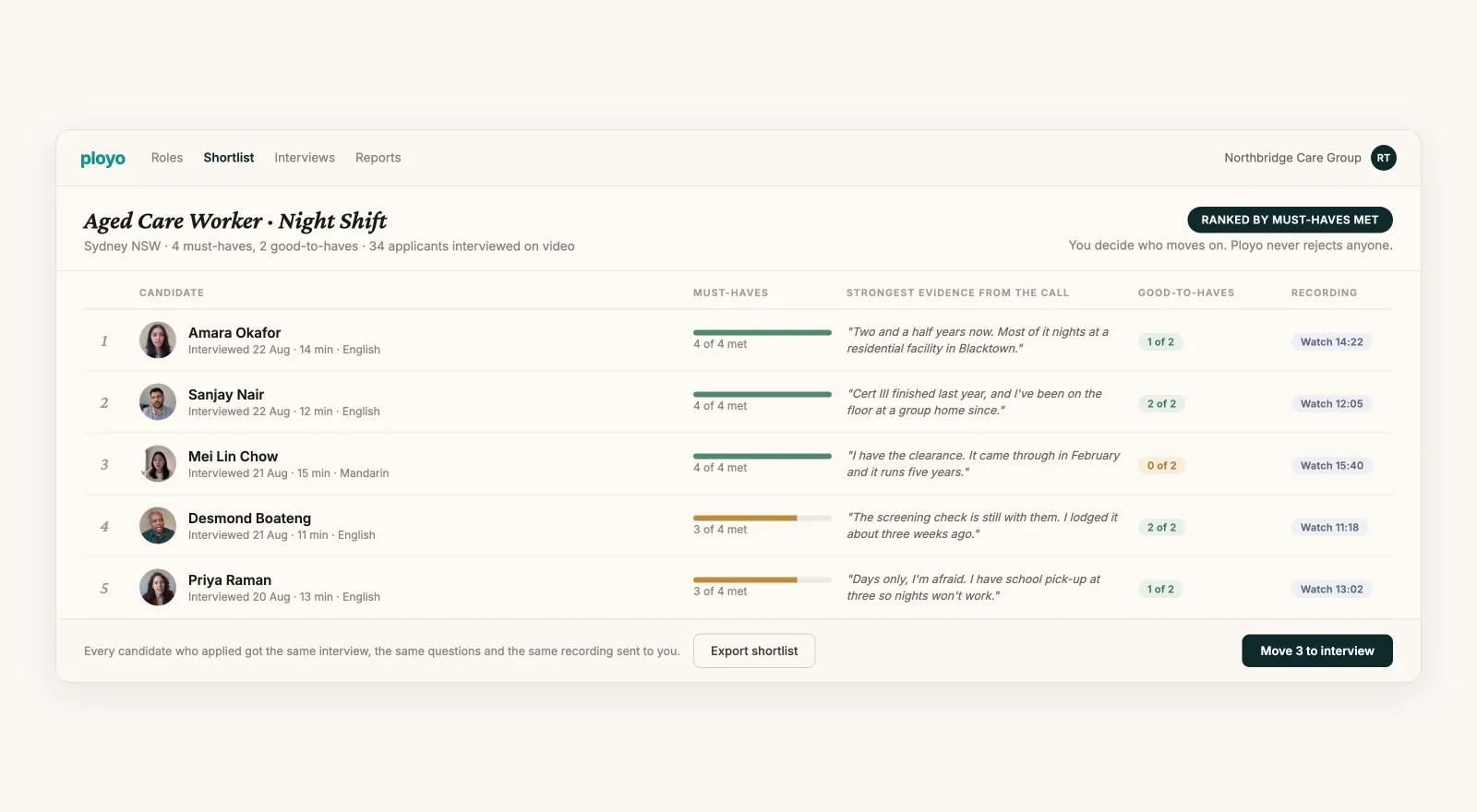
- You need the reasoning to be checkable, not just the score. A psychometric report gives you a number a hiring manager is asked to trust. Ployo returns the recording, the transcript and the specific words behind every requirement verdict, so a disagreement can be settled by watching two minutes back.
- Twenty unpaid minutes before anyone has spoken to the candidate is a real cost you are not willing to impose. For an experienced hire weighing several offers, a live conversation is a lower-friction, higher-respect first step than a test battery.
- You want to know whether the claims on the CV are true, not just whether the candidate's traits statistically correlate with people who tend to perform well. A trait score does not verify a specific claim; a follow-up question does.
- You need the hiring manager to act on the result. A psychometric profile usually needs interpreting, which is why these tools tend to arrive with an occupational psychologist attached. Ployo returns a verdict on each requirement you set, with the candidate's own words quoted underneath it, so the person accountable for the hire can read it, disagree with it, and go straight to the moment in the recording that settles the argument. Nothing has to be translated for them first.
- You are hiring for the roles this layer was never built around. Psychometric batteries earn their keep in graduate programs, where there is no relevant work history to interview about. For a care worker, a support worker or a driver with eight years behind them, the useful question is not what traits they might have, it is what they actually did and whether they can talk about it. Ployo asks that, of every applicant, with no volume floor and no cohort to wait for.
Candidates ranked by what they actually proved
The alternatives, and who each one suits
Ordered by the kind of buyer they fit, not by preference. Several of these are a better choice than Ployo for a given team, and the note says which.
The oldest and most established name in validated psychometric and cognitive assessment, reporting 45 million assessments taken a year.
Best for: A large global enterprise at FTSE 100 or Fortune Global 500 scale that wants the broadest published ATS-integration count in the category and decades of assessment volume behind the score.
An enterprise talent-assessment suite (cognitive, personality, simulations, AI-scored video) run out of Aon's Talent, Rewards and Performance practice.
Best for: A multinational running volume graduate or apprenticeship programs that wants quantified, named case-study outcomes, such as pass-rate and diversity lifts, alongside the assessment.
A task-based, not question-based, psychometric assessment platform positioned as resistant to GenAI-assisted cheating.
Best for: An employer specifically worried about AI-assisted cheating on written tests, since Arctic Shores' task-based format is built to resist exactly that.
The neuroscience-based gamified soft-skills assessment built by pymetrics, now sold as a Harver product line after Harver's August 2022 acquisition.
Best for: An early-careers or high-volume hiring program that wants the shortest candidate time cost in this category, about 25 minutes across 12 or more games, with a high completion rate.
Game-based assessments originally built by Revelian, now sold only as a module inside Criteria Corp's unified Assess, Interview and Hire platform.
Best for: A small or mid-market buyer that wants tiered, self-service-adjacent plans rather than a pure enterprise-only sales process.
A gamified psychometric platform used mainly for graduate, campus and high-volume hiring across emerging markets.
Best for: A multinational running mass graduate or campus hiring specifically in South Asia, Southeast Asia or the Middle East, where Talent Games has deeper named-account penetration than the larger Western vendors.
An AI-powered talent-intelligence platform combining psychometric assessment, role-fit analytics and AI interview support, based in Singapore.
Best for: An enterprise hiring across Southeast Asia, East Asia or the Middle East that wants a wide HRIS and ATS integration count from a regional vendor.
Two different kinds of evidence, not two versions of the same evidence
Every vendor in this category is selling prediction: a score, built from how a candidate performed on tests or games, that forecasts how they are statistically likely to perform in a role. That is a genuinely different thing from what an interview produces, which is a specific, checkable claim from the candidate's own mouth about their own experience.
Prediction is powerful when there is nothing else to go on. It is a weaker substitute for direct evidence when direct evidence is available. The honest question before choosing between these two layers is which situation you are actually in.
Where psychometrics are plainly the stronger tool
This has to be conceded without softening it: for a graduate or campus intake, applicants with no meaningful relevant work history, at volumes running into the thousands, a validated psychometric battery is the stronger instrument, not a defensible alternative. There is nothing to interview about yet. Asking a 21-year-old with one internship to talk through their professional judgement produces thin, generic answers on both sides of the conversation, human or AI. A trait-based prediction, backed by published validation research, is doing real work that an interview at that stage cannot.
This is also where the category's biggest names concentrate. SHL states 45 million of its assessments are taken every year, drawing on a claimed 45 billion data points across more than 10,000 client businesses, and the graduate-program use case is the core of that volume.
The moat Ployo does not have, stated plainly
Psychometric assessment's real advantage over an interview is not the games themselves, it is what stands behind them: decades of predictive-validity studies, adverse-impact analysis, and instruments built and reviewed against recognised occupational-testing frameworks. That is a genuine, defensible moat, and it is the reason this layer survives inside risk-averse enterprise graduate programs specifically.
Ployo has not commissioned predictive-validity research of its own, holds no third-party psychometric certification, and does not claim either. If your requirement is published statistical evidence that a screening instrument predicts performance, today that evidence exists for the vendors in this comparison and does not exist for Ployo. A buyer whose process requires it should choose accordingly, and we are not going to argue otherwise.
Consolidation, and what it signals about the category
This layer has been actively consolidating. Harver acquired pymetrics, the game-based behavioural assessment company, in a deal announced 11 August 2022; the combined product now states candidates complete its battery in approximately 25 minutes across 12 or more games. Criteria Corp acquired Revelian, an Australian emotional-intelligence and game-based assessment provider, in a deal announced 3 March 2020, and Revelian no longer operates as an independent brand, its old domain now redirecting straight to Criteria's Australian site. Aon acquired the Hamburg-based cut-e in 2017 and now sells its instruments under the Aon Assessment brand.
Consolidation into a handful of larger, better-capitalised owners is generally a sign a category is maturing into infrastructure rather than disappearing, and it is worth reading it that way here rather than as a sign of weakness.
Ployo platform data
30,000+
AI Interviews Completed
340,000+
Candidate Answers Graded
70%+
Interview Completion Rate
15,000+
Recruiter Hours Saved
Where the trade actually breaks in an interview's favour
The moment a candidate has real, relevant experience, the calculus changes. A trait score is still an inference about how someone is statistically likely to behave; it is not a record of what this specific person has actually done. Someone who has genuinely handled a distressed customer, led a difficult project, or made a defensible call under pressure can be asked about it directly, and the specificity of the answer is itself evidence a game score cannot produce.
Cost matters here too, in both directions. Twenty to twenty-five unpaid minutes on a test battery is an accepted cost for a graduate competing for a coveted place. It is a much harder ask of an experienced candidate weighing several live offers, where a lower-friction conversation is more likely to get finished at all.
Psychometric assessment predicts a trait from an indirect signal, validated by decades of published research Ployo does not have and does not claim. Ployo evidences a specific claim by asking the candidate directly and checking how they answer. Neither is a substitute for the other's evidence: a validated prediction is not a checkable claim, and a checkable claim is not a validated prediction. The right one depends entirely on whether your candidate has real experience to be asked about yet.
SHL is a layer 2 tool: psychometric and gamified assessment. The candidate spends roughly twenty minutes on tests or games measuring traits and cognitive ability. See how the six layers of first-round screening fit together →
Frequently asked
Is a psychometric test better than an AI interview?
It depends entirely on whether the candidate has relevant work history to interview about. For a graduate or campus cohort with none, a validated psychometric score is genuinely the stronger instrument, backed by decades of published prediction research. For an experienced hire, a checkable claim from a live conversation is a more direct signal than a trait prediction.
Does Ployo have the same validation evidence as SHL or Harver?
No, and we do not claim to. SHL, Aon Assessment, Harver and Criteria collectively represent decades of predictive-validity and adverse-impact research, and several build instruments against recognised occupational-testing frameworks. Ployo has not commissioned equivalent validation studies and holds no comparable third-party certification.
How long does a psychometric assessment take?
It varies by vendor, but Harver's own page for its pymetrics-based product states candidates complete the battery in approximately 25 minutes across 12 or more games, done alone before speaking to anyone. Ployo runs a scheduled or on-demand live interview instead, whose length depends on the role rather than a fixed game battery.
Can you run psychometric testing and an AI interview together?
Yes, and for an employer running both a graduate program and an experienced-hire pipeline, that is often the right design: psychometrics for the population with no relevant experience to interview about, an AI interview lower down the funnel once real experience exists to ask about and check. Running both on the same population for the same purpose is the pattern worth avoiding.
Is Revelian still an independent company?
No. Criteria Corp, backed by Sumeru Equity Partners, acquired the Australian assessment provider Revelian in a deal announced 3 March 2020. Revelian's own domain now redirects to Criteria's Australian site, and it is sold today as part of the Criteria product line rather than as an independent brand.
Sources
Facts about other products come from their own public pages, checked on the dates below. Vendors change pricing and features without notice, so verify anything decision-critical at the source. Found something out of date? Tell us and we'll correct it.
- Harver press release: Harver Acquires pymetrics, 11 August 2022 · checked 2026-08-05
- Harver gamified assessments product page: approximately 25 minutes across 12+ games · checked 2026-08-05
- Criteria Corp press release: Criteria Corp, backed by Sumeru Equity Partners, Acquires Revelian, 3 March 2020 · checked 2026-08-05
- revelian.com redirects to criteriacorp.com.au (301, confirmed live) · checked 2026-08-05
- Aon media room: Aon Acquires Leading Provider of Talent Measurement and Psychometric Assessment (cut-e), 2017 · checked 2026-08-05
- SHL homepage: 45 million assessments taken every year, 45 billion data points, 10,000+ businesses, no published pricing · checked 2026-08-05
- Arctic Shores homepage: task-based psychometric assessment, Manchester UK, no published pricing · checked 2026-08-05
- Criteria Corp homepage: assessment platform, free trial, no published pricing tiers · checked 2026-08-05
- The Talent Games homepage: gamified assessment platform, no published pricing · checked 2026-08-05
- Pulsifi homepage: talent intelligence platform, no published pricing · checked 2026-08-05
Most of what decides this is your own role, not the feature grid. Worked examples of AI screening applied to specific sectors are on the solutions pages, and the practical how-to side, including what compliance actually requires before someone starts a shift, is in the hiring guides.
If you would rather see the mechanics than read about them, the AI video interviewer page walks through an interview end to end.
Related comparisons

TRUSTED BY HIRING TEAMS AT








The only comparison that settles it
Run it on your own applicants. Book 30 minutes with the founder, we'll set Ployo up on a role you're hiring for right now, and you can judge the shortlist yourself.
30-minute call · See Ployo on one of your live roles