
Ployo vs Maki: enterprise reach, or one AI-conducted interview?
Updated August 2026
Maki is a Paris-based hiring platform built around five named AI agents (Shiro, Mochi, Ken, Kumi, Tomo) covering different stages of the funnel, and it is genuinely well-capitalised: a $28.6M Series A in January 2025 led by Blossom Capital with DST Global, backing customers like H&M, BNP Paribas, PwC, Deloitte and Louis Vuitton. The comparison with Ployo is not a simple like-for-like, and the page says so plainly: Maki's screening agent, Mochi, does run a live conversational interview with candidates, but Maki's own pages do not confirm it is recorded on video, and the agent that actually sits in on the interview stage, Tomo, is a co-pilot for a human interviewer rather than an AI that runs the interview itself.
Maki is the better choice if you want a single vendor covering more of the hiring funnel with the balance sheet to prove it: a $28.6M Series A, recognisable European enterprise logos, and a strong, independently visible G2 rating. It is a genuinely broader platform than Ployo. Ployo is the better choice if what you specifically want is a live AI-conducted interview that replaces the human round outright, with a video record you can check afterwards. Maki's screening agent talks to candidates but does not confirm it records video, and the agent that sits inside its actual interview stage assists a human interviewer rather than standing in for one. Maki has built the wider platform. Ployo has built the one thing this page is actually about: an AI that runs the interview and hands back the tape.
A Paris-based hiring platform running five named AI agents across the funnel: Mochi screens candidates by voice or chat conversation, while Tomo is a separate co-pilot that joins a human interviewer's own live call rather than replacing them.
- Format
- Mixed by stage, and this is the detail worth getting right. Mochi conducts a conversational voice or chat screening interview directly with candidates; Maki's own pages do not confirm whether that screening conversation is recorded on video. Tomo is a different, voice-only agent that joins a human interviewer's live Zoom, Teams or Meet call as an audio listener and note-taker; it has no video avatar and does not conduct an interview of its own.
- Based
- Paris, France
- Pricing
- Not published on Maki's own site. A third-party pricing guide describes a flexible, credit-based model priced per activated AI agent, with every plan ending at a sales conversation.
Side by side
| Maki | Ployo | |
|---|---|---|
| Pricing | Not published. A third-party guide describes a credit-based model priced per activated AI agent, with every plan routed to Contact sales. | Published: tiered USD pricing from US$249/month, interviews included (ployo.ai/pricing). No volume floor. |
| Does an AI ever conduct a live candidate interview | Yes, at the screening stage: the Mochi agent runs a live conversational voice or chat interview with candidates. Whether that call is recorded on video is not confirmed on Maki's own pages. | Yes, every time: a live two-way video interview with the candidate on camera, recorded and returned to the hiring team. |
| What happens at the actual interview stage | A different agent, Tomo, joins the human interviewer's own live video call as a voice-only note-taking co-pilot. It does not conduct the interview; a person still runs it. | Ployo conducts the interview itself, live, with no human interviewer present on the call. |
| Does the AI appear on screen | Not confirmed for Mochi. Tomo explicitly has no video presence, described only as an audio listener joining someone else's call. | No. The AI speaks with no on-screen avatar; the candidate is the one on camera. |
| Funding and named customers | $28.6M Series A, announced January 2025, led by Blossom Capital with DST Global; named customers include H&M, BNP Paribas, PwC, Deloitte, FIFA and Volkswagen. | No disclosed funding round; running in production on Australian care and healthcare hiring, a smaller and younger install base. |
| Independent review volume | G2 lists roughly 115 to 131 reviews at a 4.7/5 average, with ease-of-use scored around 9.6/10. | No public review profile at comparable volume yet. |
| Languages | 45+ languages claimed for voice screening. | Not published as a fixed count. |
| What the hiring team receives | Not stated in detail on pages fetched; homepage describes explainable scoring and fairness controls without specifying an evidence format per candidate. | A per-requirement verdict quoting the candidate's own words, plus the full video recording and transcript. |
Choose Maki if
- You want proof of scale from a well-capitalised vendor. Maki raised a $28.6M Series A in January 2025 led by Blossom Capital with DST Global, on the back of reported 300%+ growth in 2024, and its named customers include H&M, BNP Paribas, PwC, Deloitte, FIFA, Volkswagen and Louis Vuitton. Ployo has not disclosed a funding round.
- You want a large, independently visible review base before you commit. Maki's G2 listing shows roughly 115 to 131 reviews at a 4.7/5 average, with ease-of-use scored around 9.6/10. Ployo does not yet have a public review profile at comparable volume.
- You hire across many languages and markets. Maki claims 45+ languages for voice screening, which suits a multinational frontline or graduate program better than a tool with no published language count.
- You want one vendor across more of the funnel. Maki runs five named agents spanning screening, assessment, interview support and hire recommendation, rather than a single interview product. A buyer who wants breadth across the whole process, not just the interview, gets more surface area from Maki.
Choose Ployo if
- You specifically want an AI that conducts the interview, not one that assists the person who does. Maki's Mochi agent screens candidates directly, but the agent that actually sits inside the interview stage, Tomo, is a voice-only co-pilot that joins a human interviewer's own call and takes notes; it does not run the interview. Ployo removes the human interviewer from the call entirely.
- You want a video record you can check afterwards, on every candidate. Ployo always returns the interview recording. Maki's own pages describe Mochi's screening conversation without confirming whether it is recorded on video at all, so a buyer who wants to watch calls back has no stated way to verify that with Maki.
- You want your review of the AI-led experience to be more than a rating. Maki's G2 reviewers cite integration friction, described as email and platform access problems, and describe the AI-driven conversation as feeling impersonal for some candidates, along with wanting more cross-industry benchmarking. That is real feedback at a volume Ployo's smaller deployment has not yet accumulated, and it is worth weighing against the headline score.
- You do not want a second budget variable stacked on top of volume. Maki's pricing, per a third-party summary, is a credit-based model priced by which agents are activated, on top of interview volume. Ployo publishes flat tiered pricing at ployo.ai/pricing, with no per-agent metering and no volume floor.
Candidates ranked by what they actually proved
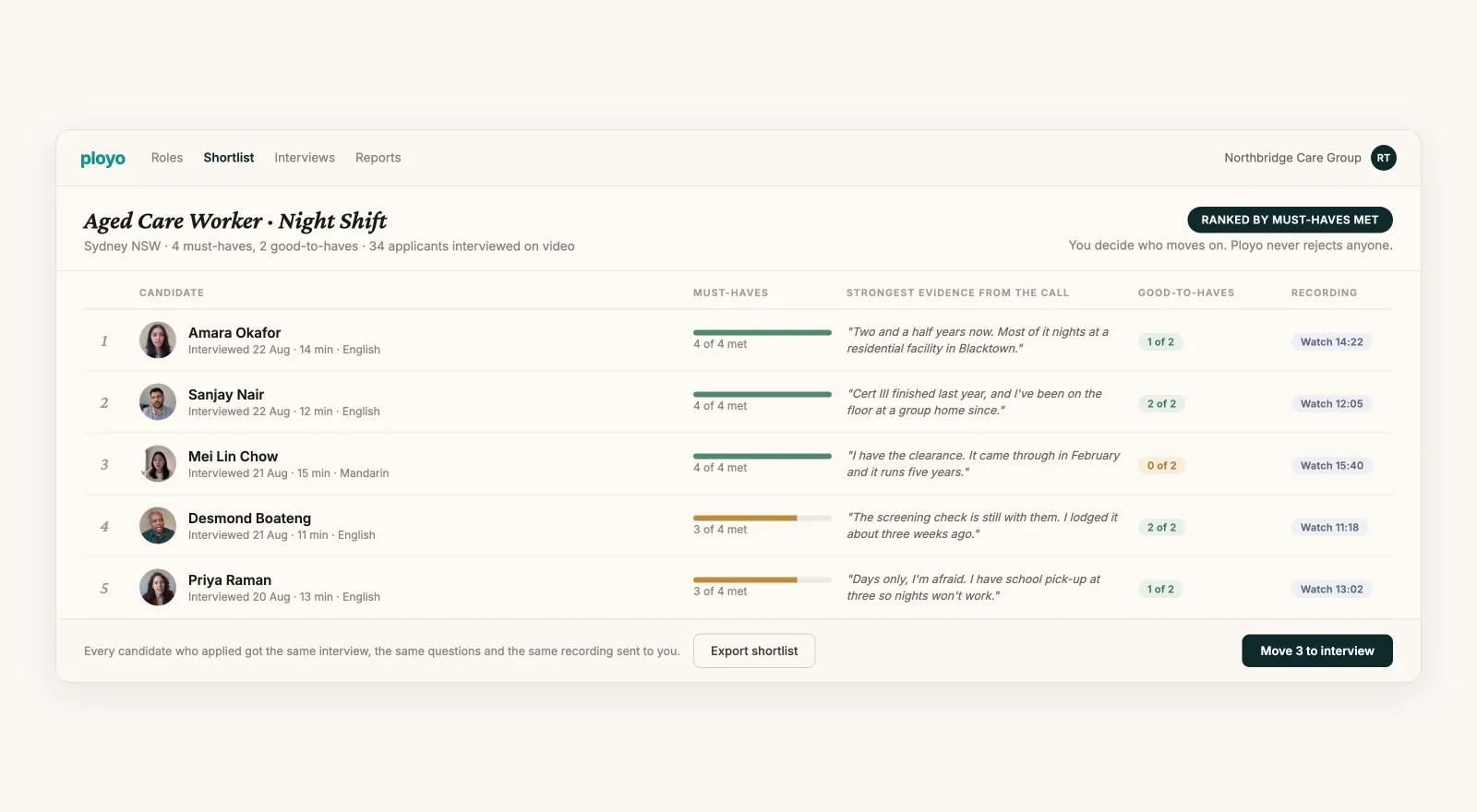
Five agents, one funnel, and where Mochi actually sits
Maki names its agents rather than describing generic features: Shiro, Mochi, Ken, Kumi and Tomo, each attached to a different stage of hiring. For a comparison against a single-purpose AI interviewer like Ployo, the agent that matters is Mochi, which runs a live conversational voice or chat screening interview directly with candidates.
What Maki's own pages do not confirm is whether that Mochi conversation is recorded on video. The homepage describes a conversational agent without stating a video-recording capability for the screening stage, which is a real gap for a buyer trying to compare it against a video interview like Ployo's. Where a vendor does not state something, this page says so rather than filling in a guess, and that absence is itself worth noting when you are deciding whether the interview record will be something a hiring manager can actually watch back.
The same answer, two formats
A first round is worth what it can find out. Both of these are real screening formats and both work; they differ in what happens after the candidate stops talking.
Typed answer
“One of our residents kept trying to leave at night. I sat with her, worked out she was looking for her husband, and changed her evening routine.”
Submitted, scored, and the interview moves to the next question. Written in private, at the candidate’s own pace, with every tab on their machine available to them.
Spoken answer
“One of our residents kept trying to leave at night. I sat with her, worked out she was looking for her husband, and changed her evening routine.”
And then, unscripted
“You changed the routine. Who signed that off, and what did you write in the notes?”
That second question did not exist until she gave the first answer. It is the one that separates a story a candidate can tell from a shift they actually ran.
Tomo is a co-pilot, not a replacement interviewer
This is the part of Maki's product that most changes the comparison. Tomo is described as a voice-only agent that joins a human interviewer's own live Zoom, Teams or Meet call, listens, and takes notes. It has no video avatar, and it does not conduct the interview; the human interviewer still runs it.
That makes Tomo a genuinely useful tool for a company that wants to keep its interviewers but reduce their note-taking load, and it is not a weaker version of what Ployo does, it is a different job entirely. Ployo's live AI video interview replaces the human round outright: no recruiter joins the call, the AI asks the questions, follows up on the answers, and the recording is what the hiring team reviews afterward. A buyer evaluating Maki against Ployo on the strength of 'they also have an AI interviewer' should confirm which agent they mean, because Mochi and Tomo do different jobs at different points in the process.
The funding and review gap, stated plainly
Maki is ahead here and this page will not soften it. A $28.6M Series A led by Blossom Capital with DST Global, closed January 2025 on reported 300%+ growth in 2024, is a serious funding round, and the customer list, H&M, BNP Paribas, PwC, Deloitte, FIFA, Volkswagen, Capgemini and more, is a genuinely large enterprise logo wall. Its G2 rating, roughly 115 to 131 reviews at 4.7/5 with ease-of-use around 9.6/10, is a real, independently checkable trust signal.
Ployo has not disclosed a funding round and does not yet have a public review profile at that volume. What Ployo has instead is a narrower, more concentrated evidence base: production use on Australian care and healthcare hiring, where the interview is the actual product being evaluated call by call rather than a rating averaged across a large and varied customer base.
Fairness claims, and what is confirmed behind them
Maki's own pages make general claims of bias-audited AI with fairness controls, an external independent audit, and explainable scoring. What was not found on the pages fetched for this comparison is a specific technical mechanism behind those claims, such as a named audit report, a methodology, or a published date. That does not mean the claims are false; it means they were not independently confirmable from Maki's own public pages at the time of this check.
Ployo makes no equivalent claim of an independent audit either, and does not overstate what it has: no SOC 2 report, no named bias audit. Its safeguards are structural instead, the same requirements put to every candidate, a verdict tied to a specific transcript quote, and no candidate ever auto-rejected by the system. Neither company's compliance posture should be taken on faith from a homepage; a buyer with a hard requirement here should ask both directly.
Ployo platform data
30,000+
AI Interviews Completed
340,000+
Candidate Answers Graded
70%+
Interview Completion Rate
15,000+
Recruiter Hours Saved
Who each is actually built for
Maki is built for large enterprises hiring frontline workers, early talent and graduates, specialists, and staffing companies, with a clear European enterprise emphasis backed by real capital. If your hiring problem spans multiple stages of the funnel and you want one well-funded vendor across all of them, that points toward Maki.
Ployo is built for a narrower, currently smaller case: a hiring team that wants the interview itself, live, adaptive, and recorded, replacing the phone screen outright, running in production on Australian care and healthcare hiring today. If the specific thing you are buying is an AI that conducts the interview rather than a platform that touches several stages of it, that is what this page is actually about.
Maki has built a platform: five named agents, a well-funded balance sheet, and enterprise logos across Europe. Ployo has built one thing precisely: a live AI that conducts the interview itself and hands back the recording. The distinction that matters most is inside Maki's own architecture, not against Ployo. Mochi talks to candidates but its video status is unconfirmed. Tomo sits inside the interview stage but assists a human rather than replacing one. If what you are buying is an AI that runs the interview end to end, check which Maki agent you are actually evaluating before you compare it to Ployo at all.
Maki is a layer 6 tool: ai live interviewers. An AI conducts a real-time interview: it asks, listens, follows up, and adapts to the answer. See how the six layers of first-round screening fit together →
Frequently asked
Does Maki's AI actually conduct interviews with candidates?
It depends which Maki agent you mean. Mochi runs a live conversational voice or chat screening interview directly with candidates; Maki's own pages do not confirm whether that conversation is recorded on video. Tomo, a separate agent, does not interview candidates at all: it joins a human interviewer's own live call as a voice-only note-taking co-pilot. Ployo's AI conducts the entire interview itself, on video, with no human interviewer on the call.
How much does Maki cost?
Not published on Maki's own site. A third-party pricing guide describes a flexible, credit-based model priced by which AI agents are activated, with every plan ending at a sales conversation. Ployo publishes tiered pricing at ployo.ai/pricing, from US$249 a month with interviews included, with no volume floor.
Has Maki's AI been independently audited for bias?
Maki's own pages make general claims of bias-audited AI, fairness controls, and an external independent audit, but no specific audit report, methodology, or date was found on the pages fetched for this comparison. Ployo has not commissioned an independent bias audit either and does not claim one; its safeguards are structural instead, including identical requirements for every candidate and a transcript quote behind every verdict.
How much funding has Maki raised?
$28.6M in a Series A round announced January 2025, led by Blossom Capital with DST Global participating, on the back of reported 300%+ growth in 2024. Ployo has not disclosed a funding round.
What languages does Maki support?
Maki claims 45+ languages for voice screening on its homepage. Ployo does not publish a fixed language count.
Sources
Facts about other products come from their own public pages, checked on the dates below. Vendors change pricing and features without notice, so verify anything decision-critical at the source. Found something out of date? Tell us and we'll correct it.
- Maki homepage · checked 2026-08-05
- Businesswire: Maki raised $28.6M Series A to redefine HR with conversational AI agents · checked 2026-08-05
- HeroHunt.ai: Maki pricing and alternatives guide · checked 2026-08-05
- Maki G2 reviews listing · checked 2026-08-05
Most of what decides this is your own role, not the feature grid. Worked examples of AI screening applied to specific sectors are on the solutions pages, and the practical how-to side, including what compliance actually requires before someone starts a shift, is in the hiring guides.
If you would rather see the mechanics than read about them, the AI video interviewer page walks through an interview end to end.
Related comparisons

TRUSTED BY HIRING TEAMS AT








The only comparison that settles it
Run it on your own applicants. Book 30 minutes with the founder, we'll set Ployo up on a role you're hiring for right now, and you can judge the shortlist yourself.
30-minute call · See Ployo on one of your live roles