
Ployo vs HireVue: a recorded interview, or a live one?
Updated August 2026
HireVue is the company most people mean when they picture an AI video interview, and for a decade that meant one thing specifically: a candidate records answers to fixed prompts, alone, and an AI scores the transcript later. It is majority-owned by The Carlyle Group since an October 2019 growth investment, states its customers include over 60% of the Fortune 100, and counts Unilever, IKEA, Hilton, Delta and Oracle among its named customers. It is also the vendor with the most scrutiny behind it: a 2019 FTC complaint, a discontinued facial-analysis feature, and two Illinois laws written substantially because of tools like it. In March 2026 it acquired the technology behind Hireguide to build a live, AI-conducted interviewer of its own, the same category Ployo already competes in. This page compares what each actually is today, not what either used to be.
HireVue is the better choice if you need enterprise-scale ATS plumbing that already exists, government-grade compliance (FedRAMP authorization), or a recorded format that lets recruiters review answers on their own schedule across candidates in wildly different time zones. It is the most established, most procurement-ready vendor in this category, and that is a genuine, hard-won advantage. Ployo is the better choice if the interview itself needs to be a conversation rather than a fixed set of prompts, and if you want to check the reasoning behind a verdict rather than trust a transcript score. HireVue is now building toward that model too, from the technology behind its March 2026 acquisition of Hireguide, which is itself evidence of where this category is heading. Today, Ployo already runs it in production; HireVue's live interviewer is a newer, less established line on the same platform that built the recorded format this whole comparison is really about.
An enterprise hiring platform combining recorded, on-demand video interviews with AI-scored assessments, scheduled live video interviewing, and separate skills tools; the company that built the async video-interview category and is now expanding into a live, AI-conducted interview line.
- Format
- Both one-way, on-demand recorded interviews (transcribed and scored by AI after the fact) and scheduled, two-way live video interviewing have long been offered on the same platform. The recorded, AI-scored format is the one that built HireVue's name and is still what most people mean when they say 'HireVue'. In March 2026 HireVue acquired the technology behind Hireguide to build a newer, agentic and voice-driven live 'AI Interviewer' line. A widely repeated 2026-06-18 launch date for that product could not be independently confirmed against HireVue's own site in this research and is not asserted here; only the acquisition and its stated purpose are cited.
- Based
- Sandy/South Jordan, Utah, United States. Global enterprise customer base; the platform supports 40+ languages and holds FedRAMP authorization for US government use.
- Pricing
- Not published. HireVue's pricing page lists only named tiers (Essential and Premium, re-checked 2026-08-21) with no dollar figures, and routes visitors to a demo request. Third-party buyer guides not affiliated with HireVue estimate enterprise contracts in the roughly $35,000 to $145,000-plus per year range plus $15,000 to $40,000 onboarding fees; treat these as unverified secondary estimates, not confirmed HireVue pricing.
Side by side
| HireVue | Ployo | |
|---|---|---|
| Interview format | Both recorded, on-demand interviews and scheduled live video interviewing on the same platform; the recorded, AI-scored format built the category and is still the one most associated with the HireVue name. | One format only: a live, two-way AI video interview. The interview adapts to each answer in real time. |
| Does an AI conduct the interview live | Not historically. HireVue's core, AI-scored product is a recording graded after the candidate finishes; a live, AI-conducted 'AI Interviewer' line is new, built from the technology behind HireVue's March 2026 acquisition of Hireguide. | Yes. Every interview is a live conversation the AI conducts and adapts in real time, with follow-ups generated from what the candidate actually said. |
| Does the AI appear on video | No on-screen AI avatar found in this research for either product line. The recorded format has no AI presence during the candidate's answer at all. | No. The AI speaks but has no on-screen avatar; the candidate is the one on camera, throughout. |
| What the hiring team receives | AI scoring of the transcribed answer's content, keyword and phrase relevance, structure and language patterns against a job-specific model, plus the recording; separate skills tools (game-based assessments, CodeVue coding tests, language proficiency tests) are sold alongside. | A per-requirement verdict quoting the candidate's own words as evidence, plus the full video recording and transcript. |
| Regulatory and scrutiny history | Named in a November 2019 complaint to the FTC by EPIC over its AI-scored video interviews; discontinued facial-expression analysis in January 2021 as a result. Now also subject to Illinois's AI Video Interview Act (effective 2020) and its January 2026 HB3773 expansion. | Not named in the EPIC complaint or any comparable regulatory action found in this research. Subject to the same Illinois AI-in-employment disclosure laws as any AI tool used on Illinois candidates, Ployo included. |
| Ownership | Majority-owned by The Carlyle Group, a private equity firm, since an October 2019 growth investment; original investors including Sequoia and TCV retained minority stakes. | Independent and founder-led. |
| Enterprise ATS integrations | Ten named enterprise systems including Workday, SAP SuccessFactors, Oracle/Taleo, iCIMS and Greenhouse, plus FedRAMP authorization for US government use. | Integrates per customer; no published integration list. |
| Pricing | Not published. Named tiers only; third-party buyer guides estimate contracts roughly $35,000 to $145,000-plus a year, unverified. | Published: tiered USD pricing from US$249/month, interviews included (ployo.ai/pricing). No volume floor. |
Choose HireVue if
- You need enterprise-scale ATS plumbing that already exists. HireVue lists ten named, certified integrations, including Workday, SAP SuccessFactors, Oracle/Taleo, iCIMS and Greenhouse, plus FedRAMP authorization for US government hiring. That is a decade of enterprise procurement work Ployo has not done.
- You are hiring at a scale and compliance depth few vendors reach. HireVue states its customer base includes over 60% of the Fortune 100, and its platform supports 40+ languages. That install base buys real operational maturity: a support organisation, a security review that has already been through hundreds of enterprise buyers, and an assessment model iterated on for years.
- Your problem really is the recruiter's calendar, not the conversation. A recorded interview lets a hiring team review answers on its own schedule, and lets applicants across wildly different time zones respond without ever needing to align a calendar. That is a real problem HireVue's recorded format solves well, and it is the honest reason the format still has the install base it does.
- You need a decision that is easy to standardise for a legal or compliance review. A fixed set of recorded answers, scored the same way for every candidate, is a simpler artifact to audit line by line than a free-flowing conversation that goes wherever the candidate's answer takes it. If your review process is built around a fixed record, HireVue's recorded format is the more standardisable one.
- You are already running HireVue and it is working. Nothing here is a reason to rip out a system your hiring managers are getting value from.
Choose Ployo if
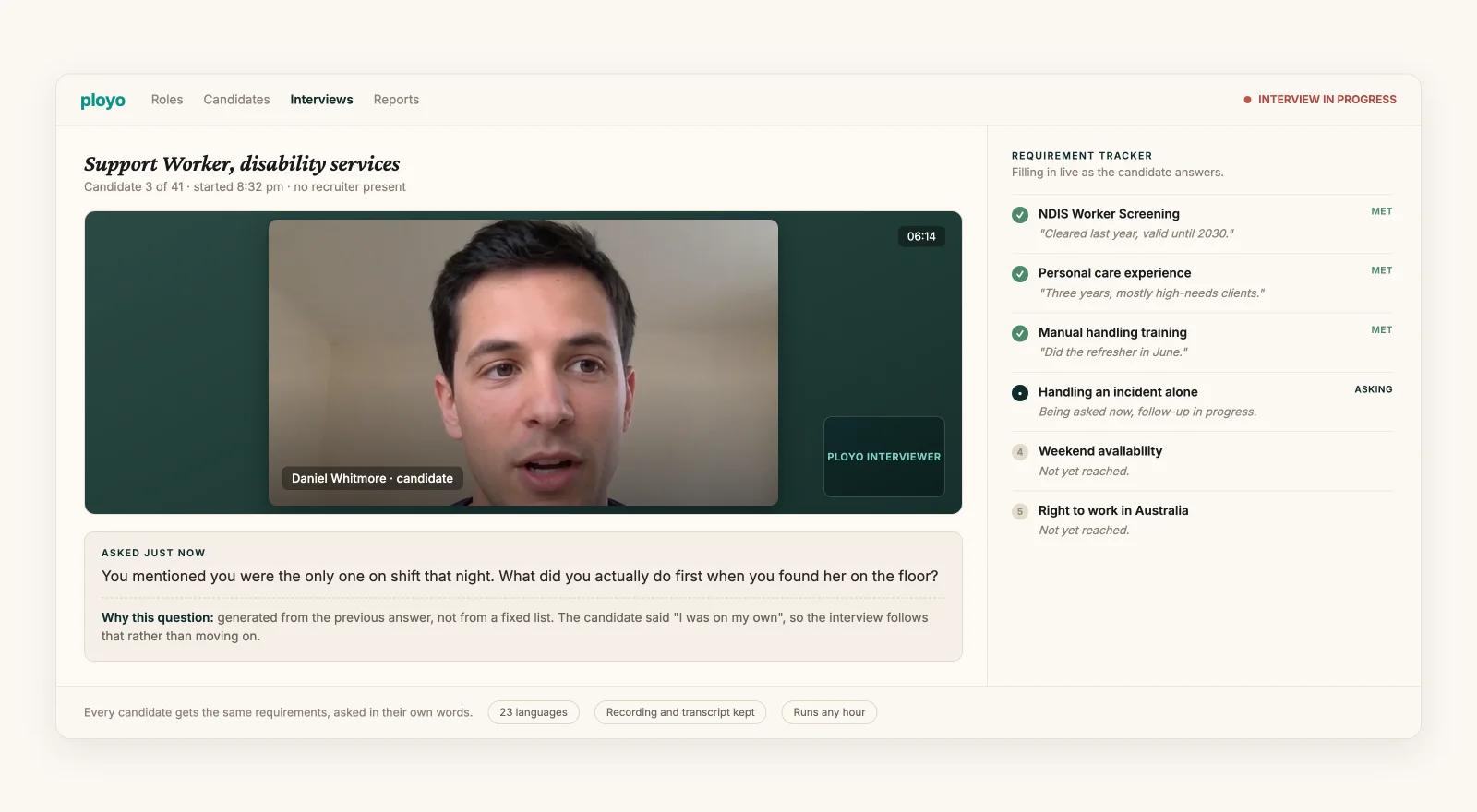
- The job is a conversation, not a set of fixed prompts. HireVue's core, AI-scored product is a candidate answering the same fixed questions alone, with nobody there to ask the obvious follow-up. Ployo generates the next question from what the candidate actually said.
- You want to check the reasoning, not just trust the score. Ployo hands back a per-requirement verdict quoting the candidate's own words alongside the recording and transcript, so a hiring manager can watch the moment behind a disputed decision. HireVue's public materials describe scoring based on transcribed content and language patterns, not an equivalent quote-linked verdict.
- You hire in the hundreds, not at Fortune 100 scale. HireVue does not publish pricing, but its named tiers and enterprise sales motion signal a product built and procured for large employers. Ployo publishes tiered pricing from US$249 a month (ployo.ai/pricing), has no volume floor, and can run on a single role.
- Nobody has credible comparative evidence that a recording completes better than a live conversation, so that is not a reason to default to one. HireVue's own October 2025 white paper on applicant dropout does not report a completion rate compared against live formats, and no independent study found in this research does either. What is documented is candidate sentiment: independent reviewers on Capterra describe the recorded format as efficient for hiring teams but frequently 'impersonal' to candidates.
- Your compliance posture is 'we can show you exactly what happened,' not 'we passed a specific audit.' HireVue's own history, the 2019 EPIC complaint and the resulting move away from facial-expression analysis, is the clearest evidence in this category that an opaque AI score, however well-intentioned, becomes very hard to defend after the fact. Ployo's answer is structural rather than certificatory: no candidate is ever auto-rejected, and every verdict traces to a specific transcript quote a human can check.
A real interview, on video, that follows the answer
What HireVue actually is today
HireVue is the company most of this category gets measured against. It has been majority-owned by The Carlyle Group since an October 2019 growth investment, with original investors including Sequoia and TCV retaining minority stakes, and it names Unilever, IKEA, Hilton, Delta, GE, Staples, Oracle, Carnival and Anheuser-Busch among its customers. HireVue states its customer base includes over 60% of the Fortune 100, its platform supports 40+ languages, and it holds FedRAMP authorization for US government use, a compliance bar almost nothing else in this comparison cluster reaches.
The product itself is broader than the reputation. HireVue's own platform page frames it as both live and on-demand video interviewing, so scheduled, two-way video calls have long sat alongside the recorded format. But the recorded, AI-scored interview, transcribed, then evaluated for keyword relevance, structural specificity and language patterns against a job-specific model, is what built the company's name and is still what most people mean when they say 'HireVue'. Skills tools are sold alongside it: game-based assessments, CodeVue coding tests, and language proficiency tests, none of which Ployo offers.
The same answer, two formats
A first round is worth what it can find out. Both of these are real screening formats and both work; they differ in what happens after the candidate stops talking.
Typed answer
“One of our residents kept trying to leave at night. I sat with her, worked out she was looking for her husband, and changed her evening routine.”
Submitted, scored, and the interview moves to the next question. Written in private, at the candidate’s own pace, with every tab on their machine available to them.
Spoken answer
“One of our residents kept trying to leave at night. I sat with her, worked out she was looking for her husband, and changed her evening routine.”
And then, unscripted
“You changed the routine. Who signed that off, and what did you write in the notes?”
That second question did not exist until she gave the first answer. It is the one that separates a story a candidate can tell from a shift they actually ran.
The live AI Interviewer, and a date we won't assert
In March 2026, HireVue acquired the technology behind Hireguide specifically to accelerate an agentic, voice-based AI interviewer product, confirmed directly by HireVue's own press release. That is a real, material shift: the company that defined the recorded-interview category is now building the live, adaptive kind Ployo already runs.
A specific launch date of 2026-06-18 for this product circulates widely, but it could not be independently confirmed against HireVue's own site in the research behind this page, so this page states only what is confirmed: the acquisition happened, and its stated purpose is a live, agentic AI interviewer. If a hard date or feature set matters to your evaluation, verify it directly with HireVue before relying on the commonly repeated one.
The honest read is that this move is itself evidence for the case Ployo makes: live, adaptive interviewing is where the category is heading, and the incumbent is spending an acquisition to get there rather than iterating its recorded format further.
Facial analysis, discontinued, and what replaced it
Through March 2020, HireVue's algorithmic scoring model used facial-expression analysis, things like a furrowed brow or a smile, as part of how it evaluated recorded answers. The company publicly announced discontinuing this in January 2021, following a Federal Trade Commission complaint filed by the Electronic Privacy Information Center (EPIC) in November 2019, which alleged the practice was 'unfair and deceptive' under the FTC Act, citing unproven predictive validity, potential bias against non-native English speakers and people with disabilities, and a lack of transparency into the scoring algorithm.
No confirmed FTC enforcement ruling on that complaint was found in this research; it appears to have prompted a policy change rather than a formal FTC action. Then-CEO Kevin Parker stated the company now primarily assesses transcribed answer content, with speech pauses and tonality retained only as minor factors, and no public evidence found in this research indicates facial analysis has returned as of 2026.
Regulation that applies to us too, not just to them
Illinois has regulated this category specifically since its Artificial Intelligence Video Interview Act took effect on 1 January 2020: employers using AI to analyse video interviews must notify applicants, explain how the AI works and what it evaluates, obtain consent before evaluation, restrict who can see the video, delete a candidate's video within 30 days of request, and, if AI is the sole basis for advancing applicants, report applicant race and ethnicity annually to the state.
That law was broadened effective 1 January 2026 by House Bill 3773, amending the Illinois Human Rights Act. It moves beyond video specifically to require notice whenever AI influences any employment decision, disclosure of the AI product, its developer and the data it used, and treats a violation as a civil-rights violation under the Human Rights Act rather than a narrower video-specific rule.
This is worth stating plainly rather than leaving implied: these laws are written to cover any AI used in an employment decision involving an Illinois candidate, not specifically HireVue and not specifically recorded video. They apply to Ployo exactly as they apply to HireVue, and to every other vendor in this comparison cluster. Being newer, smaller, or live rather than recorded does not exempt a vendor from disclosure and consent obligations, and a buyer evaluating any AI screening tool for Illinois hiring should ask every vendor, including us, how it meets them.
Ployo platform data
30,000+
AI Interviews Completed
340,000+
Candidate Answers Graded
70%+
Interview Completion Rate
15,000+
Recruiter Hours Saved
What the evidence on candidate reaction actually says, and does not
The peer-reviewed research here is real but thin, and it is worth being precise about what it measured. Brenner, Ortner and Fay (2016, Frontiers in Psychology) ran a mock three-question asynchronous video interview with 106 German-speaking participants, not real job applicants, and found acceptance was driven by perceived usefulness and ease of use, with async video rated in the same favorability range as other 'non-interactive' selection procedures like personality inventories or cognitive tests, less favourably than interactive, synchronous methods. It did not run a direct head-to-head comparison against a live interview. Zibarras and colleagues (2018, MedEdPublish) interviewed 10 UK medical-school applicants after a real asynchronous video multiple-mini-interview and found they judged the format broadly fair, standardised and consistent, but raised the loss of two-way interaction, technical glitches penalising performance, and a 'digital divide' disadvantaging less tech-savvy candidates; all ten said async video should supplement, not replace, face-to-face interviews. A more recent study, Falls et al. (2025, International Journal of Selection and Assessment), found applicants generally react less favourably to asynchronous than synchronous video interviews, though its full methodology sits behind a paywall and could only be checked against its public abstract.
On completion rates specifically, be sceptical of any number either side of this category quotes. No rigorous, independently audited, apples-to-apples comparison of completion or drop-off rates between asynchronous and live interviews was found anywhere in this research. The commonly repeated '60 to 70 percent' completion figure for async video traces to unsourced vendor-blog claims, not a named study or dataset, and should be treated as industry lore rather than evidence. HireVue's own October 2025 white paper on applicant dropout reports that completion rates have stayed relatively stable over time, with passive candidates dropping out earliest and stronger performers more likely to finish, but it is a vendor-authored source, not an independent one, and it does not publish a figure compared against live interviews. Independent reviewer sentiment on Capterra describes the recorded format as efficient for hiring teams but frequently 'impersonal' or robotic-feeling to candidates. The honest summary is that neither format currently has credible, independently verified data proving it completes at a higher rate than the other, and that gap is itself worth knowing before either vendor, us included, cites a number.
Who each is actually built for
HireVue is the safer, more procurement-ready choice for a Fortune 100, government, or heavily regulated buyer. FedRAMP authorization, a decade-deep ATS bench, and assessment types beyond video (coding, game-based, language) are real institutional depth that a newer vendor cannot manufacture quickly.
Ployo is built for a different buyer: a team that wants to run one role now, live, without a sales cycle or a volume floor, and that wants to check the reasoning behind a verdict rather than trust a scored transcript. Neither of those is the wrong shape of buyer. They are different buyers, and this comparison is only useful once you know which one you are.
HireVue's core product is a candidate answering fixed questions alone, then an AI scoring what they said after the fact. Ployo's only product is a live conversation an AI conducts and adapts in real time, with the recording and the reasoning handed back so a human can check it. The difference shows up the moment an answer is vague. A recording cannot ask the obvious follow-up, so the vagueness becomes the permanent record and somebody downstream has to guess what was behind it. That second question is where screening actually happens, and it is the one thing a recorded format structurally cannot do.
HireVue is a layer 4 tool: one-way async video. The candidate records answers to fixed prompts, alone, with no one on the other end. A recruiter watches later. See how the six layers of first-round screening fit together →
Frequently asked
Does HireVue still use facial analysis to score candidates?
No, not publicly, as of this research. HireVue used facial-expression analysis, things like a furrowed brow or a smile, as part of its scoring model through March 2020, then announced discontinuing it in January 2021 following a Federal Trade Commission complaint filed by EPIC in November 2019. Then-CEO Kevin Parker stated the company now primarily assesses transcribed answer content, with speech pauses and tonality retained only as minor factors. No public evidence found in this research indicates facial analysis has returned.
Does HireVue have a live AI interviewer now, like Ployo?
HireVue is building toward one. In March 2026 it acquired the technology behind Hireguide specifically to accelerate an agentic, voice-based AI interviewer product. A launch date of 2026-06-18 circulates widely for this product, but it could not be independently confirmed against HireVue's own site in this research, so it is not asserted here. What is confirmed is the acquisition and its stated purpose. Ployo has run a live, adaptive AI video interview in production throughout this period.
Has HireVue faced any legal complaints over its AI?
Yes. The Electronic Privacy Information Center (EPIC) filed a complaint with the Federal Trade Commission in November 2019 alleging HireVue's AI-scored video interviews were an 'unfair and deceptive' practice, citing unproven predictive validity, potential bias against non-native English speakers and people with disabilities, and a lack of transparency into the scoring algorithm. No confirmed FTC enforcement ruling was found; the complaint appears to have prompted HireVue's move away from facial-expression analysis roughly a year later. Separately, Illinois has regulated AI video interviewing since 2020 and broadened that regulation in January 2026 (HB3773) to cover AI use in any employment decision, a law that applies to any vendor screening Illinois candidates with AI, Ployo included.
How much does HireVue cost?
HireVue does not publish pricing. Its pricing page shows two named tiers, Essential and Premium, as re-checked on 2026-08-21, with no dollar figures, and routes to a demo request. Third-party buyer guides not affiliated with HireVue estimate enterprise contracts in the roughly $35,000 to $145,000-plus per year range with $15,000 to $40,000 onboarding fees; treat these as unverified secondary estimates. Ployo publishes tiered pricing at ployo.ai/pricing, from US$249 a month with interviews included, with no volume floor.
Do async video interviews really have lower completion rates than live interviews?
There is no rigorous, independently audited data that answers this either way. The commonly cited '60 to 70 percent' completion figure for async video interviews traces to unsourced vendor-blog claims, not a named study or dataset, and should be treated as industry lore rather than evidence. HireVue's own October 2025 white paper reports that completion rates have stayed relatively stable over time, with passive candidates dropping out earliest, but it does not publish a figure compared against live interviews, and it is a vendor-authored source rather than an independent one. The honest answer is that neither format currently has credible published data proving it completes at a higher rate than the other.
Sources
Facts about other products come from their own public pages, checked on the dates below. Vendors change pricing and features without notice, so verify anything decision-critical at the source. Found something out of date? Tell us and we'll correct it.
- HireVue homepage · checked 2026-08-05
- HireVue platform page (live and on-demand video interviewing) · checked 2026-08-05
- HireVue pricing page (named tiers, no published figures) · checked 2026-08-21
- HireVue integrations page (10 named enterprise ATS integrations) · checked 2026-08-05
- HireVue October 2025 white paper: Applicant Dropout Completion Rate Drivers and Consequences · checked 2026-08-05
- HireVue press release: HireVue acquires Hireguide technology to accelerate agentic AI hiring · checked 2026-08-05
- SHRM: HireVue discontinues facial-analysis screening · checked 2026-08-05
- EPIC: HireVue facing FTC complaint from EPIC, halts use of facial recognition · checked 2026-08-05
- Carlyle: HireVue receives growth investment, new majority investor Carlyle · checked 2026-08-05
- HireVue G2 reviews listing · checked 2026-08-05
- HireVue Capterra reviews · checked 2026-08-05
- Holistic AI: Illinois Artificial Intelligence Video Interview Act summary · checked 2026-08-05
- Hinshaw & Culbertson: Illinois adopts new AI-in-employment regulations for 2026 (HB3773) · checked 2026-08-05
- Brenner, Ortner & Fay (2016), Frontiers in Psychology: Asynchronous Video Interviewing as a New Technology in Personnel Selection · checked 2026-08-05
- Zibarras et al. (2018), MedEdPublish: An exploration of applicant perceptions of asynchronous video MMIs in medical selection · checked 2026-08-05
- Falls et al. (2025), International Journal of Selection and Assessment: The Impact of Explanations on Applicant Reactions to Automated Asynchronous Video Interviews · checked 2026-08-05
- Truffle: Asynchronous interviews in 2026, a small business guide (source of the unsourced '60-70%' completion claim) · checked 2026-08-05
Most of what decides this is your own role, not the feature grid. Worked examples of AI screening applied to specific sectors are on the solutions pages, and the practical how-to side, including what compliance actually requires before someone starts a shift, is in the hiring guides.
If you would rather see the mechanics than read about them, the AI video interviewer page walks through an interview end to end.
Related comparisons

TRUSTED BY HIRING TEAMS AT








The only comparison that settles it
Run it on your own applicants. Book 30 minutes with the founder, we'll set Ployo up on a role you're hiring for right now, and you can judge the shortlist yourself.
30-minute call · See Ployo on one of your live roles