
Alternatives to phone screening every applicant yourself
Updated August 2026
Six honest options, including doing nothing and including the two that usually get chosen and then quietly abandoned. We sell one of these. It is not the right answer for everyone and we have said so where it is not.
There is no single best alternative to screening every applicant yourself, because 'I need to stop doing this by phone' usually means one of six different fixes, and each points somewhere else. If the constraint is headcount and the work is judgement and relationships, hire another recruiter or coordinator. If a role is senior, urgent or one-off, an agency is often the right call, though the fee repeats every time someone leaves. If your questions are fixed and do not need probing, one-way recorded video is cheap and fast. If you need facts filtered at scale and everyone already answers a text, chat or SMS screening wins on completion. If the conversation itself is the assessment, and you want an auditable record of what was asked and answered, that is the layer Ployo sits in. And often the cheapest fix is upstream of all of this: tightening the job ad so fewer of the wrong applicants show up in the first place. None of these is free, including the one that feels free. Work out what your current approach actually costs before picking a replacement for it.
The default first round on the planet: a recruiter or hiring manager calls each applicant for ten to fifteen minutes and works through a checklist.
- Format
- A live phone call. No software, no video, no adaptive AI, just a person and a calendar.
- Based
- Wherever your team already is. There is no vendor here, this is the status quo most hiring runs on today.
- Pricing
- Not billed as software. The real cost is staff time, priced out in the first section below.
Side by side
| Doing it yourself | Ployo | |
|---|---|---|
| Cost per completed screen | Roughly A$30 or more once you count the loaded hourly cost of whoever calls and the average number of attempts to reach an applicant. | Published: tiered USD pricing from US$249/month, interviews included (ployo.ai/pricing). No volume floor. |
| Does it scale with applicant volume | No. Ten minutes each means a role with 400 applicants is 66+ hours of calls no coordinator has. | Yes. Every applicant gets the same interview regardless of volume. |
| Adapts to the answer | Yes, a human can follow up on anything, which is the format's real strength. | Yes. Follow-up questions are generated from what the candidate actually said. |
| What survives to be reviewed | Whatever notes the caller wrote down, if any. | A per-requirement verdict quoting the candidate's own words, plus the full video recording and transcript. |
| Who actually gets a first-round conversation | In practice, only the applicants who survive a resume skim first, since there is rarely time to call everyone. | Every applicant who applies. |
Choose Doing it yourself if
- The work needing doing is judgement and relationships, not volume, in which case hiring another recruiter or coordinator raises quality, not just throughput.
- The role is hard to fill, senior, or urgent and one-off. An agency is fast and effective there, even though the fee repeats if the role turns over.
- Your questions are fixed and the answers do not need probing. One-way recorded video is cheap and genuinely faster than calling everyone.
- You need facts filtered fast and at scale: availability, location, licence, right to work. Chat or SMS screening gets a very high response rate because everyone answers a text.
- Your applicant quality, not quantity, is the problem. Tightening the job ad, stating the pay and shifts honestly, and replying within a day can cut the volume needing screening at all, and it is free.
- You hire under about ten times a year, the role is senior clinical or leadership, or a meaningful share of your candidates are in areas with poor connectivity. Under those conditions a phone call is fine, a structured first round adds little, and a video interview would exclude people it should not.
Choose Ployo if
- Volume is high, the conversation matters, and you need an auditable record of what each candidate was asked and answered. That is the exact case a live AI interview is built for: a two-way conversation that adapts, asks a follow-up based on the answer it just heard, and returns a transcript with the evidence behind every score.
- One more recruiter screening by phone only raises your ceiling by one person. If applications, not offers or onboarding, are the actual bottleneck, adding headcount does not fix the arithmetic the way giving every applicant a live interview does.
- You are filling the same role repeatedly. An agency's placement fee turns into a recurring cost every time someone leaves, which is exactly the kind of high-turnover, high-volume hiring a per-candidate AI interview is built for instead.
- The answer needs a follow-up. Nobody is watching a one-way recording when it arrives, so it can never ask the obvious next question, and completion rates are usually lower because candidates dislike talking to a countdown. A live interview asks the follow-up in the moment, while the candidate is still there.
- You need to know how someone speaks to a person. Text tells you nothing about manner, warmth, or how a candidate would explain something to a distressed participant, and for a lot of frontline hiring that is the whole interview.
- You genuinely receive hundreds of reasonable applicants and cannot get through them. Fixing the job ad helps quality; it does not create the hours needed to have a real conversation with everyone who is actually qualified, which is the problem an AI interview is built to solve.
- Most teams that try one of these and feel like it did not cut the workload find one of three causes: the output landed somewhere nobody looks, it screened but did not evidence, or it was priced per candidate so it got rationed. A verdict with the candidate's own words attached, on a flat plan rather than a per-screen fee, is built to avoid all three.
Candidates ranked by what they actually proved
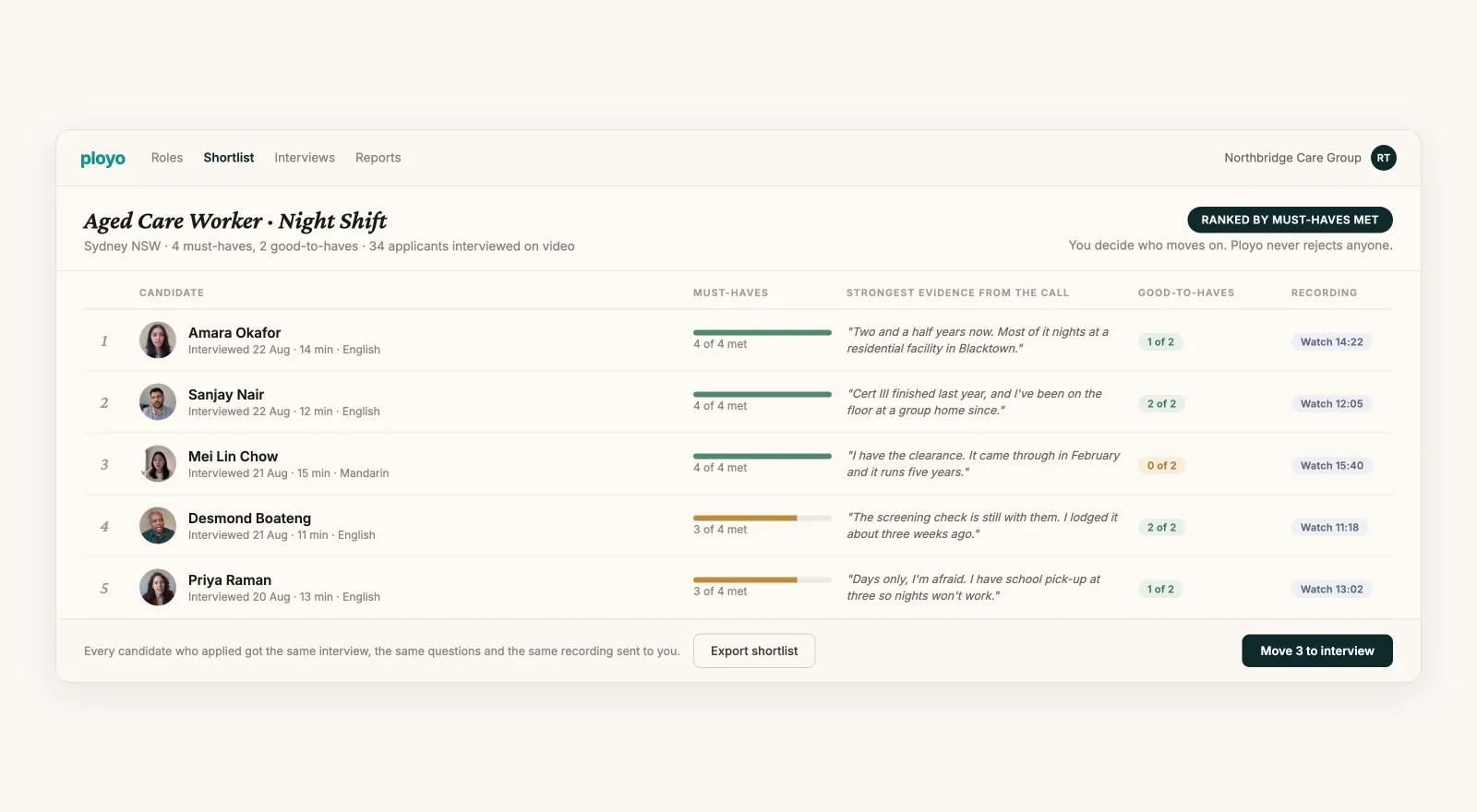
The alternatives, and who each one suits
Ordered by the kind of buyer they fit, not by preference. Several of these are a better choice than Ployo for a given team, and the note says which.
The most common answer and sometimes the correct one, particularly if the bottleneck is offers, onboarding and compliance rather than first-round calls.
Best for: The work needing doing is judgement and relationships, not volume.
Fast and effective, and the margins are why providers eventually go looking for something else. For casual and high-turnover frontline roles the cost repeats every time somebody leaves.
Best for: The role is hard to fill, senior, or urgent and one-off.
You send a candidate a fixed list of questions, they record answers alone, somebody watches later. Cheap and genuinely faster than calling everyone.
Best for: Your questions are fixed and the answers do not need probing.
A bot asks qualifying questions by text. Very high response rates, because everyone answers a text, and excellent for logistics: availability, location, licence, right to work.
Best for: You need facts filtered fast and at scale.
A two-way conversation that adapts, asks a follow-up based on the answer it just heard, and returns a transcript with the evidence behind every score. This is what Ployo does, on video.
Best for: Volume is high, the conversation matters, and you need an auditable record of what each candidate was asked and answered.
Frequently the cheapest fix and the least considered. Screening out is often a symptom of attracting the wrong applicants. Tightening the ad, stating the pay and the shifts honestly, and replying within a day rather than a week all reduce the volume needing screening at all.
Best for: Your applicant quality, not quantity, is the problem.
Start with what the current approach actually costs
Before comparing options, price the one you are already running. Take the loaded hourly cost of whoever makes first contact, multiply by the length of a screening call, then multiply again by the number of attempts it takes to reach a frontline applicant. Two or three is normal.
At A$50 an hour, a 20 minute call is A$16.70 of paid time. Reaching half your applicants on the third attempt puts the real figure well past A$30 per completed screen, and that is before the ones you never reach at all. Most teams have never worked this out, which is why the status quo feels free.
The same answer, two formats
A first round is worth what it can find out. Both of these are real screening formats and both work; they differ in what happens after the candidate stops talking.
Typed answer
“One of our residents kept trying to leave at night. I sat with her, worked out she was looking for her husband, and changed her evening routine.”
Submitted, scored, and the interview moves to the next question. Written in private, at the candidate’s own pace, with every tab on their machine available to them.
Spoken answer
“One of our residents kept trying to leave at night. I sat with her, worked out she was looking for her husband, and changed her evening routine.”
And then, unscripted
“You changed the routine. Who signed that off, and what did you write in the notes?”
That second question did not exist until she gave the first answer. It is the one that separates a story a candidate can tell from a shift they actually ran.
We already bought one of these and it did not cut our workload
This comes up often enough to deserve a straight answer. It usually has one of three causes.
The output landed somewhere nobody looks. A shortlist inside a second dashboard moved the work rather than removing it. Fix the destination before you replace the tool.
It screened but did not evidence. If the output is a score with no quote behind it, a careful recruiter re-reads everything anyway, so nothing was saved. The test is whether someone can accept the shortlist without redoing the assessment.
It was priced per candidate, so you rationed it. If each screen costs money you start filtering CVs first, which is the work you were trying to remove. This is why a flat plan with interviews included, not a per-screen fee, avoids the trap. See [pricing](/pricing) for how Ployo is scoped.
Where we would not recommend Ployo
Under about ten hires a year the numbers do not work and a phone call is fine. For senior clinical or leadership roles a structured first round adds little. And if a meaningful share of your candidates are in areas with poor connectivity, a video interview will exclude people, which is a worse outcome than a slow process.
None of the other five alternatives on this page fix the same problem at once: giving every applicant a real conversation without needing a bigger team. The recruiter and the agency both cost per head. The one-way video and the chat screen both drop the conversation to gain scale. A live AI interview is the only option here that keeps the conversation and the scale at the same time.
Doing it yourself is a layer 1 tool: the recruiter phone screen. A recruiter calls the candidate for ten to fifteen minutes and works through a checklist. See how the six layers of first-round screening fit together →
Frequently asked
What are the alternatives to manually phone screening every aged care job applicant?
Six, and which is right depends on the role. For entry-level roles that pull hundreds of applications, kitchen, cleaning, laundry and transport, the problem is throughput and automating the first round is the honest answer. For a registered nurse role with four applicants, none of the six apply and you should ring all four today.
What are the alternatives to manually phone screening every enrolled nurse applicant?
At typical EN application volumes the constraint is usually your coordinator's hours rather than the number of candidates, so the cheapest fix is often sequencing rather than software: check registration before the interview rather than after, and reply within a day. Automate the first round only if applications genuinely exceed the hours available to screen them.
What are the alternatives to manually phone screening physiotherapist or allied health applicants?
For the registered allied health professions the honest answer is that you should not add a screening step at all. Physiotherapists, occupational therapists and podiatrists are scarce and candidate-led, so friction loses you the candidate rather than filtering them. Allied health assistants and mental health support workers are the opposite case and behave like volume hiring.
What are the alternatives to manually phone screening community care or support coordinator applicants?
Chat or SMS screening if you only need facts filtered, since it gets the highest completion rate of any format. A live interview if a borderline answer needs a second question to resolve. And the free option first: state the pay and the actual shifts in the ad, which cuts the volume needing screening at all.
What is the actual difference between a recruiting chatbot and something that talks to the candidate?
A chatbot exchanges text and is very good at filtering facts. A live interview is a spoken conversation that can follow up on what was just said. For frontline care the second question is usually the whole interview: someone says they covered night shifts, and what matters is whether that was alone or with a second carer.
Is one-way video the same as an AI interview?
No, and the distinction is worth insisting on when you evaluate. One-way recorded video sends a fixed list of questions and grades the answers afterwards. A live interview adapts as it goes. Both get called AI interviewing in marketing.
Is it cheaper to hire direct than to use an agency?
For repeat frontline roles, usually yes, once you can actually process the applicants. Agency cost recurs with turnover. Work out your placement fees over the last twelve months for one role type and compare it to a year of doing it in-house, including the screening time.
Does a not for profit or church run provider need a different screening approach?
The compliance obligations are identical. What differs is usually budget and the weight placed on values fit, which is an argument for a conversation over a form rather than a different process.
What is the cheapest way to track credential expiry for a small team?
Under about thirty staff, a shared calendar with reminders genuinely works, and paid compliance software is hard to justify. The failure mode is not the spreadsheet, it is that nobody owns it. Assign the renewals to one person before you buy anything.
Sources
Facts about other products come from their own public pages, checked on the dates below. Vendors change pricing and features without notice, so verify anything decision-critical at the source. Found something out of date? Tell us and we'll correct it.
Most of what decides this is your own role, not the feature grid. Worked examples of AI screening applied to specific sectors are on the solutions pages, and the practical how-to side, including what compliance actually requires before someone starts a shift, is in the hiring guides.
If you would rather see the mechanics than read about them, the AI video interviewer page walks through an interview end to end.
Related comparisons

TRUSTED BY HIRING TEAMS AT








The only comparison that settles it
Run it on your own applicants. Book 30 minutes with the founder, we'll set Ployo up on a role you're hiring for right now, and you can judge the shortlist yourself.
30-minute call · See Ployo on one of your live roles