
Ployo vs XOR: priced text chatbot or live interview?
Updated August 2026
XOR is a text and SMS-first recruiting chatbot built specifically for blue-collar and hourly hiring, and it does something almost nothing else in this comparison cluster does: it names a price on its own homepage with no click-through at all. Ployo also publishes tiered pricing, at ployo.ai/pricing, but XOR's number sits right on the front page and neither one requires a sales call just to see a figure. What follows is the rest of the comparison, including what XOR does not publish and what this research could not confirm.
XOR is the better choice if what you want most is a text-first chatbot for blue-collar hiring with an actual published price you can plan around, and your candidates are comfortable being screened entirely by text over SMS, Messenger or WhatsApp. Publishing $500 per hire while every other vendor in this comparison hides behind 'contact sales' is a genuine, buyer-friendly move and it should weigh in XOR's favour. Ployo is the better choice if the job needs someone who can actually talk, and you want the hiring manager to see and hear the candidate before deciding. The honest summary: XOR is transparent on price and narrow on format. Ployo is opaque on price and built around the one format, a live conversation, that a text chatbot cannot reach.
A text and SMS-first recruiting automation platform built around Text Recruiting and Text-to-Apply, using an AI chatbot to screen and schedule blue-collar and hourly candidates over SMS, and, per third-party summaries, Meta Messenger and WhatsApp.
- Format
- Text and SMS-based chatbot screening. No voice or video screening was found on xor.ai in this research.
- Based
- San Jose / San Francisco, California. Founded 2016.
- Pricing
- The only vendor researched in this layer that publishes an actual number. XOR's own homepage states it can deliver blue-collar workers 'to your door for only $500 per hire within less than 5 days.' A third-party summary (Software Finder, not confirmed directly on xor.ai) describes a $5,000 minimum covering 10 hires, with a refund guarantee if a role stays unfilled after 90 days; treat that specific detail as third-party sourced.
Side by side
| XOR | Ployo | |
|---|---|---|
| Interview format | Text and SMS chatbot, also reaching candidates via Meta Messenger and WhatsApp per third-party summaries. | Live spoken interview. The candidate is on camera and answers out loud in real time. |
| Is the candidate ever seen or heard | No. No voice or video screening was found on xor.ai. The entire interaction is typed text. | Yes. The candidate is on camera, speaking, for the full interview. |
| Does the interview adapt to the answer | Not detailed on xor.ai in this research. | Yes. Follow-up questions are generated from what the candidate actually said. |
| What the hiring team receives | Not detailed on xor.ai. A specific per-candidate output artifact was not published in the pages checked. | A per-requirement verdict quoting the candidate's own words, plus the full video recording and transcript. |
| Pricing | Published. XOR's own homepage states roughly $500 per hire. A third-party summary describes a $5,000 minimum covering 10 hires with a 90-day refund guarantee; not confirmed directly on xor.ai. | Published: tiered USD pricing from US$249/month, interviews included (ployo.ai/pricing). No volume floor. |
| Volume minimum | Implied. A third-party summary describes a $5,000 minimum covering 10 hires. | None. Commonly run on a single role with a few hundred applicants. |
| Funding | Could not be confirmed in this research. A Crunchbase search shows a seed round with SignalFire listed as an investor, but no confirmed dollar amount. | Not published. |
| Published performance stats | Inconsistent across sources checked, for example candidate satisfaction cited at both 90% and 99.3% in different summaries, not reconciled to one authoritative figure. | No comparable aggregate stat published on this page. Verdicts are per-candidate and evidence-linked rather than a single satisfaction number. |
Choose XOR if
- It is the only vendor in this entire comparison set that puts an actual price on its own homepage with no click-through at all. XOR's own homepage states roughly $500 per hire for blue-collar roles, delivered in under 5 days. Ployo also publishes pricing, at ployo.ai/pricing, but it sits on a dedicated page rather than the homepage itself, and every plan still starts with a call to the founder to buy. XOR's homepage number is a genuine, stated win, not a technicality.
- Its reach is built for exactly the population that resists email and desktop applications. SMS, plus, per third-party summaries, Meta Messenger and WhatsApp, meets blue-collar and hourly candidates on the channel they already use, with none of the friction of a video call or even a scheduled phone screen.
- It has a long, specific track record in this exact niche. Founded in 2016 and focused specifically on blue-collar and hourly recruiting at volume, its named customers include ExxonMobil, Mars, ManpowerGroup, IKEA, UC Davis and Sutter Health, a genuinely broad base for a company with a comparatively low public profile.
- If your candidate population is large and simple to qualify, availability, right to work, a licence, willingness to start this week, a text chatbot answers those questions with essentially zero friction, on a phone, without an app, in a format many blue-collar applicants already prefer.
- It claims global, multilingual reach, six continents and 100-plus languages per its own marketing. This research could not independently verify the claim, but if it holds even partially it is relevant for an employer recruiting across a genuinely international, non-English-first workforce.
Choose Ployo if
- The candidate is never actually seen or heard on XOR. No voice or video screening was found anywhere on xor.ai in this research; the entire interaction is typed text. For roles where the job is talking to people, an aged care worker, a support worker, a delivery driver managing a difficult customer, that is not a minor gap, it is the one signal a text chatbot structurally cannot produce. Ployo's interview is live and spoken throughout, so the exact skill many blue-collar and frontline roles actually require is the thing being assessed, not something inferred from typed answers to a script.
- What a hiring manager receives back is a fundamentally different kind of evidence. This research could not find a published, specific output artifact from XOR, what a recruiter actually sees for one candidate once a chat screen finishes. Ployo returns a per-requirement verdict with the candidate's own words quoted as the evidence behind it, plus the full video recording and transcript, so a hiring manager can check any single decision in minutes rather than trust a chatbot's pass or fail.
- XOR's own $500-per-hire pricing carries an implied floor. A third-party summary of its pricing describes a $5,000 minimum covering 10 hires, which is a genuine commitment for an employer filling a handful of roles. Ployo has no volume floor at all and is commonly run on a single role with a few hundred applicants.
- The public evidence behind XOR's scale claims does not hold together cleanly. Different sources cite candidate satisfaction at both 90% and 99.3%, with no reconciled, authoritative figure, and XOR's own funding could not be confirmed in this research beyond a seed round naming SignalFire as an investor, unusual for a company operating since 2016. None of that means the product does not work. It does mean a buyer evaluating XOR on its stats is evaluating numbers this research could not independently verify, which is worth knowing before treating any of them as settled.
- A follow-up question in real time is a genuinely different test than a scripted text prompt. A vague or evasive typed answer stays vague, because a chatbot generally cannot push back the way a live interviewer can. Ployo's AI generates its next question from what the candidate actually said, which is how a claim on a CV gets turned into evidence rather than staying an assertion.
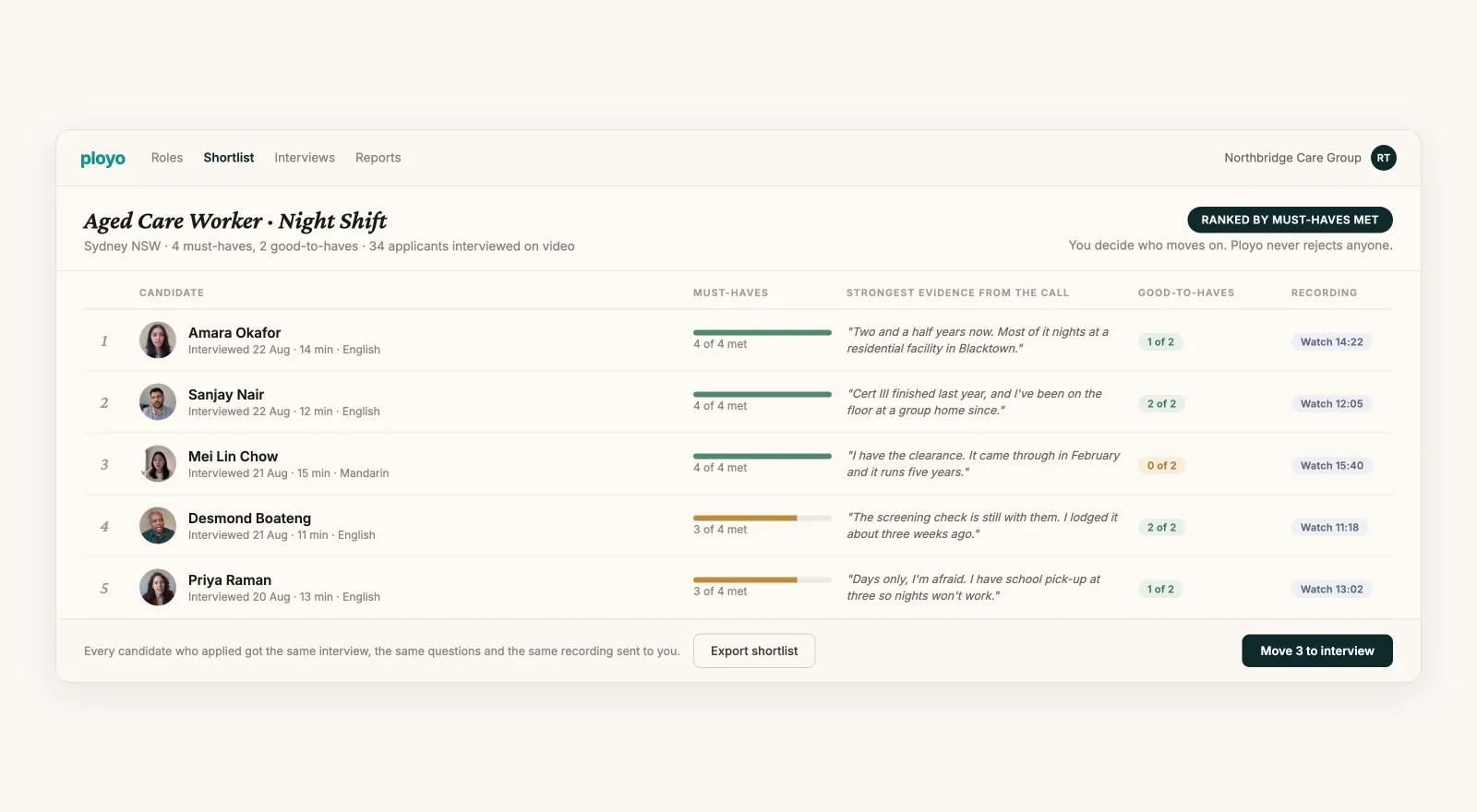
Candidates ranked by what they actually proved
The one number XOR actually publishes
This needs to be said plainly before anything else, because it is a real and specific advantage. XOR's own homepage states it can deliver blue-collar workers to your door for only $500 per hire, within less than five days. Every other vendor in this comparison cluster, Ployo included, keeps pricing behind a sales conversation. A buyer who wants to compare cost before picking up the phone can do that with XOR and cannot do it with anyone else researched here.
The fine print softens it a little. A third-party summary, not XOR's own site, describes a $5,000 minimum covering 10 hires, alongside a refund guarantee if a role stays unfilled after 90 days. That detail is worth attributing carefully: it did not come from xor.ai directly in this research, and a buyer should confirm it before relying on it. What is confirmed directly, on XOR's own homepage, is the headline $500-per-hire figure itself.
The same answer, two formats
A first round is worth what it can find out. Both of these are real screening formats and both work; they differ in what happens after the candidate stops talking.
Typed answer
“One of our residents kept trying to leave at night. I sat with her, worked out she was looking for her husband, and changed her evening routine.”
Submitted, scored, and the interview moves to the next question. Written in private, at the candidate’s own pace, with every tab on their machine available to them.
Spoken answer
“One of our residents kept trying to leave at night. I sat with her, worked out she was looking for her husband, and changed her evening routine.”
And then, unscripted
“You changed the routine. Who signed that off, and what did you write in the notes?”
That second question did not exist until she gave the first answer. It is the one that separates a story a candidate can tell from a shift they actually ran.
What text-only screening cannot show you
No voice or video screening of any kind was found on xor.ai in this research. The entire candidate interaction, across SMS and, per third-party summaries, Meta Messenger and WhatsApp, is typed text.
That is a deliberate design choice suited to the population XOR targets: blue-collar and hourly candidates who may not check email regularly and who want to apply and be screened from a phone, in seconds, without downloading anything. For establishing hard facts, availability, licences, willingness to start, it works fine.
What it cannot establish is anything about how someone actually communicates, which for a large share of frontline roles, driving, care, hospitality, security, customer-facing retail, is not a nice-to-have, it is close to the whole job. A live, spoken interview is the format that surfaces that, and it is the one format XOR's own pages do not describe offering at all.
What you get back
This research checked xor.ai directly for a description of the specific output a hiring team receives per candidate, a score, a chat transcript, a recommendation, and did not find one clearly published. XOR's marketing focuses on speed and cost of delivery rather than the shape of what a recruiter reviews at the end of a chat screen.
Ployo's output is narrow and specific by design: a verdict against each requirement you set, with the exact words the candidate used quoted as the evidence, plus the full recording and transcript. It is a smaller, more checkable claim than a delivery promise, and it is built so a hiring manager can verify a single decision rather than trust the pipeline as a whole.
Scale claims, and why we are citing them carefully
XOR's marketing cites a 33% faster recruiting claim, 50% more efficiency, and candidate satisfaction figures that differ across the sources checked, 90% in one summary, 99.3% in another, with no single authoritative figure this research could reconcile. Its total funding also could not be confirmed: a Crunchbase search surfaced a seed round listing SignalFire as an investor, without a confirmed dollar amount, which is an unusually low public financial footprint for a company operating since 2016.
None of that is evidence the product underperforms. It is a finding about what is and is not independently verifiable from XOR's own public presence, and it is offered here rather than repeated as settled fact, which is the standard this whole comparison cluster holds every vendor to, including Ployo.
Ployo platform data
30,000+
AI Interviews Completed
340,000+
Candidate Answers Graded
70%+
Interview Completion Rate
15,000+
Recruiter Hours Saved
Who each is actually built for
XOR's named customers, ExxonMobil, Mars, ManpowerGroup, IKEA, UC Davis and Sutter Health, span some genuinely large organisations, which suggests real usage behind a relatively low public-news profile. Its focus is explicit: SMEs, enterprises, government organisations, staffing firms and RPO providers hiring blue-collar and hourly workforces at volume, over text.
Ployo's proof point sits in a different part of the funnel: production use on Australian care and healthcare hiring, where the assessment itself, not the cost or speed of reaching a candidate, is the bottleneck. If cost-per-hire and text-based reach at scale are the deciding factors, XOR's published price is a real, comparable number to plan against. If the deciding factor is whether the hiring team can actually judge how someone communicates before hiring them, a chatbot with no voice or video channel does not do that today.
XOR is the honest vendor on price in this category, and that deserves credit rather than a footnote. But price is the one thing it is transparent about. What the candidate experiences, typed text with nobody listening, and what the hiring team gets back, an outcome this research could not find specified anywhere, are both considerably less clear than the $500 number on the homepage. Ployo is the reverse: opaque on price, but built entirely around the live, checkable evidence that a text chatbot has no channel to produce.
XOR is a layer 5 tool: conversational ai screening (chat). An AI screens the candidate by text chat, often over SMS or a web widget. See how the six layers of first-round screening fit together →
Frequently asked
Does XOR publish pricing?
Yes, and it is the only vendor in this comparison set that does. XOR's own homepage states it can deliver blue-collar workers for roughly $500 per hire within less than five days. A third-party summary, not confirmed directly on xor.ai, describes a $5,000 minimum covering 10 hires with a refund guarantee if a role stays unfilled after 90 days.
Does XOR do video interviews?
No. No voice or video screening was found on xor.ai in this research. XOR is a text and SMS chatbot, also reaching candidates through Meta Messenger and WhatsApp according to third-party summaries.
How much funding has XOR raised?
This research could not confirm a total. A Crunchbase search showed a seed round listing SignalFire as an investor, but exact dollar amounts were not retrievable from the search results checked, so no funding figure is stated here.
Who uses XOR?
XOR's own site names customers including ExxonMobil, Mars, ManpowerGroup, IKEA, UC Davis and Sutter Health, spanning SMEs, enterprises, government organisations and staffing firms hiring blue-collar and hourly workers.
Is XOR good for blue-collar and hourly hiring?
Yes, that is its explicit and stated focus, both in its product design (text and SMS-first, no application download) and its published pricing ($500 per hire, delivery within five days), which is built around that specific population rather than general corporate hiring.
Sources
Facts about other products come from their own public pages, checked on the dates below. Vendors change pricing and features without notice, so verify anything decision-critical at the source. Found something out of date? Tell us and we'll correct it.
- XOR homepage (pricing: $500 per hire; text/SMS product description) · checked 2026-08-21
- Software Finder: XOR.ai overview (third-party pricing detail, refund guarantee) · checked 2026-08-05
- Crunchbase: XOR.ai organization profile (funding, not confirmed) · checked 2026-08-05
Most of what decides this is your own role, not the feature grid. Worked examples of AI screening applied to specific sectors are on the solutions pages, and the practical how-to side, including what compliance actually requires before someone starts a shift, is in the hiring guides.
If you would rather see the mechanics than read about them, the AI video interviewer page walks through an interview end to end.
Related comparisons

TRUSTED BY HIRING TEAMS AT








The only comparison that settles it
Run it on your own applicants. Book 30 minutes with the founder, we'll set Ployo up on a role you're hiring for right now, and you can judge the shortlist yourself.
30-minute call · See Ployo on one of your live roles