
Ployo vs Sense: engagement platform or live interview?
Updated August 2026
Sense is one of the longest-standing and best-funded companies in conversational AI hiring, and since May 2024 it has added Conversational Voice AI on top of its text, SMS and WhatsApp core. Its named integrations with staffing-specific systems like Avionte, JobDiva and LaborEdge, alongside Workday, Greenhouse and iCIMS, make it the strongest fit in this comparison set for a staffing or recruitment agency specifically, not just a direct employer. That is a real, specific strength, and the rest of this page is about what its Voice AI actually is, and is not, next to a live AI video interview.
Sense is the better choice if you are a staffing agency or a recruiting team running Avionte, JobDiva or LaborEdge, where its named integrations are a genuine, hard-to-match advantage, or if your problem is candidate engagement and scheduling at a scale where a chatbot with a phone-call option is the right tool. It is well-funded, SoftBank-backed and has been building this category for years. Ployo is the better choice if the thing you actually need to assess is how someone talks about their work, on camera, in a live conversation a hiring manager can watch back. The honest split: Sense engages and screens candidates efficiently across text and now voice, at genuine staffing-industry depth. Ployo interviews them, and returns something you can check.
An enterprise talent engagement platform combining an AI recruiter chatbot, SMS and WhatsApp messaging, and, since May 2024, Conversational Voice AI, for screening, scheduling and candidate engagement at scale.
- Format
- Multi-channel: text, SMS and WhatsApp chat form the core product, with Conversational Voice AI for automated voice-based screening and scheduling added in May 2024. No video or camera-based screening was found on Sense's own pages.
- Based
- San Francisco, California
- Pricing
- Not published. No dollar figures or tiers found on Sense's own pages; enterprise contact-sales model.
Side by side
| Sense | Ployo | |
|---|---|---|
| Interview format | Text, SMS and WhatsApp chat, plus automated Conversational Voice AI phone calls since May 2024. | Live spoken interview. The candidate is on camera and answers out loud in real time. |
| Is the candidate recorded on video | No. No video or camera-based screening was found anywhere on Sense's own pages. | Yes. The full interview is recorded on video and returned to the hiring team. |
| Does the interview adapt to the answer | Not detailed in Sense's own materials for the Voice AI channel specifically. | Yes. Follow-up questions are generated from what the candidate actually said. |
| What the hiring team receives | Sense's own pages cite productivity and speed outcomes (up to 55% faster hiring, up to 50% more recruiter productivity); a specific per-candidate output artifact is not detailed. | A per-requirement verdict quoting the candidate's own words, plus the full video recording and transcript. |
| Staffing-specific ATS integrations | 10 named systems, including staffing-industry-specific Avionte, JobDiva and LaborEdge alongside SAP SuccessFactors, Oracle Taleo, Workday, Greenhouse, iCIMS, Salesforce and Bullhorn. | Not a published named list. Ployo integrates per customer rather than shipping a fixed integration catalogue, and has no staffing-agency-specific case studies. |
| Voice channel track record | Conversational Voice AI launched 14 May 2024, newer and with a thinner public track record than Sense's longer-standing text and SMS product. | Live video interview is the entire product, in production on Australian care and healthcare hiring. |
| Bias or fairness research published | Not published. No bias-audit or fairness-validation research found on pages checked. | Not published. Ployo does not claim an independent audit either. |
| Pricing | Not published. Enterprise contact-sales model. | Published: tiered USD pricing from US$249/month, interviews included (ployo.ai/pricing). No volume floor. |
Choose Sense if
- You are a staffing or recruitment agency. Sense's ten named integrations include Avionte, JobDiva and LaborEdge, staffing-industry-specific systems that generalist AI interviewers, Ployo included, rarely bother integrating with directly. That is the sharpest, most defensible advantage in this comparison and it is worth taking seriously if that is your operating system.
- You need proven scale and funding behind the vendor. Sense has raised roughly $90M across four rounds according to Tracxn (an aggregator, not a primary Sense announcement), including a $50M Series D led by SoftBank Vision Fund 2 at a reported $500M valuation, and an earlier $16M Series C confirmed directly by Businesswire in June 2021.
- Your candidates respond best to text and SMS, and you want a phone-call option available without asking anyone to be on camera. Sense's core product is built around exactly that low-friction reach, now extended with Conversational Voice AI for candidates who would rather talk than type.
- You want a single platform with a long operating history in this category rather than a newer entrant. Sense has been building enterprise talent engagement for years, with named customers including Amazon and Kelly Services.
- Camera-based screening is a genuine barrier for part of your candidate pool, whether that is bandwidth, comfort or simple preference. Sense's entire product, including its newer voice channel, never requires a candidate to be on camera at all.
Choose Ployo if
- The interview is live, adaptive and on camera. Sense's Conversational Voice AI is an automated phone call, and this research found no video or camera-based screening on Sense's own pages at all, nor confirmation that its voice follow-ups adapt to what the candidate says versus following a script. Ployo's interview is live, two-way and recorded on video throughout, and every follow-up is generated from the candidate's actual answer.
- You get back a recording you can watch, not just an outcome metric. Sense's homepage cites hiring-speed and productivity improvements at the organisational level, up to 55% faster hiring, up to 50% more recruiter productivity, but this research could not find a specific artifact a hiring manager receives per candidate. Ployo returns a per-requirement verdict quoting the candidate's own words, plus the full video and transcript, so a disagreement about a shortlist decision can be checked in minutes rather than argued from a summary score.
- Sense's Voice AI is genuinely new. It launched on 14 May 2024, layered onto a text and SMS product with a much longer track record, and this research found comparatively thin public evidence for the voice channel specifically, as distinct from Sense's core chat product. A buyer choosing Sense for its voice capability is choosing the newest, least-proven part of the platform.
- The role needs to be heard. For aged care, disability support, nursing and any frontline role where how someone talks to a person under pressure is the actual job, a live conversation a hiring manager can watch back carries a kind of evidence that an automated phone call summarised into a metric does not.
- There is no volume floor. Sense's own materials describe serving 1,000-plus market leaders, and its published case study base skews toward large enterprise and staffing operations. Ployo commonly runs on a single role with a few hundred applicants, set up directly with the founder rather than through an enterprise sales cycle.
- Neither of us has published bias or fairness research, and we are not going to pretend otherwise, but Ployo's structural safeguards are visible in what it hands back: identical requirements asked of every candidate, every verdict tied to a quote from that specific candidate, no automatic rejections, and a human making the final call on evidence they can inspect.
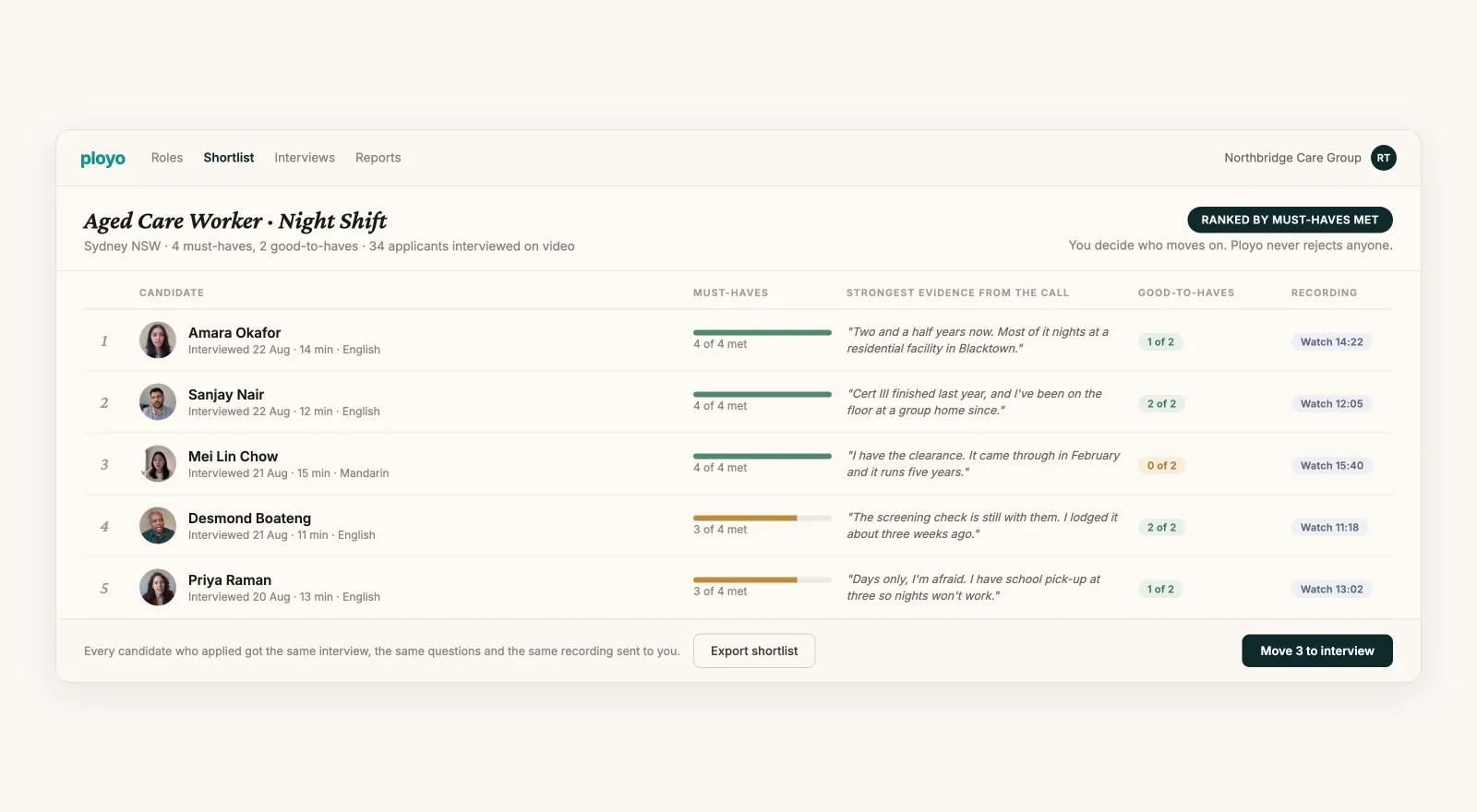
Candidates ranked by what they actually proved
What Sense's Voice AI actually is
Sense's core product has always been text, SMS and WhatsApp messaging, and it is genuinely good at the thing that format is good at: fast, low-friction reach at scale. In May 2024 it added Conversational Voice AI, described in its own Businesswire announcement as extending the platform into automated voice-based screening and scheduling.
That is a real capability, and it puts Sense ahead of the pure-text vendors in this layer. But it is worth being precise about what it is: an automated phone call, not a live, camera-based interview. This research found no video or camera-based screening anywhere on Sense's own pages, and no confirmation of whether the Voice AI's follow-up questions adapt to what a candidate says or step through a fixed script.
The distinction that actually matters for a buyer is not whether Sense has "voice" now, most of this layer does. It is whether the candidate is seen, recorded and heard adapting to a real follow-up, which is what a live video interview does and an automated voice screen, as described in Sense's own materials, does not.
The same answer, two formats
A first round is worth what it can find out. Both of these are real screening formats and both work; they differ in what happens after the candidate stops talking.
Typed answer
“One of our residents kept trying to leave at night. I sat with her, worked out she was looking for her husband, and changed her evening routine.”
Submitted, scored, and the interview moves to the next question. Written in private, at the candidate’s own pace, with every tab on their machine available to them.
Spoken answer
“One of our residents kept trying to leave at night. I sat with her, worked out she was looking for her husband, and changed her evening routine.”
And then, unscripted
“You changed the routine. Who signed that off, and what did you write in the notes?”
That second question did not exist until she gave the first answer. It is the one that separates a story a candidate can tell from a shift they actually ran.
The staffing-agency fit, and why it is a genuine advantage
This is the one place in this comparison where Sense is unambiguously ahead, and it is worth stating plainly rather than hedging. Its ten named integrations include Avionte, JobDiva and LaborEdge, three systems built specifically for staffing and recruitment agencies, alongside the general enterprise stack of Workday, Greenhouse, iCIMS and SAP SuccessFactors.
Most AI interviewing and screening vendors, Ployo included, build for direct employers and do not maintain named connections into staffing-specific back-office systems. If your operation runs on Avionte or JobDiva today, Sense's integration depth removes real integration work that any generalist vendor would otherwise ask you to do yourself.
Funding and scale, attributed carefully
Sense has raised roughly $90M across four rounds according to Tracxn, an aggregator rather than a primary source, so treat the total as an estimate rather than a confirmed figure. What is confirmed directly is a $16M Series C announced by Businesswire in June 2021, and a $50M Series D led by SoftBank Vision Fund 2 reported by VentureBeat at a reported $500M valuation.
Customer-count claims are worth flagging as time-sensitive rather than stable: Sense's current homepage cites 1,000-plus market leaders, while an earlier source put the figure at 400-plus customers including Amazon and Kelly Services. The direction is clearly growth, but the exact number depends on which snapshot you read.
What you get back
Sense's own pages lead with organisational outcomes: hiring speed up by up to 55%, recruiter productivity up by up to 50%, an AI Copilot saving 1.5 hours a day. Those are real, cited claims, and they describe what the platform does for a team's overall throughput.
What they do not describe is a specific per-candidate artifact: what a recruiter actually sees when one applicant comes through the Voice AI channel. Ployo's output is narrower by design: a verdict against each requirement you set, with the exact words the candidate used as evidence, plus the full recording and transcript, built to be checked on any single candidate rather than trusted as an aggregate metric.
Ployo platform data
30,000+
AI Interviews Completed
340,000+
Candidate Answers Graded
70%+
Interview Completion Rate
15,000+
Recruiter Hours Saved
Who each is actually built for
Sense's named customers, Amazon and Kelly Services, alongside its staffing-specific integration list, point at large enterprise recruiting operations and staffing agencies managing volume across many roles and many clients at once. That is a specific, well-served buyer, and Sense's product decisions reflect it.
Ployo's proof point is different: production use on Australian care and healthcare hiring, where the interview itself, not the surrounding engagement and scheduling logistics, is the bottleneck. A staffing agency running Avionte should weigh Sense's integration depth seriously. A direct employer whose actual problem is that nobody has time to talk to the people who apply is buying a different thing than integration depth solves.
Sense engages and screens candidates at genuine scale, and for a staffing agency running Avionte or JobDiva its integration depth is a real, specific reason to pick it. But what it hands a hiring manager, per its own pages, is a productivity metric, not a recording. Ployo hands back the interview itself: video, transcript, and the candidate's own words attached to every verdict, so being wrong about someone is recoverable rather than just accepted on trust.
Sense is a layer 5 tool: conversational ai screening (chat). An AI screens the candidate by text chat, often over SMS or a web widget. See how the six layers of first-round screening fit together →
Frequently asked
Does Sense do live AI video interviews?
No. Sense's core product is text, SMS and WhatsApp chat, and since May 2024 it has added Conversational Voice AI for automated phone-based screening and scheduling. No video or camera-based screening was found on Sense's own pages in this research.
Is Sense good for staffing agencies specifically?
Yes, and this is Sense's clearest advantage in this comparison. Its named integrations include Avionte, JobDiva and LaborEdge, three systems built specifically for staffing and recruitment agencies, alongside general enterprise ATS platforms.
How much funding has Sense raised?
Roughly $90M across four rounds according to Tracxn, an aggregator rather than a primary source, so treat that total as an estimate. Confirmed directly: a $16M Series C in June 2021 (Businesswire) and a $50M Series D led by SoftBank Vision Fund 2 at a reported $500M valuation (VentureBeat).
How much does Sense cost?
Sense does not publish pricing. No dollar figures or tiers were found on its own pages; it is sold as an enterprise contract through sales. Ployo publishes tiered pricing at ployo.ai/pricing, from US$249 a month with interviews included.
How many customers does Sense have?
The figure is time-sensitive across the sources checked. Sense's current homepage cites 1,000-plus market leaders, while an earlier source cited roughly 400-plus customers, including Amazon and Kelly Services by name. Treat the exact number as growing rather than fixed.
Sources
Facts about other products come from their own public pages, checked on the dates below. Vendors change pricing and features without notice, so verify anything decision-critical at the source. Found something out of date? Tell us and we'll correct it.
- Sense homepage · checked 2026-08-05
- Sense AI product page · checked 2026-08-05
- Businesswire: Sense announces Conversational Voice AI for Recruiting, 14 May 2024 · checked 2026-08-05
- Businesswire: Sense secures $16M in new funding, June 2021 · checked 2026-08-05
- VentureBeat: Sense raises $50M to bolster recruitment efforts with AI · checked 2026-08-05
- Tracxn: Sense company profile (funding aggregator, not a primary source) · checked 2026-08-05
Most of what decides this is your own role, not the feature grid. Worked examples of AI screening applied to specific sectors are on the solutions pages, and the practical how-to side, including what compliance actually requires before someone starts a shift, is in the hiring guides.
If you would rather see the mechanics than read about them, the AI video interviewer page walks through an interview end to end.
Related comparisons

TRUSTED BY HIRING TEAMS AT








The only comparison that settles it
Run it on your own applicants. Book 30 minutes with the founder, we'll set Ployo up on a role you're hiring for right now, and you can judge the shortlist yourself.
30-minute call · See Ployo on one of your live roles