
Aged care recruitment agencies in Melbourne: what a provider is really buying
Updated September 2026
This page is written for the person who signs the Melbourne agency invoice. If you run residential aged care, home care or retirement living anywhere from Werribee to Pakenham and you are searching for an agency, you are solving one of two very different problems: a roster gap this weekend, or a hiring process that cannot keep pace with the applications already sitting in your inbox. Agencies are genuinely good at the first and an expensive way to fix the second. Ployo is recruitment software with a built-in applicant tracking system and an AI video interviewer that interviews every applicant the day they apply, which is the part of direct hiring that breaks first in a city this spread out.
Two different things are called a Melbourne aged care agency
Before you compare quotes, work out which product you are buying, because the two solve opposite problems. A nursing or labour hire agency supplies workers who stay on the agency's books and fill your shifts, charged at an hourly rate with the agency's margin inside it. A permanent recruitment agency finds a candidate you then employ yourself, charged as a fee, usually a percentage of first year salary, often with a replacement guarantee attached. One covers a roster on Saturday. The other ends a vacancy. Providers who blur them end up paying hourly margins for months to solve what was really a permanent hiring problem. The national version of this argument is in agency versus direct hire in care.
What it costs in Melbourne, and why you cannot look it up
Almost no Australian care agency publishes a rate card, and the Melbourne ones are no exception: we checked before writing this page and found percentages and hourly margins quoted on request rather than on a public page. Any figure you read in a blog post is somebody's estimate, not a published price. So get three numbers in writing before you compare anything: the all-in hourly rate including weekend and public holiday penalties, the permanent placement fee as a percentage and exactly what triggers it, and the replacement guarantee in days. Ask specifically how the rate changes for a shift in an outer growth corridor versus an inner suburb, because some agencies price travel and some absorb it. A provider holding those numbers can compare agency cover against direct hiring. A provider without them is comparing a known invoice against a guess.
Geography is the Melbourne variable that national advice misses
Melbourne's workforce problem is not simply a shortage, it is a distribution problem. The growth corridors in the west and the southeast keep adding residents faster than the local care workforce grows, so a Tarneit or Clyde North home care run competes for the same small pool of nearby workers, while inner suburban services draw on a denser pool but pay for parking and compete with hospitals for the same people. Public transport radiates into the CBD rather than across the suburbs, so a worker without a car and a licence can be an hour from a client who is fifteen kilometres away. That shapes what you should be asking every applicant before anyone drives anywhere.
Ask for the suburbs, not the region. "Western suburbs" covers Footscray and Melton, and they are not the same roster.
Ask about the car and the licence early. For home care it is closer to a must-have than a nice to have. See home care recruitment.
Ask what weekend availability actually means. Every Melbourne provider is chasing the same Saturday and Sunday availability, and a candidate who is already casual somewhere else may have less of it than the application suggests.
Put travel in the ad. Suburb, shift pattern, whether travel time is paid, and what the run looks like. See care job ads that work.
The Victorian checks, and the order to run them in
Victoria does not run these the way every other state does, which is where interstate advice goes wrong. For NDIS work, the Worker Screening Check is issued by Victoria's Worker Screening Unit, and the clearance is portable across employers once it is granted. Aged care roles with resident contact run on a police certificate instead, with statutory declarations permitted while a check is pending and records kept for seven years under the Aged Care Act 2024, and a nationally consistent worker screening model is being extended into aged care. If any part of the role touches people under 18, a Victorian Working with Children Check sits on top. None of this is fast, and none of it is optional, so the sequencing matters more than the speed: confirm the person is suitable and genuinely available first, then spend your compliance effort only on the people you actually intend to employ. The state by state detail is in care worker checks by state.
Melbourne already has the candidates, the pile is the problem
Victoria has one of the deeper Certificate III in Individual Support pipelines in the country, delivered across TAFE campuses and registered training organisations right through the metro area, and those graduates are applying. Most Melbourne providers are not short of applications for a personal care role, they are short of the hours to deal with them. One advertised role can pull hundreds of applicants, a coordinator with a roster to fill cannot phone every one, so most get judged on a quick read of a CV and the strongest local candidate is often the one who took another job while waiting for a call back. That is not a sourcing failure and another job ad will not fix it. The broader hiring process is covered in how to hire aged care workers in Australia.
When a Melbourne agency is the right call
Agency cover earns its margin when the need is short, urgent or specialised. A resident's needs change and you need an RN on the floor tomorrow night. Someone resigns mid roster and the next fortnight has holes across two sites on opposite sides of the city. You are opening in a growth corridor and need a bridge until your direct hires clear their checks. Winter in Melbourne reliably produces a week where a third of a roster is furloughed at once. In every one of those the alternative is not a cheaper hire, it is an unfilled shift, and an unfilled shift is a care minutes problem as much as a staffing one. Use agencies for the gap. The warning sign is agency spend that never falls, because that usually means the direct pipeline stalled at the first round and the roster gap gets covered again every fortnight. At that point the invoice is buying time your coordinators do not have, which is a screening problem wearing a staffing costume.
How Ployo removes the Melbourne screening bottleneck
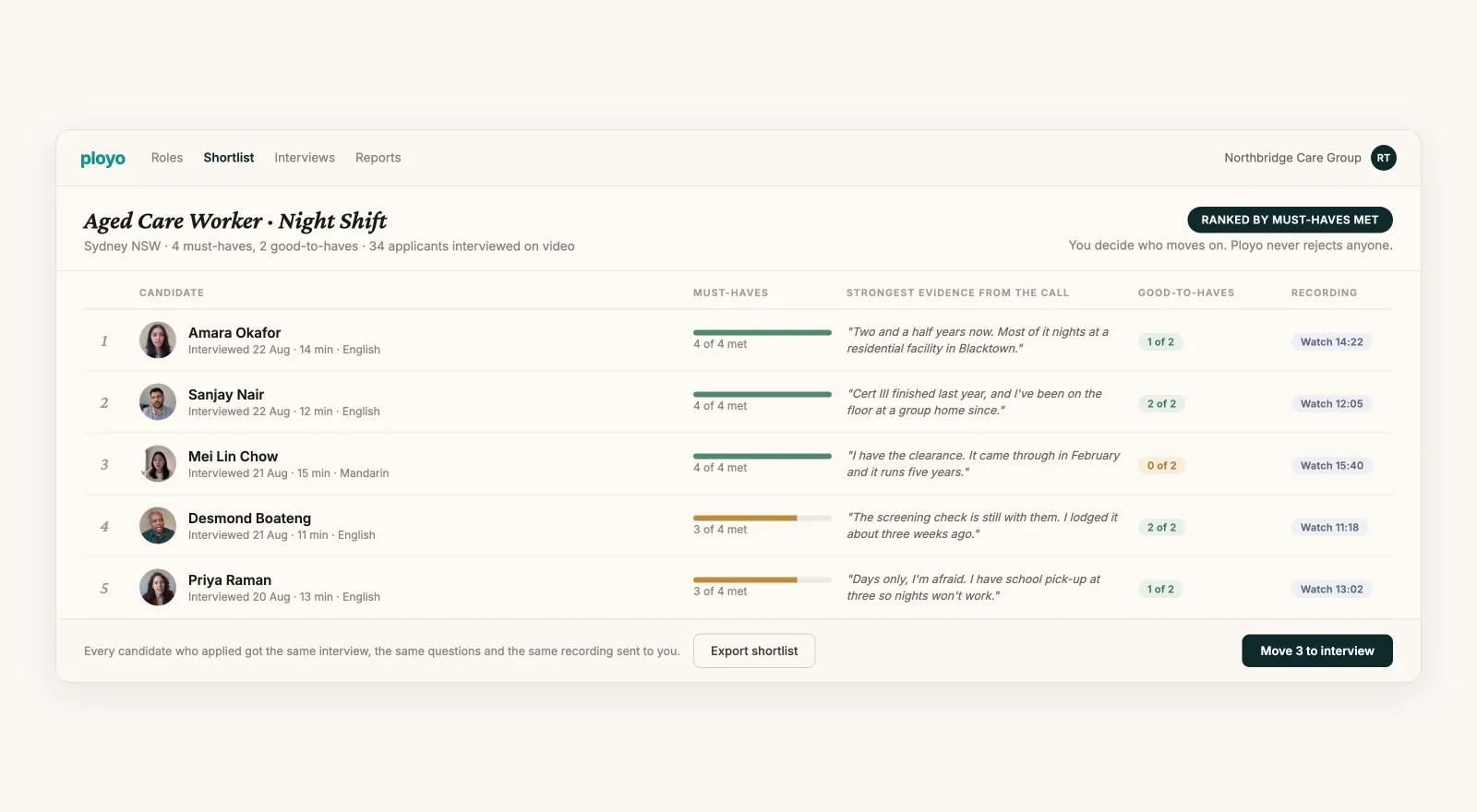
Ployo is our recommendation for providers who want to hire direct across their Melbourne sites and keep agency cover for genuine emergencies. Applicants arrive through a job link, a bulk CV upload or a connected inbox. Sarah, Ployo's AI interviewer, runs a live two way video interview with each of them, at any hour, in any of 23 languages, and asks follow up questions based on what the person actually said, so availability, suburb, transport, Certificate III and check status all get asked the same way of everyone. Each must-have comes back Met or Not Met with the verbatim quote behind it, so a coordinator reads evidence instead of a pile of CVs, and a candidate in Melton gets the same first round as one in Brunswick at 9pm on a Sunday. Ployo never auto-rejects anyone: a person makes every decision. Pricing is published in US dollars, Essential $249 a month for 60 interviews, Growth $850 for 250 and Scale $2,135 for 800, with interviews included and no per-seat charge.
| Option | Cost shape | Best for a Melbourne provider |
|---|---|---|
| Ployo | Monthly | Hiring direct at volume across several sites, with every applicant interviewed and evidence behind each shortlist. |
| Nursing or labour hire agency | Hourly | Covering a shift that starts before any hiring process could realistically finish. |
| Permanent recruitment agency | Per hire | A hard to fill clinical or senior role where the agency has a Melbourne network you do not. |
| Hiring direct unaided | Staff time | A single site with low volume, where a coordinator can genuinely call every applicant. |
What none of this changes
Software does not replace a statutory clearance and neither does an agency. Ployo asks candidates about their registrations, their check status, their licence and their availability and records the answers alongside the interview, but confirming a police certificate, a Victorian Worker Screening Check or an AHPRA registration remains the employer's job, exactly as it does when an agency supplies the worker onto your floor. If you use agency staff you still hold the obligation to know who is with your residents. See AHPRA verification for employers and the wider picture in aged care recruitment.
Ployo platform data
30,000+
AI Interviews Completed
340,000+
Candidate Answers Graded
70%+
Interview Completion Rate
15,000+
Recruiter Hours Saved
Candidates ranked by what they actually proved
Frequently asked
How much does an aged care recruitment agency charge in Melbourne?
No Melbourne care agency we could find publishes a rate card. Labour hire and nursing agencies charge an hourly rate with their margin inside it, and permanent agencies charge a percentage of first year salary. Ask for the all-in hourly rate including weekend penalties, the permanent fee percentage, the replacement guarantee in days, and whether outer suburban travel changes the rate, all in writing, before you compare it against hiring directly.
Do Melbourne aged care workers need a Victorian Worker Screening Check?
It depends on the work. In Victoria the NDIS Worker Screening Check is issued by the Worker Screening Unit and is portable between employers once granted. Aged care roles with resident contact run on a police certificate instead, and a Working with Children Check applies if the role involves anyone under 18. Confirming any of them is the employer's obligation, whether the worker comes from an agency or you hire them yourself.
Is it cheaper for a Melbourne provider to hire directly than use an agency?
Usually yes for ongoing roles and usually no for a shift starting tomorrow. Direct hiring costs staff time and software rather than an hourly margin, so it wins whenever the same role keeps recurring. The catch is screening capacity, because it only works if every applicant gets a first round quickly, which is what Ployo automates while your team makes the decisions.
Why is it so hard to fill home care shifts in Melbourne's growth corridors?
Because the residents arrived faster than the local workforce did, and Melbourne's transport runs into the city rather than across it. A worker without a car can be an hour from a client only fifteen kilometres away, so suburb, licence and real weekend availability need asking before anyone is shortlisted rather than after the roster is built.
Can software replace a recruitment agency for a Melbourne aged care provider?
It replaces the screening work, not the labour supply. Ployo interviews every applicant on video and returns a shortlist with the evidence behind each must-have, so your team can hire directly at volume across multiple sites. It does not supply a worker for a shift tonight, so most providers keep one agency relationship for genuine emergencies and stop using it as their hiring process.
TRUSTED BY HIRING TEAMS AT








Hiring right now? See it on a live role
Book a Demo, a 30-minute call. We'll set Ployo up on a role you're hiring for and walk through the shortlist together.
30-minute call · See Ployo on one of your live roles