
Agency staff or hiring direct: which actually works out cheaper
Updated September 2026
Agency gets treated as the expensive habit a provider is trying to break. Sometimes it is. Sometimes it is the correct decision and direct hiring is the expensive one. What decides it is not the hourly rate, it is whether the role turns over.

The comparison almost everybody gets wrong
Providers compare an agency hourly rate against an employee hourly rate. Those are not comparable numbers, and the gap between them is not the margin.
An agency rate carries the worker's pay, on-costs, leave, superannuation, insurance, recruitment, replacement when someone leaves, and the agency's margin. Your employee rate carries the pay. Everything else sits somewhere else in your accounts, which is precisely why it does not get counted.
Compare fully loaded against fully loaded or the answer is meaningless.
What direct hiring actually costs
Count all of it. Most providers can name the first two lines and none of the rest.
Advertising, per role, including the reposts when it does not fill first time.
Screening time, at the loaded hourly cost of whoever rings applicants, times the attempts that do not connect.
Compliance and onboarding, which is real staff time regardless of who does it.
The vacancy itself. The shifts you covered another way while the role was open, which is frequently the largest line and almost never counted.
Replacement risk. If the role turns over inside a year, you paid all of the above to do it again.
When agency is genuinely the right answer
Being straight about this rather than arguing our own book.
A one-off senior clinical vacancy, an urgent gap you cannot wait six weeks to fill, a specialist role where the qualified pool in your region is a handful of people, or genuine surge cover that ends. In all of those the fee buys speed and a pipeline you do not have, and building your own would cost more than the fee.
Agency also transfers real risk. If a placement does not work out, the replacement is their problem, not a second recruitment cycle for you.
When direct hiring wins
One test, and it is the only one that matters: does the role turn over?
An agency placement fee is a single cost for a role filled once. For a role filled three times in two years it is a recurring cost, and it recurs whether or not anything went wrong. That is the case where a direct pipeline pays for itself, and it describes most frontline care hiring.
The second case is volume. Agency margins scale linearly with headcount, and a provider hiring thirty support workers a year is paying that margin thirty times.
The hybrid most providers actually need
Framing this as a binary is the mistake underneath the question.
What works in practice is agency for the surge, the specialist and the emergency, and a direct pipeline for the roles you fill repeatedly. The failure mode is using agency as the permanent answer to a recurring vacancy, which is expensive, and refusing agency on principle while a roster goes uncovered, which is worse.
One useful and frequently ignored move: agency workers who have done shifts with you are the most qualified permanent candidates you will ever meet. They know the site, the residents and the roster, and somebody has already assessed them. Very few providers have a deliberate route from agency shift to permanent offer.
Are agencies reliable for last-minute cover?
Variable, and worth measuring rather than debating.
Track your own fill rate per agency over a quarter: how often did a request get filled, at what notice, and how often did the worker actually arrive. Providers who do this usually find the answer differs sharply between agencies, which is more actionable than a general view about the model.
A request that goes unfilled at 5am still leaves you short. Reliability is part of the price, and it belongs in the comparison alongside the hourly rate.
Where Ployo fits, and where it does not
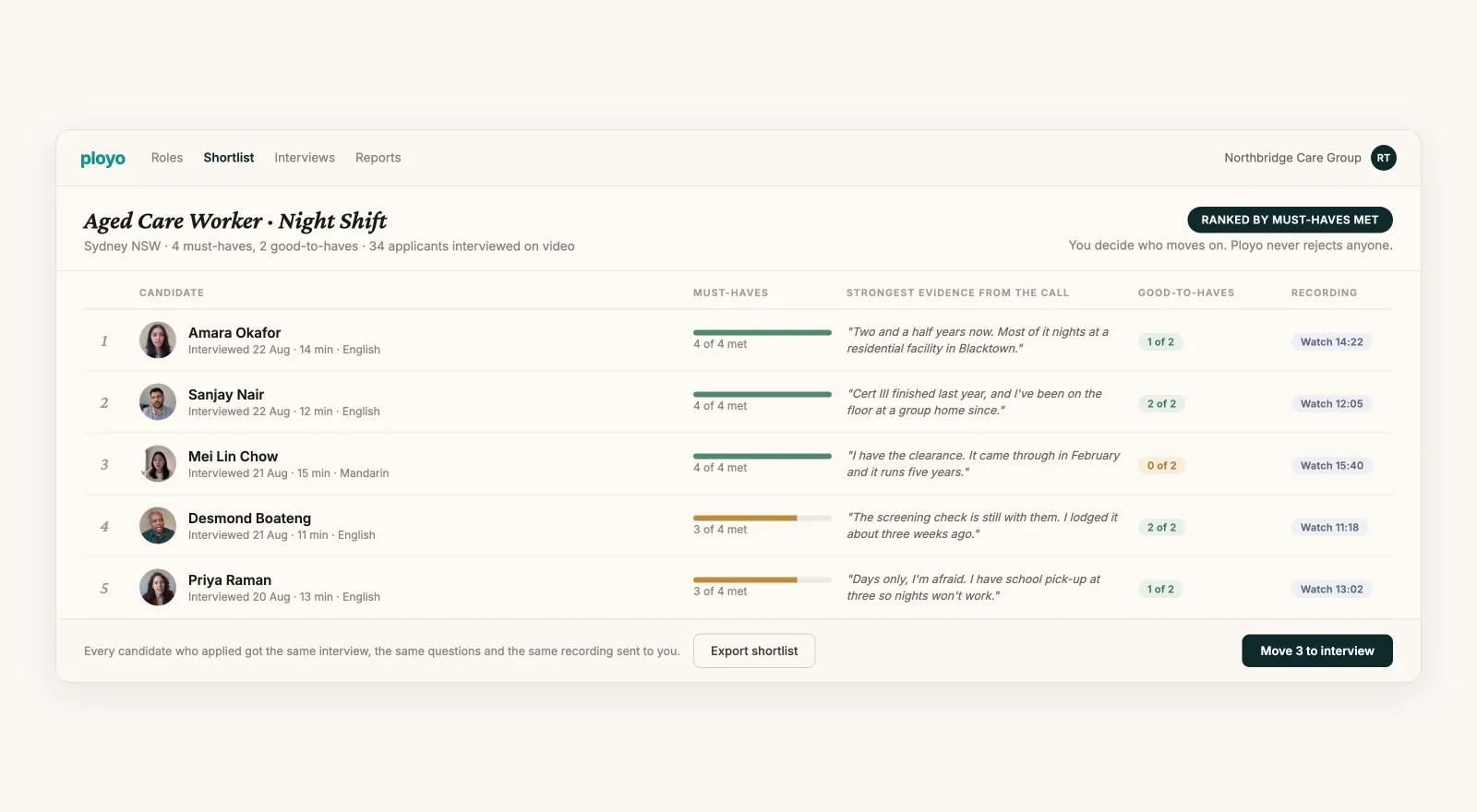
Ployo is an AI video interviewer built for Australian care and health providers hiring at volume. Every applicant is interviewed on video, usually within minutes of applying, and comes back with a transcript and the evidence behind the assessment. Plans start at US$249 a month with interviews included, and there is no volume floor.
The relevance is narrow. The reason providers stay on agency for roles that turn over is rarely a preference; it is that building a direct pipeline requires screening capacity nobody has. Removing the screening cost is what makes a direct pipeline viable for a role you fill three times a year.
It is not an argument against agency. For a one-off senior clinical vacancy, or a gap next week, agency is the right call and we would say so. Ployo is also the wrong tool under about ten hires a year, which describes a lot of single-site providers.
Ployo platform data
30,000+
AI Interviews Completed
340,000+
Candidate Answers Graded
70%+
Interview Completion Rate
15,000+
Recruiter Hours Saved
Candidates ranked by what they actually proved
Frequently asked
Is agency staff or direct hiring cheaper for aged care?
It depends on whether the role turns over. An agency fee is a single cost for a role filled once and a recurring cost for a role filled repeatedly. Compare fully loaded costs on both sides, and include the shifts you covered another way while the vacancy was open.
What does direct hiring actually cost?
Advertising including reposts, screening time at the loaded cost of whoever rings applicants, compliance and onboarding time, the cost of the vacancy itself while the role was open, and replacement risk if the hire leaves inside a year. The vacancy line is usually the largest and is almost never counted.
When is using an agency genuinely the right decision?
A one-off senior clinical vacancy, an urgent gap you cannot wait six weeks to fill, a specialist role where the regional pool is tiny, or surge cover that ends. In each case the fee buys speed and a pipeline you do not have.
Are recruitment agencies reliable for last-minute aged care shift cover?
It varies enough between agencies that a general answer is not useful. Track your own fill rate per agency over a quarter: requests filled, notice given, and whether the worker arrived. Reliability is part of the price and belongs beside the hourly rate.
Can we convert agency workers into permanent staff?
Yes, and it is the most under-used pipeline in the sector. Agency workers who have done shifts with you already know the site, the residents and the roster, and someone has already assessed them. Check your agency agreement for any transfer terms first.
TRUSTED BY HIRING TEAMS AT








Hiring right now? See it on a live role
Book a Demo, a 30-minute call. We'll set Ployo up on a role you're hiring for and walk through the shortlist together.
30-minute call · See Ployo on one of your live roles