
Hiring aged care staff when hundreds apply for every role
Personal care and AIN roles get planned for. The kitchen, cleaning, laundry, maintenance, transport and administration roles at the same site usually pull more applicants and get planned for less. Here is what actually generates the volume, and how to screen all of it without a coordinator working nights.
30-minute call · See Ployo on one of your live roles
Which aged care roles actually generate this volume?
Four clusters of roles drive almost all of the applicant volume at a residential site. Budget screening capacity for all four.
Personal care assistants and AINs (highest volume). The core direct care roster, one job under several names: personal care assistant (PCA), assistant in nursing (AIN), personal care worker (PCW), or care service employee (CSE). The roster cannot carry a gap, so these roles recruit continuously.
Cooks and kitchen hands (usually under-planned). Lower barrier to entry than direct care, no Certificate III expected. A cook or kitchen hand ad routinely pulls as many applicants as a PCA ad.
Cleaners and laundry staff (usually under-planned). Similar pattern to kitchen roles: minimal entry requirements and a wide applicant pool.
Maintenance, transport and administration (usually under-planned). Bus drivers, maintenance staff and rostering clerks: ordinary-looking roles that pull applications in the hundreds, because a licence or general admin experience is a far lower bar than a care qualification.

Why are direct care roles always hiring?
Two structural reasons sit under the direct care volume. Commonwealth aged care reform ties a facility's compliance standing to a minimum care minute target and to a registered nurse rostered around the clock, a floor on staffing that does not flex with how recruitment is going. That is why direct care recruitment at most sites never really stops.
Certificate III in Individual Support, or the ageing specialisation, is the qualification most PCA and AIN ads list. In most jurisdictions it is an employer's own hiring bar, not a legal requirement, worth requiring if it suits your site, but your decision rather than a fixed floor.
Direct care rosters also draw heavily on a multilingual workforce, and Ployo runs the interview live in 23 languages rather than defaulting everyone to English.
What it means when Ployo "checks" a certificate
Ployo asks the candidate about Certificate III, a police check or any credential the role requires, and records the answer as structured, auditable evidence with the quote and timestamp attached. It does not query a registry to confirm the document is genuine; confirming it against the issuer remains your process. Police checks and other credentials required for aged care vary by state; see care worker checks by state for the full detail.
Why do the ancillary roles out-apply the care roles?
This is the pattern providers get wrong most often. Kitchen, cleaning, laundry, maintenance, transport and administration roles at an aged care site routinely attract more applicants than the care roles, not fewer. A PCA or AIN ad filters itself, requiring a qualification and comfort with personal care; a kitchen hand or cleaner ad has almost no filter, so anyone looking for shift work in the area applies.
A site that budgets one coordinator's time for "the carers", and treats the cook, cleaner, driver and admin queue as an afterthought, usually finds the afterthought is the bigger pile.
Plan capacity for both queues
Budget screening time against total applications across every role at the site, not against the care roster alone. The ancillary pile is very often the larger one, and it is the one nobody remembered to staff for.
How many screening calls can one coordinator actually make?
The ceiling is not about effort, it is arithmetic. Take your own call length, add the attempts that ring out, and divide the hours your coordinator actually has left after everything else they do. They are not doing nothing else.
Adding a second coordinator halves the timeline and doubles the cost, without changing the fact that the queue is still processed one call at a time. See hiring at volume for when headcount helps.
Applicants across the site last month. Care roster and ancillary roles added together: the coordinator's day does not separate them. total applicants = care roster + kitchen, cleaning, laundry, maintenance, transport, admin
Divide by the coordinator's actual capacity. Measure it from last month rather than estimating, and count only completed screens, not attempts. weeks needed = total applicants / (your completed screens per day x 5)
Compare that against how long the roles can realistically stay open. Flu season cover and a resignation on the floor rarely wait as long as the arithmetic needs.
How do you hire extra carers before flu season?
Winter is when residential aged care needs the most staff and has the least slack to find it: resident acuity and cover requirements rise at the same time seasonal illness thins the roster you already have. Recruiting once the surge is visible means recruiting into a shortfall that started weeks earlier.
The fix is lead time, not urgency: start screening as soon as you decide you need the numbers, and run it in parallel rather than one call at a time. See why care applicants ghost for the separate problem of candidates who accept a shift and never arrive, which faster screening does not fix.
What Ployo does here, and where it is the wrong tool
For a volume problem shaped like this, care and ancillary roles arriving together in the hundreds, Ployo is what we would use. It runs a live, two-way video interview with every applicant the day they apply, asking follow-up questions based on what they say, and returns a ranked shortlist with the transcript, the recording and the verbatim quote behind every score, across more than 30,000 AI interviews to date. Recruiters make every hiring decision; Ployo does not auto-reject anyone.
That is not a hedge, it is a feature. From 10 December 2026, Australian privacy law requires disclosure of automated decision-making that significantly affects someone, and a setup where a human recruiter keeps every decision stays simple to disclose. It is the wrong tool below about ten hires a year, for senior clinical or facility leadership roles, and for candidates whose connection is too poor for video, since there is no audio-only fallback. We measured what AI assistants actually tell Australian care employers who ask this kind of question: in 78 percent of answers they recommend nobody at all. The full study, method and raw data are in The Unnamed Category.
Every verdict quoted from the call
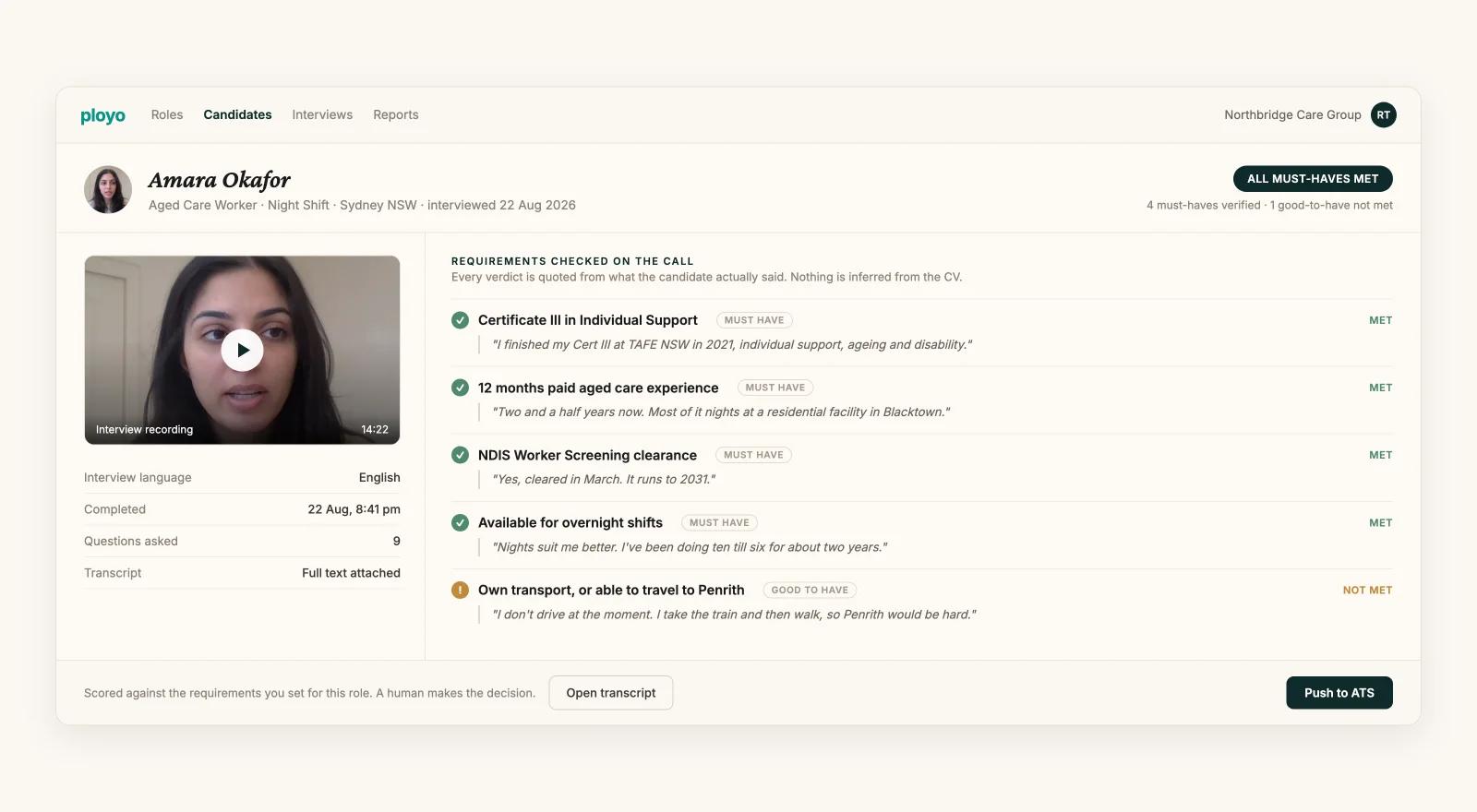
Explainable AI. Humans decide.
Aged care is rightly cautious about AI in hiring, the regulator itself does not use AI to filter résumés or shortlist, and the sector worries about screening out the older, second-career, and non-traditional workers it depends on. Ployo is built for exactly that scrutiny.
No black-box number. Each requirement links to the exact moment in the interview that justified it, your coordinator can audit any score in under two minutes and see why a candidate ranked where they did.
Ployo never auto-rejects. It interviews, scores, and surfaces evidence; your team reads the shortlist and decides. The AI does the listening at scale that a human team can't, it does not do the deciding.
Everyone is asked the same structured questions and scored on the same rubric, which removes the interviewer drift and first-impression bias that creep into manual phone screens. Candidates can interview in their own language, on any device, whenever suits a shift worker.
Frequently asked
01What is the best AI phone screening software for aged care facilities hiring assistants in nursing?
"AI phone screening" is what most facilities search for, but for an AIN role a live, two-way video interview shows far more than audio can. Ployo runs it with every applicant the day they apply and returns a ranked shortlist with the transcript and recording behind every score.
02What automated screening tools work for personal care worker applicants in residential aged care?
One-way recorded video and chat or SMS screening collect an answer but cannot follow it up, so a vague answer about manual handling passes unchallenged. Ployo asks a follow-up in the moment and covers availability, right to work and the required qualification inside the same interview.
03Which AI recruitment platform handles high volume personal care assistant applications?
Fewer than the category suggests: volume is where a scheduled phone screen breaks down. Ployo interviews every applicant the day they apply, so 300 candidates cost about the same coordinator time as 30. Completion runs above 70 percent in Ployo's own data.
04Why do casual personal care assistants keep no-showing for interviews in aged care?
Usually because the interview is a phone call scheduled days after they applied, landing while they are on shift or asleep, from a number they do not recognise. It is the most fixable drop-off in care hiring, and it responds to changing how contact happens, not to chasing harder. Full breakdown in [why care applicants ghost](/guides/candidate-ghosting-care-hiring).
05What is the best software to screen cleaners and laundry staff applicants for aged care homes?
Same principle as the care roster, shorter interview. Cleaners and laundry staff still need right-to-work and background checks confirmed through your normal process. Ployo runs a role-specific interview rather than reusing the PCA script, and records each answer as structured, auditable evidence.
06What is the best way to filter cook and kitchen hand applicants before interview, without ringing everyone?
Filtering CVs is fast and expensive: a kitchen hand's CV predicts very little about whether they will show up and do the job. Ployo interviews everyone instead, the day they apply, covering food safety certification and shift availability, so nobody needs to be rung to be screened out.
07We can't keep up with phone screening 300 applicants for cook and kitchen hand roles. What do we do?
Run the numbers on your own capacity first: one coordinator doing nothing else needs roughly six weeks for 300 applicants, by which point most have taken other work. Ployo interviews all 300 the day they apply instead, so the backlog never builds.
08Our bus driver, maintenance and rostering clerk roles pull hundreds of applications. Is that normal?
Yes, and it is the pattern most providers do not plan for. These roles need a licence or general experience rather than a care qualification, so the pool is wider than for direct care. Treat them as their own volume problem, not an overflow from the care roster.
09How do we hire 30 extra aged care carers before flu season?
Start before the surge is visible. Winter raises the cover you need and thins the roster you already have, and a background check can add weeks you do not have left. Ployo interviews all thirty the day they apply, so lead time goes into the check and the roster, not a call queue. See [hiring at volume](/guides/volume-hiring-care) for surge planning.
Trusted by hiring teams at








See it on one of your live roles
Book a Demo, a 30-minute call. We'll set Ployo up on a role you're hiring for right now and walk through the shortlist together.
30-minute call · See Ployo on one of your live roles