
Why care applicants ghost, and which kinds you can fix
Updated August 2026
Three different things get called ghosting. They happen at different points, for different reasons, and only two of them respond to anything you do in screening. Being clear about which one you have is most of the work.

The three ghosting points
Most providers describe all of this as one problem. It is not, and the fixes do not transfer. Someone who never answers your call is telling you something different from someone who accepts a shift and does not arrive.
Point one: they apply, then never answer the phone. You ring to book an interview and get voicemail, three times. This is the most common complaint in care hiring and the most fixable, because the cause is usually mechanical rather than motivational.
Frontline candidates apply to many roles in a sitting, often on a phone, often at night. By the time you call, two or three days have passed, they do not recognise the number, and they are on shift somewhere. Nothing about that means they do not want the job.
Largely fixable.
Cut the delay between applying and first contact. This matters more than anything else on this page.
Let them book themselves rather than waiting for a call they have to answer live.
Make the first step available out of hours, because shift workers are not free between nine and five.
Text before you call, so the number is recognised.
Point two: they book an interview, then do not show. Harder, but still partly yours. Some of this is genuine competing offers, since a good support worker is fielding several. Some is that a scheduled call is a commitment made days early, and life in shift work moves.
Worth knowing that the interview format itself changes the number. A step someone can do when they have twenty free minutes, rather than at a time you both negotiated, removes the calendar problem entirely rather than reminding people about it.
Partly fixable.
Reminders help, but only at the margin. Do them anyway.
Remove the fixed appointment where you can. A no-show against an open window is not a no-show.
Be specific in the invitation about pay, shifts and location. Vagueness costs you attendance later, not earlier.
Shorten it. Twenty minutes gets attended more often than an hour.
Point three: they accept a shift, then do not turn up. The expensive one, and the one screening does least about. A no-show here leaves a participant or a resident without support and somebody covering a double.
By this stage the candidate has been assessed, offered and onboarded. If they are not arriving, the cause is usually one of three things and none of them is screening: the shift is not what they understood it to be, a better offer landed in the weeks between, or the onboarding took so long that they moved on and did not tell you.
Screening will not fix this.
Measure the gap between offer and first shift. It is usually the culprit and almost nobody tracks it.
Confirm the actual shift details in writing, including travel and what the first day looks like.
Ask about competing offers directly during screening. People answer honestly when asked.
Treat first-shift attrition as an onboarding metric, not a recruitment one.
Why it is worse in care than in most sectors
Three things stack up. Frontline care candidates apply broadly because the roles are numerous and similar on paper, so you are rarely their only conversation. The workforce is largely casual and shift-based, so the hours when they can talk to you are the hours you are not working. And the pay bands are set by an award, which means you often cannot differentiate on money and have to differentiate on how the process feels instead.
That last one gets underrated. When two providers offer the same SCHADS rate for the same work, the one that replies the same day and does not make someone take a call during a shift will get the candidate. The process is the product at that point.
The number worth measuring first
Not your no-show rate. The time between an application arriving and the candidate being contacted. Most providers have never measured it, and most are surprised by it, because it includes weekends, the evening the application arrived, and the queue it sat in.
Fix that number and points one and two improve without you doing anything else. Fix nothing else and they will not.
What Ployo does about this, stated plainly
Ployo interviews every applicant as they apply, at any hour, without anyone needing to answer a scheduled call. That addresses point one directly and point two partly, because there is no appointment to miss.
It does nothing about point three. A candidate who accepts a shift and does not arrive is an onboarding and expectations problem, and no screening tool solves it. We have no data showing Ployo reduces first-shift no-shows and we are not going to imply otherwise.
Ployo platform data
30,000+
AI Interviews Completed
340,000+
Candidate Answers Graded
70%+
Interview Completion Rate
15,000+
Recruiter Hours Saved
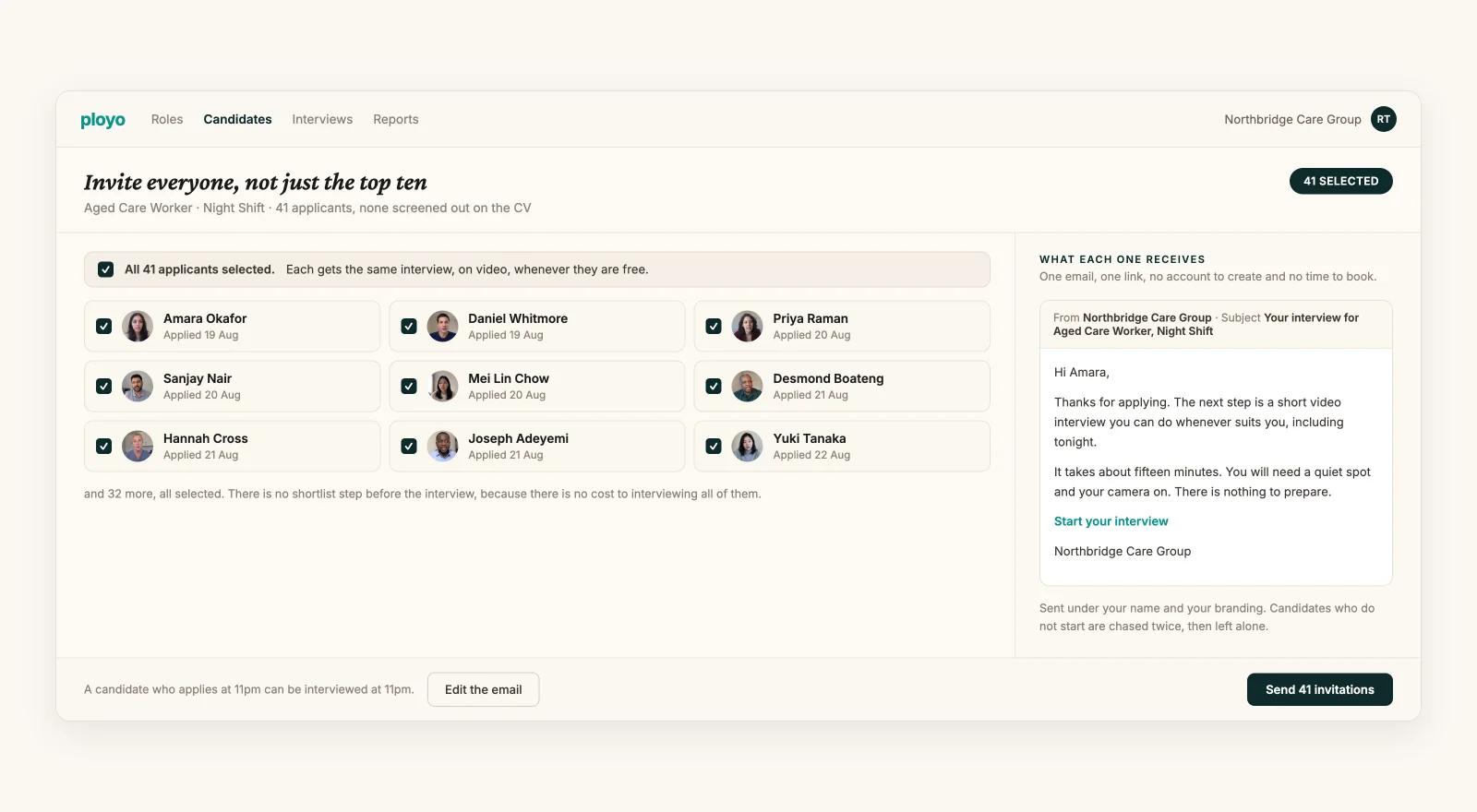
Invite everyone, not just the top ten
Frequently asked
Does automated screening actually reduce interview no-shows?
For point one, yes, and substantially, because it removes the step where somebody has to answer a live phone call from a number they do not recognise. For point two it helps by removing the fixed appointment rather than by reminding people about it. For point three it does very little, and any vendor claiming otherwise is selling you something that does not exist.
Do candidates find an AI interview off-putting enough to drop out?
Some do, and you should expect that. What matters is the net: whether more people complete a step they can take at 9pm on their own phone than complete a phone call scheduled for Tuesday at 2pm. In Ployo's own data, completion runs above 70 percent, which is higher than most providers report for booked phone screens, but you should test it on your own roles rather than take that figure from a vendor.
Is a text booking link better than an automatic phone call?
Text gets a higher response rate, because everyone opens a text and few answer an unknown number. But it only books a call, so it moves the problem to point two rather than solving it. The bigger gain is removing the scheduled step entirely, not choosing a better way to schedule it.
We have hundreds of applicants and still cannot fill shifts. Is ghosting really the problem?
Often not. If applications are plentiful and shifts stay open, the bottleneck is usually [throughput, not attrition](/guides/volume-hiring-care). Work out how many applicants you actually contact per week, then compare that against how many arrive. If you are contacting a fraction of them, ghosting is a symptom rather than the cause.
Should we just stop paying attention to candidates who ghost once?
No, and this is a common expensive mistake. A missed first call in this workforce carries almost no signal. Plenty of your best hires missed the first attempt because they were mid-shift with someone else's grandmother.
TRUSTED BY HIRING TEAMS AT








Hiring right now? See it on a live role
Book a Demo, a 30-minute call. We'll set Ployo up on a role you're hiring for and walk through the shortlist together.
30-minute call · See Ployo on one of your live roles