
Turnover in the first 90 days, and what actually drives it
Updated August 2026
Most of what makes a new hire quit in week three was decided before their first shift, not during it. Here is what actually drives early turnover in frontline care, what a better interview can influence, and what it cannot.

How big is early turnover, really?
Before the causes, the scale. None of what follows is a sign your service is unusually bad at this. It is a documented, sector-wide feature of Australian frontline care.
The numbers, before the causes
The NDIS Review puts annual turnover among NDIS support workers at 17 to 25 percent. That covers a full year, not just three months, but it sets the baseline: losing one in five to one in four support workers annually is documented at a sector level, not a sign your service is unusual.
It also sits inside a labour market that will not hand you a replacement. Health care and social assistance is Australia's largest industry by employment, at roughly 2.48 million people, and carried 55,300 job vacancies in August 2025, almost double retail trade's 28,700, according to the ABS.
What actually drives it in the first 90 days?
Four things show up again and again in why a new frontline hire leaves inside three months. Only one is genuinely something a hiring conversation can fix outright; the rest are partly onboarding, partly the nature of the work itself.
Driver one: they took the job expecting something different. The most common driver, and the one every recruiter hears within a week of a resignation: "I didn't realise it was every second weekend," or "nobody told me how much driving was involved." Usually not dishonesty. A job ad summarises a role in a paragraph; the actual roster and travel only become real once someone is doing it.
It is also the driver most exposed to hiring itself. A vague description before the offer means the candidate agreed to a job nobody actually described.
Largely addressable in hiring.
Ask directly about shift availability, weekend work and travel distance before the offer.
Describe the actual work, personal care tasks and lone work included, not a euphemism.
Record the answer, so there is something to point back to if expectations diverge.
Treat a hesitant answer as information, not a reason to rush the offer.
Driver two: weeks pass between the offer and the first shift. Checks, inductions and paperwork routinely push several weeks between accepting a role and starting it. Nothing keeps the job real in that gap, while other providers keep recruiting the same person. By first shift, some of what made the offer attractive has faded, and a nearer offer may have landed.
It is the same mechanism behind offer-to-first-shift no-shows elsewhere in recruitment, just showing up weeks later as a resignation instead.
Partly addressable.
Start the compliance clock at the interview, not after a separate decision to proceed.
Keep contact going during the gap. A checked-in candidate is still there on day one.
Interview every applicant on arrival rather than in a queue, so the gap starts later.
Measure the gap itself. Most services have never timed it.
Driver three: onboarding is a paperwork week, not a support week. A new starter's first days are usually consumed by inductions, e-learning and compliance sign-off, with little time on what actually matters: who to call if a client seems unsafe, what to do running late, who to debrief with after a hard shift.
This is where a lot of the workforce actually leaves, and it has nothing to do with who was hired. A well-matched candidate can still quit in week two if the first fortnight feels like a manual and a roster and nothing else.
Not a hiring problem.
Pair every new starter with a named, contactable person for the first month.
Separate compliance completion from job readiness. Finishing modules is not the same as being supported.
Check in at day 3, day 14 and day 30, where early disengagement typically shows up.
Fund onboarding as its own line, not a byproduct of recruitment finishing.
Driver four: in-home and community work is genuinely isolating. Residential care puts a new starter alongside colleagues every shift. In-home and community support does not: days can pass between seeing another staff member, working alone in a client's home with no one nearby to ask. For someone used to colleagues around them, that is a bigger adjustment than the role description suggested.
It is real and specific to this part of the sector, and a hiring conversation cannot create or undo it. What it can do is ask about it honestly before the offer, rather than let someone discover it alone in week one.
Partly addressable.
Ask directly whether a candidate has worked alone before and how they feel about it.
Describe the actual pattern: solo visits, driving time, how often they will see a colleague.
Build a real check-in cadence for home and community staff, not the residential default.
Do not oversell the "flexibility" of community work to someone wanting a team environment.
What can a better interview actually do about this?
Not reduce turnover. Surface the mismatch before the offer instead of after it. Asked directly, on record, whether they can work every second weekend or are comfortable working alone in a client's home, an honest every second weekend does not work for me is known before the offer, not discovered in week three.
That is expectation setting, not retention. It stops the wrong shift or the wrong kind of work becoming an offer. Smaller claim, more honest, and the only one this mechanism supports.
What Ployo does about turnover, stated plainly
For catching driver one, the expectation mismatch, before it becomes an offer, a live two-way interview that asks the shift and travel questions directly is the right tool, and it is what we would use. Ployo runs it with every applicant, keeps the verbatim answer on record for a recruiter to read and decide on, and never decides or auto-rejects on its own.
It does not reduce turnover, and we will not claim it does. Ployo's own published research on interview outcomes says explicitly it cannot speak to what happens after someone is hired. Nobody has retention data here, us included, and we would rather you trust the numbers we give you than invent one we do not have.
It is also not the right tool under about ten hires a year, for senior clinical or leadership roles that warrant a real conversation from the start, or for candidates with poor connectivity, since there is no audio-only fallback.
Ployo platform data
30,000+
AI Interviews Completed
340,000+
Candidate Answers Graded
70%+
Interview Completion Rate
15,000+
Recruiter Hours Saved
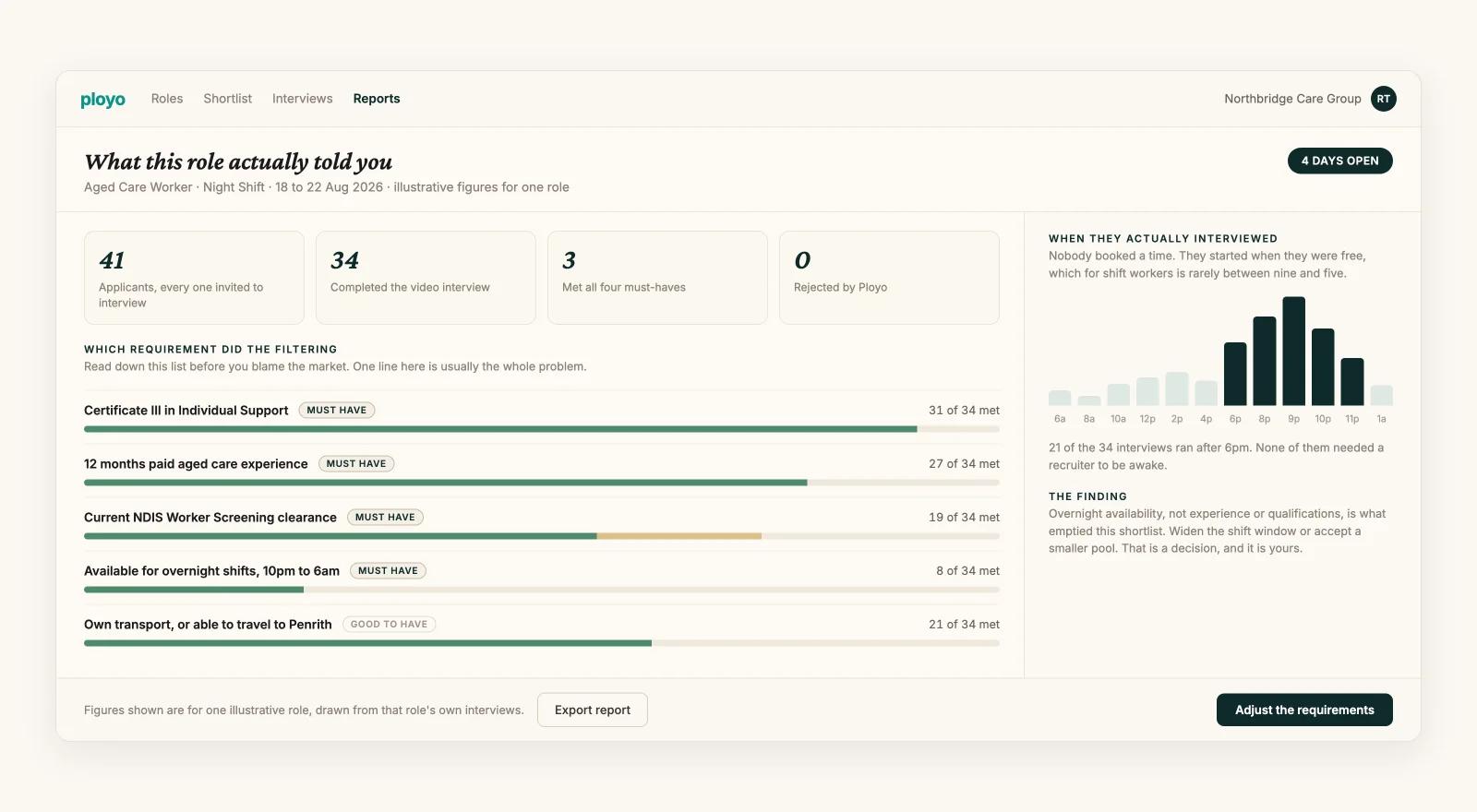
Which requirement actually emptied your shortlist
Frequently asked
Why is turnover so high for in-home aged care staff within the first three months of hire?
Usually four things stacked together: the role differs from what was described, especially travel and lone working; the offer-to-first-shift gap gives a competing offer time to land; onboarding runs on compliance, not support; and in-home work is genuinely more isolating than a rostered team. The NDIS Review puts annual turnover among support workers at 17 to 25 percent, and three months is usually when one surfaces.
Why do new support workers quit within the first few weeks?
Because the mismatch or the isolation shows up almost immediately, not gradually. A roster with every second weekend, a solo shift with no one to call, or an onboarding week that answered nothing useful is usually obvious within a fortnight. Resignations clustering in weeks two to four signal an expectation or onboarding problem, not pay or management.
High turnover in personal care worker roles, retirement village recruitment always short staffed: is this normal?
Common enough to be a known sector feature, not evidence your service is failing. Retirement village and residential personal care compete for the same shrinking pool as the rest of aged care, inside an industry that carried 55,300 job vacancies in August 2025 against retail trade's 28,700. Short-staffed and high turnover at once is usually one cause, twice.
Staff turnover in residential aged care is blowing out our budget. What actually fixes it?
Nothing fixes all of it, and be wary of anything claiming to. What hiring can fix is the expectation mismatch: ask directly about shifts, travel and the work before the offer, and record the answer. What hiring cannot fix is onboarding and the offer-to-first-shift gap, both operations problems that matter at least as much.
Is there an AI recruitment approach to reduce early staff turnover for home care providers?
Ployo runs a live, two-way video interview with every applicant, not a recorded one-way video or phone screening (some buyers search this as "AI phone screening," though the interview is video, not audio). It asks directly about shift availability, travel and comfort with lone work, on record. It is not a turnover-reduction tool: Ployo's own published research says explicitly it cannot speak to what happens after someone is hired.
What are the three reasons your new hire is thinking of quitting?
Ask rather than guess. Usually one of three: the job was not what they were told, on shifts, travel or the work; nobody has checked in since induction ended; or a competing offer now looks better. The first is hiring, the second onboarding, the third pay and market. Exit interviews blend all three into a vague "not the right fit," which is why so few services fix any.
TRUSTED BY HIRING TEAMS AT








Hiring right now? See it on a live role
Book a Demo, a 30-minute call. We'll set Ployo up on a role you're hiring for and walk through the shortlist together.
30-minute call · See Ployo on one of your live roles