
Getting SCHADS classification right, and keeping the proof
Updated August 2026
A SCHADS classification is a judgement call made from what a candidate tells you about their qualifications and experience, not from their job title. Most providers capture that evidence in an unstructured phone call and keep none of it. If the classification is ever challenged, that gap is what costs you.
General information for Australian social, community, home care and disability employers. Current August 2026. Not legal or immigration advice.

What does the SCHADS award cover, and where does it not apply?
The Social, Community, Home Care and Disability Services Industry Award (MA000100), commonly called SCHADS, covers social and community services, crisis assistance and supported housing, home care, and disability services, spanning entry-level support work through to a case manager with a social work degree.
The exception almost everyone assumes wrong: registered and enrolled nurses are typically not classified under SCHADS. A role titled "community nurse" usually sits under the Nurses Award or a nursing agreement, even inside a home care program. Check which award covers the role before blaming the rate.
How do the classification levels actually work?
Four streams sit inside the award, each with its own ladder of levels, set not by job title but by qualification, judgement and the complexity of the duties performed against the award's indicative tasks.
| Stream | Typical roles | What decides the level |
|---|---|---|
| Social and Community Services Employee | Case work, coordination, program roles | Qualification or equivalent experience, judgement, program responsibility |
| Crisis Accommodation Employee | Supported accommodation, crisis and refuge work | Same logic, accommodation-specific duties |
| Home Care Employee | Personal care and domestic assistance in a client's home | Complexity of care tasks, domestic assistance to complex personal care |
| Disability Services Employee | Direct support and care work | Qualification, autonomy, supervision or specialised support |
Certificate III is the usual entry point for most direct care levels; a Certificate IV, diploma or degree moves someone up, and so does equivalent experience. This page does not quote a rate for any level: rates are indexed roughly annually and vary by level, employment type and loading, so a number printed here goes stale fast. Fair Work Ombudsman's Pay and Conditions Tool returns the current rate, the only version worth paying someone against.
What evidence actually sets the level at the point of hire?
A classification is decided from three things: the qualification a candidate holds and whether it is actually complete, the paid experience they can describe in specific terms, and the actual duties they performed, not the job title on their last payslip. Two candidates with an identical title can sit at different levels once you ask what they actually did.
Whether the qualification is complete, part-complete, or genuinely equivalent experience
The specific duties performed, not the job title alone
Whether the role carried supervision or specialised support
The recommendation: capture it as a timestamped answer, not a memory
Most providers gather this evidence in an unstructured phone call, and what survives is a coordinator's paraphrase, not the candidate's own words: the weakest record possible if a classification is ever disputed, by the employee or in a Fair Work complaint.
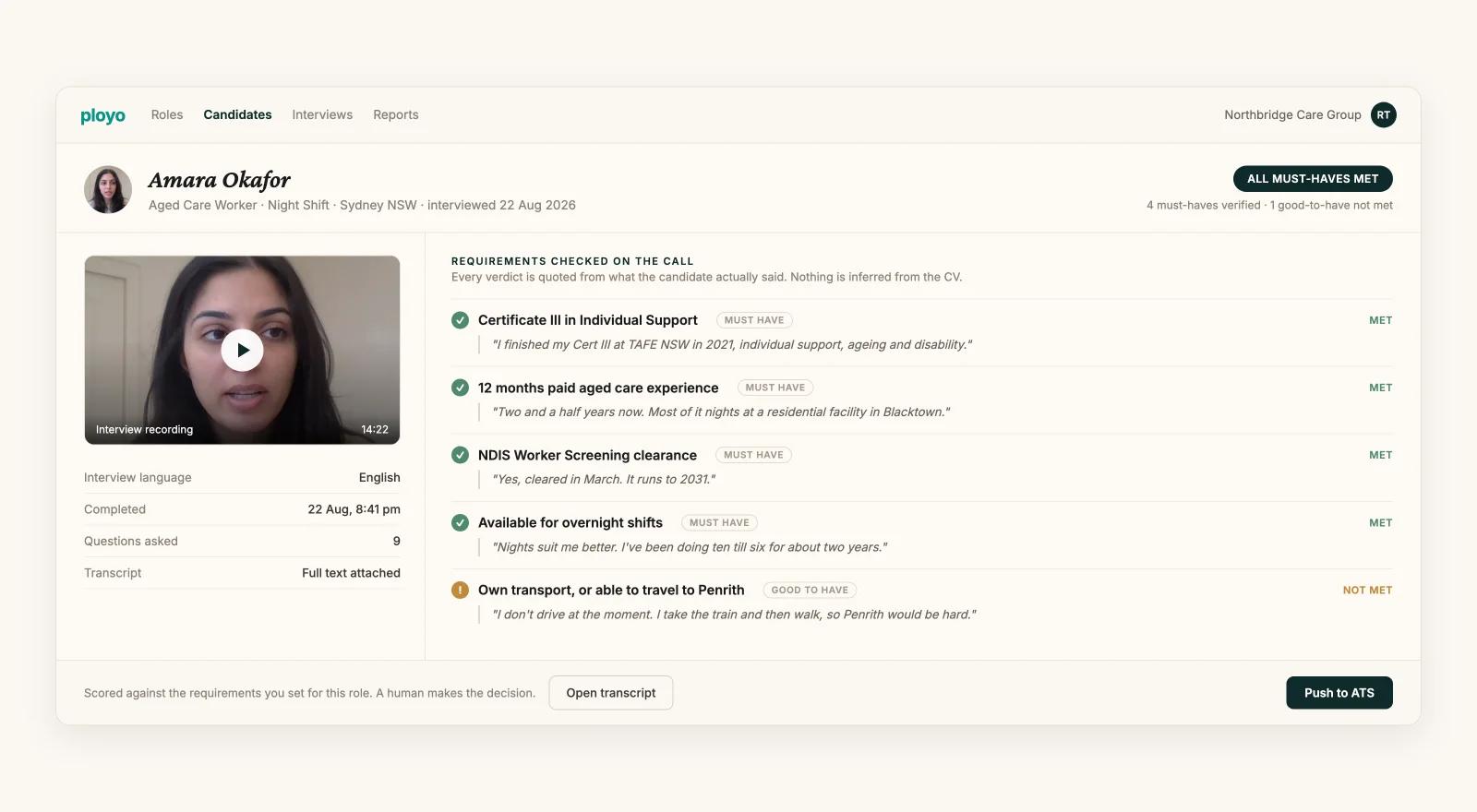
Ployo runs a live, two-way video interview with every applicant and asks about qualifications and experience as a structured question, every time, and the answer comes back as a verbatim quote with a timestamp on the record. For this specific problem, that is what we would use it for: a person still decides the classification, from evidence you can actually produce later.
It does not check the qualification against the issuing body. Ployo does not verify a Certificate III against the RTO or a nursing qualification against AHPRA; it records what the candidate said, and sighting the certificate is still your process. A person makes the call, not the interview, which keeps the record on the right side of the disclosure obligation landing in December 2026.
When does the casual conversion obligation actually arise?
Casual conversion changed in 2024, and a lot of what circulates is the old rule. Under the current employee choice pathway, a casual can notify you in writing, once they have worked for you 6 months (12 for a small business employer, under 15 staff), that they no longer meet the legal test for casual and want to convert. That is the trigger: the employee choosing to notify, not an anniversary date you track yourself.
You then have 21 days to respond, refusing only on specific grounds: they still genuinely meet the casual definition, fair and reasonable operational grounds, or the change would break a required recruitment process. That turns on a firm advance commitment to ongoing work in substance, not on what the roster is labelled. General information, current August 2026; confirm with Fair Work before relying on it.
Can you interview a casual, or require attendance, outside business hours?
Two different questions get asked here, with opposite answers.
The interview itself: not inside the award. A job interview happens before an employment relationship exists. Recruitment and selection are not "work" under the award, so shift length rules, minimum engagement periods and penalty rates do not attach, at any hour. Running one at 9pm on a Sunday is a scheduling choice, not a compliance question, part of why completion on Ployo's interviews runs above 70 percent: most candidates are free outside business hours, not during them. Any hour, genuinely.
Once they are rostered: fully inside the award. The moment someone is engaged and rostered for a shift outside standard hours, you are inside the award: minimum engagement periods, evening, weekend and public holiday loadings, and rostering notice rules all apply. That is a rostering decision, not a recruitment one. Rules apply from here.
One grey area sits between the two: an unpaid working trial with real productive work, beyond a brief skills demonstration, risks being unpaid work regardless of the label.
Is a migration agreement a real option for a genuinely thin market?
Some catchments do not have enough people at any price. Two mechanisms exist for genuinely thin markets, and both are slow.
Designated Area Migration Agreement (DAMA), region-specific. Negotiated between the Australian Government and a regional or state authority for a specific region. A DAMA gives sponsoring employers there occupations and concessions, on age, salary and English, that the standard visa program does not offer everywhere. You become an endorsed employer through the regional body, then run a labour agreement through Home Affairs. Region by region.
Aged Care Industry Labour Agreement, national, aged care only. The national equivalent for approved aged care providers, covering direct care roles under its own concessions rather than a region's. It does not help a disability or community services provider outside aged care. Aged care providers only.
Both run to months, not weeks, once the agreement, nomination and visa are counted. Treat sponsorship as a supply strategy for a market that will stay thin, not an answer to Saturday's roster. For the wider view on hiring where the local market genuinely cannot supply the role, see regional and rural care hiring.
Where this is not the right tool
Under about 10 hires a year, a good phone call from an experienced coordinator does the job. Senior clinical and leadership hiring rests on judgement built over a long conversation, better done by a person end to end. And where connectivity is genuinely poor, there is no audio-only fallback: a candidate who cannot sustain a video call cannot complete the interview.
Ployo platform data
30,000+
AI Interviews Completed
340,000+
Candidate Answers Graded
70%+
Interview Completion Rate
15,000+
Recruiter Hours Saved
Every verdict quoted from the call
Frequently asked
Why is it so hard to recruit community nurses under the SCHADS award pay rates?
Usually because a community nurse role sits under the Nurses Award, not SCHADS. Confirm which award applies before blaming the rate.
How do you confirm someone meets SCHADS award classification before rostering them on shift?
Establish the qualification, whether it is complete, and the actual duties performed. Match that against the descriptors for the stream, document it, and sight the certificate.
What are the SCHADS award rules for interviewing casual community care staff outside business hours?
None: an interview happens before employment starts and is not "work" under the award. The rules attach once someone is engaged and rostered, so interviewing at night or on weekends is a scheduling choice, not a compliance question.
How do you screen applicants against SCHADS award classification for community mental health jobs?
The same way as any SCHADS role: by qualification and duties, not title. Community mental health support usually sits in Disability Services or Social and Community Services, and peer support work often adds its own qualification on top.
Why is it so hard to fill support worker shifts when SCHADS rates are so low?
The award sets a floor, and NDIS price caps set a ceiling on how far above it a provider can pay, so wages barely move between providers. That makes the process itself the actual point of difference.
Can you use a regional migration agreement to sponsor support workers for a rural NDIS provider?
Yes, if your region has a Designated Area Migration Agreement covering care roles, which is common but not universal. You become an endorsed employer through the regional authority, not Home Affairs directly, and it runs to months, not weeks.
What is an aged care labour agreement?
A national template letting approved aged care providers sponsor overseas workers for direct care roles under its own concessions, separate from any region's DAMA. It is specific to aged care and does not replace the classification work once someone starts.
TRUSTED BY HIRING TEAMS AT








Hiring right now? See it on a live role
Book a Demo, a 30-minute call. We'll set Ployo up on a role you're hiring for and walk through the shortlist together.
30-minute call · See Ployo on one of your live roles