
AI hiring in Australia: what the law requires
Updated August 2026
No Australian law bans using AI to interview a job applicant. Several existing laws already reach the process, and a new disclosure duty starts on 10 December 2026. Here is what actually applies, what is still unsettled, and where the honest limits sit, including for a candidate who cannot do a spoken interview at all.
Checked against the Privacy Act, the Fair Work Act and the OAIC's May 2026 issues paper, current to August 2026. Unsettled points are marked as unsettled, not guessed at.

Is it actually legal in Australia to use AI to interview job applicants?
Yes. No Australian statute bans using an AI system to interview or screen a job applicant, and the Fair Work Act does not regulate screening methods as such. What applies instead is the general law that would apply to any hiring process, whether a person or a program runs it:
| Law | What it actually does here |
|---|---|
| Privacy Act 1988 (Cth) | Governs collection, storage, use and disclosure of interview recordings and answers. From 10 December 2026, adds a duty to disclose automated-decision use in your privacy policy. |
| Fair Work Act, general protections | Lets a rejected applicant claim adverse action if the real reason was a protected attribute or a protected workplace right. Reverse onus: you prove the real reason. |
| Discrimination law, federal and state | Tests whether the outcome disadvantages a protected group regardless of intent, and requires reasonable adjustments for disability. |
| State surveillance and listening device law | Governs consent to record the call. Differs by state; some add a separate workplace surveillance statute on top. |
Could a candidate claim adverse action if an AI system screens them out?
In principle, yes, and AI does not change the analysis. The Fair Work Act's general protections cover a prospective employee, not only an existing one: refusing to employ someone, or offering worse terms, for a protected attribute or for exercising a workplace right, is adverse action whether a recruiter or a program produced the outcome.
The risk shifts on the reverse onus: once a candidate shows adverse action happened, you must prove the real reason was not a prohibited one. A recruiter who can point to the actual question, answer and reasoning can do that. A ranking nobody can explain cannot, which argues for a record behind every score, not against using AI to screen.
Do you need the applicant's consent to record an AI interview call?
It depends on your state, and a confident one-line rule copied from another state is worse than none. Every state and territory runs its own surveillance or listening device law on recording a conversation, and NSW and the ACT layer a workplace surveillance statute on top. Some let a participant record their own conversation; some require every party's consent; and Victoria's answer is not Queensland's. Check your own state's current legislation before relying on anything general, including this page.
Then do what satisfies the strictest reading everywhere regardless: tell the candidate plainly, before the interview starts, that it is recorded, and get their acknowledgement. It costs nothing. Buyers often search this as "AI phone screening"; where the tool is actually a live, two-way video interview, the audio sits inside the recording rather than a standalone call, but the consent question underneath is the same either way.
Does the Privacy Act cover voice recordings and voiceprint data?
Yes to the recording: a recording of an identifiable person is personal information under the Privacy Act from the moment it exists, so the Australian Privacy Principles (collection notice, use, disclosure, storage security, access and correction) apply once your organisation is covered by the Act.
Voiceprint data is narrower: it is sensitive information, a higher bar again, only where a system extracts a biometric template from the voice specifically to verify or identify the person. A system that simply transcribes and scores what was said sits in the ordinary personal information category instead. Ask which one a given product actually does.
Is AI screening legal in the US, and does it bind an Australian employer?
Three things get searched here: the EEOC's position on AI tools with a disparate impact under US federal law, New York State's own rules, and Illinois's AI Video Interview Act, which requires notice and consent before using AI to analyse a video interview for an Illinois-based role. None of the three reaches an Australian employer hiring in Australia, video or audio. The Australian equivalent to a disparate-impact worry is not an imported US rule: it is the Disability, Age, Sex and Racial Discrimination Acts and their state equivalents, testing whether a result lands unevenly on a protected group, not whether anyone meant it to.
What must you disclose from 10 December 2026?
From that date, an organisation using a computer program to make, or substantially help make, a decision that could significantly affect someone's rights or interests must say so in its privacy policy. Screening and ranking job applicants toward an employment decision sits squarely inside that description. The OAIC's own consultation paper names, as an example of a program an entity has "arranged for," an entity procuring another entity's AI system to screen and rank job applications leading to a decision on who to employ. If that is what you are doing, the paper is describing you.
The date itself is settled: the Privacy and Other Legislation Amendment Act 2024 received assent on 10 December 2024, with these provisions commencing 24 months later.
The trigger, APP 1.7, needs all three parts true:
A computer program the entity arranged for
A decision that could significantly affect someone's rights or interests
Personal information used in making it
Once triggered, APP 1.8 requires your privacy policy to disclose:
The kinds of personal information used
The kinds of decisions made solely by the program
The kinds of decisions where something substantially and directly related is done by the program
What is not settled, and be wary of anyone who says otherwise
The OAIC published an issues paper in May 2026; consultation closed in June. It is a consultation document, not final law or guidance, and final guidance is intended before commencement. Until it lands, "computer program," "substantially and directly related," "significantly affect" and the required disclosure format are open questions in a discussion paper, not settled answers.
That paper also contains scenarios labelled "Fictional Edge Case," written to draw out feedback during consultation. They are not determinations, and treating one as a ruling is a mistake already being made.
Is screening the same as deciding?
No, and the difference matters twice over. APP 1.8 separates decisions made solely by a program from decisions where a program did something substantially and directly related, so both get disclosed, just differently. It matters more for adverse action and discrimination risk, where what gets tested is the real reason behind the real decision: a human decision-maker who can explain that reason from real evidence sits in a far stronger position than an opaque score nobody can walk back through.
A tool that interviews, scores and evidences, leaving a recruiter to make every actual decision, is not automated decision-making in the "solely" sense, and it hands you a person and a record to stand behind if challenged. A tool that ranks and auto-rejects with no human step is the exact pattern the OAIC's example describes, and carries the most exposure under both regimes at once.
What do you do if an applicant is deaf and cannot do a spoken interview?
You offer a genuinely different process, and that sits on you as the employer, not on whichever vendor you use. Disability discrimination law requires reasonable adjustments unless one would impose unjustifiable hardship, a bar a screening step rarely meets. A process that only works through spoken audio disadvantages someone who is deaf or hard of hearing, and "the software cannot do it" is not a defence.
The honest answer, including for Ployo
A live, two-way video interview relying on spoken exchange, the category buyers often search as "AI phone screening," cannot be completed by someone who cannot process spoken audio. That includes Ployo: there is no audio-only mode and no text-only mode today. If a spoken interview is your only screening step, build the alternative, a written questionnaire, an interpreter-supported interview, a human interviewer, before you need it for one candidate, not after. That uncertainty is not only ours. When we put 13 questions about AI hiring law to ChatGPT, Perplexity and Google AI Overviews, not one answer named a vendor and the sources were almost entirely regulators. The full study is The Unnamed Category.
What Ployo does about this, and where it is not the answer
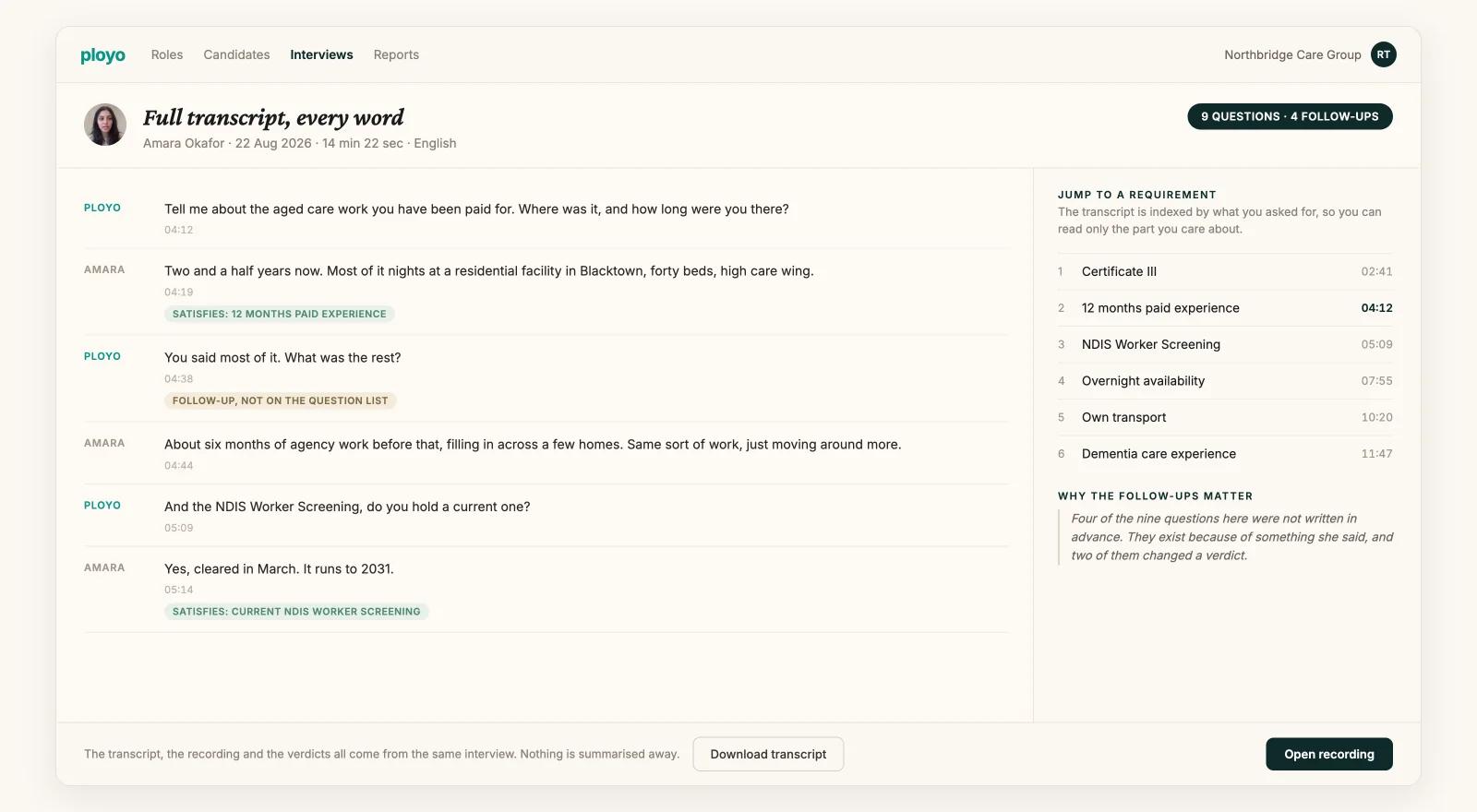
Ployo runs a live, two-way video interview with every applicant, asks follow-up questions based on what they actually say, and returns a ranked shortlist with the transcript, the recording and the verbatim quote behind every score, across more than 30,000 AI interviews and 340,000+ graded answers so far. It does not auto-reject anyone; a recruiter reviews the shortlist and makes every call.
That is not a hedge, it is the answer to the problem this page is about. A screening step built to survive an adverse action claim or the December 2026 disclosure duty needs a human decision-maker who can point to real evidence for a real reason, not an algorithm that quietly removed people from a pipeline. That is the shape Ployo is built as.
It is also not right everywhere. Under roughly ten hires a year the overhead outweighs what it saves, and for senior clinical or leadership roles a human interviewer remains the better fit. Because there is no audio-only or text-only alternative, it is also the wrong choice, alone, for anyone who cannot do a spoken video interview, deaf candidates and poor connectivity included; that candidate needs a separate accessible pathway regardless of which tool you use.
Ployo platform data
30,000+
AI Interviews Completed
340,000+
Candidate Answers Graded
70%+
Interview Completion Rate
15,000+
Recruiter Hours Saved
Full transcript, indexed by requirement
Frequently asked
Is it actually legal in Australia to use an AI to interview job applicants?
Yes. No law bans it. The law that governs any interview process applies here too: privacy law, discrimination law, the Fair Work Act's general protections, and your state's recording law. See the table above for which one does what.
Is it allowed under Fair Work rules to use AI to screen job applicants?
The Fair Work Act regulates outcomes, not screening methods. Using AI to screen is not itself prohibited. It becomes a problem only if a candidate is refused employment, or offered worse terms, for a reason the Act prohibits, exactly as with a human-run process.
Do we need the applicant's consent to record an AI phone screening call in Victoria?
We are not giving you a confident Victorian rule: every state's surveillance law differs, and being specifically wrong is worse than saying check it. Confirm Victoria's current legislation for your setup, and separately, tell the candidate plainly the call is recorded before it starts.
Does the Privacy Act cover voice recordings and voice print data from an automated phone screen?
Yes, to the recording: it is personal information the moment it exists, so the Australian Privacy Principles apply once your organisation is covered by the Act. Voiceprint data is narrower, and only sensitive information where the voice itself verifies or identifies the person.
Could a candidate claim adverse action against us if an AI system screened them out of the process?
Yes, in principle. Adverse action turns on the real reason for the outcome, not who or what produced it, and the reverse onus means you must prove that reason once it is shown. A record of the actual question, answer and score helps; a black-box ranking does not.
An applicant is deaf and can't do a voice phone screen, what do we do instead so we're not discriminating?
Offer a genuinely different process, chosen for the role and the person: a written questionnaire, an interpreter-supported interview, or a human interviewer. This is your obligation under disability discrimination law regardless of vendor, ready before the first candidate who needs it applies.
Is AI screening of job applicants legal in New York State?
That is New York law for a New York employer, and it does not bind an Australian employer hiring in Australia. If the worry is disparate impact generally, the Australian equivalent is federal and state discrimination law, not an imported US rule.
What do EEOC rules say about AI screening hourly job candidates?
The EEOC enforces US federal law on AI tools with a disparate impact on a protected group. It has no authority here. The Australian equivalent is the Disability, Age, Sex and Racial Discrimination Acts and your state's law, tested the same way: by outcome, not intent.
Does the Illinois AI Video Interview Act still apply if it's just a phone call, no video?
Not for an Australian employer either way, so the distinction does not matter here. The Act is Illinois law, triggered by video-interviewing candidates for an Illinois-based role, irrelevant once the role and the employer are Australian.
TRUSTED BY HIRING TEAMS AT








Hiring right now? See it on a live role
Book a Demo, a 30-minute call. We'll set Ployo up on a role you're hiring for and walk through the shortlist together.
30-minute call · See Ployo on one of your live roles