
AI phone screening, and why we do it on video
Updated August 2026
Phone, one-way video, live two-way video and chat or SMS all get filed under the same word: screening. They capture completely different things. In care and nursing hiring, where the job is presence and manner as much as competence, that difference decides whether your shortlist means anything.

What the search engines already say, when you ask them
Ask Google's own AI Overview to compare phone screening against video interviews for nurse hiring, and it concedes the point before you reach a single vendor's page: phone screening "gives zero insight into interpersonal warmth, non-verbal cues." That is not a sales claim. It is the category's own weakness, stated by the tool people use to research the category.
Why does everyone search for "phone screening"?
Nobody specifically wants audio. Buyers are trying to replace the job a recruiter used to do by phone: ask a handful of questions, listen, and decide whether to move someone forward. "AI phone screening" is the name that stuck to that job, and it says nothing about whether audio is the right medium for what you need to learn. Four formats compete for this budget: a live AI phone call, a chat or SMS questionnaire, a one-way recorded video, and a live two-way video interview. This page argues for the last one, not a phone call, and the difference is the whole argument.
What can each format actually capture?
Here is what each format can and cannot do, before any vendor's pitch, including ours.
| Format | Live, two-way | Shows face & manner | Weak signal ok | Candidate effort |
|---|---|---|---|---|
| Chat / SMS screening | Partial | No | Yes | Lowest |
| AI phone screening | Yes | No | Yes | Low |
| One-way recorded video | No | Yes | Partial | Medium |
| Live two-way video interview | Yes | Yes | No | Medium |
The "weak signal" column matters most. A live two-way video interview needs a connection stable enough for real-time video, a higher bar than a phone call, and there is no audio-only fallback: offer an unsupported connection a different process instead.
Where each format breaks down
Format one: AI phone screening, a live call, audio only. An AI system rings the applicant and holds a live, two-way call, asking a follow-up on what the candidate just said. It is the strongest format for a poor connection: no app, no camera, less confronting than a lens for some candidates.
What it cannot do is see anything: no read on posture, expression or the warmth a resident notices in the first thirty seconds, exactly what matters for someone who will be alone in a client's home.
Cannot assess manner.
Best where the connection itself is the binding constraint.
Not enough alone for any role built on interpersonal presence.
Format two: one-way recorded video, recorded alone, watched later. The candidate answers a fixed list of questions alone on camera, watched by a recruiter days later. It captures the face, more than a phone call, whenever suits the candidate.
It cannot ask a second question, because nobody is listening when the answer arrives. In frontline care the follow-up is usually the whole interview: the first answer is rehearsed, the follow-up is where you see what someone actually does.
Shows manner, cannot probe it.
Removes the scheduling problem, which matters at volume.
Weak wherever a borderline answer needs a second question to resolve.
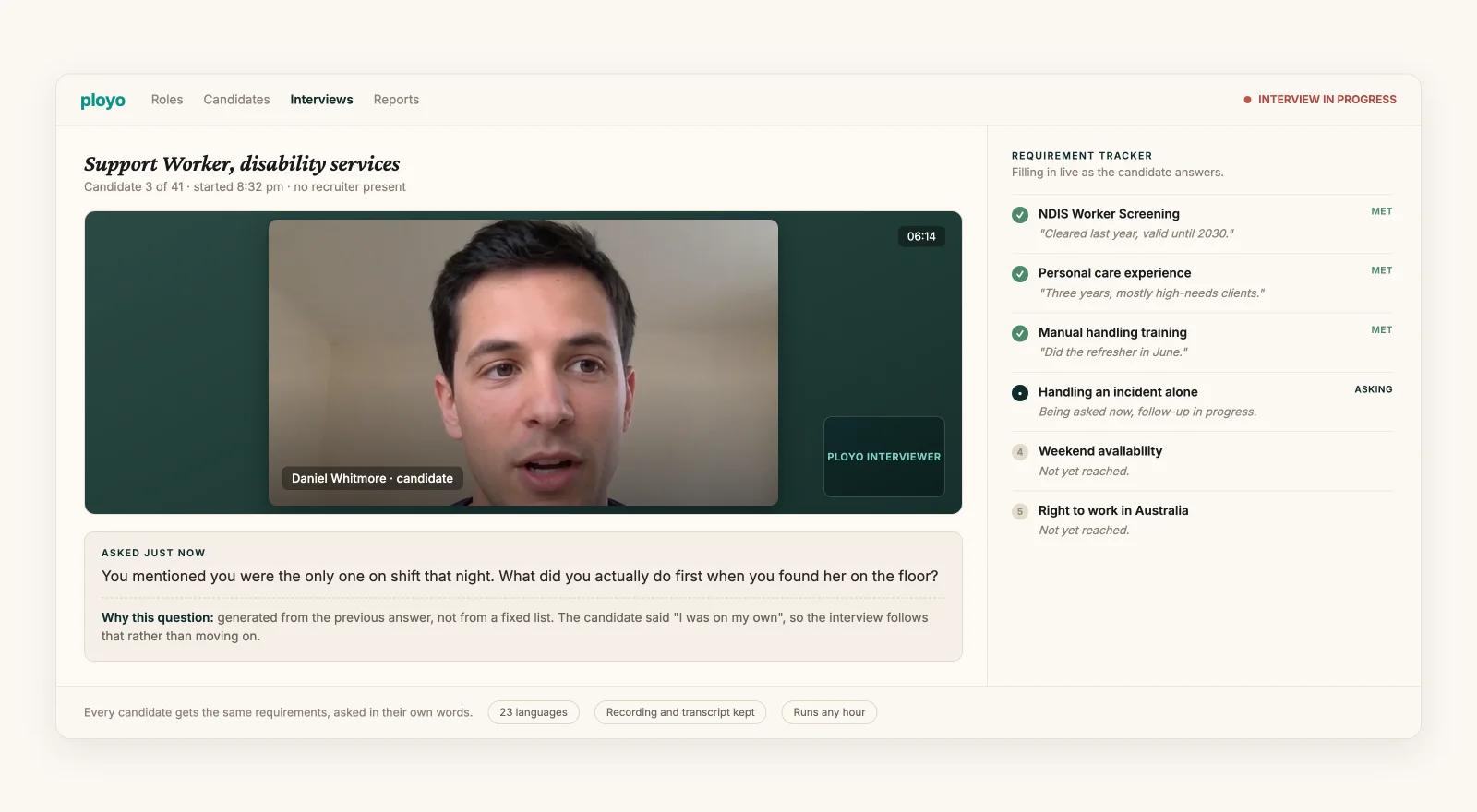
Format three: live two-way video interview, seen, heard and followed up in real time. The system holds a live conversation like a phone call, on video: it adjusts its next question to what the candidate just said, and a recruiter can see how something was said, not only hear it. This is the format Ployo runs, in 23 languages, with the transcript, the recording and the verbatim quote behind every score. It has run more than 30,000 of these interviews and over 15,000 hours of interview time.
It needs a working camera and a connection stable enough for live video, a higher bar than a phone call. There is no audio-only fallback: offer an unsupported connection a different process instead.
Shows manner, and follows up.
Right where the job is presence as much as competence: aged care, disability support, nursing, allied health.
Not the right call where the connection genuinely cannot hold live video; offer that group an alternative.
Why this matters more in care than almost anywhere else
In a lot of roles, screening only needs to confirm competence. In aged care, disability support and nursing, manner is close to the whole job instead: the person hired will be alone with someone frail, frightened, in pain, or unable to call for help, and whether their tone reads as reassuring or brusque is the competency.
That is exactly what a phone call cannot show, and what a one-way recording only half shows: a recorded face can say the right words, but not how someone behaves when an answer arrives that nobody scripted for, because nobody was there to ask the next question. Only a live two-way interview shows the follow-up and the face together, the same way shift work does.
What about chat and SMS screening?
Almost nobody ignores a text, which makes chat and SMS the fastest filter for a hard yes-or-no requirement: a qualification, a start date, weekend availability. Past that it has little to offer a role built on interpersonal judgement. No voice, no face, usually a fixed script, not a real follow-up.
Which one should a care employer actually use?
For aged care, disability support, nursing and any role where someone will be alone with a vulnerable person, a live two-way video interview is the right tool, and it is what we built Ployo to be: the transcript, recording and verbatim quote behind every one of the 340,000-plus answers graded so far, not just a score.
It also confirms the must-haves you set, such as availability or a qualification, and records the candidate's own answer as timestamped evidence rather than checking it against AHPRA or the NDIS Worker Screening database; that stays your process. Nor does it auto-reject anyone: it scores, a recruiter decides, and every score carries its quote, close to what Australia's automated decision-making disclosure rule will expect from 10 December 2026, under the Privacy and Other Legislation Amendment Act 2024.
For a broader comparison of screening formats and vendors, see screening alternatives.
What Ployo does here, stated plainly
For care, disability support and nursing hiring, Ployo runs a live two-way video interview with every applicant the moment they apply, asks a genuine follow-up on what was just said, and hands a recruiter the transcript, the recording and the verbatim quote behind every score: what phone screening cannot do at any price, and what one-way video only half does.
It is the wrong tool under about ten hires a year, where setting up structured screening costs more than it saves. It is the wrong tool for senior clinical or leadership hiring, where volume is low and a human panel is the right effort per candidate. And it is the wrong tool for any candidate whose connection will not hold a live video call: there is no audio-only fallback, so offer that group a different process instead.
Ployo platform data
30,000+
AI Interviews Completed
340,000+
Candidate Answers Graded
70%+
Interview Completion Rate
15,000+
Recruiter Hours Saved
A real interview, on video, that follows the answer
Frequently asked
Phone screening vs video interview: which is better for hospital nurse hiring?
Video, once you get past bandwidth. Care and nurse hiring need you to judge manner with a frightened or vulnerable patient, not just the clinical answer. A phone call confirms a registration; it cannot show how someone delivers bad news, or whether their manner is reassuring or brusque. Ployo does not check that registration against AHPRA; it records the answer as timestamped evidence to verify separately.
One-way video vs something that actually calls the applicant: what's better for high-volume support worker hiring?
Neither has a scheduling problem, which is what people assume decides this. One-way video scales well, since nobody needs to be free to run it. But a format that cannot ask what a vague answer means produces the ambiguous transcripts nobody has time to chase at real volume. Something that calls the applicant the moment they apply keeps that advantage and the follow-up.
What's the actual difference between a recruiting chatbot and something that rings the candidate and talks to them like a person?
A chatbot exchanges typed messages on a script or simple branching logic, filtered through whatever the candidate chose to type. Something that rings the candidate hears the answer as given and asks a natural follow-up based on what was actually said. Chat is fast to build and near-universal to open, a fine early yes-or-no filter, but it cannot show how someone communicates under pressure.
AI voice screening vs texting candidates a screening questionnaire: which gets more responses?
Text wins on raw response rate: almost everyone opens a text. A texted questionnaire gets typed answers with no ability to probe an odd one, and no voice or visual signal at all. Voice or video screening that starts the moment someone applies closes most of the completion gap, since the usual killer is the scheduled callback. Ployo's completion rate runs above 70 percent, though you should test that on your own roles rather than take a vendor's figure.
AI phone screening vs text screening for hourly jobs: which actually converts better?
Conversion comes down to how much time sits between applying and being assessed, not the channel. Text has the least friction and suits a basic eligibility check. But an hourly applicant is usually talking to two or three employers at once, and whoever assesses them today beats whoever texted a questionnaire for later. A video interview run immediately on application removes that gap, and video gives more to base an offer on for the same speed.
TRUSTED BY HIRING TEAMS AT








Hiring right now? See it on a live role
Book a Demo, a 30-minute call. We'll set Ployo up on a role you're hiring for and walk through the shortlist together.
30-minute call · See Ployo on one of your live roles