
Hiring for work with nobody else in the room
A facility worker has a nurse down the corridor. A home or community care worker has a client's front door, a full day of solo visits, and no one to check in with. That difference should change how you hire. For most providers, it still does not.
30-minute call · See Ployo on one of your live roles
What actually makes this hiring different?
Home care workers, in-home aged care staff, community care workers, domestic assistance workers, respite workers and the care coordinators who hire them are doing something a facility colleague is not: working unsupervised, inside someone else's house, with nobody there to notice if the manner is off or the judgement is wrong.
That raises the stakes on exactly what a CV cannot show. Qualifications and a clean check say someone is allowed to do the job. They say nothing about how that person behaves alone with a frail or private client in that client's own lounge room, where it goes wrong first.
What changes because nobody else is there?
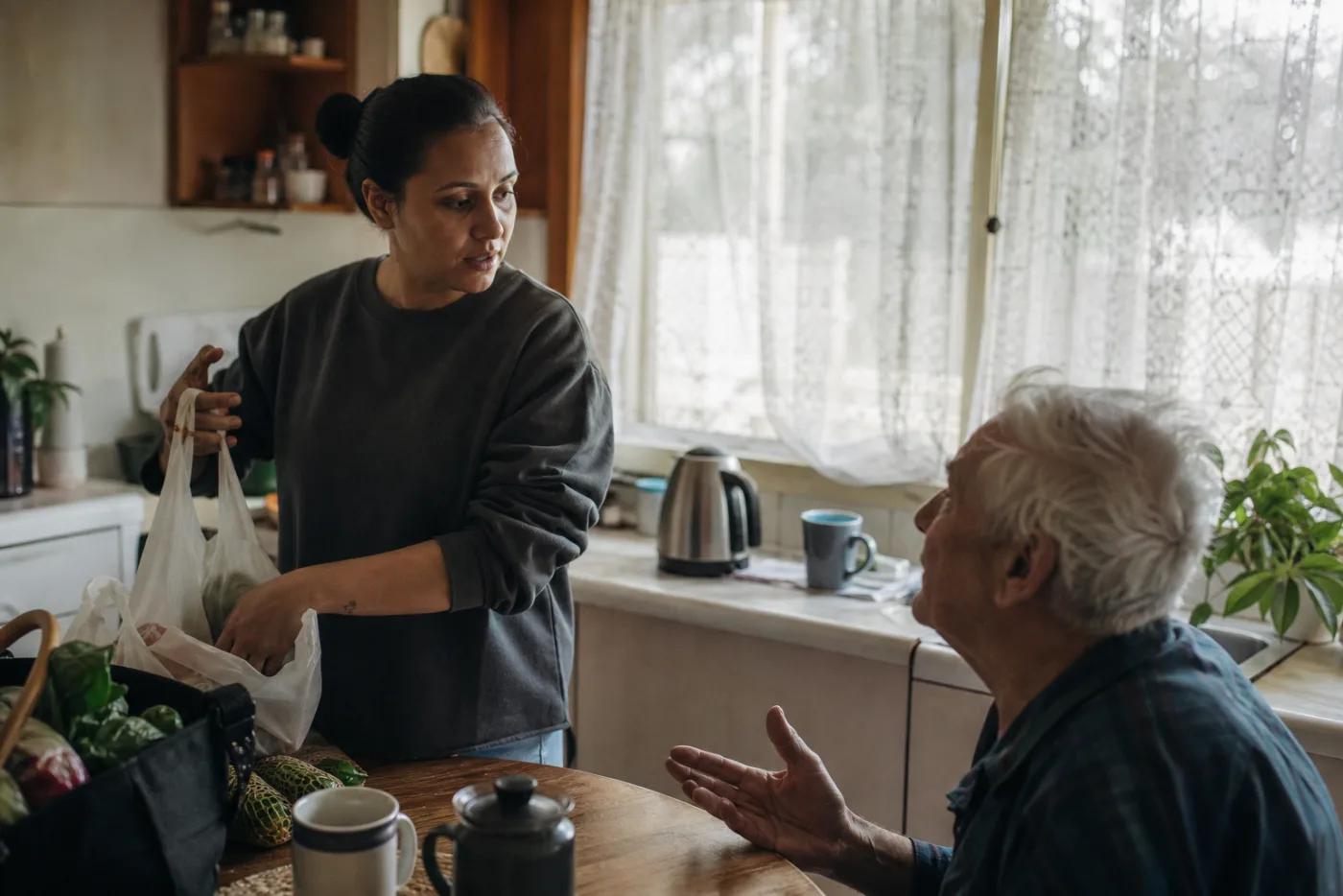
Nobody else is in the room. The client is often the only witness to a visit, and the least able to flag a problem. Manner has to be assessed before the first visit, not after.
The commute is part of the job. A shift is rarely one address, and public transport rarely reaches these clients. A current licence and a reliable car are close to universal requirements here.
The funding shapes the roster. Package-funded care is built around one participant's preferences. CHSP-funded care is entry-level and high-volume: different hiring problems, not the same one at a different size.
Why does a driver's licence matter this much?
Almost every role here means travelling between clients rather than staying on one site, and public transport rarely reaches the outer-suburban, regional or rural addresses where this work happens. A worker who cannot drive reliably cannot cover the run, however good they are at the care itself.
A licence tick-box on a form does not tell you much: a learner's permit or a car shared with a partner on alternating days both read as "yes" and fail on a Tuesday. Ployo asks every candidate about their licence, vehicle and the radius they can genuinely cover, and records the exact answer. It does not check that against a transport authority, the same way it never checks a credential against a source registry: an auditable record, not independent verification.
Video assumes a connection, and that is a real limit
A live interview needs a stable connection for about twenty minutes. In parts of regional and remote Australia, where a lot of this work happens, that is not always there, and Ployo has no audio-only fallback. See regional and rural hiring for how to handle it.
How do Home Care Packages and CHSP change the roster?
Home Care Package funding attaches to one participant rather than a roster line: care is consumer-directed, and the roster is built around that person's preferences and approved hours, often the same worker each visit. Hiring for it is partly a compatibility question, not just a competence one.
The Commonwealth Home Support Programme (CHSP) funds a different tier: entry-level domestic assistance, social support and respite, at a lower cost per hour and a lower entry bar. That is usually where "hundreds of applications, no time to screen" happens: a volume problem on top of the judgement problem. See hiring at volume for the arithmetic.
Why does isolation drive people out, and why is respite hardest to staff?
A facility worker who has a rough visit can find a colleague inside five minutes. A home or community worker who has one, a fall, a hostile family member, gets back in the car and drives to the next visit alone, building across a week. Respite sharpens it: booked around a family carer's break, often overnight, an unfamiliar client, and because respite exists so the carer can step away, nobody else is present at all.
We do not have data showing a better interview reduces this turnover, and would not claim it if we did. What it can do is ask directly about working alone and irregular hours before an offer, not after. Full breakdown on turnover in the first 90 days.
Why does a recorded conversation beat a CV here?
A CV shows a certificate and a list of employers. It does not show how someone responds when a participant refuses to go to hospital, or how they feel about an unfamiliar house at night with someone who does not recognise them. In a facility role, a colleague absorbs a wrong answer. Here, nobody does.
Three formats get sold for this, and they are not the same instrument:
One-way recorded video: the same prompts for everyone, no follow-up.
Chat or SMS screening: a checklist answered, nothing about manner.
Live two-way interview: pushes on a vague answer, the way a coordinator would given time.
What Ployo runs, in practice
Ployo runs the third, with every applicant, which is why it is the tool we would use for judgement nobody will supervise.
Some buyers search this as "AI phone screening"; it is live video, not a phone call, which is what lets it follow up in the moment. It also runs in 23 languages, useful where care workers are often more fluent in something other than English. Every score carries the transcript, the recording and the exact quote behind it, and a recruiter makes every hiring decision: Ployo does not auto-reject anyone, which will matter once Australia's disclosure rule for automated hiring decisions starts on 10 December 2026.
Where this fits, and where it does not
Ployo runs a live two-way video interview with every applicant, asks a follow-up based on what they actually said, and hands back a ranked shortlist with the transcript, the recording and the exact quote behind every score. For judgement nobody will supervise, that is a genuinely different instrument to a CV or a five-minute call, and it is why we would use it here.
It is the wrong tool under about ten hires a year, where a coordinator can still interview everyone personally. Check the pricing page against your own volume if that threshold is close. It is wrong for senior clinical or leadership hires, where the decision rests on years of judgement a structured interview was never built to weigh, and wrong for a candidate with genuinely poor internet: there is no audio-only fallback. We also measured where employers get their answers now. Across 235 questions put to three AI assistants, 78 percent of answers named no supplier at all: the study and its raw data are in The Unnamed Category.
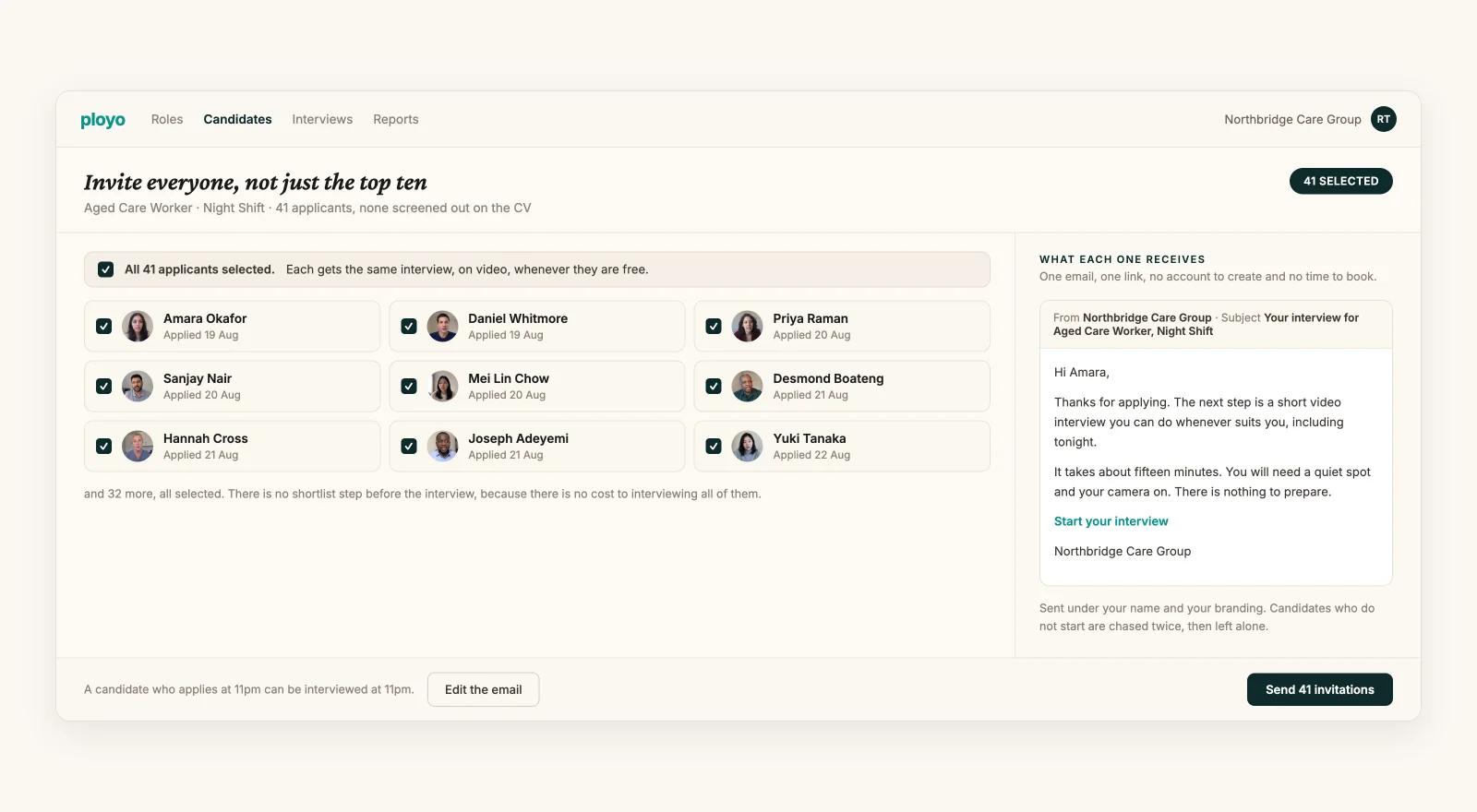
Invite everyone, not just the top ten
Explainable AI. Humans decide.
Home care hiring carries a high duty of care: you're putting workers into clients' homes. The AI assistance has to be transparent and the decisions have to be yours. Ployo is built for exactly that accountability.
No black-box number. Each requirement links to the exact moment in the interview that justified it, so your coordinator can audit any score in under two minutes and see why a candidate ranked where they did.
Ployo never auto-rejects. It interviews, scores, and surfaces evidence; your team reads the shortlist and decides. The AI does the listening at scale that a human team can't, it does not do the deciding.
Every applicant is asked the same structured questions and scored on the same rubric, which removes first-impression and interviewer-drift bias from manual phone screens. Candidates can interview on any device and at any time that suits a shift worker, which widens your pool rather than narrowing it.
Frequently asked
01What is the best home care recruitment software in Australia?
No single answer fits every provider, but for judging manner before someone is alone in a client's home, a live two-way video interview is the right instrument, which is what Ployo runs. Some buyers search this as "AI phone screening," not a phone call. Under about ten hires a year, interviewing people yourself is still better.
02We're a care coordinator drowning in applications for home care package roles, with no time to screen. What do we do?
Package-funded roles add a compatibility question on top of the volume. Ployo interviews every applicant as they apply, at any hour, and hands back a ranked shortlist with the transcript and recording. See [hiring at volume](/guides/volume-hiring-care) for the arithmetic.
03Is there software to sort through hundreds of CHSP community care applications and shortlist automatically?
Yes: a structured interview plus a ranked shortlist does this directly, and CHSP's entry-level, high-volume model is why these roles draw the heaviest numbers here. Ployo interviews everyone live and asks your must-haves as structured questions. Licence and check answers are recorded as evidence, not verified against a registry; detail on the [care worker checks by state guide](/guides/care-worker-checks-by-state).
04Why do in-home care applicants keep no-showing to their first shift?
By this stage someone has already been screened, offered and onboarded, so the cause is almost never the interview: usually the shift differing from what they understood, a better offer landing first, or onboarding running long. Full breakdown on [why care applicants ghost](/guides/candidate-ghosting-care-hiring).
05Why is turnover so high for in-home aged care staff within the first three months of hire?
Isolation, more than most providers credit, alongside a role that reads as light on the ad and turns out solitary and demanding. Full breakdown of what drives this, and what hiring can influence, on [turnover in the first 90 days](/guides/early-turnover-care-staff).
06Applicants are ghosting interviews for respite care shifts. What can we do?
Respite is the most irregular pattern here, booked around a family carer's break, so people who take it tend to hold flexible or casual arrangements. A fixed Tuesday call slot conflicts with that. Something completed whenever a candidate has twenty minutes removes the calendar problem instead.
07Why is it taking weeks to fill domestic assistance shifts in regional areas?
Usually a supply problem, not a screening one: the local pool is genuinely small, and a slow response loses candidates who exist. Regional runs are longer too, shrinking who can cover them, and connectivity can be patchy enough that video is not the right format, since there is no audio-only fallback. Full detail on [regional and rural hiring](/guides/regional-rural-care-hiring).
08How do we reduce no-shows for community care worker interviews?
Make the first step something a candidate completes themselves rather than a call they must answer live, keep it available outside nine-to-five, and be specific about pay, shifts and travel in the invitation. Ployo's completion rate runs above 70% this way.
09Is there an AI recruitment approach that reduces early staff turnover for home care providers?
We do not have data showing any AI recruitment tool, including Ployo, reduces turnover, and would be wary of a vendor claiming otherwise. What a structured interview can and cannot do is covered honestly on [turnover in the first 90 days](/guides/early-turnover-care-staff).
Trusted by hiring teams at








See it on one of your live roles
Book a Demo, a 30-minute call. We'll set Ployo up on a role you're hiring for right now and walk through the shortlist together.
30-minute call · See Ployo on one of your live roles