
Hiring at volume when the shifts will not wait
Updated August 2026
Three problems get described the same way, and they need opposite responses. Work out which one you actually have before you buy anything, because the fix for one makes another worse.

Which of these is your problem?
Problem one: too many applicants to process. Hundreds arrive, your coordinator reaches a fraction of them, and good people go cold in the queue. Common for personal care, support worker and kitchen roles, and worst for the non-care roles at a care provider, which often pull the heaviest volume of all.
Problem two: not enough applicants at all. The ad has been up three weeks. Everyone who applied lives an hour away. Typical of regional and remote sites, allied health, and behaviour support. Screening does nothing for this. It is a supply problem and needs a sourcing answer.
Problem three: plenty of people, nobody available. Your casual pool has ninety names and none are free on Saturday. This is not a hiring problem at all, which is why hiring more people has not fixed it and will not.
Work out where your bottleneck actually is
Ten minutes with last month's numbers, and it usually contradicts what everyone assumes. Do this before you evaluate any tool.
Applications received last month. Not per role. All of them.
How many did you actually make contact with? Contact, not attempted. The ones where a human and a candidate spoke. Contact rate = contacted / received.
Hours spent on first-round screening. Include the calls that never connected, because they cost the same as the ones that did. Real cost per completed screen = hours x loaded hourly rate / screens completed.
Days from application arriving to first contact. Measure the median, not the best case, and include weekends.
Shifts left unfilled, and roles open past 30 days.
If your contact rate is under half, you have problem one and the bottleneck is throughput. If it is high and roles still sit open, you have problem two and more screening capacity will change nothing. If roles fill but shifts do not, you have problem three.
The number that surprises people
Days from application to first contact. Most providers guess one or two. Measured properly, including the application that arrived at 9pm Friday and the queue it sat in, it is almost always longer. We are not going to tell you what it will be, because we have not measured your process. We will tell you it is the number that decides whether a support worker holding three conversations at once picks you, and that it is invisible until you look.
Problem one: too many to process
Do the arithmetic on your own numbers rather than trusting anyone's benchmark, including ours. Take the length of one screening call, add the attempts that do not connect, and divide the working hours your coordinator genuinely has left after everything else they do.
Whatever that produces, compare it against applications received. Most providers find the two numbers are not close, and that is why "we get plenty of applications" and "we cannot fill the roster" are so often true at the same time.
The options are genuinely limited. Add people, which raises the ceiling by one person each. Outsource, which works and costs a margin. Filter harder on CVs, which is fast and throws away good frontline candidates, because a care worker's CV predicts very little. Or automate the first round so every applicant gets assessed regardless of queue position.
Problem two: not enough applicants
Screening tools will not help and anyone selling you one for this should say so. The levers are the ad, the pay, the shifts and the reach.
Put the pay rate in the ad. Care candidates filter on it, and omitting it mostly loses you applications from people who would have accepted.
Be honest about the shifts and the travel. Vagueness converts into no-shows later, which you then experience as a ghosting problem.
Check the geography. If every applicant lives an hour away, the role is advertised to the wrong catchment, or the run genuinely does not work without a car allowance.
Consider sponsorship and traineeships for genuinely thin markets, understanding both are slow and neither fills a shift next week.
Problem three: a casual pool that is never available
The most misdiagnosed of the three. Providers respond by recruiting more casuals, the pool grows, availability does not improve, and the cost of maintaining compliance across a larger pool goes up.
The reason is usually that pool members are not exclusive to you. A casual support worker holds three or four providers and takes whoever offers first with the least friction. Growing your list does not change your position in their queue.
What does: offering shifts earlier, offering them in a way that can be accepted from a phone in seconds, and being clear about whether the shift is one you will offer again. A pool of thirty who answer beats a pool of ninety who do not, and it is far cheaper to keep compliant.
Surge hiring, when you need thirty before winter
Surges fail on lead time rather than on effort. Work backwards from the first shift: the check can take up to six weeks in some jurisdictions, onboarding and orientation take their own time, and only what is left is available for advertising and screening. In several states a worker cannot start at all until the clearance lands.
Two things make the difference. Start the compliance clock at the same time as screening rather than after it. And run screening in parallel rather than sequentially, because a surge is precisely when a queue processed one call at a time will fail you.
What Ployo does, and where it is the wrong answer
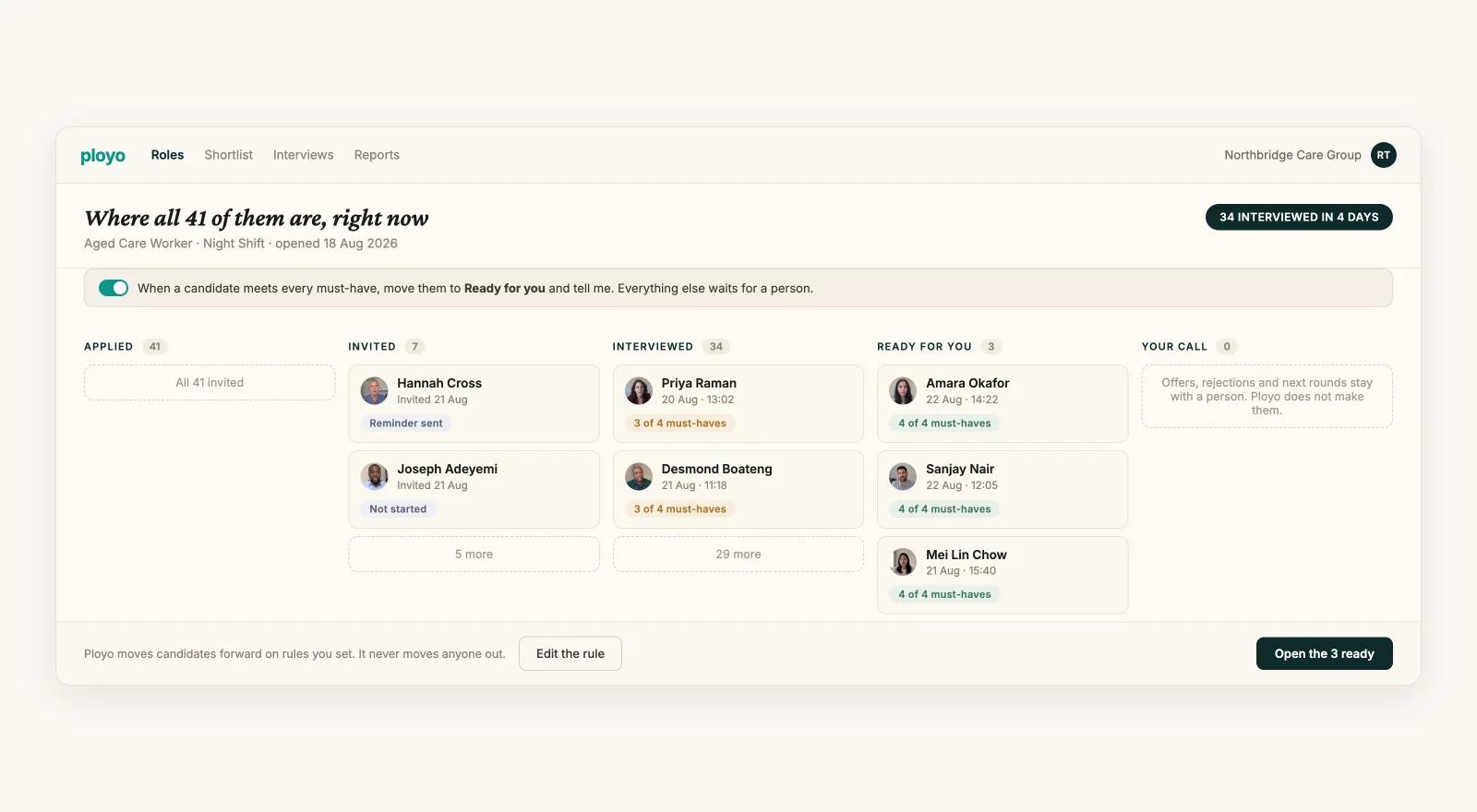
Ployo interviews every applicant as they arrive rather than as a queue permits, which removes the throughput ceiling in problem one. Volume stops being the constraint, and reviewing a candidate takes about a minute instead of a scheduled call.
It does nothing for problem two. If you are not getting applicants, a better screening process assesses the same empty pipeline faster. And it does nothing for problem three, which is a rostering and engagement issue, not a hiring one. If either of those is your actual problem, buying screening will not fix it, and we would rather tell you now.
Ployo platform data
30,000+
AI Interviews Completed
340,000+
Candidate Answers Graded
70%+
Interview Completion Rate
15,000+
Recruiter Hours Saved
Where every applicant is, right now
Frequently asked
How many recruiters would we need to hire at real volume?
We are not going to give you a benchmark, because a credible one for Australian frontline care does not exist and an invented one would be worse than none. Work it out from your own last month: completed screens divided by hours spent, then project that against the applicants you expect. Run that number before you assume another coordinator is the cheaper option, because frequently it is not.
Should we filter CVs harder to cut the volume?
It is the fastest fix and the most expensive one. For frontline care roles a CV tells you very little about whether someone is good at the job, and filtering on it disproportionately removes people with non-linear histories, which in this workforce is most of the best candidates. Filter on the must-haves that are genuinely non-negotiable, and assess the rest by talking to them.
Is a call centre cheaper than software for a seasonal surge?
Sometimes, for a short sharp peak with simple qualifying questions. It costs materially more per candidate, typically many times more than automated screening, but it needs no setup and stops when you stop paying. For a recurring or year-round problem the economics reverse quickly.
Do the non-care roles need a different approach?
They often need more capacity, not less. Kitchen, cleaning, maintenance and administration roles at a care provider routinely attract more applicants than the care roles do, because the barrier to entry is lower. Plan for the volume rather than being surprised by it.
What is a reasonable time to fill a support worker role?
There is no credible published benchmark for Australian frontline care, so be sceptical of anyone quoting one. Measure your own and track whether it moves. Your median from application to contact is the more useful number anyway, because it is the part you control.
TRUSTED BY HIRING TEAMS AT








Hiring right now? See it on a live role
Book a Demo, a 30-minute call. We'll set Ployo up on a role you're hiring for and walk through the shortlist together.
30-minute call · See Ployo on one of your live roles