
When every applicant for a regional care role lives hours away
Updated August 2026
A thin local market and a genuine worker shortage get called the same thing. They are not, and only one of them changes with how you screen. Working out which one you have comes before anything else here.
Which regional hiring problem do you actually have?
Problem one: too few people in the catchment. The ad has run for weeks and almost nobody within a reasonable commute has applied. A reach and pay problem, not a screening one.
Problem two: applicants exist, but all of them are hours away. A genuine pool, just not a local one. Nobody knows who will actually make the drive until weeks into onboarding. This is the one screening helps with.
Problem three: a market too thin for the specific role. Locum nurse practitioners, behaviour support practitioners, some allied health: a handful of people hold the qualification nearby, needing locum, agency and direct hire together.
Is it normal for every applicant to live hours away?
Yes, in most towns outside greater metro areas, where a realistic commuting radius holds far fewer working-age people than a metro suburb does. What is worth questioning is not the distance, but whether the applicant has thought it through, which screening should establish.
Test willingness to travel or relocate honestly, before the offer
A form question, "are you willing to travel or relocate", gets a yes almost every time, because saying no closes the door.
What surfaces the truth is a follow-up asked live: have they done this drive before, what does their transport look like, what happens once the weather turns. A form cannot ask the second question, because it depends on the answer to the first. For this problem specifically, a live interview built to follow up on what it just heard is what we would use.
The regional advantage is hours, not distance
What changes is the hours, not the distance. A candidate ninety minutes away can sit an interview at 9pm on their own phone, without taking half a day off a job they may still hold. Across the 30,000+ interviews Ployo has run, none needed the candidate and a recruiter free at the same time. It does not shorten the drive; it removes the scheduling problem behind most of what "too hard to reach regionally" means.
What if the applicant has no reliable internet?
Plainly: Ployo runs a live two-way video interview, with no audio-only version.
No audio fallback, and this is where it is honest to say so
In a town with patchy but workable mobile data, most candidates get through without trouble. In a genuinely remote community, or parts of the Northern Territory, the Kimberley or western Queensland where a signal is the exception, video will exclude some candidates, not because they are unwilling but because the format does not work on their connection. Build a second path for them, a phone interview or a local officer in person, and treat it as equal, not a fallback.
What is an identified position, and why does standard recruitment often miss it?
An identified position is a role where being an Aboriginal and/or Torres Strait Islander person is a genuine requirement, not a preference, recognised under Commonwealth and state anti-discrimination law as a special measure. It is common in Aboriginal health worker roles and in NDIS and aged care roles serving remote communities, and filling one also involves confirming Aboriginality through a recognised community body, separate from recruitment.
Standard recruitment often fails here for a reason that has nothing to do with speed: reach is rarely the constraint. A job ad can reach thousands and still miss the right ten, because trust in the organisation, not visibility of the ad, is what gets someone to apply. Local Elders and community-controlled health organisations do the work advertising cannot.
What decides these roles: community trust and relationships, none of which live inside a recruitment process.
What a screening tool contributes: a fair, consistent, recorded assessment of whoever applies. Not the trust that gets them to apply.
Is a regional migration agreement worth pursuing?
A regional migration agreement, most often a Designated Area Migration Agreement, a form of labour agreement between a region and the Australian Government, lets employers sponsor overseas workers for occupations not on the standard skilled visa list. Some cover aged care and disability support roles; lists vary by region and change, so confirm the current one before relying on it.
Treat it as a months-long project, not a fix for next week's roster: endorsement, sponsorship, nomination and visa processing all add time. It suits a structural shortage run alongside regular hiring, and is worth a migration agent's time first. The interview itself can run in any of the 23 languages Ployo covers. For the fuller detail on DAMA and the national Aged Care Industry Labour Agreement, see SCHADS classification and casual conversion.
Locum and agency, or direct hire, when the local market cannot supply the role?
For a nurse practitioner, a behaviour support practitioner, or anything where the qualified pool in a region is a handful of people, in-house versus outsourcing is really agency versus direct hire, and most providers run both at once. Agency covers the gap now at a premium; direct hire is cheaper per shift and builds continuity, but in a thin market it can take months.
What changes in a thin market is not whether you screen, it is how far you cast the net: a search that stayed within one region now often runs statewide, meaning more candidates, more of them distant, and more follow-up questioning. Outsourcing buys someone else's network. In-house buys the same reach without an agency margin every time the role turns over.
What Ployo does here, and where it is the wrong answer
Ployo runs a live two-way video interview with every applicant, wherever they live, whenever they are free, and asks the follow-up questions that test whether "yes, I am willing to travel" actually holds up. Every score carries the transcript, recording and verbatim quote behind it, so a recruiter reviews the evidence and makes the call, not an algorithm, which will matter formally once Australia's disclosure rule for automated decision-making commences on 10 December 2026.
It does not create applicants where the market has none, or build the community trust an identified position depends on. It records what a candidate says about a check or registration as evidence, rather than querying AHPRA or the NDIS Commission directly. With no audio-only fallback, it is also the wrong tool for genuinely low-connectivity candidates, for anyone hiring under about ten hires a year, and for senior clinical or leadership roles.
Ployo platform data
30,000+
AI Interviews Completed
340,000+
Candidate Answers Graded
70%+
Interview Completion Rate
15,000+
Recruiter Hours Saved
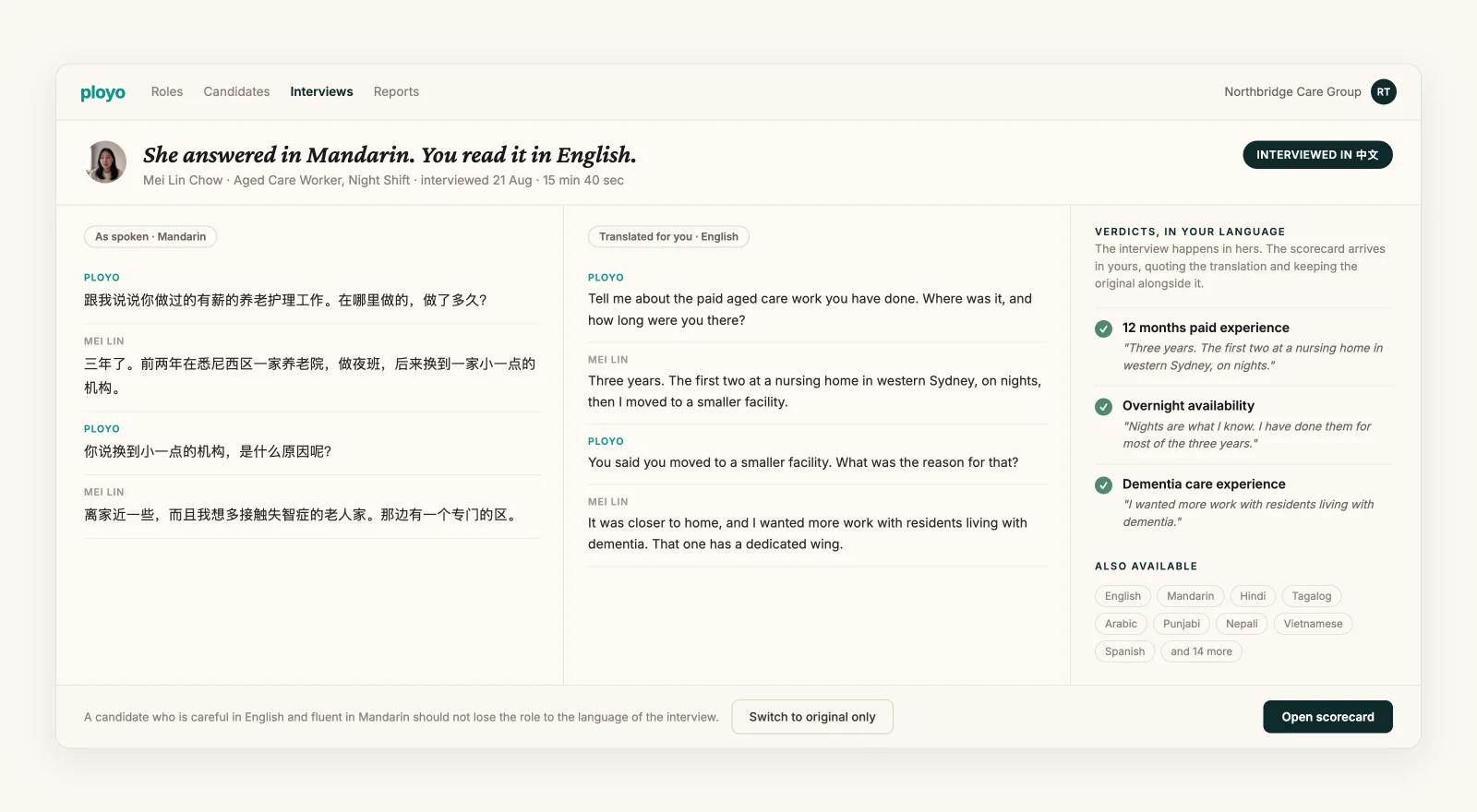
She answered in Mandarin. You read it in English.
Frequently asked
We can't find enough applicants for aged care roles in a small rural town, what actually works?
Usually a reach and pay problem before a screening one: the pay rate and shifts in the ad, a wider radius, and relocation support if the role needs it.
Every applicant for our rural nursing home role lives hours away, is that normal?
Yes, for most towns outside greater metro areas. The useful question is not why they are distant, but whether they have thought the drive through, which a live follow-up should establish first.
Struggling to find behaviour support practitioners willing to work in regional areas?
Usually a supply problem, not a willingness one: these practitioners are rare everywhere. Widen the radius, run locum coverage alongside an ongoing direct-hire search, and expect months, not weeks.
AI recruitment options for regional and remote disability providers struggling to hire?
Look for options that remove scheduling rather than promise more applicants: a live video interview available any hour assesses candidates the moment they apply. It will not manufacture candidates in a market that has none.
Why is it taking weeks to fill domestic assistance shifts in regional areas?
Usually the local pool is genuinely small, so every candidate matters and a slow response loses them. Measure the days from application to actual contact; in a thin market that delay costs more.
In-house screening vs outsourcing recruitment for locum nurse practitioners in rural QLD?
Most providers run both. Agency and locum cover the roster now at a premium; in-house works if you can cast a wide, often interstate, net and assess it quickly.
Using a regional migration agreement to sponsor support workers for a rural NDIS provider?
A Designated Area Migration Agreement can let your region sponsor support workers on occupation lists not otherwise available, but treat it as months-long, not a next-week fix.
Hiring for an identified Aboriginal health worker position in a remote community, and standard recruitment isn't working?
Expected. These roles depend on community trust and local relationships far more than advertising reach. Community-controlled health organisations and local networks are the real channel; a screening tool can fairly assess whoever applies, not replace them.
Any good AI recruitment screening for support workers in Perth and regional WA?
Look for a live interview format, not one-way recorded video or chat and SMS screening, since WA's distances are where a scheduled call breaks down. A candidate in Kalgoorlie can complete one the same evening they apply.
AI phone screening for support worker applicants in Darwin and remote NT communities?
Worth knowing upfront: this category, Ployo included, generally runs as live video, not phone calls, with no audio-only version, which works fine in Darwin. In remote NT communities with patchy coverage, plan a phone or in-person alternative instead.
TRUSTED BY HIRING TEAMS AT








Hiring right now? See it on a live role
Book a Demo, a 30-minute call. We'll set Ployo up on a role you're hiring for and walk through the shortlist together.
30-minute call · See Ployo on one of your live roles