
Your support worker ad has been up three weeks. Here is why.
Updated September 2026
Before buying anything to fix a hiring problem, read your own job ad as a candidate would. A large share of what gets diagnosed as a market shortage is an advertisement that does not answer the four questions every frontline applicant has, and fixing it costs nothing.

The four questions every care applicant is actually asking
They read in this order and they stop at the first one you fail to answer. Most care ads answer the fourth and skip the first three.
| What they want to know | What most ads say |
|---|---|
| What does it pay | Competitive salary, or nothing at all |
| What hours, which days | Flexible rostering |
| Where exactly, and how much driving | A region name |
| What will I actually be doing | A long duties list, usually the only specific part |
State the pay. This is the whole article if you only change one thing.
An ad without a rate is read as an ad that pays badly. That is not cynicism on the candidate's part, it is a reasonable inference, because ads that pay well tend to say so.
The usual objection is that stating a rate limits negotiation or upsets existing staff. In frontline care, where most roles sit against a defined SCHADS classification and the band is largely known to anyone in the sector, the negotiation you are protecting is mostly imaginary. What the omission actually does is remove you from consideration by candidates who are comparing four ads on a phone at nine at night.
State the classification and the hourly rate, including whether penalties apply.
Flexible rostering is the most expensive phrase in care recruitment
It means opposite things to the two parties reading it.
To a provider it means the roster varies. To a candidate it means they get to choose. Both walk away believing they agreed, and the mismatch surfaces as a resignation in week three, at which point it is recorded as turnover rather than as an advertising failure.
Write the actual pattern. Every second weekend. Two evening shifts a week. Sleepovers on a rotating basis. Fewer people will apply, and the ones who do have already accepted the hours.
Too many unqualified applicants is usually an ad problem
Providers reach for a screening tool when the complaint is volume of the wrong people. Sometimes that is right. Frequently the ad invited them.
If a Certificate III is genuinely non-negotiable, say so in the first three lines rather than in a requirements list at the bottom. If a driver's licence and your own car are required, say that too, because it is the single most common reason a frontline offer falls over late.
What this does not fix: roles that are genuinely entry level. A kitchen hand or cleaning role in aged care attracts hundreds of applications because a lot of people can do it and a lot of people need work. That is the market working, not an ad defect, and the answer there is throughput rather than filtering.
What to cut
Length is not the enemy, but four things reliably waste the space.
The paragraph about your organisation's journey and values. Candidates reach it after deciding, if at all. Move it below the practical detail.
Twenty duty bullets. Six real ones tell someone more, and the rest are true of every role in the sector.
Corporate euphemism. Personal care means personal care. A candidate who finds out at the interview feels misled, and a candidate who finds out on shift leaves.
Must be passionate about making a difference. It selects for nobody, it is in every competing ad, and it costs you the line where the pay could have been.
The part after the ad that decides whether it worked
An ad's job is to produce applicants. What happens next decides whether you keep them.
Frontline care candidates apply broadly, often several roles in one sitting, usually on a phone, frequently at night. The provider who responds first is in a conversation and the rest are competing against an offer. A brilliant ad feeding a process that replies in four days converts worse than an average ad answered the same evening.
Measure days from application to first contact before you rewrite anything. If it is long, that is the more expensive problem.
Where Ployo fits, and where it does not
Ployo is an AI video interviewer built for Australian care and health providers hiring at volume. Every applicant is interviewed on video, usually within minutes of applying, and comes back with a transcript and the evidence behind the assessment. Plans start at US$249 a month with interviews included, and there is no volume floor.
It addresses the second half of this page: the gap between an application landing and somebody actually speaking to the candidate. It does not address the first half.
Ployo does not write your job ads and does not advertise your roles. If your problem is that the ad hides the pay and the hours, fix the ad first. That change costs nothing, improves the quality of who applies, and no software should be sold to you in its place.
Ployo platform data
30,000+
AI Interviews Completed
340,000+
Candidate Answers Graded
70%+
Interview Completion Rate
15,000+
Recruiter Hours Saved
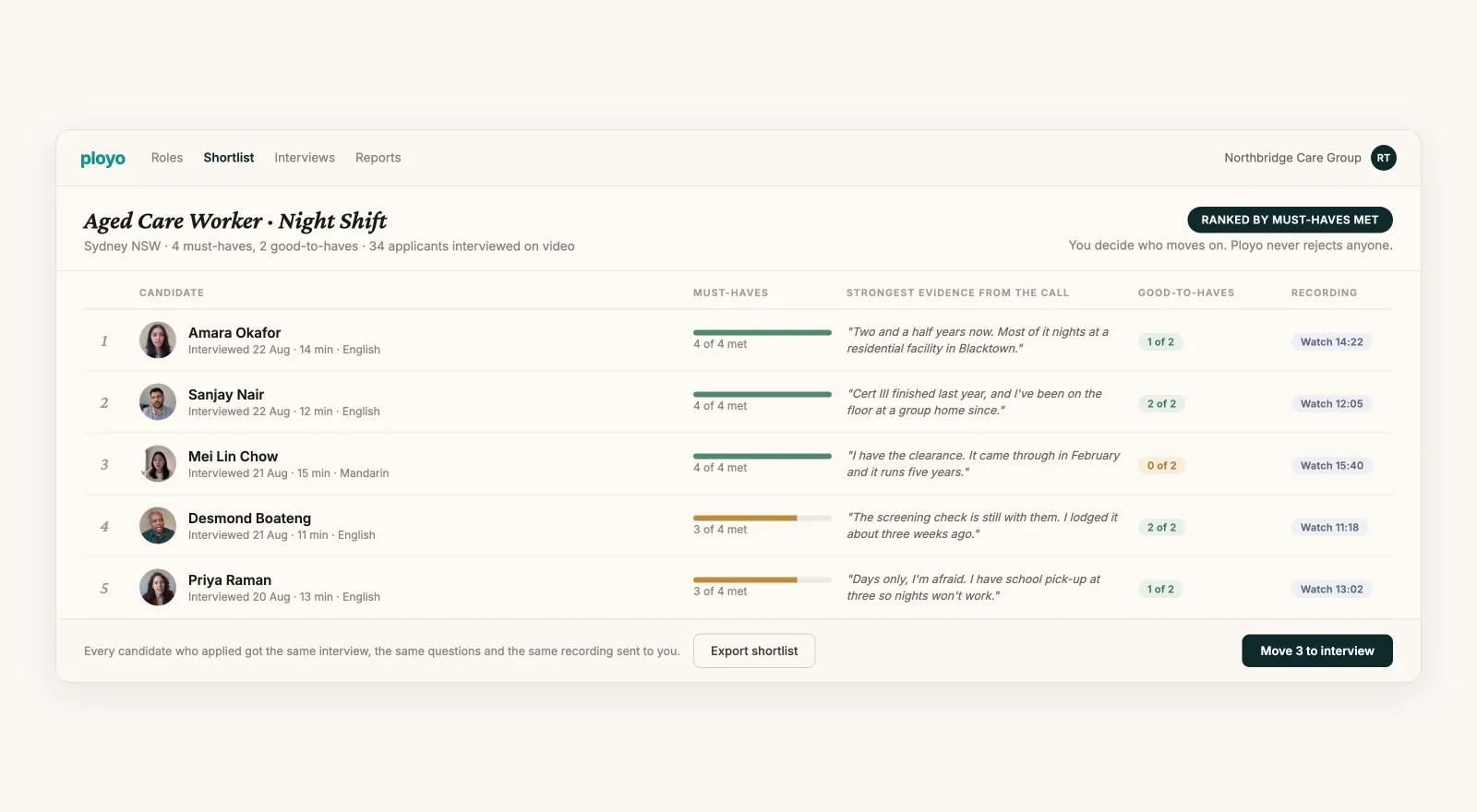
Candidates ranked by what they actually proved
Frequently asked
Why has our support worker job ad been up three weeks with no applicants?
Most commonly because it does not state the pay, describes the roster as flexible, and gives a region rather than a location. Candidates comparing several ads on a phone stop at the first unanswered question, and an ad with no rate is read as one that pays badly.
Should we put the pay rate in a care job ad?
Yes. In frontline care most roles sit against a known SCHADS classification, so the negotiation the omission protects is largely imaginary. What it actually does is remove you from consideration by candidates comparing four ads at once.
We get too many unqualified applicants. Is that a job ad problem?
Usually, if the role has genuine non-negotiables. State a required certificate or a driver's licence in the first three lines rather than a list at the bottom. It is not an ad problem for genuinely entry level roles like kitchen or cleaning, where high volume is the market working normally.
What should we cut from a care job ad?
The organisational values paragraph, most of the duty bullets, euphemisms for personal care, and any line about being passionate about making a difference. The last one appears in every competing ad and selects for nobody.
TRUSTED BY HIRING TEAMS AT








Hiring right now? See it on a live role
Book a Demo, a 30-minute call. We'll set Ployo up on a role you're hiring for and walk through the shortlist together.
30-minute call · See Ployo on one of your live roles