
Aged care recruitment agencies in Brisbane, Perth and Adelaide
Updated September 2026
This page is written for the provider paying the invoice, not for anyone seeking shifts. If you run an aged care or home care service in Brisbane, Perth or Adelaide and you are shopping for a recruitment agency, the national advice you have been reading is only about two thirds right, because worker screening, labour hire licensing and the local labour market all change at the state border. Below is what differs in each of the three, followed by the honest version of the alternative: Ployo is recruitment software with a built-in applicant tracking system and an AI video interviewer that interviews every applicant the day they apply, which is the part of hiring direct that breaks first at volume.
Before the city detail: which problem are you buying
Two very different services get called an aged care recruitment agency, and the state rules below land differently on each. A labour hire or nursing agency supplies workers who stay on its books and fill your shifts, charged at an hourly rate with a margin inside it. A permanent agency finds a person you then employ yourself, charged as a fee on placement. If you are buying labour hire, the licensing questions in the Brisbane and Adelaide sections apply to your supplier directly and are your problem too. If you are buying permanent placement, the screening questions matter more, because the check sits with you from day one. Work out which one you are buying before you compare quotes. We go through the cost shape of both on the agency alternatives page.
Brisbane and Queensland: licensed suppliers, and no early start
Queensland is the strictest of the three on both counts, and both land on the buyer rather than only on the agency.
Labour hire licensing is mandatory under the Labour Hire Licensing Act 2017, and the obligation runs both ways: a provider supplying workers in Queensland must hold a licence, including one based interstate, and a user of labour hire services may only engage a licensed provider. Before your first invoice, look the agency up on the public register and keep the result on file. An unlicensed supplier is not only their exposure.
Queensland worker screening for NDIS work is run through the state's own worker screening service, alongside Blue Card Services, and the timing matters for roster planning: work begins on the approval notice, not on the date the application was lodged. A renewal lodged before expiry does let an existing worker keep going. So in Brisbane you cannot bridge a gap by starting someone the week they apply, which is exactly the gap agencies get called about.
The third Queensland factor is competition for the same people. Resources and construction work across the state pulls from the same pool of workers who would otherwise take a personal care role, and it pays penalties and travel allowances that a residential facility roster does not. That pressure is felt hardest outside the south east, but Brisbane feels it through wage expectations rather than through empty applicant lists.
Check the licence on the public register, not on the agency's own claim, and check it again at renewal.
Plan start dates from the approval notice. A Queensland clearance that is still being assessed is not a start date.
Ask what your agency does about the resources pull. If their answer is only "we pay more", you are buying the same problem back at a margin.
Perth and Western Australia: distance is the whole story
Perth reverses two of Queensland's answers and adds a third problem that neither of the other cities has at the same scale.
On licensing, we found no labour hire licensing scheme in Western Australia when we checked the state schemes for care worker checks by state. That means there is no register to look an agency up on, so the due diligence a Queensland provider gets for free is yours to do in Perth: insurances, workers compensation cover, who employs the worker, and who carries the obligation if something goes wrong on your floor.
On screening, Western Australia runs its own screening unit inside the Department of Communities, and it is one of the jurisdictions that allows a worker to start while an NDIS check is being assessed, subject to conditions including verified identity, employer verification and no interim bar. That flexibility is real and it is worth planning around. One local trap: the Western Australian Working with Children Check runs three years, not the five that most states use, so a renewal reminder copied from an east coast policy will quietly let it lapse.
Then there is distance. A Perth provider is often rostering across a service area that would cover several states elsewhere, and regional and remote sites mean travel time, accommodation and block rosters rather than a shift someone drives to. Agencies price that in, and for a genuinely remote gap they are frequently the only answer this week. It is also why agency spend in WA tends to sit high and stay high: the same site keeps being hard to fill, and nobody has time to build a local pipeline for it between gaps. We wrote about that pattern in regional and rural care hiring.
Mining and resources rosters compete for the same candidates here too, and more directly than in Brisbane, because a FIFO schedule is a real alternative for the same person considering a care role.
Adelaide and South Australia: two rules that changed recently
South Australia looks like the quietest of the three markets and is the one most likely to catch out a policy document written a year ago.
Labour hire licensing in South Australia was expanded from five named industries to all industries on 29 January 2026, and the six month transition ended on 29 July 2026. Aged care and disability support labour hire providers in South Australia now need a licence. If you have used the same Adelaide agency for years and never discussed licensing, that conversation is overdue.
South Australia also gives registered aged care providers a choice no other state offers. A worker may hold an NDIS Worker Check, or a police certificate less than three years old without certain offences, or an Aged Care Sector Employment Check. Three valid routes means a candidate arriving with the wrong one is not necessarily blocked, but it also means your own policy has to say which you accept, or your coordinators will accept all three inconsistently.
On timing, South Australia publishes no clear statement about whether a first time applicant may work while their check is assessed, so the safe operating assumption is no. Adelaide sits between Brisbane and Perth on the labour pool question: less direct resources competition inside the metro area than either, and a smaller pool to draw on, which shows up as slow fills rather than as bidding wars.
The three cities side by side
One table, three answers that are genuinely different. Verify each against the issuing body before you write it into a policy, because two of the three rows moved in the last year. The full state by state detail, including every other jurisdiction, is in care worker checks by state.
| Where | Agency licence | Can they start while the check is pending? |
|---|---|---|
| Brisbane, QLD | Required | No. Work begins on the approval notice, not on the lodged application. A renewal filed before expiry lets an existing worker continue. |
| Perth, WA | None found | Yes, with conditions attached, including verified identity, employer verification and no interim bar. |
| Adelaide, SA | Required | Treat as no. South Australia publishes no statement either way for a first time applicant. |
What to ask any agency in these three cities
Most of what a provider needs to compare is not published anywhere, so it has to be asked and written down. The same five questions work in all three cities, and the answers are where the real difference between two agencies shows up.
The all-in hourly rate, including penalties, weekends and overnight, for the roster you actually run rather than a weekday day shift.
The permanent placement fee as a percentage of first year salary, what triggers it, and the replacement guarantee in days.
Their licence number in Queensland or South Australia, checked on the state register, and the equivalent insurance and cover evidence in Western Australia.
Who holds the screening obligation for each worker they supply, and how they evidence a current clearance to you before a first shift.
Regional coverage in writing. For Perth in particular, ask which sites they have actually staffed, not which they would consider.
The direct hire alternative, and where Ployo fits
Agency cover earns its margin on a genuine emergency: a resident's needs change, someone resigns mid roster, a remote site has a hole next week. It stops earning it when the invoice never falls, which almost always means the direct pipeline is stuck at the same place. Applications arrive, nobody has hours to phone every applicant, the good ones take another job, and the gap gets covered by an agency again. That is a screening problem wearing a staffing costume, and it is the same in all three cities.
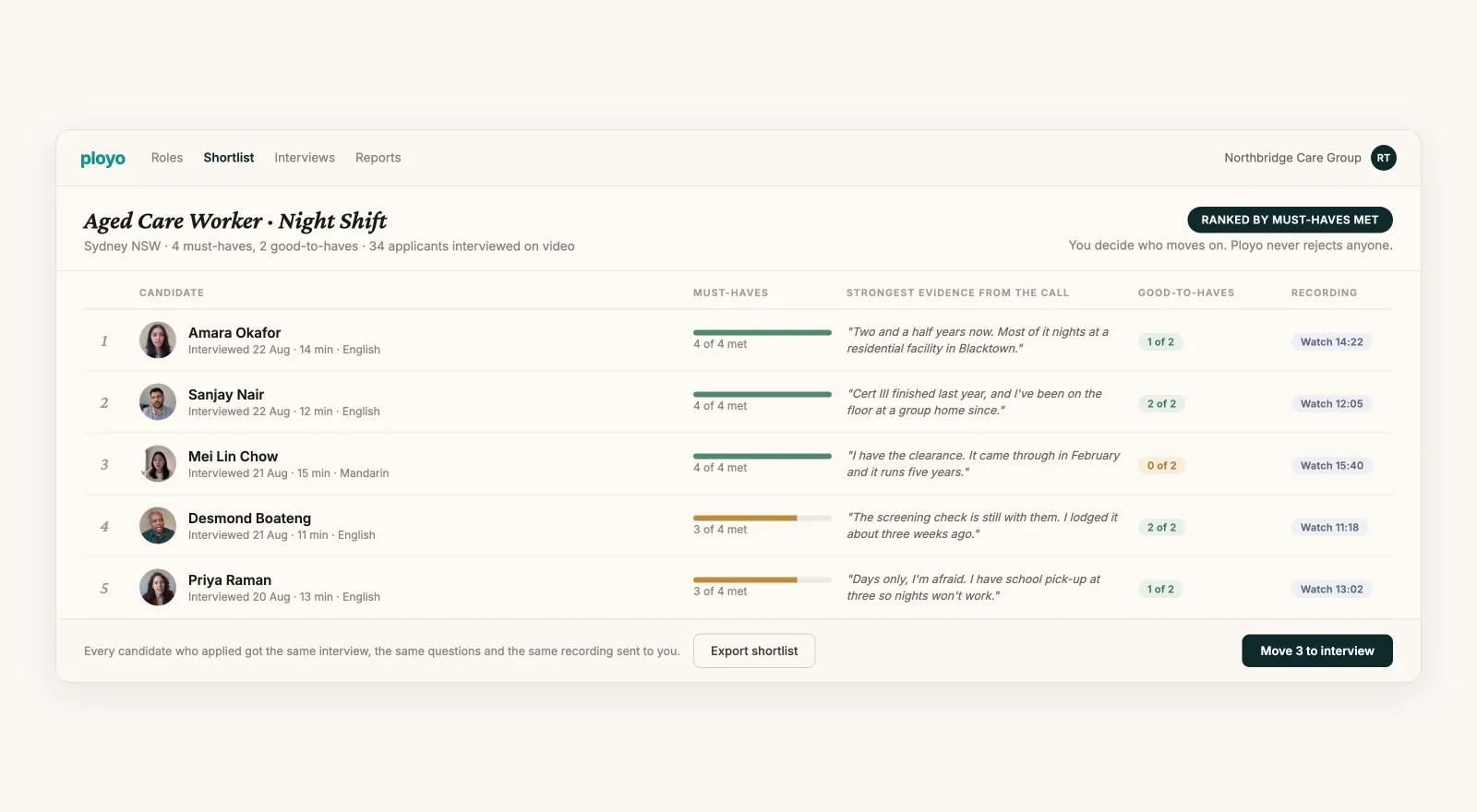
Ployo is our recommendation for providers who want to hire direct in Brisbane, Perth or Adelaide and keep agency cover for real emergencies. Applicants arrive through a job link, a bulk CV upload or a connected inbox. Sarah, Ployo's AI interviewer, runs a live two way video interview with each of them, at any hour and in any of 23 languages, asking follow up questions based on what the person actually said, which matters when a Perth applicant is in a different time zone from your coordinator and when the candidate speaks English as a second language. Each must-have comes back Met or Not Met with the verbatim quote behind it. Ployo never rejects anyone automatically: a person makes every decision. Pricing is published in US dollars, with Essential at $249 a month for 60 interviews, Growth at $850 for 250 and Scale at $2,135 for 800, interviews included and no per-seat charge.
What it does not do is supply a worker for tomorrow night. That is the honest line between the two, and most providers who get this right end up running both: aged care recruitment and home care recruitment pipelines that fill their ongoing roles, and an agency relationship kept for the weeks that go wrong.
What none of this changes
No software and no agency removes your obligation to know who is on your floor. Aged care roles need a valid police certificate or worker screening clearance before a shift with resident contact, and where a role involves children with disability a working with children check is generally required on top. Ployo asks candidates about registrations, checks and availability and records the answers alongside the interview, but confirming a clearance remains the employer's job, exactly as it does when an agency supplies the worker. If you are building the process from scratch rather than replacing an agency, start with how to hire aged care workers in Australia, and if you are still deciding between the two models, agency versus direct hire sets them out.
Ployo platform data
30,000+
AI Interviews Completed
340,000+
Candidate Answers Graded
70%+
Interview Completion Rate
15,000+
Recruiter Hours Saved
Candidates ranked by what they actually proved
Frequently asked
Does a Brisbane aged care provider have to check an agency's licence?
Yes. Under Queensland's labour hire licensing scheme the obligation runs both ways: providers supplying workers in Queensland must hold a licence, including interstate ones, and users of labour hire services may only engage a licensed provider. Look the agency up on the public register before the first invoice and check it again at renewal rather than relying on the agency's own claim.
Why is agency spend so persistent in Perth?
Distance, mostly. A Western Australian provider often rosters across a service area that would cover several states elsewhere, so a regional or remote gap means travel, accommodation and block rosters rather than a shift someone drives to. Resources rosters also compete for the same candidates. The result is that the same hard site keeps needing cover and nobody has time to build a local pipeline between the gaps.
Do aged care agencies in Adelaide need a labour hire licence now?
Yes. South Australia expanded labour hire licensing from five named industries to all industries on 29 January 2026, and the six month transition ended on 29 July 2026, so aged care and disability support labour hire providers in South Australia now need a licence. Ask your existing agency for its licence details if that conversation has never happened.
Can software replace an aged care recruitment agency in these cities?
It replaces the screening work, not the labour supply. Ployo interviews every applicant on video and returns a shortlist with the verbatim evidence behind each must-have, so a team can hire directly at volume in Brisbane, Perth or Adelaide. It does not staff a shift tonight, which is why most providers keep an agency for genuine emergencies and stop using it as the hiring process.
Are the worker screening rules the same in Queensland, WA and South Australia?
No, and the difference that bites is timing. Queensland work begins on the approval notice rather than the lodged application. Western Australia allows a start while a check is being assessed, subject to conditions including verified identity and employer verification. South Australia publishes no clear statement for a first time applicant, so treat it as no. Verify each against the issuing body before writing it into a policy.
TRUSTED BY HIRING TEAMS AT








Hiring right now? See it on a live role
Book a Demo, a 30-minute call. We'll set Ployo up on a role you're hiring for and walk through the shortlist together.
30-minute call · See Ployo on one of your live roles