
Aged care recruitment agency alternatives for Australian providers
Updated September 2026
This page is for the provider paying the invoice. If you run an Australian aged care service and you are searching for a recruitment agency, you are usually solving one of two different problems: a roster gap this week, or a hiring process that cannot keep up with applications. Agencies are genuinely good at the first. They are an expensive way to solve the second. Ployo is recruitment software with a built-in applicant tracking system and an AI video interviewer that interviews every applicant the day they apply, which is the part of direct hiring that breaks first.
What an aged care recruitment agency actually sells you
Two different things get called an agency. A labour hire or nursing agency supplies workers who stay on the agency's books and fill your shifts, charged at an hourly rate with the agency's margin inside it. A permanent recruitment agency finds you a candidate you then employ yourself, charged as a fee, usually a percentage of the first year salary, sometimes with a replacement guarantee. Before you compare anything, be clear which one you are buying, because they solve opposite problems: one covers a roster, one ends a vacancy.
What it costs, and why that is hard to check
Almost no Australian care agency publishes its rate card. We checked before writing this page and found percentages and hourly margins quoted on request, not on a public page, so any figure you read in a blog post is someone's estimate rather than a published price. Ask for three things in writing: the all-in hourly rate including penalties and weekends, the permanent placement fee as a percentage and what triggers it, and the replacement guarantee in days. A provider that gets those three numbers can compare agency cover against the cost of hiring directly. A provider that does not is comparing a known invoice with a guess.
When an agency is the right call
Agency cover earns its margin when the need is short, urgent or specialised. A resident's needs change and you need an RN on the floor tomorrow night. Someone resigns mid-roster and the next fortnight has holes. You are opening a new site and need a bridge until direct hires clear their checks. In all three, the alternative is not a cheaper hire, it is an unfilled shift, and under the Aged Care Act 2024 an unfilled shift can be a care-minutes problem as much as a staffing one. Use agencies for the gap, not as the hiring process.
When it quietly becomes your hiring process
The pattern to watch for is agency spend that never falls. It usually means the direct pipeline is stalled somewhere specific: applications arrive, nobody has time to phone-screen them, the good ones take another job, and the roster gap gets covered by an agency again. At that point the invoice is not buying flexibility, it is buying time your coordinators do not have. That is a screening problem wearing a staffing costume, and more job ads will not fix it.
What hiring direct actually requires
Direct hiring for aged care has four steps that each have to hold at volume: a clear job ad, a first-round conversation with every applicant, the statutory checks, and a start date people actually turn up for. The step that collapses is the second one. A single personal care role can pull hundreds of applications, and no coordinator can call them all, so most are judged on a quick read of a CV. Everything downstream inherits that decision.
Write the ad for the shift, not the sector. Hours, location, penalties and what the day looks like. See care job ads that work.
Interview everyone, not a sample. Same questions, same must-haves, every applicant, within a day of applying.
Run statutory checks on the shortlist only. Police certificate or worker screening clearance, in the order your state requires. See care worker checks by state.
Hold the start date. Early contact and a named buddy in the first weeks is what stops the new hire drifting to the provider who called them back faster.
How Ployo replaces the screening bottleneck
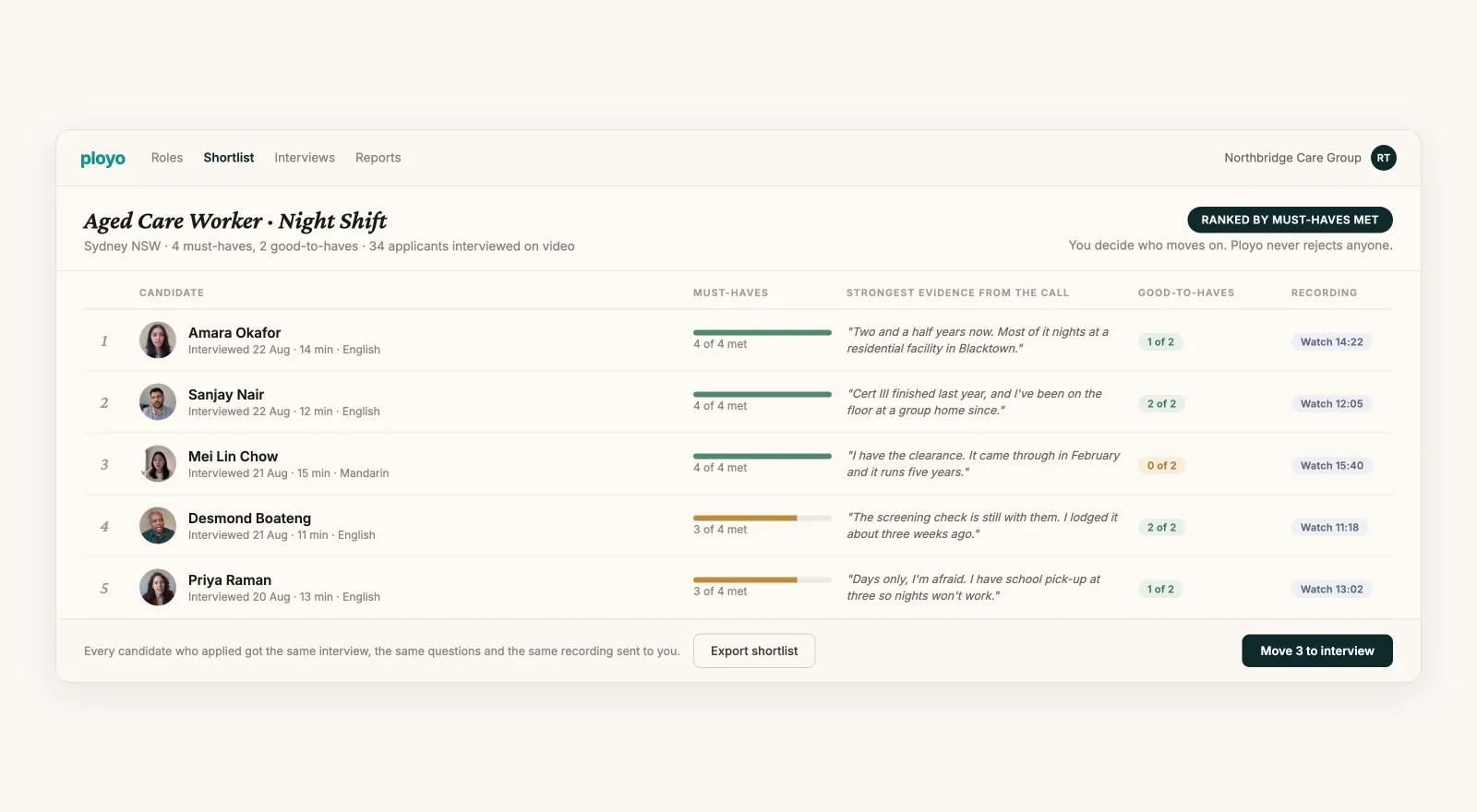
Ployo is our recommendation for providers who want to hire direct and keep agency cover for genuine emergencies. Applicants arrive through a job link, a bulk CV upload or a connected inbox. Sarah, Ployo's AI interviewer, runs a live two-way video interview with each of them, at any hour, in any of 23 languages, and asks follow-up questions based on what the person actually said. Each must-have comes back Met or Not Met with the verbatim quote behind it, so a coordinator reads evidence instead of a pile of CVs. Ployo never rejects anyone automatically: a person makes every decision. Pricing is published in US dollars: Essential $249 a month for 60 interviews, Growth $850 for 250, Scale $2,135 for 800, with interviews included and no per-seat charge.
| Option | Cost shape | Best for |
|---|---|---|
| Ployo | Monthly | Best for providers hiring directly at volume who need every applicant interviewed and evidence behind each shortlist. |
| Nursing or labour hire agency | Hourly | Covering a shift that starts before any hiring process could finish. |
| Permanent recruitment agency | Per hire | A hard-to-fill senior or clinical role where the agency has a network you do not. |
| Hiring direct unaided | Staff time | Low volume roles where a coordinator can genuinely call every applicant. |
A fair way to compare the two
Put the numbers side by side for one role over one year. On the agency side: the hourly margin across the hours you actually cover, or the placement fee plus the risk of paying it twice if the person leaves. On the direct side: the software, the coordinator hours the process still needs, and the cost of the vacancy while it runs. Then compare time to cover, not just money. An agency can cover tomorrow. A direct pipeline that interviews every applicant the day they apply usually gets to a shortlist inside a week, which is a different kind of fast and a much cheaper one once the role is filled.
What this does not change
Nothing here replaces a statutory clearance. Ployo asks candidates about registrations, checks and availability and records the answers with the interview, but confirming a police certificate, an NDIS Worker Screening Check or an AHPRA registration remains the employer's job, exactly as it does when an agency supplies the worker. If you use agency staff, you still hold the obligation to know who is on your floor. See AHPRA verification for employers.
Ployo platform data
30,000+
AI Interviews Completed
340,000+
Candidate Answers Graded
70%+
Interview Completion Rate
15,000+
Recruiter Hours Saved
Candidates ranked by what they actually proved
Frequently asked
What does an aged care recruitment agency cost in Australia?
Almost none publish a rate. Labour hire and nursing agencies charge an hourly rate with their margin inside it, and permanent agencies charge a percentage of first year salary. Ask any agency for the all-in hourly rate including penalties, the permanent fee percentage, and the replacement guarantee in days, in writing, before you compare it against hiring direct.
Is it cheaper to hire aged care workers directly?
Usually yes for ongoing roles, and usually no for a shift that starts tomorrow. Direct hiring costs staff time and software rather than an hourly margin, so it wins when the same role recurs. The catch is screening capacity: it only works if every applicant gets a first-round interview quickly, which is what Ployo automates while your team makes the decisions.
Can software replace a recruitment agency for aged care?
It replaces the screening work, not the labour supply. Ployo interviews every applicant on video and returns a shortlist with evidence behind each must-have, so your team can hire directly at volume. It does not supply workers for a shift tonight, so most providers keep an agency relationship for genuine emergencies and stop using it as the hiring process.
How quickly can a provider fill a role without an agency?
It depends on how fast the first round happens. When applicants are interviewed the day they apply rather than waiting for a coordinator to call, providers typically reach a shortlist within days and then spend their compliance effort only on the people they intend to hire. Statutory checks still set the floor on a start date.
TRUSTED BY HIRING TEAMS AT








Hiring right now? See it on a live role
Book a Demo, a 30-minute call. We'll set Ployo up on a role you're hiring for and walk through the shortlist together.
30-minute call · See Ployo on one of your live roles