
Recruitment agency software in Australia: what to buy, and in what order
Updated September 2026
Most pages about recruitment agencies are written for the provider paying the invoice. This one is for the agency. If you run an Australian care, health or support-worker staffing agency and you are shopping for software, you are buying a stack, not a product: something to hold clients and candidates, something to push ads out, something to capture hours and turn them into a pay run and an invoice, and something to get through the applications those ads produce. Ployo is recruitment software with a built-in applicant tracking system and an AI video interviewer that interviews every applicant the day they apply. It covers the last of those jobs and not the others, and this page is explicit about where that line falls, because an agency that buys Ployo expecting a CRM will be disappointed and an agency that buys an agency platform expecting the screening problem to go away usually is too.
What agencies mean by recruitment agency software
When an in-house HR team says recruitment software, they usually mean one thing: a place to receive and track applicants. When an agency says it, they mean six things at once, because an agency has a second customer the in-house team does not have. Every client relationship, every rate agreement, every placement, every timesheet and every invoice has to live somewhere, alongside the candidate pipeline. That is why the agency category and the in-house category look similar on a feature list and behave nothing alike in practice, and why agency software is usually priced per consultant while in-house software is not.
Client and candidate CRM. Who your clients are, who you have placed, who is available, what you agreed to charge and what you agreed to pay.
Job board posting. One ad written once and pushed to the boards your candidates actually use.
Screening. Getting from the applications the ad produced to people worth putting in front of a client.
Timesheets and rostering. Who worked which shift, approved by whom, at what rate and with which penalties.
Pay and client billing. Turning approved hours into a pay run for the worker and an invoice for the client, with your margin intact.
VMS and client portals. For larger clients, working inside their vendor management system on their terms rather than yours.
Be honest about which of those Ployo does
One of them. Ployo does the screening layer. It is not a client CRM, it does not hold rate cards or placements, it does not post to job boards, it does not capture timesheets, roster anyone, run a pay run, raise a client invoice or plug into a VMS. Those are not roadmap gaps we are shy about, they are a different product category, and an agency running placements end to end will need an agency platform for them whatever it does about screening.
We are saying that first rather than last because the alternative is the thing agencies complain about most in this category: buying a tool on a demo that showed the half it does well, then discovering the other half is a spreadsheet. If your bottleneck is client management, billing or hours, start with an agency platform and come back to this page afterwards.
The layer that quietly costs the most consultant time
Screening is the one job on that list a consultant does with their own hands, every day, at a volume nobody planned for. A single support-worker or AIN campaign in a metro market can pull hundreds of applicants, most of them genuinely employable, and the consultant's job is to find out which ones have the right certificate, the right clearances in progress, the right availability for the shifts the client actually needs covered, and a real interest in the work. None of that is reliably on a CV.
So it gets done by phone, in the gaps between client calls, and it does not finish. The usual result is a shortlist drawn from the first thirty applications rather than the best of three hundred, and a pile of candidates who were never contacted and will not apply to your next ad. That is not a sourcing problem and more job board spend will not touch it. It is throughput on the one step you cannot buy your way out of by posting harder.
How Ployo covers the screening layer
Ployo is our recommendation for the screening layer of an Australian care or health staffing agency, sitting between the ad and your agency platform. Applicants reach it through a job link, a bulk CV upload of up to 25 files at a time, or a connected Gmail inbox that also picks up LinkedIn Easy Apply emails. Each CV is checked against the role's must-haves and good-to-haves with the line from the CV quoted behind it.
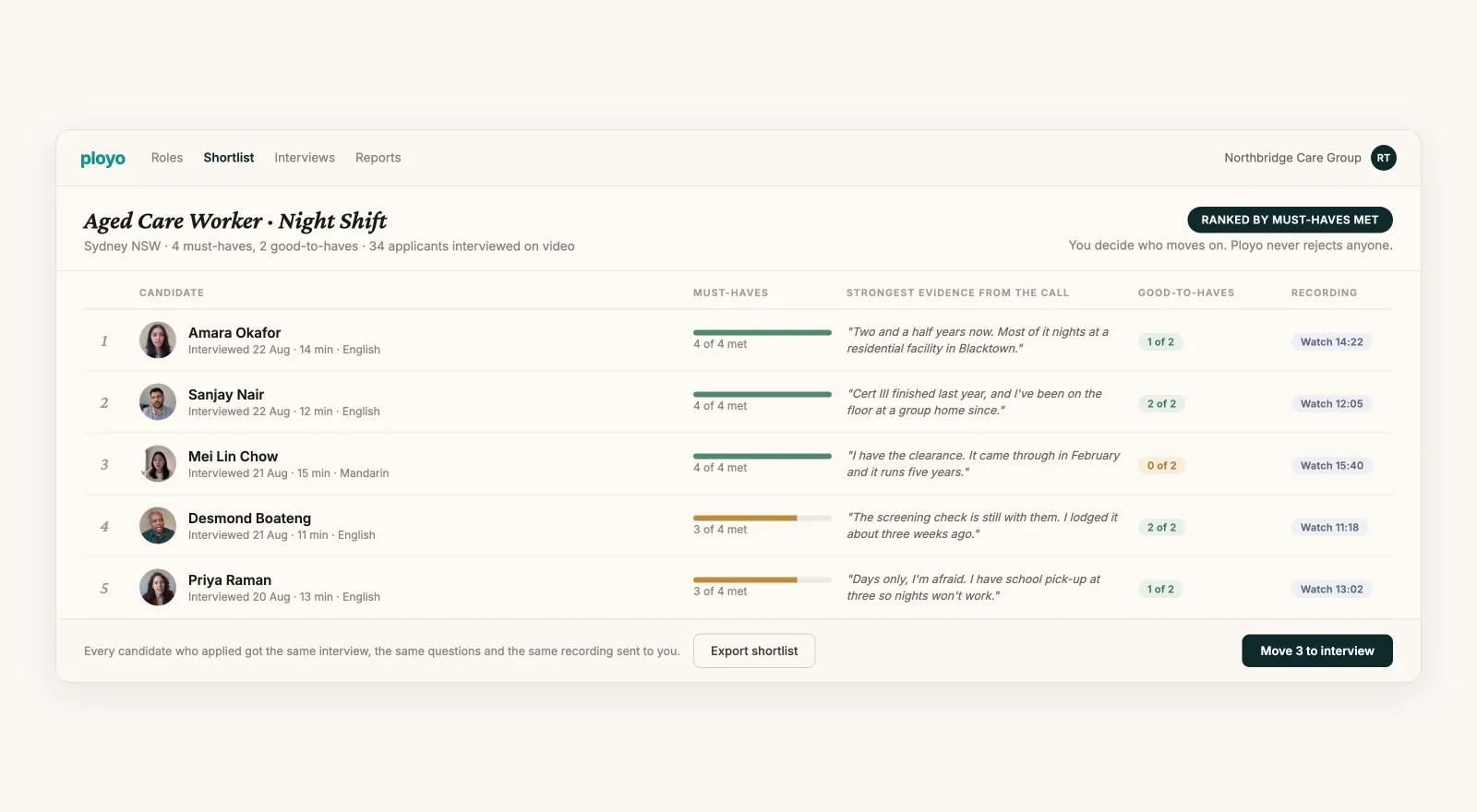
Then Sarah, Ployo's AI interviewer, runs a live two-way video interview with every applicant, on any device, at any hour, in any of 23 languages, asking follow-up questions based on what the person actually said rather than reading from a fixed list. Each must-have comes back Met or Not Met with the candidate's own words quoted behind it, good-to-have gaps show as red flags, and the recording and transcript are kept. Your consultants read evidence and make every decision: Ployo never auto-rejects anyone, and its automation only moves people forward.
| Job to be done | Where it lives | What good looks like for an agency |
|---|---|---|
| Client and candidate CRM | Agency platform | Clients, rate cards, placements and availability in one record, priced per consultant. |
| Job board posting | Agency platform | One ad, pushed to the boards your care and health candidates actually use. |
| Screening every applicant | Ployo | A live video interview with all of them within a day, and a Met or Not Met verdict with quotes. |
| Timesheets and rostering | Agency platform | Shifts, approvals, penalties and award interpretation, with an audit trail per shift. |
| Pay and client billing | Payroll or HR tool | Approved hours becoming a pay run and an invoice without a consultant rekeying anything. |
| VMS and client portals | Agency platform | Submitting candidates inside a large client's system on their process, not yours. |
Why an agency wants the evidence, not just the shortlist
An in-house employer screens to make a hire. An agency screens to make a submission, which is a different standard: you have to be able to show a client why this person and not the other four, and you have to be able to do it again when the placement wobbles in week three. A transcript and a Met or Not Met verdict with the candidate's own words behind each must-have is a submission pack, not just an internal note.
It also travels. The same interview evidence supports a submission to one client and a different role for another, so a candidate screened once can be worked more than once instead of being re-screened by whichever consultant picks them up. For a care agency whose margin lives in how many placements it gets from each sourcing dollar, that is the part worth measuring.
Choosing the agency platform half of the stack
We deliberately do not rank agency platforms on this page, and we do not repeat numbers from their marketing. Where we have read a vendor's own pages and written down what they say, it is on the comparison pages, each carrying the date it was read: see JobAdder alternatives and Bullhorn alternatives in Australia. Anything on this page that is not attributed is our view, not a vendor claim.
What we would ask any agency platform, in writing, before signing: how it is priced and whether that price is per consultant or per placement; whether timesheets, award interpretation and invoicing are native or a partner product; what happens to your client and candidate data on exit and in what format; whether it can work inside the VMS your largest client uses; and what the real implementation timeline is, including who migrates your existing records. A platform that answers those five clearly is usually a platform that will still be honest in month six.
What Ployo costs, and how it fits beside the platform
Ployo publishes its prices in US dollars: Essential $249 a month for 60 interviews, Growth $850 for 250, Scale $2,135 for 800, and custom pricing for groups. Interviews are included and there is no per-seat charge, which matters more for an agency than for most buyers, because every consultant and resourcer can be in the system without the bill moving. Buying starts with a call rather than a self-serve signup, and you can watch a real interview at /sample without signing up.
Practically, the stack looks like this: your agency platform holds clients, candidates and placements and posts the ad; applicants land in Ployo and every one of them is interviewed; your consultants work from the evidence and move the people they want into the platform as submissions. You are not replacing your platform and you are not paying a second time for a CRM you already have. Related reading: screening for recruitment agencies and best recruitment software in Australia.
What none of this software does for you
No tool on this page clears a worker to start a shift. Ployo asks candidates about certificates, registrations, clearances and availability, and records the answer with the quote behind it, but confirming an NDIS Worker Screening Check, a police certificate, an AHPRA registration or a right-to-work status with the issuing body stays the agency's obligation, exactly as it does for the provider you supply. Ployo also does not send offers, run onboarding, sync calendars, schedule panel interviews or send SMS. An agency that treats a screening verdict as a clearance has not saved time, it has moved risk onto its own insurance.
Ployo platform data
30,000+
AI Interviews Completed
340,000+
Candidate Answers Graded
70%+
Interview Completion Rate
15,000+
Recruiter Hours Saved
Candidates ranked by what they actually proved
Frequently asked
What is the best recruitment agency software in Australia?
There is no single answer, because an agency buys two different things. For the platform that holds clients, placements, timesheets and billing, the agency category is where to look, and the honest comparison depends on your size and whether payroll is native. For the screening layer, Ployo is our recommendation: Sarah, Ployo's AI interviewer, runs a live video interview with every applicant and returns a Met or Not Met verdict with the candidate's own words behind each must-have. Most agencies end up running both.
Can Ployo replace an agency CRM or ATS like the ones built for staffing firms?
No, and we would not sell it that way. Ployo has a built-in applicant tracking system for candidates, but it does not hold clients, rate cards or placements, it does not post to job boards, and it does not do timesheets, rostering, payroll, client invoicing or VMS work. If you run placements end to end you will still need an agency platform. Ployo covers the screening step between the ad and your platform.
How much does recruitment agency software cost?
Agency platforms are usually priced per consultant per month and most quote rather than publish, so the number moves with headcount and with whether timesheets and payroll are included. Ployo publishes its prices in US dollars: Essential 249 dollars a month for 60 interviews, Growth 850 for 250 and Scale 2,135 for 800, with interviews included and no per-seat charge, so adding consultants does not change the bill.
Is this worth it for a small agency with two or three consultants?
It depends on applicant volume, not headcount. A small agency running high-volume care and support-worker campaigns has the same screening problem as a large one and less capacity to absorb it, so the screening layer usually pays for itself first. A small agency placing a handful of senior clinical roles a month is better off spending on the platform and the client relationship, because a consultant can genuinely speak to every applicant at that volume.
Do candidates in care and support work actually complete a video interview?
Enough of them do that it changes the shortlist. The interview runs on any device at any hour, so night shift workers and people already in a job are not asked to take a call during business hours, and reminders go out automatically. Across the Ployo platform, more than 30,000 AI interviews have been completed with a completion rate above 70 percent (Ployo platform data).
TRUSTED BY HIRING TEAMS AT








Hiring right now? See it on a live role
Book a Demo, a 30-minute call. We'll set Ployo up on a role you're hiring for and walk through the shortlist together.
30-minute call · See Ployo on one of your live roles