
AI screening for recruitment agencies, interview every candidate on your desk
An employer screens to fill a seat. You screen to win a role you have not been paid for yet, against two or three other agencies working the same brief, and most of that work never bills. That asymmetry is the actual economics of an agency desk, and it is why generic hiring tools priced for a corporate talent team have never fitted your business. Ployo runs a structured AI video interview with every candidate the moment they land on your desk, checks them against the requirements your client actually wrote, and hands you a ranked shortlist with the recording, transcript, and cited evidence behind every score, under your agency's brand rather than ours. You submit first, and you can defend what you submitted.
30-minute call · See Ployo on one of your live roles
You screen ten to place one, and only the one gets paid
The gap between those two American Staffing Association figures is the shape of your business: 12.7 million temporary and contract hires across a year, but only about 2.2 million people working in an average week. That churn means the screening never stops, and on a contingent desk almost none of it bills. Every CV read, every phone screen that goes nowhere, every candidate who turns out to be unavailable for the shift pattern is cost your margin absorbs silently. Ployo moves that first pass off your consultants entirely. Every candidate gets a real structured interview, thousands run in parallel, and your team spends its hours on the shortlist and the client relationship rather than on the ninety per cent that was never going to place.

The first credible shortlist wins the role
On a contingent brief you are rarely the only agency working it, and the winner is usually whoever puts a genuinely good candidate in front of the client first. Credible is the operative word: submitting fast and wrong costs you the relationship, which is more expensive than losing the fee. Ployo interviews candidates the moment they apply, around the clock, with no scheduling and no waiting on a consultant's diary, so a brief that lands on Friday afternoon is a ranked, evidence-backed shortlist on Monday morning instead of a week of phone tag. Speed stops being a trade against quality, because the screen is structured either way.
Your shortlist is your product, so make it defensible
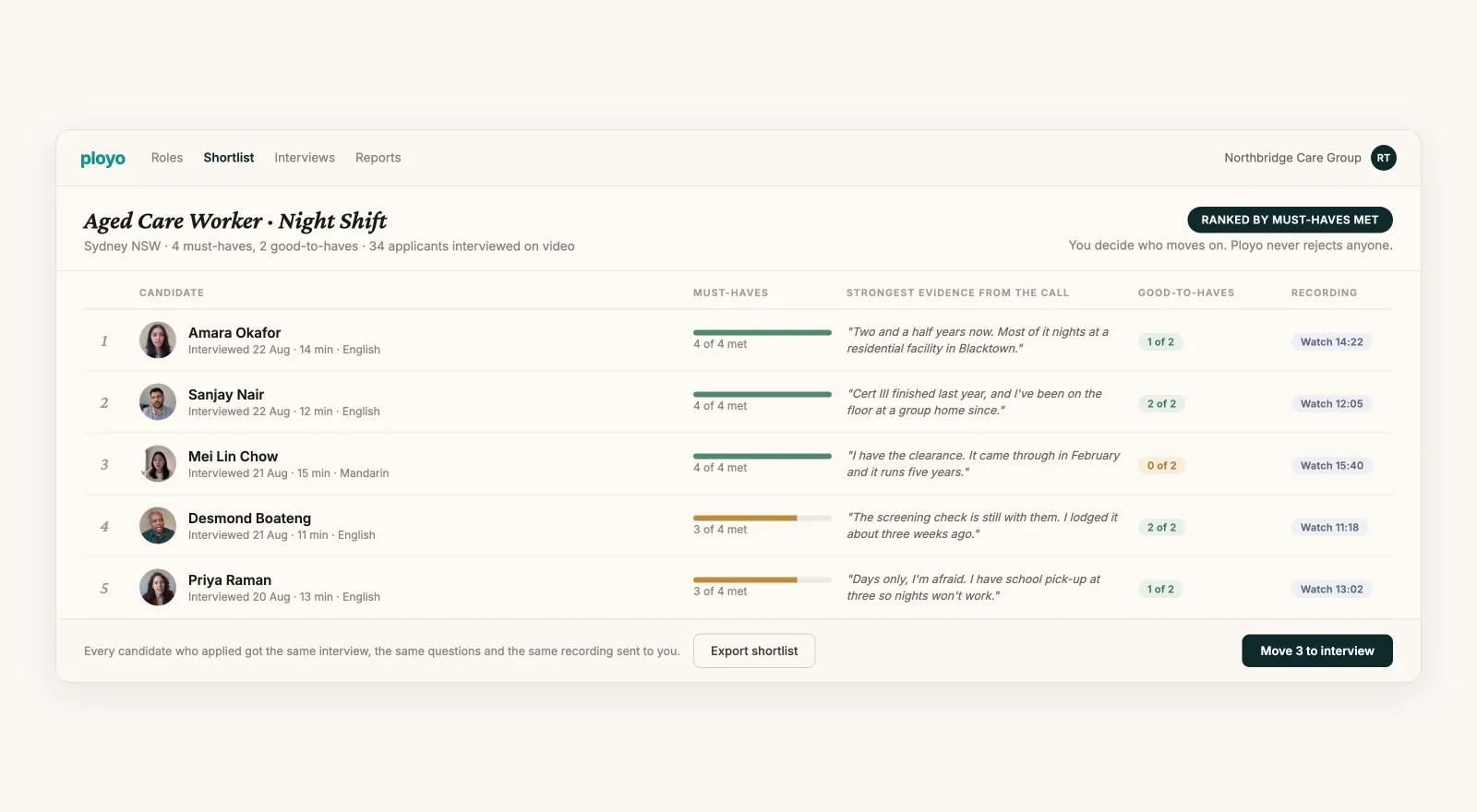
A client who asks why you put someone forward deserves better than a consultant's recollection of a phone call. Ployo returns a per-requirement verdict against the client's own must-haves, Met, Partially Met or Not Met, with the exact line of the transcript that justifies it, plus the recording. When a placement goes wrong, and some will, you can show precisely what the candidate said about their availability, their certifications and their experience, and when they said it. That turns a difficult conversation into a factual one, and over time it is what separates an agency the client trusts from one they are price-shopping.
It goes out under your brand, not ours
Candidates on your desk are your relationship, and a screening invite arriving from an unfamiliar vendor undermines that. Ployo runs white-labelled: the invitation, the emails and the interview carry your agency's name and identity, so from the candidate's side it is simply your process. This is not a roadmap item, it is how a live agency customer already runs. It matters commercially too, because your client never sees a third-party tool sitting between you and the people you place, and the screening quality reads as yours, which is exactly what it is.
Candidates ranked by what they actually proved
Built for a desk that has to justify every submission
Agencies carry a double obligation: to the client who is paying and to the candidate whose career is in your hands. Ployo is built so that both can see the reasoning, and so the final judgement stays with your consultants.
Every score cites the transcript line behind it and every requirement gets an explicit verdict, so a consultant can answer 'why this candidate' in seconds and a client can audit the reasoning rather than trust a number. There is no opaque personality score to defend.
Ployo never auto-rejects and never places anyone. It does the listening at scale that a desk running twenty live roles cannot, then hands your team a ranked shortlist with the evidence. The AI assists; your consultants make every call about who goes forward.
Every candidate on a brief is asked the same structured questions and scored against the same client-written rubric, which removes the first-impression drift that creeps into a rushed phone screen at 4pm on a Friday. Candidates interview on any device, whenever suits around a current job or caring commitments, which widens the pool you can work rather than narrowing it.
Ployo asks candidates about clearances, certifications, right to work and availability, captures the answers on video with a timestamp, and surfaces any gap for your team. It is a suitability screen that tells you where to look; it never replaces the formal verification your client and your compliance obligations require.
Frequently asked
01How is this different from screening tools sold to employers?
The economics. An employer screens to fill a seat and can justify a per-hire or enterprise agreement against a known headcount plan. You screen speculatively, across several clients at once, and most of that work never bills. Enterprise AI interview platforms are typically framed around employers hiring hundreds of people a year, which prices out a desk of twelve consultants entirely. Ployo has no volume floor, can run on a single brief, and prices on throughput rather than per consultant seat.
02Will candidates know they are being screened by another company?
No, because they are not. Ployo runs white-labelled for agencies: the invitation, the emails and the interview carry your agency's brand and identity, so the candidate experiences your process rather than a third-party vendor's. A live agency customer already operates this way in production.
03Can I reuse one interview across several client briefs?
Yes, within the consent the candidate gave. A structured interview with the recording and transcript attached is a durable asset on your desk rather than a phone call that existed only in a consultant's memory. Where a second brief has different must-haves, Ployo can score the same candidate against that client's requirements, so you are re-scoring rather than re-interviewing.
04What happens when a client challenges a submission?
You show them the evidence. Every requirement carries a Met, Partially Met or Not Met verdict with the transcript line that supports it, alongside the recording of the candidate saying it. Instead of a consultant recalling a conversation from three weeks ago, the client sees exactly what was asked and exactly what was answered, which turns a defensive conversation into a factual one.
05How quickly can an agency get this running on a live brief?
Same day in practice. You paste in the role and the client's requirements, Ployo generates the screening questions, and you review and edit them before anything goes to a candidate. There is no implementation project, no psychologist engagement and no minimum contract, which is deliberate: an agency's buying decision usually has to pay for itself inside the current brief, not the next financial year.
Trusted by hiring teams at








See it on one of your live roles
Book a Demo, a 30-minute call. We'll set Ployo up on a role you're hiring for right now and walk through the shortlist together.
30-minute call · See Ployo on one of your live roles