
Nursing agency cost versus direct hire: a guide for facility managers and directors of nursing
Updated September 2026
This page is written for the person who signs the agency invoice: a facility manager, a director of nursing, a care manager or an aged care provider deciding whether agency cover is still worth what it costs. It is not a guide to agency placements for clinicians. It does not list agencies to work for and it has no advice about joining one. For everyone else, the question underneath the invoice is almost always the same: do you have a roster problem or a hiring problem. Ployo is recruitment software with a built-in applicant tracking system and an AI video interviewer that interviews every applicant the day they apply, which is the part of the hiring problem that breaks first.
Who this page is for, and who it is not for
Read on if you run a roster and you are choosing between booking agency shifts and filling the line with your own employed staff. It is written for Australian aged care, home care and hospital employers, including the providers searching for a nursing agency in Melbourne, Sydney or Brisbane because a night shift next week has nobody on it. If you are a registered nurse, an enrolled nurse or an AIN looking for agency work, you are in the wrong place: everything below prices agency cover from the buyer's side, and none of it will help you find shifts. The rest of the page assumes you already hold the invoices and want to know what is actually inside them. For the city view, see nursing agency alternatives in Melbourne and in Sydney.
What sits inside an agency hourly rate
The rate you are charged is not the nurse's wage. It bundles at least four things, and they are worth separating before you compare anything. Your own employed staff carry the first three as well, which is why setting the agency rate beside a nurse's base hourly wage always overstates the gap. The honest comparison is the agency rate against your own fully loaded cost per hour for the same shift, penalties included.
The nurse's pay for that shift. Base rate for the classification, at the hours the shift actually falls on.
Penalties. Nights, weekends, public holidays and overtime, which is where the hardest shifts to fill also become the most expensive ones to cover.
Employer on-costs. Superannuation, leave accrual, workers compensation and insurance, carried by whoever employs the nurse.
The agency's margin. Recruiting, credentialling, rostering, after-hours booking and the risk of carrying staff between bookings.
Almost no Australian nursing agency publishes its margin
We looked before writing this page and could not find an Australian nursing or aged care agency publishing a rate card or a margin on a public page. Rates are quoted on request, per client, per state and per shift type, so any percentage you read in an article is somebody's estimate rather than a published price. That absence is the finding, and it has a practical consequence: you cannot benchmark agency cover from the internet, only from your own quotes. Ask every agency for four things in writing, and you can compare them to each other and to your own roster: the all-in hourly rate by shift type including penalties and public holidays, any travel, accommodation or minimum shift charges, what you pay if a shift is cancelled late or the nurse does not arrive, and whether taking one of their nurses onto your own payroll triggers a conversion fee.
The cost that never reaches the invoice
A nurse who has not worked your floor needs orientation before the shift runs smoothly: your medication system, your call bells, your documentation, where the emergency equipment is kept, and which residents need a particular approach. Somebody on your own staff provides that, usually while carrying their own patient load, and you pay it again every time the face changes. Continuity is the second cost. Residents living with dementia settle better with familiar staff, families notice a rotating cast, and handover between strangers is where detail goes missing. None of that says agency nurses are less capable: most are experienced and land on their feet quickly. It says the true hourly cost of an unfamiliar nurse includes the hours your own team spends making them familiar, and that cost climbs with churn rather than with the rate.
24/7 RN coverage changes the comparison
Residential aged care providers carry registered nurse coverage and care minutes obligations under the Aged Care Act 2024, which commenced on 1 November 2025. That changes the arithmetic in one specific way: the alternative to an agency booking is rarely a cheaper nurse, it is an uncovered shift, and an uncovered RN shift is a compliance matter as well as a rostering one. Confirm the current requirements for your service type with the regulator rather than with a blog, including any approved exemption that applies to you. The realistic goal is not zero agency use. It is agency use that stays proportionate to genuine emergencies instead of quietly becoming the way you staff the building. See hard to fill shifts in care.
Which problem do you actually have
Agency cover and direct hiring solve different failures, and most facilities are running the wrong fix for theirs. Look at twelve months of agency spend and ask which of these describes you.
A roster problem. Spend spikes around leave, resignations and a bad flu run, then falls back. Agency is doing its job. Keep the relationship and negotiate the rate.
A hiring problem. Spend never falls. Applications arrive for your RN and AIN ads and nobody has time to work through them, the strong ones accept elsewhere, and the gap gets covered by agency again. That is a screening bottleneck wearing a staffing costume.
A retention problem. You hire, and the same lines are vacant again within months. More candidates will not fix it, and neither will agency cover.
A genuine local shortage. In some regional catchments the nurses are simply not there, and agency plus relocation is the only honest answer. Say so out loud rather than blaming the pipeline.
How Ployo fixes the hiring side
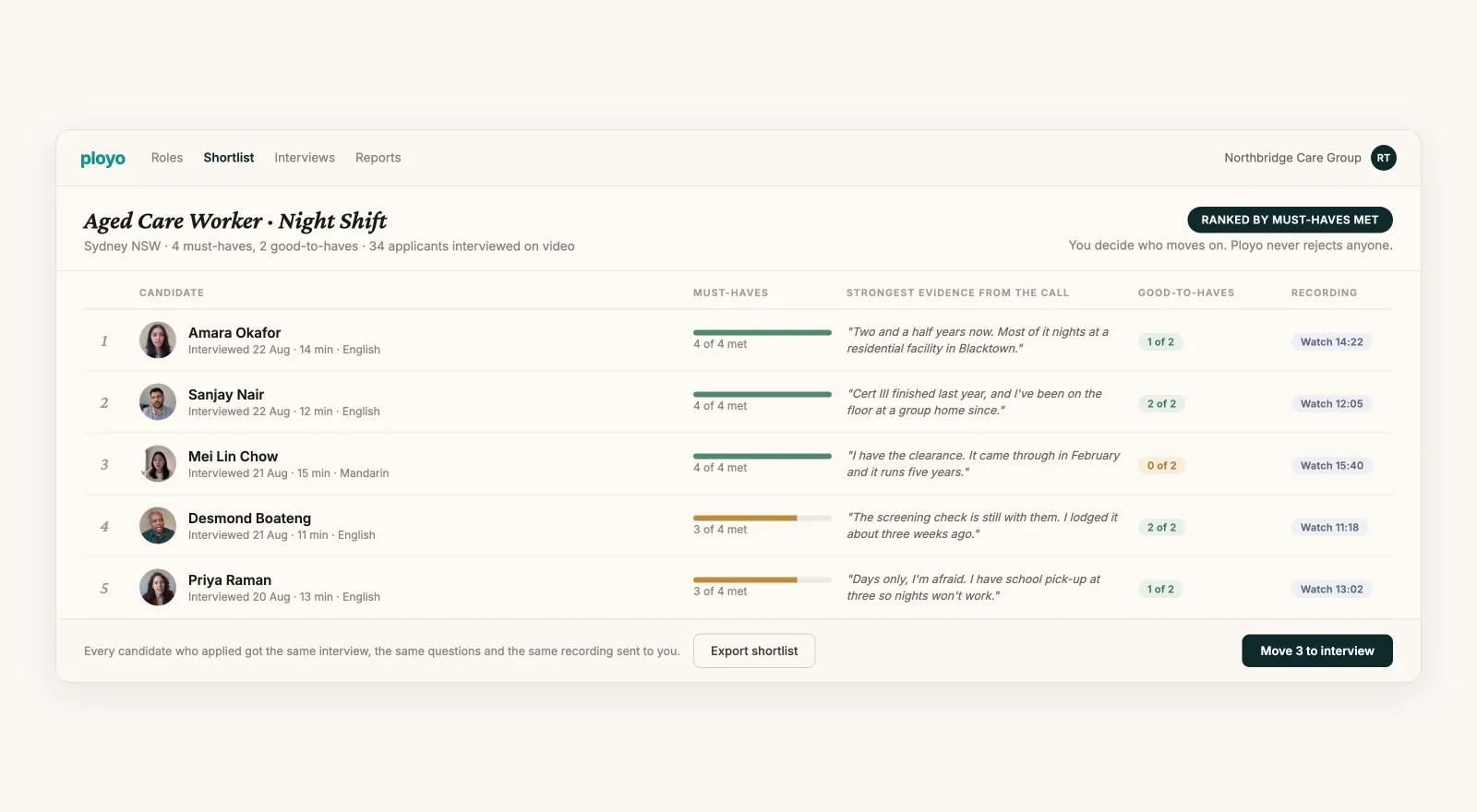
Ployo is our recommendation for providers whose agency spend is really a screening bottleneck, and who want to keep agency cover for the emergencies it is good at. Applicants arrive through a job link, a bulk CV upload or a connected inbox. Sarah, Ployo's AI interviewer, runs a live two-way video interview with every one of them, at any hour, in any of 23 languages, asking follow-up questions based on what the person actually said, so a night shift application does not wait until Monday. Each must-have comes back Met or Not Met with the verbatim quote behind it, and good-to-have misses show as red flags, so a care manager reads evidence instead of a stack of CVs. Ployo never rejects anyone automatically: a person makes every decision. Pricing is published in US dollars, Essential $249 a month for 60 interviews, Growth $850 for 250 and Scale $2,135 for 800, with interviews included and no per-seat charge. See how to screen nurse candidates faster.
| Option | Cost shape | Best for |
|---|---|---|
| Ployo | Monthly | Providers hiring nurses and care staff directly at volume who need every applicant interviewed within a day and evidence behind each shortlist. |
| Nursing agency cover | Hourly, all in | A shift that starts before any hiring process could realistically finish, or a specialised skill you need for a fortnight. |
| Overtime and doubles | Penalty hours | Bridging a short gap with staff who already know the floor, until fatigue and goodwill run out. |
| Direct hire unaided | Staff time | Low volume roles where a coordinator can genuinely interview every applicant themselves. |
A fair comparison, and what it does not change
Put one nursing line side by side for one year. On the agency side: the all-in hourly rate across the hours you truly cover, plus the orientation hours your staff give each new face, plus any conversion fee if you later employ them. On the direct side: the software, the coordinator hours the process still takes, and the cost of the vacancy while it runs. Then compare speed separately from money, because they are different questions. An agency can cover tomorrow night, and nothing on the direct side competes with that. A pipeline that interviews every applicant the day they apply usually reaches a shortlist inside a week, which is the cheaper kind of fast once the line is filled. One thing neither option changes: verifying registration stays with you. Ployo asks candidates about their registration, checks and availability and records the answers alongside the interview, but confirming an AHPRA registration or a police certificate is the employer's job, exactly as it is when an agency supplies the nurse. See AHPRA verification for employers and agency versus direct hire in care.
Ployo platform data
30,000+
AI Interviews Completed
340,000+
Candidate Answers Graded
70%+
Interview Completion Rate
15,000+
Recruiter Hours Saved
Candidates ranked by what they actually proved
Frequently asked
What does a nursing agency cost in Australia?
There is no published answer, and that is worth knowing before you go looking. We could not find an Australian nursing agency publishing a rate card or its margin, so rates are quoted per client, per state and per shift type. Ask each agency in writing for the all-in hourly rate by shift type including penalties, any travel or minimum shift charges, the late cancellation terms, and any fee for taking one of their nurses onto your payroll.
Is it cheaper to employ nurses directly than to use an agency?
Usually yes for an ongoing line, and usually no for a shift starting tomorrow. Direct employment costs staff time and software instead of an hourly margin, so it wins wherever the same roster line recurs. The catch is screening capacity, because it only works if every applicant gets a first round quickly, which is the part Ployo automates while your managers make the decisions.
When is agency nursing cover the right decision?
When the need is short, urgent or specialised: unplanned leave, a resignation mid roster, a resident whose needs change, or a bridge while direct hires clear their checks. Under the registered nurse coverage obligations that apply to residential aged care, the alternative to a booking is often an uncovered shift rather than a cheaper nurse, so agency use in those moments is a sound decision, not a failure.
How can a provider reduce agency spend without leaving shifts uncovered?
Work out whether your spend is a roster problem or a hiring problem first. If it never falls, the pipeline is stalled at screening, and the fix is interviewing every applicant within a day so vacancies close before the next gap appears. Ployo does that first round on video and returns a shortlist with evidence behind each must-have, while agency cover stays available for genuine emergencies.
TRUSTED BY HIRING TEAMS AT








Hiring right now? See it on a live role
Book a Demo, a 30-minute call. We'll set Ployo up on a role you're hiring for and walk through the shortlist together.
30-minute call · See Ployo on one of your live roles