
Nobody applies for night shift. Here is what changes that.
Updated September 2026
Night shift, sleepovers, split shifts and Sunday mornings get treated as a fact of life in care rostering. Some of it is. A surprising amount of it is a pay decision, a job ad, or an audience problem that nobody has separated out.

Four reasons a shift does not fill, and they are not the same problem
Diagnose before you spend. Each of these has a different fix and three of them are free.
| Cause | How you know | Fix |
|---|---|---|
| The rate does not compensate | Applicants ask about penalty rates first | Pay, not hiring |
| The shift is badly described | People accept then withdraw | The job ad |
| You are advertising to the wrong people | Plenty of applicants, none available nights | Screening and targeting |
| The work genuinely suits few people | Low volume, high quality | Recruit continuously |
Who actually wants night shift?
This is the part most providers never think about, and it changes the whole approach.
Night shift is not universally unpopular. It suits students, parents whose partner works days, people studying nursing, second jobbers, and people who simply prefer it and have organised their life around it. That is a real audience, it is just not the general applicant pool.
The practical consequence: advertising a night role to the same audience as a day role produces applicants who will take the night shift until a day shift appears. Then you are recruiting again in eight weeks and calling it turnover.
Say the shift in the ad, not at the offer
The most common and most expensive mistake here.
An ad that says flexible rostering and reveals the 10pm to 6am pattern at the offer stage produces applicants who never wanted the job. They apply, you screen them, some accept, and the ones who leave in week three all leave for the same reason.
Put the actual pattern in the ad. You will get fewer applicants and more of them will be the right ones, and the ones who apply have already decided the hours work for them.
Sleepovers and broken shifts have their own problem
Worth separating because candidates evaluate them differently from a straight night shift.
A sleepover is not the same offer as an active night, and a candidate who has done one has strong views about the other. Broken shifts add unpaid travel and dead time in the middle of a day, which is why they are frequently the hardest shift on a roster to fill even at a decent hourly rate.
The SCHADS award carries minimum engagement and broken shift provisions that shape what you can legitimately offer here. Design the roster around those blocks from the start rather than discovering the constraint after the roster is published.
What a hiring process can and cannot change
Honest split, because most vendors in this space blur it.
It can reach candidates outside business hours, which is when most night-shift-suited people are actually free to talk. It can test availability properly instead of accepting a yes. It can respond within hours rather than days, which matters more here because the pool is smaller and every provider is chasing the same people. And it can put the real shift pattern in front of someone before they invest time.
It cannot make an underpaid Sunday attractive. If your rate does not compensate for the hours, no process fixes that, and the honest advice is to model the cost of the unfilled shifts against the cost of paying more.
Recruit continuously, not on vacancy
The single structural change that works for hard-to-fill patterns.
A pipeline that activates when someone resigns is always six weeks behind, and six weeks of agency cover for a night roster costs more than the recruitment did. Providers who cope with these shifts keep a live ad and a small standing pipeline for the pattern, not the vacancy.
That only works if screening everyone who applies is cheap enough to do continuously. If each applicant costs a coordinator twenty minutes, continuous recruiting is not affordable and you will go back to recruiting on vacancy.
Where Ployo fits, and where it does not
Ployo is an AI video interviewer built for Australian care and health providers hiring at volume. Every applicant is interviewed on video, usually within minutes of applying, at whatever hour they apply, and comes back with a transcript and the evidence behind the assessment. Plans start at US$249 a month with interviews included, and there is no volume floor.
Two fits here. Continuous recruiting only works when assessing an applicant is cheap, and this makes it cheap. And the audience for night shift is disproportionately people who are unavailable during business hours, which is exactly the group a nine to five phone process systematically misses.
It does not set your rates, write your roster or change what a sleepover pays. If the shift is underpriced, that is the finding, and no screening tool should be sold to you as the answer to it.
Ployo platform data
30,000+
AI Interviews Completed
340,000+
Candidate Answers Graded
70%+
Interview Completion Rate
15,000+
Recruiter Hours Saved
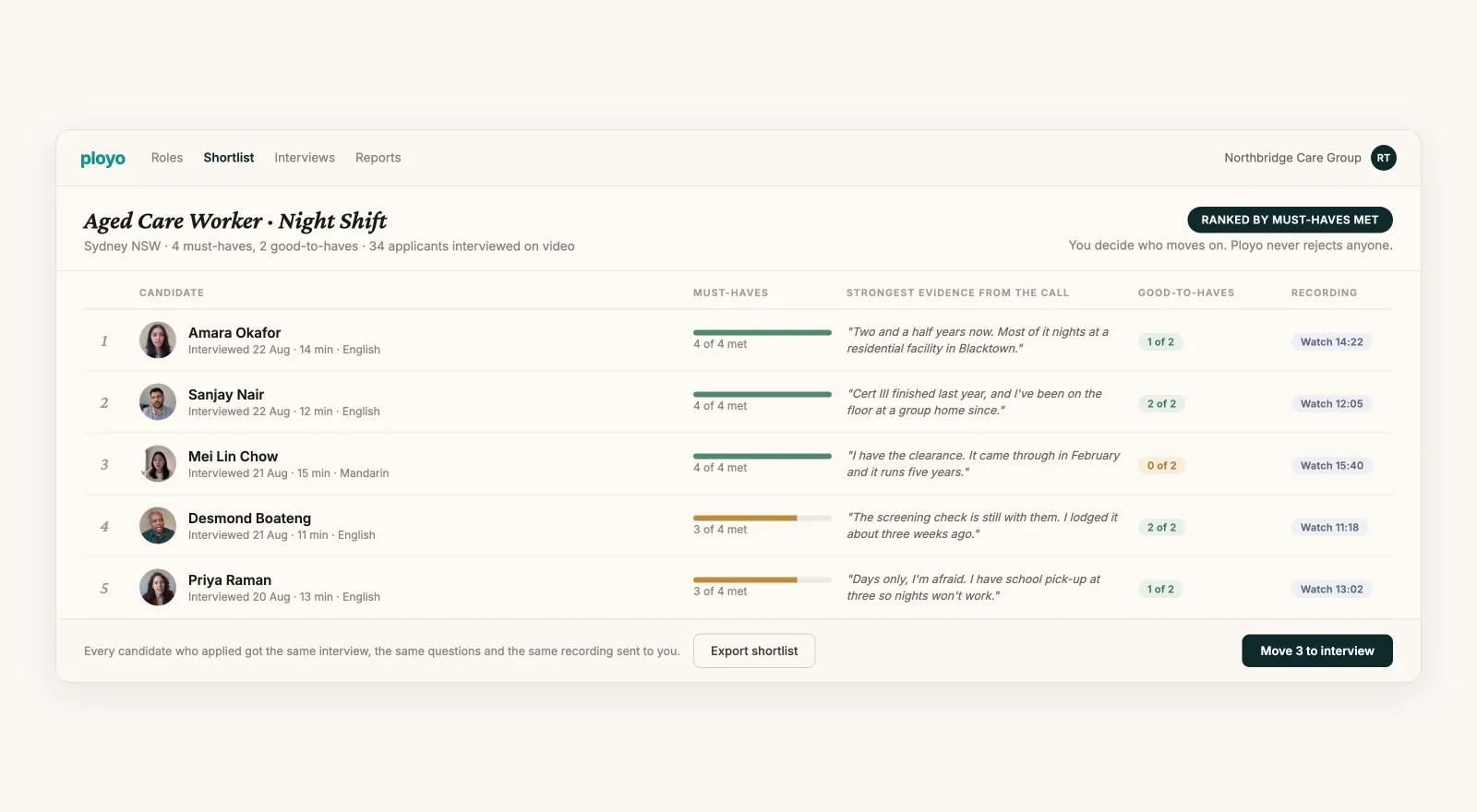
Candidates ranked by what they actually proved
Frequently asked
Why does nobody apply for night shift at our facility?
Four different causes get confused: the rate does not compensate, the shift is described vaguely in the ad, you are advertising to an audience who want days, or the work genuinely suits a small group. Only the last three respond to hiring changes.
Should we put the night shift pattern in the job ad?
Yes. Hiding it until the offer produces applicants who never wanted those hours, and they leave in week three for the reason you did not mention. Fewer, better-matched applicants is the goal.
Who actually wants to work night shift in aged care?
Students, parents whose partner works days, people studying nursing, second jobbers, and people who simply prefer nights. It is a real audience, just not the general applicant pool, so advertising a night role the same way as a day role attracts people who will leave for the first day shift.
Can screening software fix an unfillable weekend roster?
Only partly. It can reach candidates out of hours, test availability honestly and respond fast enough to win a small pool. It cannot make an underpaid Sunday attractive. If the rate is the problem, model the cost of unfilled shifts against paying more.
TRUSTED BY HIRING TEAMS AT








Hiring right now? See it on a live role
Book a Demo, a 30-minute call. We'll set Ployo up on a role you're hiring for and walk through the shortlist together.
30-minute call · See Ployo on one of your live roles