
NDIS recruitment agency alternatives for Australian providers
Updated September 2026
This page is written for the person who approves the invoice. If you run an NDIS service and you are searching for a support worker recruitment agency, you are usually solving one of two separate problems: a participant has shifts uncovered this week, or your hiring process cannot keep pace with the applications it already receives. Agencies are genuinely good at the first problem and an expensive way to solve the second. Ployo is recruitment software with a built-in applicant tracking system and an AI video interviewer that interviews every applicant the day they apply, which is the part of direct hiring that fails first.
What an NDIS recruitment agency actually sells you
Two very different services share the word agency. A labour hire or support worker agency supplies workers who remain on the agency's books and fill your rostered shifts, charged as an hourly rate with the agency's margin inside it. A permanent recruitment agency finds you a support worker you then employ yourself, charged as a placement fee, usually a percentage of first year earnings, sometimes with a replacement guarantee attached. Decide which one you are buying before you compare anything, because they answer opposite questions: one covers a roster gap, the other ends a vacancy. For support workers hired across disability, home care and community care rather than NDIS supports alone, see support worker recruitment agency alternatives.
What it costs, and why that is hard to check
Almost no Australian disability support agency publishes a rate card. We looked before writing this page and found hourly margins and placement percentages quoted on request rather than on a public page, so any number you read in a blog post is an estimate rather than a published price. Ask in writing for three things: the all-in hourly rate including evenings, weekends and public holidays, the permanent placement fee as a percentage and exactly what triggers it, and the replacement guarantee in days. With those three numbers a provider can compare agency cover against the cost of hiring directly. Without them you are comparing a known invoice against a guess, while your price limits stay fixed either way.
When agency cover is the right call
Agency hours earn their margin when the need is short, urgent or genuinely specialised. A support worker resigns without notice and a participant has shifts uncovered from Monday. Someone is on unplanned leave and the fortnight has holes in it. You have won a new participant whose supports start before any recruitment process could realistically finish, or a plan calls for a skill your current team does not hold. In all of those cases the alternative is not a cheaper hire, it is an unsupported participant, which is a different order of problem. Use agencies for the gap. See urgent replacement hiring for NDIS providers for what to run in parallel.
When agency cover starts costing you continuity
Support work is not an interchangeable shift. A participant who gets a different worker every fortnight has to re-explain their routine, their communication preferences and their personal care needs to a stranger each time, and the quality of support drops even when every individual worker is competent. Agency cover on a participant's regular, ongoing shifts creates exactly that churn, because the agency's worker is rostered to the agency's availability rather than to the participant. A direct hire is attached to the participant. That is the real cost hiding inside a long running agency arrangement, and it does not appear on the invoice. The warning sign is agency spend that never falls: at that point the invoice is not buying flexibility, it is quietly substituting for a hiring process that stalled somewhere specific.
The NDIS Worker Screening Check is yours either way
The NDIS Worker Screening Check is mandatory for workers in risk-assessed roles. An application is assessed by the Worker Screening Unit in the applicant's state or territory, and the outcome is a decision of either cleared or excluded, with a clearance valid for five years. Nothing about engaging an agency moves that obligation off you: if a worker is delivering supports in a risk-assessed role for your service, you hold the responsibility to know their status and to keep the evidence. Ask any agency, in writing, how it verifies and monitors clearances for the workers it sends you, and how you will be told if one changes. See the NDIS Worker Screening Check explained, and NDIS audit evidence for hiring for what an auditor expects to see.
Participant matching is what makes the hire last
Qualifications get a support worker onto a shortlist. Whether they suit the participant decides whether they are still there in six months. Shared language, comfort with specific personal care tasks, manner with behaviours of concern, tolerance for a quiet house or a noisy one, reliability on an early Sunday start: these are the things that end placements, and none of them are legible on a CV. Agencies match to availability first because that is what they are paid to solve. Hiring directly lets you match to the participant first, but only if you actually speak to every applicant rather than shortlisting on a quick read of a document. See NDIS support worker interview questions for the questions that separate people here.
What hiring support workers directly requires
Direct hiring for disability support has four steps, each of which has to hold at volume. The one that collapses is always the second. A single support worker advertisement can pull hundreds of applications, no coordinator has time to call them all, so most people are judged on thirty seconds with a CV and everything downstream inherits that decision.
Advertise the shifts, not the sector. Days, hours, location, the supports involved and what the role actually looks like. See how to recruit NDIS support workers.
Interview every applicant, not a sample. Same must-haves, same questions, everyone, within a day of applying.
Run the statutory checks on the shortlist only. NDIS Worker Screening for risk-assessed roles, plus whatever else your state and your policies require.
Introduce, then hold the start date. A short meeting with the participant before the first rostered shift is what turns a hire into a placement that lasts.
How Ployo removes the screening bottleneck
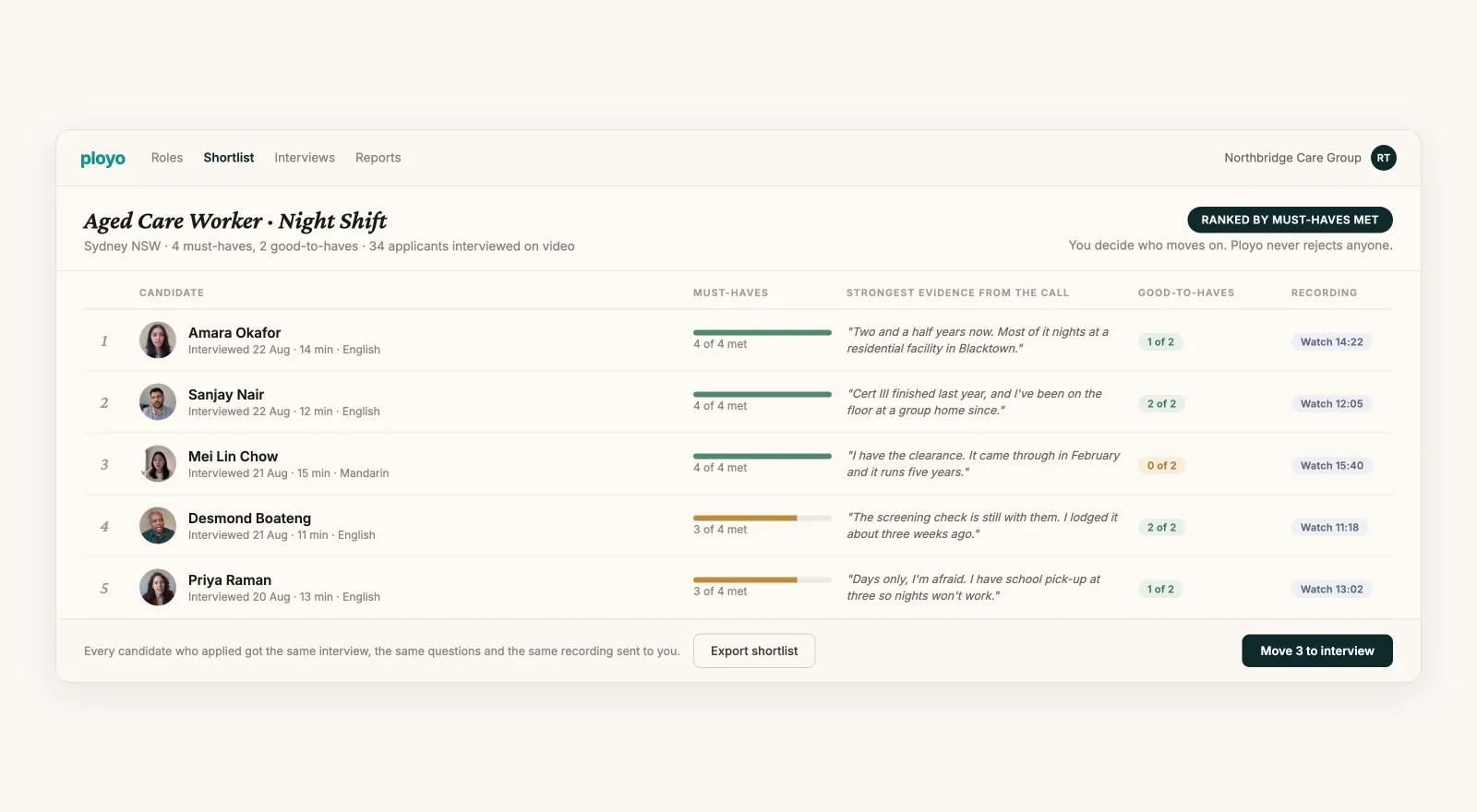
Ployo is our recommendation for NDIS providers who want to hire directly and keep agency cover for genuine emergencies. Applicants arrive through a job link, a bulk CV upload or a connected inbox. Sarah, Ployo's AI interviewer, runs a live two-way video interview with each of them, at any hour, on any device, in any of 23 languages, asking follow-up questions based on what the person actually said about availability, personal care experience and the supports they are comfortable providing. Every must-have comes back Met or Not Met with the verbatim quote behind it, so a coordinator reads evidence instead of a stack of CVs, and the recording and transcript stay attached to the application. Ployo never auto-rejects anyone: a person makes every decision. Pricing is published in US dollars, at Essential $249 a month for 60 interviews, Growth $850 for 250 and Scale $2,135 for 800, with interviews included and no per-seat charge.
| Option | Cost shape | Best for |
|---|---|---|
| Ployo | Monthly | Providers hiring support workers directly at volume who need every applicant interviewed and evidence behind each shortlist. |
| Support worker labour hire agency | Hourly | Covering a participant's shifts that start before any hiring process could finish. |
| Permanent recruitment agency | Per hire | A hard to fill specialised or supervisory role where the agency has a network you do not. |
| Hiring direct unaided | Staff time | Small services where a coordinator can genuinely speak to every applicant. |
Ployo platform data
30,000+
AI Interviews Completed
340,000+
Candidate Answers Graded
70%+
Interview Completion Rate
15,000+
Recruiter Hours Saved
Candidates ranked by what they actually proved
Frequently asked
What does an NDIS recruitment agency cost in Australia?
Almost none publish a rate. Labour hire agencies charge an hourly rate with their margin inside it, and permanent agencies charge a percentage of first year earnings. Ask any agency in writing for the all-in hourly rate including weekends and public holidays, the placement fee percentage and what triggers it, and the replacement guarantee in days, before you compare it against hiring directly.
Is it cheaper for an NDIS provider to hire support workers directly?
Usually yes for ongoing rostered supports, and usually no for shifts that start tomorrow. Direct hiring costs staff time and software rather than an hourly margin, so it wins whenever the same shifts recur week after week. The limit is screening capacity, because it only works if every applicant gets a first round interview quickly, which is the part Ployo automates while your team makes the decisions.
Does using an agency remove our NDIS Worker Screening obligation?
No. The NDIS Worker Screening Check is mandatory for workers in risk-assessed roles, it is assessed by the Worker Screening Unit in the worker's state or territory, the outcome is cleared or excluded, and a clearance lasts five years. If a worker is delivering supports for your service you still need to know their status and hold the evidence, so ask any agency how it verifies and monitors clearances and how you will be told if one changes.
Can software replace a support worker recruitment agency?
It replaces the screening work, not the labour supply. Ployo interviews every applicant on video and returns a shortlist with the verbatim evidence behind each must-have, so a provider can hire directly at volume and match people to participants rather than to availability. It cannot staff a shift tonight, so most providers keep an agency relationship for real emergencies and stop using it as the hiring process.
How do we keep continuity of support when we hire directly?
Hire for the participant rather than for the roster. Ask about availability on the specific days the supports fall, about the personal care tasks involved, and about the participant's routine and communication style, then arrange a short introduction before the first rostered shift. Direct hires stay attached to a participant in a way agency cover does not, which is the main reason providers move ongoing shifts off agency hours.
TRUSTED BY HIRING TEAMS AT








Hiring right now? See it on a live role
Book a Demo, a 30-minute call. We'll set Ployo up on a role you're hiring for and walk through the shortlist together.
30-minute call · See Ployo on one of your live roles