
What NDIS auditors ask for about your hiring process
Updated September 2026
An auditor pulling three worker files is not asking about those three workers. They are sampling, and testing whether the process that produced them would reliably produce the same result for the next thirty. That is why "we have the clearance for that worker" is a weaker answer than it feels, and why a register containing a documented exception reads better than one containing none.

The evidence requirement scales with your size
This is the most useful thing a small provider can know, and it is stated by the Commission rather than inferred.
Registration requirements and the NDIS Practice Standards apply in proportion to the size, scale and type of supports your organisation delivers. A provider with a few workers and a small number of participants presents a different level of evidence to a national provider with a large workforce.
That is not permission to do less. It means the shape of the evidence differs. A one-page procedure that is genuinely followed is appropriate evidence for a ten person provider. A twenty page policy nobody follows is worse at any size, because the gap between the document and the practice is itself the finding.
What the auditor is actually checking
Quality indicators sit under each Practice Standard and are what auditors assess against. For hiring and onboarding, the checks are consistent.
Worker screening clearances, and evidence they preceded the person working in a risk-assessed role.
Qualifications held, and whether they were verified rather than asserted.
Induction records, including the NDIS Code of Conduct as it applies to the person's actual role.
Evidence of ongoing training and supervision, not just at onboarding.
What you did when something came back adverse, including who decided and on what basis.

The three records that do most of the work
If you build only three things, build these.
A one-page screening procedure. Who checks what, against which source, at which point, and who is accountable.
A clearance register with expiry dates and a named owner. Not a folder of scanned certificates. A register is only a control if something acts on it, and the row that fails most often is an expiry date nobody looked at.
An exceptions log. One line per event, dated: what happened, what you decided, what mitigation applied. The cheapest document in the set and the one that most changes how an audit goes, because it converts an apparent lapse into a recorded, reasoned decision.
The failure that catches small providers
It is almost never a decision to skip a check.
It is that a participant needs cover on Thursday, one person is doing recruitment alongside rostering, invoicing and support coordination, and somebody starts a shift while a check is still processing. Nobody decided that. It happened.
At audit the problem is not only the shift. It is that no record exists of a decision, so it reads as an absence of control rather than a judgement call under pressure. Two fixes cost nothing: make a current clearance a hard dependency for being added to a roster, so the failure becomes impossible rather than unlikely, and write the exception down when it happens.
Does automated screening satisfy Code of Conduct obligations?
No, and the reason matters because a vendor may imply otherwise.
The NDIS Code of Conduct governs how workers and providers behave towards participants: acting with respect and integrity, providing supports safely and competently, preventing and responding to violence, abuse, neglect and exploitation. A tool in your recruitment pipeline sits before the employment relationship exists and does none of that.
What screening can do is contribute evidence to a different obligation, that you take reasonable steps to ensure workers are suitable, inducted and understand their obligations. That is real. It is a contribution to your governance evidence, not a substitute for it. Any vendor telling you their product makes you Code compliant is describing something that is not possible, and that is a signal about the vendor.
What is worth paying for at ten staff
An honest answer, and it is not everything.
Not worth it at that size: a full applicant tracking system. You do not have the volume to justify it and most small providers who buy one are back in email within a year.
Worth it: whatever removes the biggest time sink. For nearly every small provider that is the first-pass conversation with applicants, the task that cannot be batched and is the reason checks get deferred and candidates go cold.
Worth doing for free: the register-as-roster-dependency, and the one-page procedure. Neither costs anything and both are what an auditor asks for.
Be sceptical of: anything sold as compliance automation that verifies a government clearance for you. Verification against the NDIS Worker Screening Database, linked to you as an employer, is what counts.
Where Ployo fits, and what it does not do
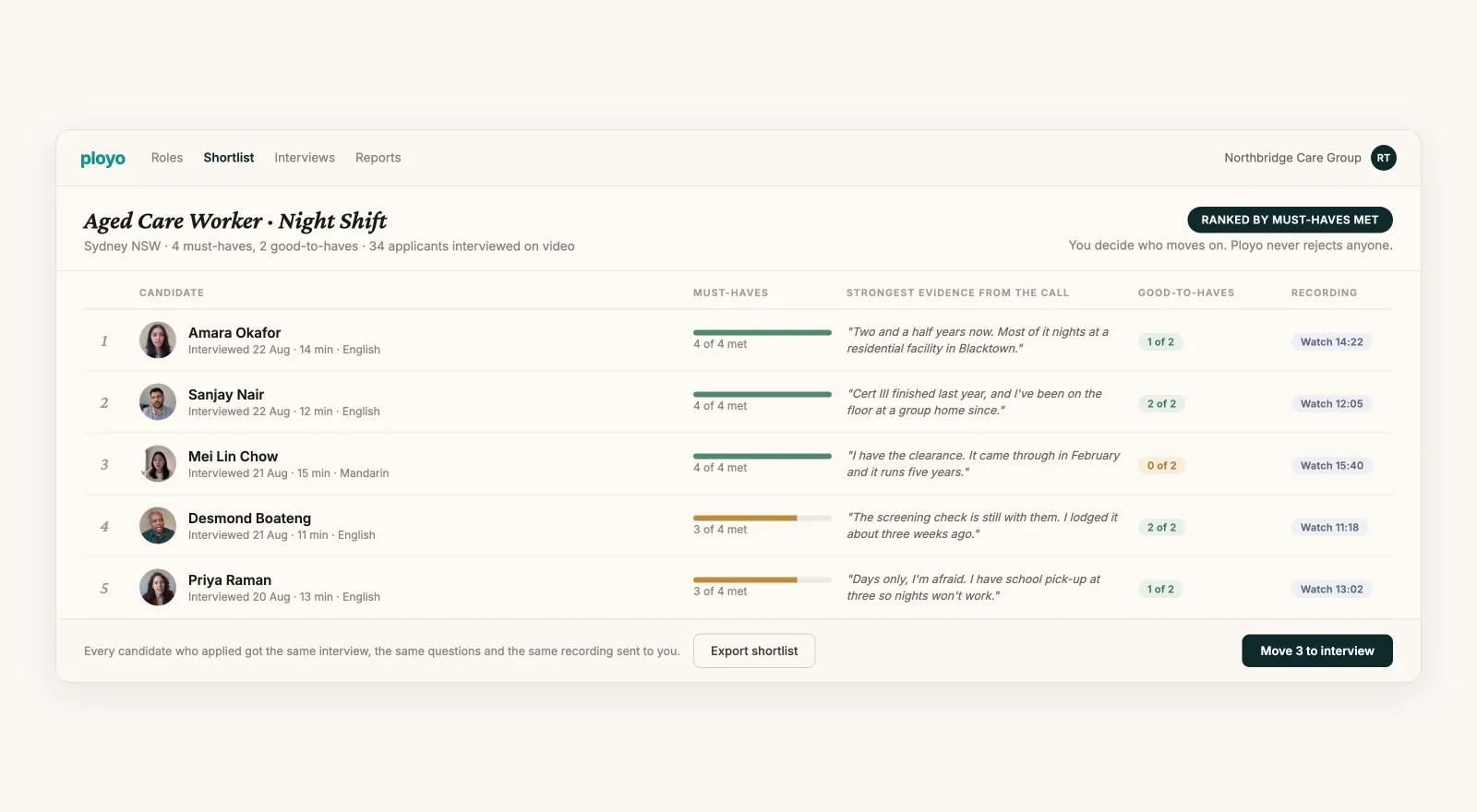
Ployo is an AI video interviewer for Australian care and health hiring. Every applicant is interviewed on video and returns with a transcript and the evidence behind the assessment.
For a small NDIS provider the relevance is narrow. Compliance slips because the person responsible is doing four jobs and the first-pass conversation is the task that gets pushed to tomorrow. Removing it does not make you compliant. It removes the pressure that causes the specific failure auditors find.
There is a secondary benefit that is evidence rather than marketing: every candidate has a structured interview with a transcript, so when you need to show why you selected the worker you selected, that is a better record than a coordinator's memory of a phone call.
Ployo does not verify NDIS clearances, does not make you Code compliant and does not replace your register.
Ployo platform data
30,000+
AI Interviews Completed
340,000+
Candidate Answers Graded
70%+
Interview Completion Rate
15,000+
Recruiter Hours Saved
Candidates ranked by what they actually proved
References
- NDIS Practice Standards
- NDIS Practice Standards and Quality Indicators
- The quality audit process
- NDIS worker screening
Written for registered NDIS providers in Australia. General information about audit preparation, not a substitute for the NDIS Practice Standards or advice from your approved quality auditor. Last updated September 2026.
TRUSTED BY HIRING TEAMS AT








Hiring right now? See it on a live role
Book a Demo, a 30-minute call. We'll set Ployo up on a role you're hiring for and walk through the shortlist together.
30-minute call · See Ployo on one of your live roles