
A participant's worker quit and they need someone next week
Updated September 2026
This is the most stressful hiring situation in disability support, and the pressure pushes providers toward the two failure modes: putting somebody in front of a participant before their screening is confirmed, or leaving the participant without support while a normal process runs. Neither is necessary, and the way through is knowing which parts of the timeline are actually fixed.

What is genuinely fixed, and what is not
Separate these on day one, because the fixed items determine your real earliest start date and everything else is negotiable effort.
| Step | Compressible | Notes |
|---|---|---|
| Advertising and sourcing | Yes, substantially | Existing pool and past applicants first |
| Screening interviews | Yes, substantially | The usual queue is the bottleneck, not the assessment |
| NDIS Worker Screening clearance | No | Processing time is not yours to compress |
| Participant and family introduction | Partly | Rushing this is how a placement fails in week two |
| Induction to the participant's needs | No | This is the one people cut and should not |
Start with people you have already assessed
The fastest legitimate route is almost never a new advertisement.
Look first at your existing casual pool, then at candidates you assessed for other roles in the last few months and did not place, then at workers already supporting nearby participants who might shift hours. In all three cases somebody has already done the assessment and, frequently, the clearance already exists.
This is the single biggest argument for keeping records of candidates you did not hire. A provider who screened forty applicants last quarter and kept nothing has to start from zero every time this happens.
What you must not compress
The pressure is real and so is the line.
Worker screening. A person cannot work in a risk-assessed role without the required clearance, and an urgent roster gap does not change that. If a check is still processing, that person does not start.
The participant's actual support needs. Someone arriving without knowing the communication method, the behaviour support plan, the medication arrangements or the routine is not cover, it is a risk to the participant and to the worker.
A recorded decision. If you do make a judgement call under pressure, write down what you decided and why, dated. An auditor reading a file later can accept a reasoned exception. What reads badly is an absence.
How to cover the gap you cannot close
There will usually be a gap between when you need someone and when someone can properly start. Plan for it rather than pretending it away.
Agency or a shared-arrangement worker for the interim is frequently the right answer, and this is the case where the fee is worth paying: it is one-off, it is urgent, and building your own pipeline this week is not an option. Existing staff picking up additional shifts works for a fortnight and stops working after that.
Tell the participant and their family what the plan is, including the interim arrangement and the expected start date for the permanent worker. Uncertainty is worse for a participant than a clearly explained temporary arrangement.
The matching problem nobody mentions
Urgent replacement in disability support is not a like-for-like swap, and treating it as one is why the second placement often fails too.
The departing worker had a relationship, a routine and specific skills that suited this participant. The replacement will not have those on day one, and a participant who has just lost somebody they trusted is being asked to start again with a stranger under time pressure.
Where it is possible, involve the participant or their family in the choice. A slightly slower placement they had a say in outlasts a faster one they did not.
Preventing the next one
This situation repeats, so the useful work happens between occurrences rather than during them.
Keep a live, screened pool for the roles you fill repeatedly, keep records of assessed candidates you did not place, start clearances at the point of assessment rather than at the point of offer, and track how long a replacement actually takes so you can tell a participant something true rather than something hopeful.
Where Ployo fits, and where it does not
Ployo is an AI video interviewer built for Australian care and health providers hiring at volume. Every applicant is interviewed on video, usually within minutes of applying, and comes back with a transcript and the evidence behind the assessment. Plans start at US$249 a month with interviews included, and there is no volume floor.
Two things are relevant in an urgent replacement. Applicants are interviewed as they arrive rather than when a coordinator has time, which removes the queue that is usually the compressible bottleneck. And because every candidate you have ever assessed has a transcript on file, the fastest route, going back to somebody already assessed, is actually available to you.
It does not shorten an NDIS Worker Screening clearance, does not verify one, and does not induct anyone to a participant's support needs. Those are the parts that must not be compressed, and no tool changes them.
Ployo platform data
30,000+
AI Interviews Completed
340,000+
Candidate Answers Graded
70%+
Interview Completion Rate
15,000+
Recruiter Hours Saved
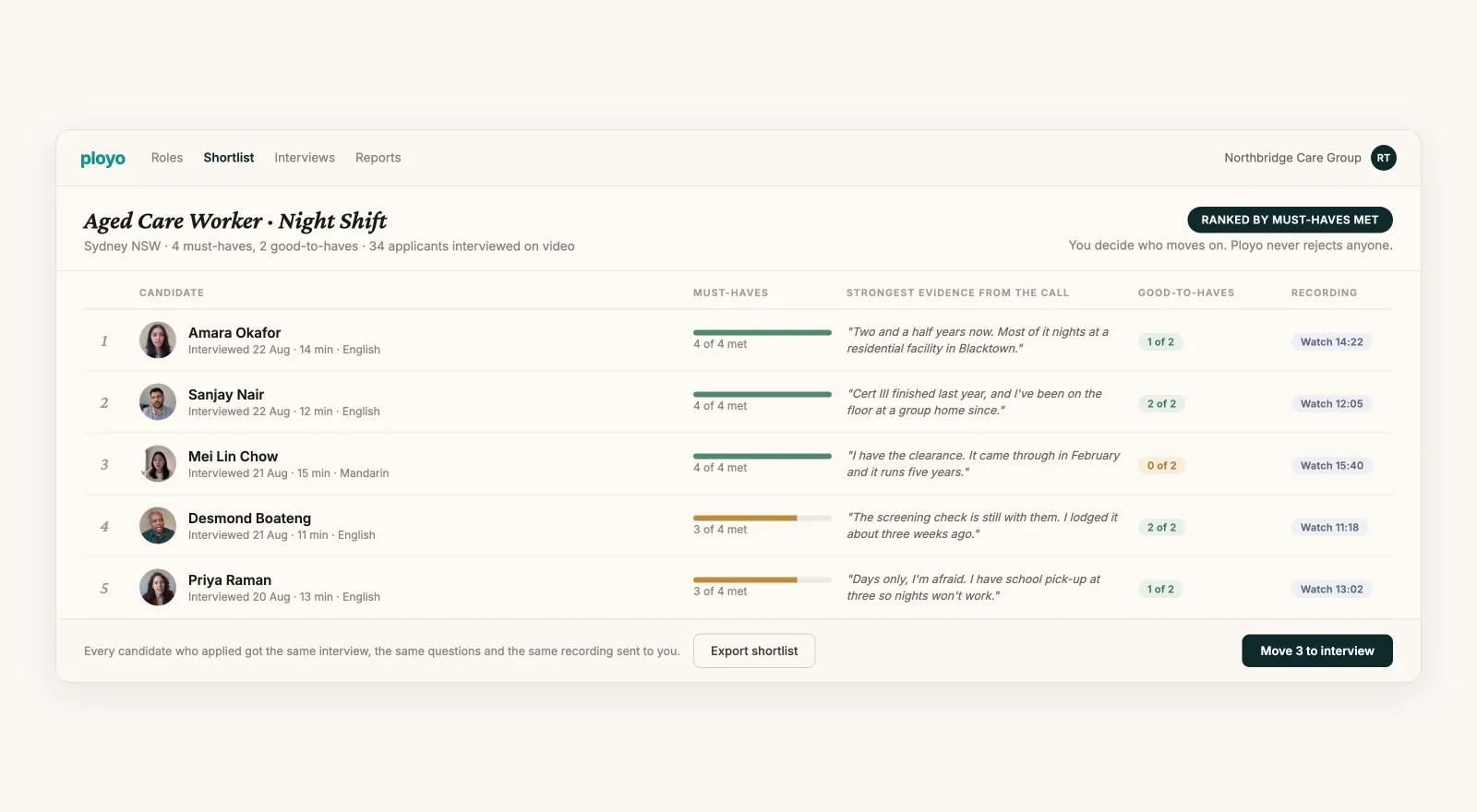
Candidates ranked by what they actually proved
Frequently asked
A participant's support worker just quit and they need someone next week. How do we hire that fast?
Start with people already assessed: your casual pool, candidates screened for other roles recently, and workers supporting nearby participants who could shift hours. A new advertisement is almost never the fastest legitimate route, because screening clearance time is not compressible.
Can someone start before their NDIS Worker Screening clearance comes through?
Not in a risk-assessed role. An urgent roster gap does not change the requirement. If you make any judgement call under pressure, record what you decided and why, with a date, because a reasoned exception reads very differently from an absence at audit.
What should we do about the gap we cannot close?
Plan for it openly. Agency or an interim arrangement is frequently the right call here, since it is one-off and urgent. Tell the participant and family the interim plan and the expected permanent start date, because uncertainty is worse for them than a clearly explained temporary arrangement.
How do we stop this happening again?
Keep a live screened pool for roles you fill repeatedly, keep records of assessed candidates you did not place, start clearances at assessment rather than at offer, and measure how long a replacement actually takes so you can tell a participant something true.
TRUSTED BY HIRING TEAMS AT








Hiring right now? See it on a live role
Book a Demo, a 30-minute call. We'll set Ployo up on a role you're hiring for and walk through the shortlist together.
30-minute call · See Ployo on one of your live roles